


Deinotherium

Encyclopedia
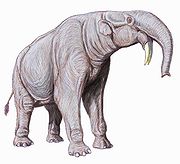
Deinotherium also called the Hoe tusker, was a large prehistoric relative of modern-day elephant
s that appeared in the Middle Miocene
and continued until the Early Pleistocene
. During that time it changed very little. In life it probably resembled modern elephant
s, except that its trunk was shorter, and it had downward curving tusks attached to the lower jaw.
Deinotherium is the third largest land mammal known to have existed; only Paraceratherium
and Mammuthus sungari
were larger, although Mammuthus imperator
may have rivaled it in size. Males were generally between 3.5 and 4.5 metres (12 and 15 feet) tall at the shoulders although large specimens may have been up to 5 m (16 ft). Their weight is estimated to have been between 5 and 10 tonne
s (5.5 and 11 US Standard tons), with the largest males weighing in excess of 14 tonnes (15.4 US Standard tons). Deinotherium's range covered parts of Asia, Africa, and Europe. Adrienne Mayor
, in The First Fossil Hunters: Paleontology In Greek and Roman Times, has suggested that deinothere fossils found in Greece helped generate myths of archaic giant beings. A tooth of a deinothere found on the island of Crete
, in shallow marine sediments of the Miocene
suggests that Crete was closer or connected to the mainland during the Messinian Salinity Crisis
.
 Deinotherium is the type genus of the family Deinotheriidae
, evolving from the smaller, early Miocene Prodeinotherium
. These proboscideans represent a totally distinct line of evolutionary descent to that of other elephants, one that probably diverged very early in the history of the group as a whole. The large group to which elephant
s belong formerly contained several other related groups: besides the deinotheres there were the gomphothere
s (some of which had shovel-like lower front teeth), and the mastodon
s. Only elephants survive today.
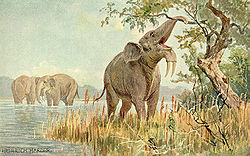 The way Deinotherium used its curious tusks has been much debated. It may have rooted in soil for underground plant parts like roots and tubers, pulled down branches to snap them and reach leaves, or stripped soft bark from tree trunks. Deinotherium fossils have been uncovered at several of the African sites where remains of prehistoric hominid relatives of modern human
s have also been found.
Permanent tooth formula 0-0-2-3/1-0-2-3 (deciduous
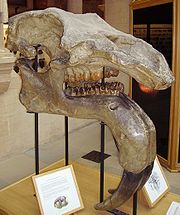
0-0-3/1-0-3), with vertical cheek tooth replacement. Two sets of bilophodont and trilophodont teeth. Molars and rear premolars tapiroid, vertical shearing teeth, and show that deinotheres became an independent evolutionary branch very early on; other premolars used for crushing. The cranium
is short, low, and flattened on the top (in contrast to more advanced proboscids, which have a higher and more domed forehead; the implication may be that deinotheres were less intelligent than other proboscids), with very large, elevated occipital condyle
s. The nasal opening is retracted and large, indicating a large trunk. The rostrum
is long and the rostral fossa broad. Mandibular symphyses (the lower jaw-bone) is very long and curved downward, which, with the backward curved tusks, is a distinguishing feature of the group; it possessed no upper tusks.
Deinotherium is distinguished from its predecessor Prodeinotherium by its much greater size, greater crown
dimensions, and reduced development of posterior cingula ornamentation in the second and third molar
.
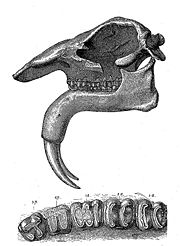 Deinotherium giganteum is the type species
, and is described above. It is primarily a late Miocene species, most common in Europe, and is the only species known from the circum-Mediterranean. Its last reported occurrence is from the middle Pliocene
of Romania (2 to 4 million BP
). An entire skull, found in the Lower Pliocene beds of Eppelsheim
, Hesse-Darmstadt
in 1836, measured 4 ft (1.2 m) in length and 3 ft (.9 meters) in breadth, indicating an animal exceeding modern elephants in size.
and p4-m3 intravalley tubercles. D. indicum appears in the middle Miocene, and is most common in the late Miocene. It disappears from the fossil record about 7 million years BP
(late Miocene).
, and a higher and narrower cranium, and shorter mandibular symphysis, than the other two species. D. bozasi appears at the beginning of the late Miocene, and continues there after the other two species have died out elsewhere. The youngest fossils are from the Kanjera Formation, Kenya, about a million years old (early Pleistocene
)
. The animal was shown to live side by side with the early human ancestor Australopithecus
, the Chalicothere Ancylotherium
, and the primitive cat Dinofelis
in Ethiopia
about 3.2 million years ago.
Deinotherium was also depicted in Karel Zeman
's live action/stop motion film Journey to the Beginning of Time
. One of the characters in the film initially mistakes it for an elephant.
----
Elephant
Elephants are large land mammals in two extant genera of the family Elephantidae: Elephas and Loxodonta, with the third genus Mammuthus extinct...
s that appeared in the Middle Miocene
Miocene
The Miocene is a geological epoch of the Neogene Period and extends from about . The Miocene was named by Sir Charles Lyell. Its name comes from the Greek words and and means "less recent" because it has 18% fewer modern sea invertebrates than the Pliocene. The Miocene follows the Oligocene...
and continued until the Early Pleistocene
Pleistocene
The Pleistocene is the epoch from 2,588,000 to 11,700 years BP that spans the world's recent period of repeated glaciations. The name pleistocene is derived from the Greek and ....
. During that time it changed very little. In life it probably resembled modern elephant
Elephant
Elephants are large land mammals in two extant genera of the family Elephantidae: Elephas and Loxodonta, with the third genus Mammuthus extinct...
s, except that its trunk was shorter, and it had downward curving tusks attached to the lower jaw.
Deinotherium is the third largest land mammal known to have existed; only Paraceratherium
Paraceratherium
Paraceratherium, also commonly known as Indricotherium or Baluchitherium , is an extinct genus of gigantic hornless rhinoceros-like mammals of the family Hyracodontidae, endemic to Eurasia and Asia during the Eocene to Oligocene 37.2—23.030 Mya, existing for approximately...
and Mammuthus sungari
Mammuthus sungari
Mammuthus sungari, sometimes called the Songhua River Mammoth, evolved from smaller Siberian mammoths and occurred in Northern China during the middle Pleistocene...
were larger, although Mammuthus imperator
Mammuthus imperator
The Imperial Mammoth is an extinct species of mammoth endemic to North America from the Pliocene through Pleistocene, living from 4.9 mya—11,000 years ago....
may have rivaled it in size. Males were generally between 3.5 and 4.5 metres (12 and 15 feet) tall at the shoulders although large specimens may have been up to 5 m (16 ft). Their weight is estimated to have been between 5 and 10 tonne
Tonne
The tonne, known as the metric ton in the US , often put pleonastically as "metric tonne" to avoid confusion with ton, is a metric system unit of mass equal to 1000 kilograms. The tonne is not an International System of Units unit, but is accepted for use with the SI...
s (5.5 and 11 US Standard tons), with the largest males weighing in excess of 14 tonnes (15.4 US Standard tons). Deinotherium's range covered parts of Asia, Africa, and Europe. Adrienne Mayor
Adrienne Mayor
Adrienne Mayor is a historian of ancient science and a classical folklorist.Mayor specializes in ancient history and the study of "folk science": how pre-scientific cultures interpreted data about the natural world, and how these interpretations form the basis of many ancient myths, folklore and...
, in The First Fossil Hunters: Paleontology In Greek and Roman Times, has suggested that deinothere fossils found in Greece helped generate myths of archaic giant beings. A tooth of a deinothere found on the island of Crete
Crete
Crete is the largest and most populous of the Greek islands, the fifth largest island in the Mediterranean Sea, and one of the thirteen administrative regions of Greece. It forms a significant part of the economy and cultural heritage of Greece while retaining its own local cultural traits...
, in shallow marine sediments of the Miocene
Miocene
The Miocene is a geological epoch of the Neogene Period and extends from about . The Miocene was named by Sir Charles Lyell. Its name comes from the Greek words and and means "less recent" because it has 18% fewer modern sea invertebrates than the Pliocene. The Miocene follows the Oligocene...
suggests that Crete was closer or connected to the mainland during the Messinian Salinity Crisis
Messinian salinity crisis
The Messinian Salinity Crisis, also referred to as the Messinian Event, and in its latest stage as the Lago Mare event, was a geological event during which the Mediterranean Sea went into a cycle of partly or nearly complete desiccation throughout the latter part of the Messinian age of the Miocene...
.
Evolutionary Relationships
Deinotheriidae
Deinotheriidae is a family of prehistoric elephant-like proboscideans that lived during the Tertiary period, first appearing in Africa, then spreading across southern Asia and Europe. During that time they changed very little, apart from growing much larger in size - by the late Miocene they had...
, evolving from the smaller, early Miocene Prodeinotherium
Prodeinotherium
Prodeinotherium is an early representative of the family Deinotheriidae, that lived in Africa, Europe, and Asia in the early and middle Miocene. It was the size of a small elephant, about 9 feet at the shoulders, but differed from elephants in possessing a pair of downward curving tusks on the...
. These proboscideans represent a totally distinct line of evolutionary descent to that of other elephants, one that probably diverged very early in the history of the group as a whole. The large group to which elephant
Elephant
Elephants are large land mammals in two extant genera of the family Elephantidae: Elephas and Loxodonta, with the third genus Mammuthus extinct...
s belong formerly contained several other related groups: besides the deinotheres there were the gomphothere
Gomphothere
Gomphotheriidae is a diverse taxonomic family of extinct elephant-like animals , called gomphotheres. They were widespread in North America during the Miocene and Pliocene epochs, 12-1.6 million years ago. Some lived in parts of Eurasia, Beringia and, following the Great American Interchange,...
s (some of which had shovel-like lower front teeth), and the mastodon
Mastodon
Mastodons were large tusked mammal species of the extinct genus Mammut which inhabited Asia, Africa, Europe, North America and Central America from the Oligocene through Pleistocene, 33.9 mya to 11,000 years ago. The American mastodon is the most recent and best known species of the group...
s. Only elephants survive today.
Paleoecology
Human
Humans are the only living species in the Homo genus...
s have also been found.
Characteristics
The following description is for D. giganteus but in general applies to the other two species as well.Permanent tooth formula 0-0-2-3/1-0-2-3 (deciduous
Deciduous
Deciduous means "falling off at maturity" or "tending to fall off", and is typically used in reference to trees or shrubs that lose their leaves seasonally, and to the shedding of other plant structures such as petals after flowering or fruit when ripe...
0-0-3/1-0-3), with vertical cheek tooth replacement. Two sets of bilophodont and trilophodont teeth. Molars and rear premolars tapiroid, vertical shearing teeth, and show that deinotheres became an independent evolutionary branch very early on; other premolars used for crushing. The cranium
Skull
The skull is a bony structure in the head of many animals that supports the structures of the face and forms a cavity for the brain.The skull is composed of two parts: the cranium and the mandible. A skull without a mandible is only a cranium. Animals that have skulls are called craniates...
is short, low, and flattened on the top (in contrast to more advanced proboscids, which have a higher and more domed forehead; the implication may be that deinotheres were less intelligent than other proboscids), with very large, elevated occipital condyle
Occipital condyle
The occipital condyles are undersurface facets of the occipital bone in vertebrates, which function in articulation with the superior facets of the atlas vertebra....
s. The nasal opening is retracted and large, indicating a large trunk. The rostrum
Rostrum (anatomy)
The term rostrum is used for a number of unrelated structures in different groups of animals:*In crustaceans, the rostrum is the forward extension of the carapace in front of the eyes....
is long and the rostral fossa broad. Mandibular symphyses (the lower jaw-bone) is very long and curved downward, which, with the backward curved tusks, is a distinguishing feature of the group; it possessed no upper tusks.
Deinotherium is distinguished from its predecessor Prodeinotherium by its much greater size, greater crown
Tooth
Teeth are small, calcified, whitish structures found in the jaws of many vertebrates that are used to break down food. Some animals, particularly carnivores, also use teeth for hunting or for defensive purposes. The roots of teeth are embedded in the Mandible bone or the Maxillary bone and are...
dimensions, and reduced development of posterior cingula ornamentation in the second and third molar
Molar (tooth)
Molars are the rearmost and most complicated kind of tooth in most mammals. In many mammals they grind food; hence the Latin name mola, "millstone"....
.
Deinotherium giganteum Kaup 1829
Type species
In biological nomenclature, a type species is both a concept and a practical system which is used in the classification and nomenclature of animals and plants. The value of a "type species" lies in the fact that it makes clear what is meant by a particular genus name. A type species is the species...
, and is described above. It is primarily a late Miocene species, most common in Europe, and is the only species known from the circum-Mediterranean. Its last reported occurrence is from the middle Pliocene
Pliocene
The Pliocene Epoch is the period in the geologic timescale that extends from 5.332 million to 2.588 million years before present. It is the second and youngest epoch of the Neogene Period in the Cenozoic Era. The Pliocene follows the Miocene Epoch and is followed by the Pleistocene Epoch...
of Romania (2 to 4 million BP
Before Present
Before Present years is a time scale used in archaeology, geology, and other scientific disciplines to specify when events in the past occurred. Because the "present" time changes, standard practice is to use AD 1950 as the origin of the age scale, reflecting the fact that radiocarbon...
). An entire skull, found in the Lower Pliocene beds of Eppelsheim
Eppelsheim
Eppelsheim is an Ortsgemeinde – a municipality belonging to a Verbandsgemeinde, a kind of collective municipality – in the Alzey-Worms district in Rhineland-Palatinate, Germany.- Municipal council :...
, Hesse-Darmstadt
Grand Duchy of Hesse
The Grand Duchy of Hesse and by Rhine , or, between 1806 and 1816, Grand Duchy of Hesse —as it was also known after 1816—was a member state of the German Confederation from 1806, when the Landgraviate of Hesse-Darmstadt was elevated to a Grand Duchy, until 1918, when all the German...
in 1836, measured 4 ft (1.2 m) in length and 3 ft (.9 meters) in breadth, indicating an animal exceeding modern elephants in size.
Deinotherium indicum Falconer 1945
Deinotherium indicum is the Asian species, known from India and Pakistan. It is distinguished by a more robust dentitionDentition
Dentition pertains to the development of teeth and their arrangement in the mouth. In particular, the characteristic arrangement, kind, and number of teeth in a given species at a given age...
and p4-m3 intravalley tubercles. D. indicum appears in the middle Miocene, and is most common in the late Miocene. It disappears from the fossil record about 7 million years BP
Before Present
Before Present years is a time scale used in archaeology, geology, and other scientific disciplines to specify when events in the past occurred. Because the "present" time changes, standard practice is to use AD 1950 as the origin of the age scale, reflecting the fact that radiocarbon...
(late Miocene).
Deinotherium bozasi Arambourg 1934
Deinotherium bozasi is the African species. It is characterized by a narrower rostral trough and smaller but higher nasal apertureNostril
A nostril is one of the two channels of the nose, from the point where they bifurcate to the external opening. In birds and mammals, they contain branched bones or cartilages called turbinates, whose function is to warm air on inhalation and remove moisture on exhalation...
, and a higher and narrower cranium, and shorter mandibular symphysis, than the other two species. D. bozasi appears at the beginning of the late Miocene, and continues there after the other two species have died out elsewhere. The youngest fossils are from the Kanjera Formation, Kenya, about a million years old (early Pleistocene
Pleistocene
The Pleistocene is the epoch from 2,588,000 to 11,700 years BP that spans the world's recent period of repeated glaciations. The name pleistocene is derived from the Greek and ....
)
Deinotherium in popular culture
Deinotherium was shown in the fourth episode of BBC's Walking with BeastsWalking with Beasts
Walking with Beasts is a 2001 six-part television documentary miniseries, produced by the BBC in the United Kingdom, narrated by Kenneth Branagh. In North America it has been retitled Walking with Prehistoric Beasts, and the original Discovery Channel broadcast was narrated by Stockard Channing...
. The animal was shown to live side by side with the early human ancestor Australopithecus
Australopithecus
Australopithecus is a genus of hominids that is now extinct. From the evidence gathered by palaeontologists and archaeologists, it appears that the Australopithecus genus evolved in eastern Africa around 4 million years ago before spreading throughout the continent and eventually becoming extinct...
, the Chalicothere Ancylotherium
Ancylotherium
Ancylotherium is an extinct genus of the family Chalicotheriidae, subfamily Schizotheriinae, endemic to Europe, Asia, and Africa during the Late Miocene-Pliocene , existing for approximately .-Taxonomy:...
, and the primitive cat Dinofelis
Dinofelis
Dinofelis is a genus of sabre-toothed cats belonging to the tribe Metailurini. They were widespread in Europe, Asia, Africa and North America at least 5 million to about 1.2 million years ago...
in Ethiopia
Ethiopia
Ethiopia , officially known as the Federal Democratic Republic of Ethiopia, is a country located in the Horn of Africa. It is the second-most populous nation in Africa, with over 82 million inhabitants, and the tenth-largest by area, occupying 1,100,000 km2...
about 3.2 million years ago.
Deinotherium was also depicted in Karel Zeman
Karel Zeman
Karel Zeman was a Czech film director, artist, production designer and animator. Because of his creative use of special effects and animation in his films, he has often been called the "Czech Méliès."-Life:...
's live action/stop motion film Journey to the Beginning of Time
Journey to the Beginning of Time
Journey to the Beginning of Time is a 1955 Czechoslovak children's science fiction feature film directed by Karel Zeman. Produced using a combination of 2-D and 3-D models, it was the first of Zeman's productions to include actors in conjunction with stop-motion and special effects, and won awards...
. One of the characters in the film initially mistakes it for an elephant.
External links
- FactFile: Deinotherium
----