

Dehradun

Encyclopedia
Geography
The Dehradun district has various types of physical geography from Himalayan mountains to Plains. Raiwala is the lowest point at 315 meters above sea level, and the highest points are within the Tiuni hills, rising to 3700 m above sea level. The Doon valleyDoon Valley
Doon Valley is a valley located in Sivalik Hills in Uttarakhand, India. It is the location of Dehradun, capital of Uttarakhand state.-Etmology:...
contains the settlements including Dehradun, Doiwala, Herbertpur, Vikasnagar, Sahaspur, Rishikesh, Raiwala and Clement Town.
There district contains Rajaji National Park
Rajaji National Park
Rajaji National Park is an Indian national park that encompasses the Shivaliks, near the foothills of the Himalayas. It is spread over 820 km²., and three districts of Uttarakhand: Haridwar, Dehradun and Pauri Garhwal. In 1983, three wildlife sanctuaries in the area namely, Chilla, Motichur...
which is home to several elephants. The Doon valley has the Terai and Bhabar forests within it as well as the Shiwalik hills and Lesser Himalayan Range containing hill stations such as Mussoorie and Chakrata.
The district is bordered by the Himalayas
Himalayas
The Himalaya Range or Himalaya Mountains Sanskrit: Devanagari: हिमालय, literally "abode of snow"), usually called the Himalayas or Himalaya for short, is a mountain range in Asia, separating the Indian subcontinent from the Tibetan Plateau...
in the north, the Sivalik Hills to the south, the river Ganges to the east, and the Yamuna
Yamuna
The Yamuna is the largest tributary river of the Ganges in northern India...
river to the west. Towns located in the foothills of the mountain ranges include Mussoorie
Mussoorie
Mussoorie is a city and a municipal board in the Dehradun District of the northern Indian state of Uttarakhand. It is located about 35 km from the state capital of Dehradun and 290 km north from the national capital of New Delhi...
,Sahastradhara, Chakrata, Lahkhamondal and Dakpathar.
This district is divided into two major parts, the main city Dehradun surrounded by Shivalik and the Himalayas, and Jaunsar Bavar, which is located in the foothills of Himalayas. In the north and northwest it borders on the district of Uttarkashi and in the east by Tehri
Tehri Garhwal District
Tehri Garhwal is one of the largest districts in the hill state of Uttarakhand, India. Its administrative headquarters is at New Tehri. The district has a population of 604,747 , a 16.15% increase over the previous decade...
and Pauri. In the west, it is bordered by Sirmaur district
Sirmaur district
Sirmour is the most south-eastern district of Himachal Pradesh, India. It is largely mountainous and rural, with 90% of its population living in villages...
of Himachal Pradesh
Himachal Pradesh
Himachal Pradesh is a state in Northern India. It is spread over , and is bordered by the Indian states of Jammu and Kashmir on the north, Punjab on the west and south-west, Haryana and Uttar Pradesh on the south, Uttarakhand on the south-east and by the Tibet Autonomous Region on the east...
and the Tons
Tons River
The Tons is the largest tributary of the Yamuna and flows through Garhwal region in Uttarakhand, touching Himachal Pradesh. The Tons thrust is named after this river....
and Yamuna
Yamuna
The Yamuna is the largest tributary river of the Ganges in northern India...
rivers. To the south are Haridwar
Haridwar District
Haridwar district is a district in the state of Uttarakhand, India. It is headquartered at Haridwar which is also its largest city. The district is ringed by the districts Dehradun in the north and east, Pauri Garhwal in the east and the Uttar Pradesh districts of Muzaffarnagar and Bijnor in the...
and Uttar Pradesh
Uttar Pradesh
Uttar Pradesh abbreviation U.P. , is a state located in the northern part of India. With a population of over 200 million people, it is India's most populous state, as well as the world's most populous sub-national entity...
's Saharanpur district
Saharanpur District
Saharanpur district is the northernmost of the districts of Uttar Pradesh state, India. Bordering the states of Haryana and Uttarakhand, and close to the foothills of Shivalik range, it lies in the northern part of the Doab region...
.
It is located between latitudes 29 °58' N and 31°2'N and longitudes 77° 34' E and 78° 18'E. This district consists of 6 tehsils namely Dehardun, Chakrata, Avicasnagr, Kalsi, Tjonee and Rishikesh, 6 Community Development Blocks namely Vis, Chakrata, Kalsi,Vikashnagar, Shaspur, Rajpur and Doivala, 17 towns and 764 villages. Out of these 746 villages are inhabited whereas 18 districts are uninhabited. The literacy rate in Dehardun is 85%, with 88.87% of males literate and 79.20% of females. The total population in the rural area is 601,965. The population in the urban area is 677,118.
Climate
The climate of Dehradun is generally temperate, although it varies from tropical, from hot in summers to severely cold, depending upon the season and the altitude of the specific location. The nearby hilly regions often get snowfall during winter but the temperature in Dehradun is not know to fall below freezing (zero Celsius). Summer temperatures can often reach 40 degrees Centigrade whereas winter temperatures are usually between 2 and 24 degrees. During the monsoonMonsoon
Monsoon is traditionally defined as a seasonal reversing wind accompanied by corresponding changes in precipitation, but is now used to describe seasonal changes in atmospheric circulation and precipitation associated with the asymmetric heating of land and sea...
season there is often heavy and protracted rainfall. Dehradun and other plains areas of Uttarakhand see almost as much rainfall as Coastal Maharashtra and more than Assam. The weather is considered to be good during winter in the hilly regions but it is often hot in the Doon valley. Agriculture benefits form fertile alluvial soil, adequate drainage and plentiful rain. Mountain areas are also used for agriculture. Dehradoon is known internationally for its variety of Basmati rice and Lychee
Lychee
The lychee is the sole member of the genus Litchi in the soapberry family, Sapindaceae. It is a tropical and subtropical fruit tree native to Southern China and Southeast Asia, and now cultivated in many parts of the world...
s.
Demographics
Dehradun city had a population of 530,263 as per the 2001 census with the majority of the population being GarhwaliGarhwali people
Garhwali people are an Indo-Aryan ethno-linguistic group who primarily live in the Garhwal Himalayas of the north-western Indian state of Uttarakhand...
. Data is awaited for the city population as per 2011 census which is expected to be above 800,000. As of 2011 Indian census provisional figures, the Dehradun district has a population of 1,698,560 the second highest in Uttarakhand after Haridwar (1,927,029). The Decadal growth rate has jumped up from 25% (1991–2001) to 32.48% (2001–2011). This is the third highest in Uttarakhand after Haridwar (33.16%) and Udham Singh Nagar (33.40%). The district has a gender ratio of 902 as against a state average of 963. This has however improved from 887 in the 2001 census. The population density is 550, again the 3rd highest after Haridwar(817) and Udham Singh Nagar (648). The state average is 189. The literacy rate is the highest in the state at 85.24% (90.32 for males, 79.61 for females)
Tourism
Tourism
Tourism is travel for recreational, leisure or business purposes. The World Tourism Organization defines tourists as people "traveling to and staying in places outside their usual environment for not more than one consecutive year for leisure, business and other purposes".Tourism has become a...
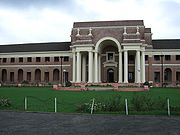
destination. The famous Tapkeshwar temple, Malsi Deer Park, Kalanga monument, Laxman Siddh, Chandrabani, Guchhupani, Forest Research Institute, Tapovan, Santala Devi temple and Wadia Institute are all situated here. On the other side, away from the valley there are other attractions as well. The tourist destinations in Dehradun can be divided into four - five parts : nature, sports, sanctuary, museums and institutions. The nearby hill stations are well known for its nature, temples for its faith dimensions, sanctuary for animal and bird lovers. You can also engage in activities like rafting, trekking and rock climbing. It is easy to get to the nearby hillstations like Mussoorie
Mussoorie
Mussoorie is a city and a municipal board in the Dehradun District of the northern Indian state of Uttarakhand. It is located about 35 km from the state capital of Dehradun and 290 km north from the national capital of New Delhi...
, Ssahssradhara, Chakrata, Dakpathar and Lahkhamondal. Famous temples Tapkeshwar and Santala Devi are located here as well along with amusement parks like fun and food and fun valley. There are also museums and institutions for those who are interested in history and architecture.
Traffic -
Dehradun can be visited in any season but the weather is best in September–October and March–April. Transport options include:
- By air - Indian Airlines and private carriers offer five flights per week from Delhi to Dehradun's Jolly Grant AirportJolly Grant AirportJolly Grant Airport , also known as Dehradun Airport, is an airport serving Dehradun, Uttarakhand, India.-Overview:The airport is located about southeast of the city of Dehradun. Nestled in the foothills of the Himalayas, the airport, after a runway extension to accommodate larger aircraft,...
, 25 km from the valley of Dehradun. - Railways - Dehradun has a railway station with services to major cities including Delhi, Mumbai, Kolkata, Lucknow and Varanasi. High speed trains running via Dehradun include the Shatabdi, Mussoorie Express, Jan Shatabdi and Doon Express.
- Transportation by road - Dehradun is linked to all parts of the country by road. Deluxe buses are easily available from Delhi to Dehradun. Deluxe and semi-deluxe buses run to Shimla and Mussoorie from Dehradun Interstate bus terminal(ISBT) near Clement Town. A deluxe bus service is offered by UPSRTC to and from Delhi (Gandhi Road). From ISBT there are bus services to Dehradun and Mussorie every 15–70 minutes. There are also buses available to and from cities neighbouring Dehradun starting at the Parade Ground. The distances to Dehradun from some of the major cities - Delhi 255 km, Haridwar 54 km, Risikesh 42 km, Agra 382 km, Shimla 221 km, Yamunotri 279 km, Kedarnath 270 km and Nainital 297 km.
Education
Dehradun is home to some of India's most ancient and elite educational institutions. The Doon School,Convent of Jesus and MaryConvent of Jesus and Mary
The Convent of Jesus and Mary, Delhi, India, often known by the acronym CJM, is a prestigious all girls' day school in Delhi, India. Established in 1919, it is one of a network of Convents of Jesus and Mary in India, Pakistan, and the UK.-History:...
, Rashtriya Indian Military College, Welham Girls School
Welham Girls School
Welham Girls School is a boarding school for girls located at the foothills of the Himalayas in Dehradun, India...
, Welham Boys School, St. Joseph's Academy
St. Joseph's Academy, Dehradun
St. Joseph's Academy, Dehradun is a co-educational Indian Certificate of Secondary Education school in Dehradun, the capital of the state of Uttarakhand in India. Founded in 1934, the school is governed by the members of the Patrician Brothers' Institute. It celebrated the bicentenary of the...
, Guru Nanak Academy are considered to be some of India's most prestigious and well performing schools. Several Indian luminaries have attended these schools including former prime ministers and film stars.Other good schools are St. Thomas' College, Dehradun
St. Thomas' College, Dehradun
St. Thomas' College is a private co-educational school in Dehradun, Uttaranchal, India, under the supervision of Mr. R.V. Gardner.- Academics :St. Thomas' College is a senior secondary school, founded in 1916....
, Marshall School, Dehradun
Marshall School, Dehradun
Marshall School, Dehradun is a co-educational Indian Certificate of Secondary Education school in Dehradun, the capital of the state of Uttarakhand in India. Founded in 1967...
, Brightlands School.
Dehradun is also well renowned for Indian Administrative Service (IAS) training and military services. The Indian Military Academy
Indian Military Academy
The Indian Military Academy, Dehradun is the officer training school of the Indian Army. IMA was established in 1932.-Demands for an Indian military training academy:...
, a premier institution for training the nation's military officers, is located there. In addition, other national foundations like Oil and Natural Gas Corporation
Oil and Natural Gas Corporation
The Oil and Natural Gas Corporation Limited is an Indian state-owned oil and gas company headquartered in New Delhi, India. It is one of the largest Asia-based oil and gas exploration and production companies, and produces around 77% of India's total crude oil production and around 81% of...
, Survey of India
Survey of India
The Survey of India is India's central engineering agency in charge of mapping and surveying. Set up in 1767 to help consolidate the territories of the British East India Company, it is one of the oldest Engineering Departments of the Government of India...
, Indian Institute of Petroleum
Indian Institute of Petroleum
The Indian Institute of Petroleum , established in 1960, is one of the constituent laboratories of the Council of Scientific and Industrial Research , dedicated to R&D in the hydrocarbon sector....
and FFP are also located here. There are numerous forest officials in India who have attended the Forest Research Institute
Forest Research Institute
The Forest Research Institute is an institute of the Indian Council of Forestry Research and Education and is a premier institution in the field of forestry research in India. It is located at Dehradun in Uttarakhand. It was established in 1906 and is one of the oldest institutions of its kind...
in Dehradun. The University of Petroleum and Energy Studies
University of Petroleum and Energy Studies
The University of Petroleum and Energy Studies is a university situated at Dehradun, india, specializing in the fields of oil and gas, power and infrastructure. Established in 2003, UPES offers over 47 undergraduate, postgraduate and doctoral programs...
, Dehradun institute of technology
Dehradun Institute of Technology
Dehradun Institute of Technology is an engineering college in Uttarakhand, India.DIT is a technical institute offering undergraduate and post-graduate programmes in several streams of Engineering, IT and Management. It has over 2,300 students....
and ICFAI University are some of the best institutes in Dehradun. It is also home to many different religious schools as well as public schools. Yoga
Yoga
Yoga is a physical, mental, and spiritual discipline, originating in ancient India. The goal of yoga, or of the person practicing yoga, is the attainment of a state of perfect spiritual insight and tranquility while meditating on Supersoul...
, Ayurveda
Ayurveda
Ayurveda or ayurvedic medicine is a system of traditional medicine native to India and a form of alternative medicine. In Sanskrit, words , meaning "longevity", and , meaning "knowledge" or "science". The earliest literature on Indian medical practice appeared during the Vedic period in India,...
and meditation also have a great influence in Dehradun.
Some key organisations are in the process of doing important work in the field of education. Among which National Institute for Visually Handicapped (NIVH) plays a key role in helping the blind people. It is first such institute in India and also the first press for Braille script. This campus is spread over large area and is located in Rajpur Road. The employees board in the campus itself. In addition, there is also a part of this campus which is located in Rajpur and named Sharp Memorial School for the Blind, which provides education and service to the blind children. There is other institute called Bajaj institute of learning which is built up for people with hearing problems and other disabilities. All these organisations and institutes are located in Rajpur Marg. Uttarakhand government had also built up institute for the mentally challenged children which is called Kruna Vihar All these organisations and institutes support to improve the life of the residents here.
Culture
Dehradun is a part of Garhwal regionGarhwal Division
Garhwal is the north-western region and administrative division of the northern Indian state of Uttarakhand which is home to the Garhwali people. Lying in the Himalayas, It is bounded on the north by Tibet, on the east by Kumaon region, on the south by Uttar Pradesh state, and on the north-west by...
, therefore the local customs of the Garhwali people
Garhwali people
Garhwali people are an Indo-Aryan ethno-linguistic group who primarily live in the Garhwal Himalayas of the north-western Indian state of Uttarakhand...
have had a great influence on its culture. Garhwali
Garhwali
The Garhwali language is a Central Pahari language belonging to the Northern Zone of Indo-Aryan languages. It is primarily spoken by the Garhwali people who are from the north-western Garhwal Division of the northern Indian state of Uttarakhand in the Indian Himalayas.The Central Pahari...
and Hindi
Hindi
Standard Hindi, or more precisely Modern Standard Hindi, also known as Manak Hindi , High Hindi, Nagari Hindi, and Literary Hindi, is a standardized and sanskritized register of the Hindustani language derived from the Khariboli dialect of Delhi...
are the primary languages spoken here. Other languages spoken in this region include Gorkhali
Gorkhali
Gorkhali was a Nepali language weekly newspaper published from Varanasi, India. It began its publication in 1919. Devi Prasad Sapkota was the editor of the newspaper....
, Punjabi
Punjabi language
Punjabi is an Indo-Aryan language spoken by inhabitants of the historical Punjab region . For Sikhs, the Punjabi language stands as the official language in which all ceremonies take place. In Pakistan, Punjabi is the most widely spoken language...
, English & Kumaoni.There are people from different religions and backgrounds residing here. After becoming the capital there has been continuous growth in education , communication and transport. As the state capital, Dehradun is home to many government institutions. Dehradun is also renowned all over India for its quality education institutions.
Buses are identified with blue bars. There are also auto-rickshaws which are often used for transportation but also blamed for pollution and noise. The evening buzz of Rajpur road is an attraction. After becoming the capital of Uttarakhand
Uttarakhand
Uttarakhand , formerly Uttaranchal, is a state in the northern part of India. It is often referred to as the Land of Gods due to the many holy Hindu temples and cities found throughout the state, some of which are among Hinduism's most spiritual and auspicious places of pilgrimage and worship...
, the development of the city has accelerated but it is still known as a peaceful city with pleasant weather. The center of the city is easily recognised by the Clock Tower (Ghanta-ghar), a structure with 6 functioning clocks. The statue of San Dijen placed in Shanti Niketan contributes to the beauty of the city. This is the reason that Dehradun is home to many artists as well as writers like David Cling, Nayantara Sahgal
Nayantara Sahgal
Nayantara Sahgal is an Indian writer in English. Her fiction deals with India's elite responding to the crises engendered by political change; she was one of the first female Indo-Anglian writers to receive wide recognition...
, Alan Saila, Bil Acne and Ruskin Bond
Ruskin Bond
Ruskin Bond, born 19 May 1934, is an Indian author of British descent. He is considered to be an icon among Indian writers and children's authors and a top novelist....
, who either stayed in Dehradun for a longer period of time or wrote during their stay. Dehradun has also been home to freedom fighters whose names are engraved in gold on the Clock Tower.
Culture - Woolen blankets are typical of this region and worn by people living at high altitude. Women wear saris with full sleeved blouses along with angra, a kind of jacket. Young girls used to wear full skirts along with scarfs covering their head and shoulders, but more recently they have adopted more modern day wear and salwar suits. In villages and to a lesser extent in towns, men wear the traditional dhoti, angarkha and langoti. The way dhotis are put on represents their backgrounds and castes. For example: short dhotis represent low status whereas long dhotis represent high status. It is more common in urban areas for men to wear shirts and trousers, denims or kurta-pyjamas as daily wear. In winter men usually dress in jacket, hat and overcoat. Hemp is grown in great quantities in this region, so hemp yarn is frequently used as lining. The largest profession in Dehradun is agriculture, but there are large numbers of people who in the military, in businesses or education. Staple foods are rice and dal with raita, curd and salad. Dehradun is known its lychees.
Festivals - There are various fairs (mela
Mela
Mela is a Sanskrit word meaning 'gathering' or 'to meet' or a Fair. It is used in the Indian subcontinent for all sizes of gathering and can be religious, commercial, cultural or sports. In rural traditions melas or village fairs were of great importance...
s) that take place throughout the year. Notable fairs include Magh Mela, held on the 14 January every year and Jhanda Mela in March, a fair for the Sikh community that attracts Sikhs from all over India and abroad.
Architecture
Dehradun has many beautiful old buildings. Unusually in India, house roofs are slanted, as rainfall can often be heavy. As winters can be cold, houses traditionally have a fireplace, even if they also have modern central heating. After Dehradun was made the capital of Uttarakhand there was a construction boom, especially in residential property. Modern buildings have gradually supplanted older architectural styles including those related to the British colonial rule of India. Important older buildings include Clock Tower, Forest Research Institute, CNI College, Morrison Memorial Church, Inamullah Building, Jama Masjid, Osho Meditation Center, Indian Military Academy and Darbar Sahib.Economy
Dehradun has a per capita income close to $2400 (national average $800), and has enjoyed strong economic growth in the last 20 years. Dehradun today has experienced a commercial and information technology boom, amplified by the establishment of Software Technology Parks of India (STPI) and various SEZs (special economic zones) throughout the city. The construction of the Delhi-Dehradun four lane highway will enable more economic development.Paltan bazar and Rajpur road are the economic heart of business in Dehradun.See also
- Garhwali peopleGarhwali peopleGarhwali people are an Indo-Aryan ethno-linguistic group who primarily live in the Garhwal Himalayas of the north-western Indian state of Uttarakhand...
- GarhwalGarhwal DivisionGarhwal is the north-western region and administrative division of the northern Indian state of Uttarakhand which is home to the Garhwali people. Lying in the Himalayas, It is bounded on the north by Tibet, on the east by Kumaon region, on the south by Uttar Pradesh state, and on the north-west by...
- GarhwaliGarhwaliThe Garhwali language is a Central Pahari language belonging to the Northern Zone of Indo-Aryan languages. It is primarily spoken by the Garhwali people who are from the north-western Garhwal Division of the northern Indian state of Uttarakhand in the Indian Himalayas.The Central Pahari...
- Garhwal RiflesGarhwal RiflesThe Garhwal Rifles is a light infantry or 'rifle' regiment of the Indian Army. It was originally raised as the 39th Garhwal Rifles of the Bengal Army, became part of the old Indian Army, and received its present name on Indian independence...
- Bengal Engineer GroupBengal Engineer GroupThe Bengal Engineer Group or the Bengal Sappers or Bengal Engineers as they are informally known, are remnants of British Indian Army's Bengal Army of the Bengal Presidency in British India; now a regiment of the Corps of Engineers in the Indian Army. The Bengal Sappers have their regimental...
(based in Uttarakhand) - KumaonKumaon DivisionFor Kumaoni/Kumauni People see Kumauni PeopleKumaon or Kumaun is one of the two regions and administrative divisions of Uttarakhand, a mountainous state of northern India, the other being Garhwal. It includes the districts of Almora, Bageshwar, Champawat, Nainital, Pithoragarh, and Udham Singh Nagar...
- Kumaoni people
- Kumaon RegimentKumaon RegimentThe Kumaon Regiment is one of the most decorated regiments of the Indian Army. The regiment traces its origins to the 18th century and has fought in every major campaign of the British Indian Army and the Indian Army, including the two world wars...
- Special Frontier ForceSpecial Frontier ForceThe Special Frontier Force is a paramilitary unit of India. It was conceived in the post Sino-Indian war period as a guerrilla force composed mainly of Tibetan refugees whose main goal was to conduct covert operations behind Chinese lines in case of another war between the People's Republic of...