
|
|
|
|
Lychee
|
| |
|
| |
The Lychee (; Litchi chinensis), also spelled Litchi (the U.S. Food and Drug Administration spelling) or Laichi and Lichu, Chinese: ??, Hanyu Pinyin: Lìzhi, is the sole member of the genus Litchi in the soapberry family Sapindaceae. It is a tropical fruit tree. It is also commonly found in Madagascar, India, Nepal, Bangladesh, Pakistan, southern Taiwan, northern Vietnam, Indonesia, Thailand, the Philippines, and Southern Africa.
It is a medium-sized evergreen tree, reaching 15–20 m tall, with alternate pinnate leaves, each leaf 15–25 cm long, with 2-8 lateral leaflets 5–10 cm long; the terminal leaflet is absent.

Discussion
Ask a question about 'Lychee'
Start a new discussion about 'Lychee'
Answer questions from other users
|
Encyclopedia
The Lychee (; Litchi chinensis), also spelled Litchi (the U.S. Food and Drug Administration spelling) or Laichi and Lichu, Chinese: ??, Hanyu Pinyin: Lìzhi, is the sole member of the genus Litchi in the soapberry family Sapindaceae. It is a tropical fruit tree. It is also commonly found in Madagascar, India, Nepal, Bangladesh, Pakistan, southern Taiwan, northern Vietnam, Indonesia, Thailand, the Philippines, and Southern Africa.
It is a medium-sized evergreen tree, reaching 15–20 m tall, with alternate pinnate leaves, each leaf 15–25 cm long, with 2-8 lateral leaflets 5–10 cm long; the terminal leaflet is absent. The newly emerging young leaves are a bright coppery red at first, before turning green as they expand to full size. The flowers are small, greenish-white or yellowish-white, produced in panicles up to 30 cm long.
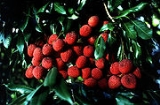
The fruit is a drupe, 3–4 cm long and 3 cm in diameter. The outside is covered by a pink-red, roughly-textured rind that is inedible but easily removed. The inside consists of a layer of sweet, translucent white flesh, rich in vitamin C, with a texture somewhat similar to that of a grape. The edible flesh consists of a highly developed aril enveloping the seed. The center contains a single glossy brown nut-like seed, 2 cm long and 1–1.5 cm in diameter. The seed, similar to a buckeye seed, is not poisonous but should not be eaten. The fruit matures from July to October, about 100 days after flowering.
There are two subspecies:
- Litchi chinensis subsp. chinensis. China, Indochina (Vietnam, Laos and Cambodia). Leaves with 4 to 8 (rarely 2) leaflets.
- Litchi chinensis subsp. philippinensis (Radlk.) Leenh. Philippines, Indonesia. Leaves with 2-4 (rarely 6) leaflets.
History A major early Chinese historical reference to lychees was made in the Tang Dynasty, when it was the favourite fruit of Emperor Li Longji (Xuanzong)'s favoured concubine Yang Yuhuan (Yang Guifei). The emperor had the fruit, which was only grown in southern China, delivered by the imperial messenger service's fast horses, whose riders would take shifts day and night in a Pony Express-like manner, to the capital. (Most historians believe the fruits were delivered from modern Guangdong, but some believe they came from modern Sichuan.)
In the Chinese classical work, Shanglin Fu, it is related that the alternate name, ?? (pinyin: lízhi), meaning leaving its branches, is so-called because once the fruit is picked it deteriorates quickly.
The lychee was first described in the West by Pierre Sonnerat (1748–1814) on a return from his travel to China and Southeast Asia.
It was then introduced to the Réunion Island in 1764 by Joseph-François Charpentier de Cossigny de Palma. It was later introduced to Madagascar which has become a major producer.
Cultivation and uses Lychees are extensively grown in the native region of China, and also elsewhere in South-East Asia, especially in north of Thailand, Laos, Cambodia, Vietnam, Bangladesh, India, southern Japan, Taiwan, and more recently in California, Hawaii, Florida in the United States, the wetter areas of eastern Australia and sub-tropical regions of South Africa,Israel and also in the state of Sinaloa in Mexico. They require a warm subtropical to tropical climate that is cool but also frost-free or with only very slight winter frosts not below -4°C, and with high summer heat, rainfall, and humidity. Growth is best on well-drained, slightly acidic soils rich in organic matter. A wide range of cultivars is available, with early and late maturing forms suited to warmer and cooler climates respectively. They are also grown as an ornamental tree as well as for their fruit.
Lychees are commonly sold fresh in Vietnamese, Chinese and Asian markets, and in recent years, also widely in supermarkets worldwide. The red rind turns dark brown when the fruit is refrigerated, but the taste is not affected. It is also sold canned year-round. The fruit can be dried with the rind intact, at which point the flesh shrinks and darkens.
According to folklore, a lychee tree that is not producing much fruit can be girdled, leading to more fruit production.
Cultivars
There are many different cultivars of lychee (lizhi), of which two are considered to be the most sought-after.
The "Prestigious Cultivars"
- Hanging Green (gualü, ??): The most famous (and most rare) lychee in existence. It received its name because of the barely noticeable light green hue and green line on the shell. Ancient records have described Hanging Green as "Fresh and crispy as pear, without juice. It can last for three days after the shell is removed". For centuries, Hanging Green was an item of tribute to the imperial government of various dynasties, until people in Canton revolted during the Qianlong era against the tributes and chopped all but one of the Hanging Green trees. The sole remaining tree still produces fruit each year, and fruits from that tree are now called "Zhengcheng Hanging Green" (Zengcheng gualü, ????).
- Sweet Osmanthus Flavour (gui mei, ??): Named because of the Sweet Osmanthus flavour it contains, this lychee has light red shells, which contains sharp edges. The fruits are described as crispy and sweet. There is a related cultivar, called "Yatou Green" (yatoulü, ???). The shell of this cultivar has dark green spots.
- Glutinous Rice Ball (nuomici, ???): Named after its thick fruit flesh and sweet (some described the taste as close to honey) flavours. The fresh red shells are not sharp and hard, and the seeds from this cultivar are noticeably smaller than others. Some fruits from this cultivar are seedless.
V?i thi?u
V?i thi?u is a well-known cultivar in Vietnam. It roots in Thanh Ha district, Hai Duong province and recently exists in Luc Ngan district, Bac Giang province.
The fruit is notable for its small globe, red shell, tiny or no seed, very sweet taste and special flavour.
Other notable cultivars
- Baila
- Baitangying
- Black Leaves: This cultivar matures less than others, and has big meats and seeds. The shell exhibits a dark red tint.
- Huaizhi: Literally "Branches [of fruit] in the arms of [a person]", this lychee supposedly received its name when a government official toured Lingnan (modern day Canton) and placed within his arms lychee branches gifted by local villagers.
- March Red (sanyuehong, ???): This lychee matures the earliest, and are usually available annually around March. This particular type has a more subtle fragrance and is sweeter than most.
- The Concubine Smiles (feizixiao, ???): Famed as the cultivar of lychee Emperor Xuanzong of Tang brought from the edges of the Tang empire to cheer up Yang Guifei, this lychee matures earlier than others, and has a very light red tint on its shells.
- The Jade Purse (yuhebao, ???): Named because of its large fruits and the thick flesh within. The seed is small in this cultivar.
Name in different languages
The name 'lychee' comes from the Chinese , which may have been in Middle Chinese. This name in various forms is used throughout South and East Asia.
Nutritional Facts
The Lychee contains on average a total 72mg of Vitamin C per 200 grams of flesh. This makes lychees a very good source of Vitamin C. On average as little as three (3)lychee fruits would meet a third of an adult’s daily recommend Vitamin C requirement.
Lychess are also high in Copper, Phosphorous, Potassium and the B vitamin, Thiamine.
Lychess are low in Saturated Fat, Cholesterol and Sodium.
Most of the energy in a lychee is in the form of carbohydrate.
Gallery
See also
External links
|
| |
|
|