

Cotonou

Encyclopedia
Demographics
- 1979: 320,348 (census count)
- 1992: 536,827 (census count)
- 2002: 665,100 (estimate)
- 2005: 690,584 (estimate)
The main languages spoken in Cotonou include the Fon language
Fon language
Fon is part of the Gbe language cluster and belongs to the Volta–Niger branch of the Niger–Congo languages. Fon is spoken mainly in Benin by approximately 1.7 million speakers, by the Fon people...
, Aja language
Aja language (Niger-Congo)
The Aja language is a Gbe language of the Niger–Congo language spoken by the Aja people; and it is closely related to other Gbe languages such as Ewe, Mina, Fon, and Phla Phera.-Aja:...
, Yoruba language
Yoruba language
Yorùbá is a Niger–Congo language spoken in West Africa by approximately 20 million speakers. The native tongue of the Yoruba people, it is spoken, among other languages, in Nigeria, Benin, and Togo and in communities in other parts of Africa, Europe and the Americas...
and French
French language
French is a Romance language spoken as a first language in France, the Romandy region in Switzerland, Wallonia and Brussels in Belgium, Monaco, the regions of Quebec and Acadia in Canada, and by various communities elsewhere. Second-language speakers of French are distributed throughout many parts...
.
Transport
Parakou
Parakou is the largest city in eastern Benin, with an estimated population of around 188,853 people, and capital of the Borgou Department. The mayor as of 2008 was Samou Seidou Adambi and administratively the commune of Parakou makes up one of Benin's 77 communes.-Economy:Parakou lies on the main...
in the north of the country by the Benin-Niger railway. Cotonou International Airport
Cadjehoun Airport
Cotonou Cadjehoun Airport is an airport located in Cotonou, the biggest city in Benin in West Africa.In 2004, the airport served 301,493 passengers.-Airlines and destinations:-Incidents and accidents:...
provides service to the capitals of the region and to France, as well as the major cities of Benin: Parakou, Kandi
Kandi
Kandi is a town, arrondissement and commune in the Alibori Department of eastern Benin. Originally a market town, Kandi is now primarily a farming centre. It lies on the nation's main north-south highway, 650 km from Cotonou and 325 miles north of Porto-Novo. The town is the capital of...
, Natitingou
Natitingou
Natitingou is a city and commune in north western Benin. It is about 50 km from Benin's Pendjari National Park, where tourists can see West African wildlife during the months of December through June...
, Djougou
Djougou
Djougou is the largest city in north west Benin. It is an important market town. The commune covers an area of 3,966 square kilometres and as of 2002 had a population of 181,895 people.-General Information:...
, and Savé
Savé
Savé is a city in Benin, lying on the Cotonou-Parakou railway and the main north-south road. It is known for its local boulders, popular with climbers.The commune covers an area of 2228 square kilometres and as of 2002 had a population of 67,753 people....
. There are also road connections to several neighboring countries: Nigeria, Burkina Faso, Niger, and Togo
Togo
Togo, officially the Togolese Republic , is a country in West Africa bordered by Ghana to the west, Benin to the east and Burkina Faso to the north. It extends south to the Gulf of Guinea, on which the capital Lomé is located. Togo covers an area of approximately with a population of approximately...
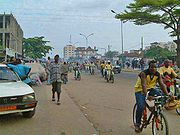
. A notable form of transport in the city is known as a Zémidjan
Zémidjan
A zémidjan is a type of taxi found in Benin. The highest concentration is found in the largest city, Cotonou, where there are an estimated 72,000. Zémidjans are motorcycles that carry one to two passengers for short distances within towns. The fares are entirely negotiable...
.
Economy
Because of its status as a transport hub, Cotonou has become a crossroads of West African commerce, with much trade moving here from AbidjanAbidjan
Abidjan is the economic and former official capital of Côte d'Ivoire, while the current capital is Yamoussoukro. it was the largest city in the nation and the third-largest French-speaking city in the world, after Paris, and Kinshasa but before Montreal...
because of the Ivorian Civil War. The city is a so-called 'market town,' enabling trade with the countries of the African interior, such as Mali
Mali
Mali , officially the Republic of Mali , is a landlocked country in Western Africa. Mali borders Algeria on the north, Niger on the east, Burkina Faso and the Côte d'Ivoire on the south, Guinea on the south-west, and Senegal and Mauritania on the west. Its size is just over 1,240,000 km² with...
, Burkina Faso
Burkina Faso
Burkina Faso – also known by its short-form name Burkina – is a landlocked country in west Africa. It is surrounded by six countries: Mali to the north, Niger to the east, Benin to the southeast, Togo and Ghana to the south, and Côte d'Ivoire to the southwest.Its size is with an estimated...
, and Niger
Niger
Niger , officially named the Republic of Niger, is a landlocked country in Western Africa, named after the Niger River. It borders Nigeria and Benin to the south, Burkina Faso and Mali to the west, Algeria and Libya to the north and Chad to the east...
. In addition to the port, there is a free trade zone
Free trade zone
A free trade zone or export processing zone , also called foreign-trade zone, formerly free port is an area within which goods may be landed, handled, manufactured or reconfigured, and reexported without the intervention of the customs authorities...
in the interior of the city for use by the landlocked Saharan states. However, the city is rife with corruption and illegal trade, especially with neighboring Nigeria
Nigeria
Nigeria , officially the Federal Republic of Nigeria, is a federal constitutional republic comprising 36 states and its Federal Capital Territory, Abuja. The country is located in West Africa and shares land borders with the Republic of Benin in the west, Chad and Cameroon in the east, and Niger in...
. It can be considered the economic capital as it houses two-thirds of Benin's industries and is the headquarters of the nation's major enterprises and banks.
Important manufactured goods include palm oil
Palm oil
Palm oil, coconut oil and palm kernel oil are edible plant oils derived from the fruits of palm trees. Palm oil is extracted from the pulp of the fruit of the oil palm Elaeis guineensis; palm kernel oil is derived from the kernel of the oil palm and coconut oil is derived from the kernel of the...
and cake, brewing
Brewing
Brewing is the production of beer through steeping a starch source in water and then fermenting with yeast. Brewing has taken place since around the 6th millennium BCE, and archeological evidence suggests that this technique was used in ancient Egypt...
, textiles, and cement
Cement
In the most general sense of the word, a cement is a binder, a substance that sets and hardens independently, and can bind other materials together. The word "cement" traces to the Romans, who used the term opus caementicium to describe masonry resembling modern concrete that was made from crushed...
. Motor vehicles
Automobile
An automobile, autocar, motor car or car is a wheeled motor vehicle used for transporting passengers, which also carries its own engine or motor...
and bicycle
Bicycle
A bicycle, also known as a bike, pushbike or cycle, is a human-powered, pedal-driven, single-track vehicle, having two wheels attached to a frame, one behind the other. A person who rides a bicycle is called a cyclist, or bicyclist....
s are assembled, and there are also sawmill
Sawmill
A sawmill is a facility where logs are cut into boards.-Sawmill process:A sawmill's basic operation is much like those of hundreds of years ago; a log enters on one end and dimensional lumber exits on the other end....
s in the city. Petroleum
Petroleum
Petroleum or crude oil is a naturally occurring, flammable liquid consisting of a complex mixture of hydrocarbons of various molecular weights and other liquid organic compounds, that are found in geologic formations beneath the Earth's surface. Petroleum is recovered mostly through oil drilling...
products, bauxite
Bauxite
Bauxite is an aluminium ore and is the main source of aluminium. This form of rock consists mostly of the minerals gibbsite Al3, boehmite γ-AlO, and diaspore α-AlO, in a mixture with the two iron oxides goethite and hematite, the clay mineral kaolinite, and small amounts of anatase TiO2...
, and iron
Iron
Iron is a chemical element with the symbol Fe and atomic number 26. It is a metal in the first transition series. It is the most common element forming the planet Earth as a whole, forming much of Earth's outer and inner core. It is the fourth most common element in the Earth's crust...
are major exports. There are also offshore platforms drilling for oil
Petroleum
Petroleum or crude oil is a naturally occurring, flammable liquid consisting of a complex mixture of hydrocarbons of various molecular weights and other liquid organic compounds, that are found in geologic formations beneath the Earth's surface. Petroleum is recovered mostly through oil drilling...
. The city is also a center for the automotive trade, with European brands being sold from vast open-air parking lots. In the past, Citroën assembled cars (for instance, the 2CV
Citroën 2CV
The Citroën 2CV |tax horsepower]]”) was an economy car produced by the French automaker Citroën between 1948 and 1990. It was technologically advanced and innovative, but with uncompromisingly utilitarian unconventional looks, and deceptively simple Bauhaus inspired bodywork, that belied the sheer...
and Ami 8
Citroën Ami
The Citroën Ami is a supermini produced by the French automaker Citroën from 1961 to 1978. The Ami and stablemate Citroën Dyane were replaced by the Citroën Visa and Citroën Axel . The Ami was for some years the best-selling car model in France...
) locally.
In Missebo area, Cotonou is a textile market of African Print mainly handled by Indian wholesalers and retailers.
Main sights


- Cotonou CathedralCotonou CathedralThe cathedral of Notre Dame de Miséricorde, commonly known as Cotonou Cathedral is a Roman Catholic cathedral, located near the Ancien Pont Bridge in Cotonou, Benin. It is noted for its distinct burgundy and white striped tiled architecture...
, or Notre Dame des Apotres, located near the Ancien Pont Bridge. It is noted for its distinct burgundy and white striped tiled architecture. The cathedral is the seat of the Roman Catholic Archdiocese of CotonouRoman Catholic Archdiocese of CotonouThe Archdiocese of Cotonou is the Metropolitan See for the Ecclesiastical province of Cotonou in Benin.-History:* 1883.06.26: Established as Apostolic Prefecture of Dahomey from the Apostolic Vicariate of Benin Coast, Nigeria...
.The diocese was originally created on June 26, 1883, as the Apostolic Prefecture of Dahomey from the Apostolic Vicariate of Benin Coast, NigeriaNigeriaNigeria , officially the Federal Republic of Nigeria, is a federal constitutional republic comprising 36 states and its Federal Capital Territory, Abuja. The country is located in West Africa and shares land borders with the Republic of Benin in the west, Chad and Cameroon in the east, and Niger in...
. After several names changes under DahomeyDahomeyDahomey was a country in west Africa in what is now the Republic of Benin. The Kingdom of Dahomey was a powerful west African state that was founded in the seventeenth century and survived until 1894. From 1894 until 1960 Dahomey was a part of French West Africa. The independent Republic of Dahomey...
, on 14 September 1955 it was promoted as the Metropolitan Archdiocese of Cotonou. The cathedral was run by Archbishop Bernardin Gantin (died 2008) from 1960 to 1971. The current archbishop of the cathedral and Cotonou is Marcel Honorat Léon AgbotonMarcel Honorat Léon AgbotonArchbishop Marcel Honorat Léon Agboton is a retired Beninese Roman Catholic archbishop; he is the Archbishop Emeritus of Cotonou....
. - National University of BeninNational University of BeninThe National University of Benin is the principal university in the country of Benin. The university was founded in 1970 as the Université du Dahomey. In 1975 the name was changed to Université Nationale du Bénin. Its name is abbreviated UNB....
– is the principal university in Benin. The university was founded in 1970 as the Université du Dahomey. In 1975 the name was changed officially to Université Nationale du Bénin. The school is composed of 19 institutions and six campuses. The main campus is the Université d'Abomey-Calavi (UAC). In 1999 students numbered 16,000, including over 3,300 women. - Ancien Pont BridgeAncien Pont BridgeThe Ancien Pont Bridge is a bridge in Cotonou, Benin....
- Dantokpa MarketDantokpa MarketThe Dantokpa Market is a market in Cotonou, Benin. It is one of the most important retailing areas in Benin, covering over 20 hectares. It is also economically important for the country, with a reported commercial turnover of over a billion CFA Francs a day....
Media
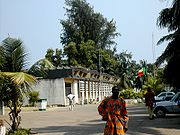
- Office de Radiodiffusion et Télévision du BéninOffice de Radiodiffusion et Télévision du BéninOffice de Radiodiffusion et Télévision du Bénin ' is a the mainstream terrestrial television channel and radio operator in Benin. It has its headquarters in Cotonou....
(ORTB) is the national television and radio operator and is based in Cotonou.
Sister cities
TaipeiTaipei
Taipei City is the capital of the Republic of China and the central city of the largest metropolitan area of Taiwan. Situated at the northern tip of the island, Taipei is located on the Tamsui River, and is about 25 km southwest of Keelung, its port on the Pacific Ocean...
, Republic of China
Republic of China
The Republic of China , commonly known as Taiwan , is a unitary sovereign state located in East Asia. Originally based in mainland China, the Republic of China currently governs the island of Taiwan , which forms over 99% of its current territory, as well as Penghu, Kinmen, Matsu and other minor...
Atlanta, USA Salvador
Salvador, Bahia
Salvador is the largest city on the northeast coast of Brazil and the capital of the Northeastern Brazilian state of Bahia. Salvador is also known as Brazil's capital of happiness due to its easygoing population and countless popular outdoor parties, including its street carnival. The first...
, Brazil