

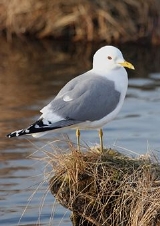
Common Gull

Encyclopedia
The Common Gull or Mew Gull (North American subspecies) Larus canus is a medium-sized gull
which breeds in northern Asia
, northern Europe
and northwestern North America
. It migrates
further south in winter. Its name does not indicate that it is an abundant species, but that during the winter it feeds on common land
, short pasture used for grazing.
Adults are 40-46 cm long, obviously smaller than the Herring Gull
, and slightly smaller than the Ring-billed Gull
, also differing from this in its shorter, more tapered bill with a more greenish shade of yellow, as well as being unmarked during the breeding season. The body is grey above and white below. The legs are greenish-yellow. In winter, the head is streaked grey, and the bill often has a poorly-defined blackish band near the tip (sometimes sufficiently obvious to cause confusion with Ring-billed Gull). They have black wingtips with large white "mirrors". Young birds have scaly black-brown upperparts and a neat wing pattern, and grey legs. They take two to three years to reach maturity. The call is a high-pitched "laughing" cry.
, two of them considered distinct species by some authorities:
varies from 2 to 320 or even more pairs. Usually three eggs are laid (sometimes just one or two); they hatch after 24–26 days, with the chicks fledging after a further 30–35 days. Like most gulls, they are omnivores and will scavenge as well as hunt small prey. The global population is estimated to be about one million pairs; they are most numerous in Europe, with over half (possibly as much as 80-90%) of the world population. By contrast, the Alaskan population is only about 10,000 pairs.
, and there is one recent record of Mew Gull in Europe on the Azores
.
Gull
Gulls are birds in the family Laridae. They are most closely related to the terns and only distantly related to auks, skimmers, and more distantly to the waders...
which breeds in northern Asia
Asia
Asia is the world's largest and most populous continent, located primarily in the eastern and northern hemispheres. It covers 8.7% of the Earth's total surface area and with approximately 3.879 billion people, it hosts 60% of the world's current human population...
, northern Europe
Europe
Europe is, by convention, one of the world's seven continents. Comprising the westernmost peninsula of Eurasia, Europe is generally 'divided' from Asia to its east by the watershed divides of the Ural and Caucasus Mountains, the Ural River, the Caspian and Black Seas, and the waterways connecting...
and northwestern North America
North America
North America is a continent wholly within the Northern Hemisphere and almost wholly within the Western Hemisphere. It is also considered a northern subcontinent of the Americas...
. It migrates
Bird migration
Bird migration is the regular seasonal journey undertaken by many species of birds. Bird movements include those made in response to changes in food availability, habitat or weather. Sometimes, journeys are not termed "true migration" because they are irregular or in only one direction...
further south in winter. Its name does not indicate that it is an abundant species, but that during the winter it feeds on common land
Common land
Common land is land owned collectively or by one person, but over which other people have certain traditional rights, such as to allow their livestock to graze upon it, to collect firewood, or to cut turf for fuel...
, short pasture used for grazing.
Adults are 40-46 cm long, obviously smaller than the Herring Gull
Herring Gull
The European Herring Gull is a large gull , and is the most abundant and best known of all gulls along the shores of western Europe. It breeds across Northern Europe, Western Europe, Scandinavia and the Baltic states...
, and slightly smaller than the Ring-billed Gull
Ring-billed Gull
The Ring-billed Gull is a medium-sized gull.Adults are length and with a wingspan. The head, neck and underparts are white; the relatively short bill is yellow with a dark ring; the back and wings are silver gray; and the legs are yellow. The eyes are yellow with red rims...
, also differing from this in its shorter, more tapered bill with a more greenish shade of yellow, as well as being unmarked during the breeding season. The body is grey above and white below. The legs are greenish-yellow. In winter, the head is streaked grey, and the bill often has a poorly-defined blackish band near the tip (sometimes sufficiently obvious to cause confusion with Ring-billed Gull). They have black wingtips with large white "mirrors". Young birds have scaly black-brown upperparts and a neat wing pattern, and grey legs. They take two to three years to reach maturity. The call is a high-pitched "laughing" cry.
Taxonomy
There are four subspeciesSubspecies
Subspecies in biological classification, is either a taxonomic rank subordinate to species, ora taxonomic unit in that rank . A subspecies cannot be recognized in isolation: a species will either be recognized as having no subspecies at all or two or more, never just one...
, two of them considered distinct species by some authorities:
- Larus canus canus Linnaeus, 1758 – Common Gull. Europe and western Asia. Small; mantle medium grey (palest subspecies); wingtips with extensive black; iris dark. Wingspan 110–125 cm; mass 290–480 g.
- Larus canus heinei Homeyer, 1853 – Russian Common Gull . Central northern Asia. Medium size; mantle dark grey (darkest subspecies); wingtips with extensive black; iris dark. Mass 315–550 g.
- Larus canus kamtschatschensis (Bonaparte, 1857); syn. L. kamtschatschensis – Kamchatka Gull. Northeastern Asia. Large; mantle medium-dark grey; wingtips with extensive black; iris pale. Mass 394–586 g.
- Larus canus brachyrhynchus Richardson, 1831; syn. L. brachyrhynchus – Mew Gull or Short-billed Gull. AlaskaAlaskaAlaska is the largest state in the United States by area. It is situated in the northwest extremity of the North American continent, with Canada to the east, the Arctic Ocean to the north, and the Pacific Ocean to the west and south, with Russia further west across the Bering Strait...
and western CanadaCanadaCanada is a North American country consisting of ten provinces and three territories. Located in the northern part of the continent, it extends from the Atlantic Ocean in the east to the Pacific Ocean in the west, and northward into the Arctic Ocean...
. Small; mantle medium-dark grey; wingtips with little black and much white; iris pale. Wingspan 96–102 cm; mass 320–550 g.
Ecology
Both Common and Mew Gulls breed colonially near water or in marshes, making a lined nest on the ground or in a small tree; colony sizeGroup size measures
Many animals, including humans, tend to live in groups, herds, flocks, bands, packs, shoals, or colonies of conspecific individuals. The size of these groups, as expressed by the number of participant individuals, is an important aspect of their social environment...
varies from 2 to 320 or even more pairs. Usually three eggs are laid (sometimes just one or two); they hatch after 24–26 days, with the chicks fledging after a further 30–35 days. Like most gulls, they are omnivores and will scavenge as well as hunt small prey. The global population is estimated to be about one million pairs; they are most numerous in Europe, with over half (possibly as much as 80-90%) of the world population. By contrast, the Alaskan population is only about 10,000 pairs.
Vagrancy
The Common Gull occurs as a scarce winter visitor to coastal eastern Canada and as a vagrant to the northeastern USAUnited States
The United States of America is a federal constitutional republic comprising fifty states and a federal district...
, and there is one recent record of Mew Gull in Europe on the Azores
Azores
The Archipelago of the Azores is composed of nine volcanic islands situated in the middle of the North Atlantic Ocean, and is located about west from Lisbon and about east from the east coast of North America. The islands, and their economic exclusion zone, form the Autonomous Region of the...
.
Other names
An old historical name for the Common Gull is sea mew, from the old English .External links
- Common Gull videos, photos & sounds on the Internet Bird Collection