


Colorado Central Railroad

Encyclopedia
United States
The United States of America is a federal constitutional republic comprising fifty states and a federal district...
railroad company that operated in Colorado
Colorado
Colorado is a U.S. state that encompasses much of the Rocky Mountains as well as the northeastern portion of the Colorado Plateau and the western edge of the Great Plains...
and southeastern Wyoming
Wyoming
Wyoming is a state in the mountain region of the Western United States. The western two thirds of the state is covered mostly with the mountain ranges and rangelands in the foothills of the Eastern Rocky Mountains, while the eastern third of the state is high elevation prairie known as the High...
in the late 19th century. Originally founded in the Colorado Territory
Colorado Territory
The Territory of Colorado was an organized incorporated territory of the United States that existed from February 28, 1861, until August 1, 1876, when it was admitted to the Union as the State of Colorado....
in the wake of the Colorado Gold Rush
Colorado Gold Rush
The Pike's Peak Gold Rush was the boom in gold prospecting and mining in the Pike's Peak Country of western Kansas Territory and southwestern Nebraska Territory of the United States that began in July 1858 and lasted until roughly the creation of the Colorado Territory on February 28, 1861...
to ship gold
Gold
Gold is a chemical element with the symbol Au and an atomic number of 79. Gold is a dense, soft, shiny, malleable and ductile metal. Pure gold has a bright yellow color and luster traditionally considered attractive, which it maintains without oxidizing in air or water. Chemically, gold is a...
from the mountains, it eventually expanded from its initial Golden
Golden, Colorado
The City of Golden is a home rule municipality that is the county seat of Jefferson County, Colorado, United States. Golden lies along Clear Creek at the edge of the foothills of the Front Range of the Rocky Mountains. Founded during the Pike's Peak Gold Rush on 16 June 1859, the mining camp was...
–Denver
Denver, Colorado
The City and County of Denver is the capital and the most populous city of the U.S. state of Colorado. Denver is a consolidated city-county, located in the South Platte River Valley on the western edge of the High Plains just east of the Front Range of the Rocky Mountains...
line to form a crucial link connecting Colorado with the transcontinental railroad and the national rail network. The history of the railroad throughout the 1870s was driven at times by a fierce struggle between local interests, led by W.A.H. Loveland, and outside investors of the Union Pacific Railroad
Union Pacific Railroad
The Union Pacific Railroad , headquartered in Omaha, Nebraska, is the largest railroad network in the United States. James R. Young is president, CEO and Chairman....
led at times by Jay Gould
Jay Gould
Jason "Jay" Gould was a leading American railroad developer and speculator. He has long been vilified as an archetypal robber baron, whose successes made him the ninth richest American in history. Condé Nast Portfolio ranked Gould as the 8th worst American CEO of all time...
. The early struggle of the company to build its lines was a major part of the early competition between Denver and Golden for supremacy as the principal metropolis of Colorado.
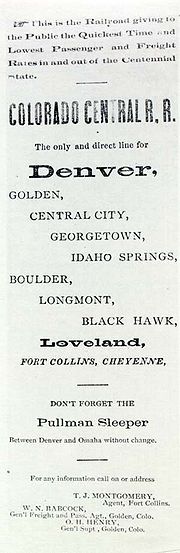
The company built the first rail lines up connecting historic Colorado mining communities such as Black Hawk
Black Hawk, Colorado
The historic City of Black Hawk is a Home Rule Municipality located in Gilpin County, Colorado, United States. The city population was 118 at U.S. Census 2000, making Black Hawk the least populous city in Colorado...
, Central City
Central City, Colorado
Central City is a home rule municipality in Clear Creek and Gilpin counties in the U.S. state of Colorado, and the county seat of Gilpin County. The city population was 515 in the 2000 United States Census...
, and Idaho Springs
Idaho Springs, Colorado
The City of Idaho Springs is a municipality in the U.S. state of Colorado that is the most populous settlement in Clear Creek County, Colorado. Idaho Springs is located in Clear Creek Canyon, in the mountains upstream from Golden, some thirty miles west of Denver...
. Through a series of reorganizations and acquisitions, it eventually became part of the Colorado and Southern Railway
Colorado and Southern Railway
The Colorado and Southern Railway was a railroad company in the western United States that operated independently from 1898 to 1908, then as part of the Chicago, Burlington and Quincy Railroad until it was absorbed into the Burlington Northern Railroad in 1981.The railway began as the...
. Although its historic mountain lines were dismantled by the mid 20th century, its connecting lines on the Colorado Eastern Plains
Colorado Eastern Plains
The Eastern Plains of Colorado refers to a region of the U.S. state of Colorado east of the Rocky Mountains and east of the population centers of the Front Range.-Geography:...
survive as active lines of BNSF Railway
BNSF Railway
The BNSF Railway is a wholly owned subsidiary of Berkshire Hathaway Inc., and is headquartered in Fort Worth, Texas. It is one of seven North American Class I railroads and the second largest freight railroad network in North America, second only to the Union Pacific Railroad, its primary...
.
History
The railroad was chartered as the Colorado and Clear Creek Railroad Company on February 9, 1865 by Loveland and other entrepreneurs in the town of Golden, which at time was the capital of the Colorado Territory. Loveland and his partners desired to build a (standard gaugeStandard gauge
The standard gauge is a widely-used track gauge . Approximately 60% of the world's existing railway lines are built to this gauge...
) railroad up Clear Creek Canyon
Clear Creek (Colorado)
Clear Creek is a tributary of the South Platte River, approximately long, in north central Colorado in the United States. The creek flows through Clear Creek Canyon in the Rocky Mountains directly west of Denver, descending through a long gorge to emerge on the Colorado Eastern Plains where it...
to Central City
Central City, Colorado
Central City is a home rule municipality in Clear Creek and Gilpin counties in the U.S. state of Colorado, and the county seat of Gilpin County. The city population was 515 in the 2000 United States Census...
and other mining centers, as well as to connect to nearby Denver and Boulder
Boulder, Colorado
Boulder is the county seat and most populous city of Boulder County and the 11th most populous city in the U.S. state of Colorado. Boulder is located at the base of the foothills of the Rocky Mountains at an elevation of...
. It would three years before actual construction on the line began, during which time company underwent several reorganizations. On January 20, 1866, the name of the railroad was changed to the Colorado Central & Pacific Railroad. The following year, in June 1867, the company was reorganized with Union Pacific investors in control, but providing no funds for construction. In that same year, the capital of the Colorado Territory was shifted from Golden to Denver.
On January 1, 1868, construction at last began on the first line connecting Denver and Golden. On January 14, the company changed its name to Colorado Central Railroad. Construction of the initial line was slow. By the end of the year, only the small portion (less than 12 miles) between Denver and Golden had been graded. In the meantime, Territorial Governor John Evans and other business leaders in Denver had formed the Denver Pacific Railway
Denver Pacific Railway
The Denver Pacific Railway was a historic railroad that operated in the western United States during the late 19th century.Formed in 1867 in the Colorado Territory, the company operated lines in Colorado and present-day southeastern Wyoming in the 1870s until merging with the Kansas Pacific and...
in May 1868 with the intention of building a rail line from Denver to Cheyenne. The formation of the Denver Pacific set off an intense struggle over the next two years between the two companies to complete their lines connecting to Union Pacific. By the following year, the success of the Denver Pacific investors in persuading the United States Congress
United States Congress
The United States Congress is the bicameral legislature of the federal government of the United States, consisting of the Senate and the House of Representatives. The Congress meets in the United States Capitol in Washington, D.C....
to grant them land allowing them to construct a line throughout the South Platte River
South Platte River
The South Platte River is one of the two principal tributaries of the Platte River and itself a major river of the American Midwest and the American Southwest/Mountain West, located in the U.S. states of Colorado and Nebraska...
valley to Cheyenne made it evident that Denver would prevail over Golden. The Denver Pacific line was complete in June 1870 and the first train arrived in Denver from Cheyenne, bypassing Golden completely. Two months later, the Kansas Pacific
Kansas Pacific Railway
The Kansas Pacific Railway was a historic railroad company that operated in the western United States in the late 19th century. It was a federally chartered railroad, backed with government land grants. It operated many of the first long-distance lines in the state of Kansas in the 1870s,...
completed its line to Denver, linking up with the Denver Pacific, and cementing the central role of Denver in Colorado.
As a consequence, the Colorado Central turned its attention towards linking up with the Denver Pacific and Kansas Pacific lines. On September 24, 1870, the company achieved its first success with the completion of the standard gauge line from Golden to "Jersey Junction", the junction of the Kansas Pacific and Denver Pacific lines located approximately 3 miles north of Denver.
In May 1871 local interests regained control of the railroad from Union Pacific investors. By the following September, 150 men were at work in the mountains west of Golden to extend the line to the mining communities. In the spring of 1872 the company acquired critical right-of-way along Clear Creek to extend its line. In late August, the company took delivery of its first two locomotive
Locomotive
A locomotive is a railway vehicle that provides the motive power for a train. The word originates from the Latin loco – "from a place", ablative of locus, "place" + Medieval Latin motivus, "causing motion", and is a shortened form of the term locomotive engine, first used in the early 19th...
s (both 0-4-0
0-4-0
Under the Whyte notation for the classification of steam locomotives, 0-4-0 represents one of the simplest possible types, that with two axles and four coupled wheels, all of which are driven...
T), the General Sherman, No. 2, followed a week later by General Sheridan, No. 1. On September 1, the track was completed 13.3 miles to Forks Creek. By mid-December, the line had been extended 7.7 miles further to Black Hawk
Black Hawk, Colorado
The historic City of Black Hawk is a Home Rule Municipality located in Gilpin County, Colorado, United States. The city population was 118 at U.S. Census 2000, making Black Hawk the least populous city in Colorado...
. By February 24, 1873, a second line from Forks Creek had been extended 3.3 miles to Floyd Hill.
In September, the company's shop in Golden produced the first passenger car in Colorado. On May 11, 1874, the company took delivery of an 18 ton mogul from Dawson & Baily. The new locomotive replaces the "Sheridan" as the #1 locomotive.
The see-saw battle for control of the company between local and outside interests continued during the expansion of its lines into the mountains. By the spring of 1873, Jay Gould
Jay Gould
Jason "Jay" Gould was a leading American railroad developer and speculator. He has long been vilified as an archetypal robber baron, whose successes made him the ninth richest American in history. Condé Nast Portfolio ranked Gould as the 8th worst American CEO of all time...
and other Union Pacific investors had contributed a large financial stake in the railroad, but the company was still controlled by Loveland. The nationwide financial collapse the following year practically halted new construction on the company lines, instigating a period of legal struggles for control of the near-bankrupt enterprise. In 1875, in the midst of the Depression, the Union Pacific controlled three-fourths of the company stock. In April, at a company board meeting, Union Pacific proxies voted to lease the company to the Kansas Pacific. The following month, the company board of directors repudiated the agreement by voiding the votes of the Union Pacific proxies on a technicality. The board re-establishes Loveland as president. On May 21, 1876, Loveland's forces seize physical control of assets of the Kansas Pacific. In retaliation, the Union Pacific sues the company, forcing it into receivership, during which time Loveland fights to keep control of the company through numerous court proceedings. In February 1877, the Union Pacific relinquished control to Loveland once again.
In 1877, with Loveland once again in control, and with the national Depression receding, the company began expanding its lines once again.
External links
- History of the Colorado Central Railroad
- Guide to Views Along Colorado Railroad Lines, circa 1875 at The Bancroft Library