

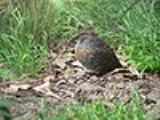
Cocos Buff-banded Rail

Encyclopedia
The Cocos Buff-banded Rail, Gallirallus philippensis andrewsi, is an endangered subspecies of the Buff-banded Rail
endemic to the Cocos (Keeling) Islands
, an Australian Offshore Territory in the central-eastern Indian Ocean
. The local Cocos Malay
name of the bird is Ayam Hutan ("Chicken of the Forest").
Island. It is still occasionally reported from the 26 islands comprising the Southern Atoll of the Cocos (Keeling) Islands, where it was once common, but recent surveys have failed to find it. It is apparently extinct throughout the Southern Atoll apart from occasional visits by birds dispersing from North Keeling, which are unable to establish viable populations.
On North Keeling the Rails occupy all the limited ground habitats on the island, including the shore of the lagoon and the understorey vegetation of Pisonia
forest and Coconut palms
.
Population size is estimated as 850-1000 birds, with a population density
of 7-8 birds/ha
.
for crustacean
s, molluscs, insect
s, worm
s, seeds, fruits, eggs
and carrion
, as well as scavenging
the refuse of the seabird breeding colonies.
on the islands of the Southern Atoll are habitat clearance
and predation
by introduced mammal
s, including feral cat
s, Black Rat
s and human
s, as well as competition with feral junglefowl
. Threats to the only remaining breeding population on North Keeling are the introduced Yellow Crazy Ant
, the possibility of accidental introduction of terrestrial predators, and the impact of cyclone
s and tsunami
s. North Keeling is entirely contained within the Pulu Keeling National Park, but the island is so small that reintroduction
of the Rail to one or more of the southern islands, after habitat preparation, is envisaged as a precautionary measure. The Cocos Buff-banded Rail is classified as Endangered under Australia's Environment Protection and Biodiversity Conservation Act 1999
.
As the only bird taxon endemic to the Territory, the Cocos Buff-banded Rail has featured frequently on postage stamp
s issued by the Australian Government for the Cocos (Keeling) Islands.
Buff-banded Rail
The Buff-banded Rail, Gallirallus philippensis is a distinctively coloured, highly dispersive, medium-sized rail of the family Rallidae....
endemic to the Cocos (Keeling) Islands
Cocos (Keeling) Islands
The Territory of the Cocos Islands, also called Cocos Islands and Keeling Islands, is a territory of Australia, located in the Indian Ocean, southwest of Christmas Island and approximately midway between Australia and Sri Lanka....
, an Australian Offshore Territory in the central-eastern Indian Ocean
Indian Ocean
The Indian Ocean is the third largest of the world's oceanic divisions, covering approximately 20% of the water on the Earth's surface. It is bounded on the north by the Indian Subcontinent and Arabian Peninsula ; on the west by eastern Africa; on the east by Indochina, the Sunda Islands, and...
. The local Cocos Malay
Cocos Malays
Cocos Malays are a community that form the predominant group of the Cocos Islands, which is now part of Australia. The Cocos Malays are originated from the descendants of Malay settlers from the British colonies of British Malaya, Singapore, Brunei and the Riau Archipelago of Dutch East Indies.The...
name of the bird is Ayam Hutan ("Chicken of the Forest").
Distribution and habitat
This bird is now effectively limited to the 1.2 km² North KeelingNorth Keeling
North Keeling is a small, uninhabited coral atoll of about 1.2 km2, about 25 km north of Horsburgh Island. It is the northernmost atoll and island of the Australian territory of the Cocos Islands...
Island. It is still occasionally reported from the 26 islands comprising the Southern Atoll of the Cocos (Keeling) Islands, where it was once common, but recent surveys have failed to find it. It is apparently extinct throughout the Southern Atoll apart from occasional visits by birds dispersing from North Keeling, which are unable to establish viable populations.
On North Keeling the Rails occupy all the limited ground habitats on the island, including the shore of the lagoon and the understorey vegetation of Pisonia
Pisonia
Pisonia is a genus of flowering plants in the four o'clock flower family, Nyctaginaceae. It was named for Dutch physician and naturalist Willem Piso . Certain species in this genus are known as Catchbirdtrees because their sticky seeds reportedly trap small birds...
forest and Coconut palms
Coconut
The coconut palm, Cocos nucifera, is a member of the family Arecaceae . It is the only accepted species in the genus Cocos. The term coconut can refer to the entire coconut palm, the seed, or the fruit, which is not a botanical nut. The spelling cocoanut is an old-fashioned form of the word...
.
Population size is estimated as 850-1000 birds, with a population density
Population density
Population density is a measurement of population per unit area or unit volume. It is frequently applied to living organisms, and particularly to humans...
of 7-8 birds/ha
Hectare
The hectare is a metric unit of area defined as 10,000 square metres , and primarily used in the measurement of land. In 1795, when the metric system was introduced, the are was defined as being 100 square metres and the hectare was thus 100 ares or 1/100 km2...
.
Diet
The Rails are omnivorous, foraging over the ground throughout the island and the intertidal fringe of the central lagoonLagoon
A lagoon is a body of shallow sea water or brackish water separated from the sea by some form of barrier. The EU's habitat directive defines lagoons as "expanses of shallow coastal salt water, of varying salinity or water volume, wholly or partially separated from the sea by sand banks or shingle,...
for crustacean
Crustacean
Crustaceans form a very large group of arthropods, usually treated as a subphylum, which includes such familiar animals as crabs, lobsters, crayfish, shrimp, krill and barnacles. The 50,000 described species range in size from Stygotantulus stocki at , to the Japanese spider crab with a leg span...
s, molluscs, insect
Insect
Insects are a class of living creatures within the arthropods that have a chitinous exoskeleton, a three-part body , three pairs of jointed legs, compound eyes, and two antennae...
s, worm
Worm
The term worm refers to an obsolete taxon used by Carolus Linnaeus and Jean-Baptiste Lamarck for all non-arthropod invertebrate animals, and stems from the Old English word wyrm. Currently it is used to describe many different distantly-related animals that typically have a long cylindrical...
s, seeds, fruits, eggs
Egg (biology)
An egg is an organic vessel in which an embryo first begins to develop. In most birds, reptiles, insects, molluscs, fish, and monotremes, an egg is the zygote, resulting from fertilization of the ovum, which is expelled from the body and permitted to develop outside the body until the developing...
and carrion
Carrion
Carrion refers to the carcass of a dead animal. Carrion is an important food source for large carnivores and omnivores in most ecosystems. Examples of carrion-eaters include vultures, hawks, eagles, hyenas, Virginia Opossum, Tasmanian Devils, coyotes, Komodo dragons, and burying beetles...
, as well as scavenging
Scavenger
Scavenging is both a carnivorous and herbivorous feeding behavior in which individual scavengers search out dead animal and dead plant biomass on which to feed. The eating of carrion from the same species is referred to as cannibalism. Scavengers play an important role in the ecosystem by...
the refuse of the seabird breeding colonies.
Conservation
The probable causes of extinctionExtinction
In biology and ecology, extinction is the end of an organism or of a group of organisms , normally a species. The moment of extinction is generally considered to be the death of the last individual of the species, although the capacity to breed and recover may have been lost before this point...
on the islands of the Southern Atoll are habitat clearance
Habitat destruction
Habitat destruction is the process in which natural habitat is rendered functionally unable to support the species present. In this process, the organisms that previously used the site are displaced or destroyed, reducing biodiversity. Habitat destruction by human activity mainly for the purpose of...
and predation
Predation
In ecology, predation describes a biological interaction where a predator feeds on its prey . Predators may or may not kill their prey prior to feeding on them, but the act of predation always results in the death of its prey and the eventual absorption of the prey's tissue through consumption...
by introduced mammal
Mammal
Mammals are members of a class of air-breathing vertebrate animals characterised by the possession of endothermy, hair, three middle ear bones, and mammary glands functional in mothers with young...
s, including feral cat
Feral cat
A feral cat is a descendant of a domesticated cat that has returned to the wild. It is distinguished from a stray cat, which is a pet cat that has been lost or abandoned, while feral cats are born in the wild; the offspring of a stray cat can be considered feral if born in the wild.In many parts of...
s, Black Rat
Black Rat
The black rat is a common long-tailed rodent of the genus Rattus in the subfamily Murinae . The species originated in tropical Asia and spread through the Near East in Roman times before reaching Europe by the 1st century and spreading with Europeans across the world.-Taxonomy:The black rat was...
s and human
Human
Humans are the only living species in the Homo genus...
s, as well as competition with feral junglefowl
Junglefowl
Junglefowl are the four living species of bird from the genus Gallus in the Gallinaceous bird order, which occur in India, Sri Lanka, Southeast Asia and Indonesia....
. Threats to the only remaining breeding population on North Keeling are the introduced Yellow Crazy Ant
Yellow crazy ant
The yellow crazy ant is a species of ant, introduced accidentally to northern Australia and Christmas Island in the Indian Ocean, that has wreaked ecological damage in both locations....
, the possibility of accidental introduction of terrestrial predators, and the impact of cyclone
Cyclone
In meteorology, a cyclone is an area of closed, circular fluid motion rotating in the same direction as the Earth. This is usually characterized by inward spiraling winds that rotate anticlockwise in the Northern Hemisphere and clockwise in the Southern Hemisphere of the Earth. Most large-scale...
s and tsunami
Tsunami
A tsunami is a series of water waves caused by the displacement of a large volume of a body of water, typically an ocean or a large lake...
s. North Keeling is entirely contained within the Pulu Keeling National Park, but the island is so small that reintroduction
Reintroduction
Reintroduction is the deliberate release of a species into the wild in zones formerly inhabited by said species but where it has disappeared from for a number of reasons, from captivity or relocated from other areas where the species still survives in...
of the Rail to one or more of the southern islands, after habitat preparation, is envisaged as a precautionary measure. The Cocos Buff-banded Rail is classified as Endangered under Australia's Environment Protection and Biodiversity Conservation Act 1999
Environment Protection and Biodiversity Conservation Act 1999
The Environment Protection and Biodiversity Conservation Act 1999 is an Act of the Parliament of Australia that provides a framework for protection of the Australian environment, including its biodiversity and its natural and culturally significant places...
.
As the only bird taxon endemic to the Territory, the Cocos Buff-banded Rail has featured frequently on postage stamp
Postage stamp
A postage stamp is a small piece of paper that is purchased and displayed on an item of mail as evidence of payment of postage. Typically, stamps are made from special paper, with a national designation and denomination on the face, and a gum adhesive on the reverse side...
s issued by the Australian Government for the Cocos (Keeling) Islands.