


Chellah

Encyclopedia
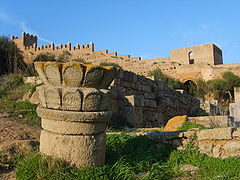
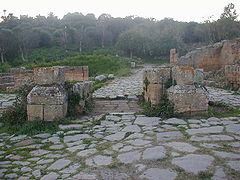
Necropolis
A necropolis is a large cemetery or burial ground, usually including structural tombs. The word comes from the Greek νεκρόπολις - nekropolis, literally meaning "city of the dead"...
and complex of ancient Roman Mauretania Tingitana
Mauretania Tingitana
Mauretania Tingitana was a Roman province located in northwestern Africa, coinciding roughly with the northern part of present-day Morocco. The province extended from the northern peninsula, opposite Gibraltar, to Chellah and Volubilis to the south, and as far east as the Oued Laou river. Its...
and medieval ruins
Ruins
Ruins are the remains of human-made architecture: structures that were once complete, as time went by, have fallen into a state of partial or complete disrepair, due to lack of maintenance or deliberate acts of destruction...
at Rabat
Rabat
Rabat , is the capital and third largest city of the Kingdom of Morocco with a population of approximately 650,000...
, Morocco
Morocco
Morocco , officially the Kingdom of Morocco , is a country located in North Africa. It has a population of more than 32 million and an area of 710,850 km², and also primarily administers the disputed region of the Western Sahara...
. It is the most ancient human settlement on the mouth
River delta
A delta is a landform that is formed at the mouth of a river where that river flows into an ocean, sea, estuary, lake, reservoir, flat arid area, or another river. Deltas are formed from the deposition of the sediment carried by the river as the flow leaves the mouth of the river...
of the Bou Regreg
Bou Regreg
The Bou Regreg is a river located in western Morocco which discharges to the Atlantic Ocean between the cities of Rabat and Salé. The estuary of this river is termed Wadi Sala....
River.
History
The PhoeniciaPhoenicia
Phoenicia , was an ancient civilization in Canaan which covered most of the western, coastal part of the Fertile Crescent. Several major Phoenician cities were built on the coastline of the Mediterranean. It was an enterprising maritime trading culture that spread across the Mediterranean from 1550...
ns and the Carthaginians
Carthage
Carthage , implying it was a 'new Tyre') is a major urban centre that has existed for nearly 3,000 years on the Gulf of Tunis, developing from a Phoenician colony of the 1st millennium BC...
, who founded several colonies in Morocco, probably inhabited the banks of the Bou Regreg. Chellah is the site of the ruins of the Roman
Ancient Rome
Ancient Rome was a thriving civilization that grew on the Italian Peninsula as early as the 8th century BC. Located along the Mediterranean Sea and centered on the city of Rome, it expanded to one of the largest empires in the ancient world....
town known as Sala Colonia, referred to as Sala by Ptolemy
Ptolemy
Claudius Ptolemy , was a Roman citizen of Egypt who wrote in Greek. He was a mathematician, astronomer, geographer, astrologer, and poet of a single epigram in the Greek Anthology. He lived in Egypt under Roman rule, and is believed to have been born in the town of Ptolemais Hermiou in the...
. Excavations show an important port city with ruined Roman architectural elements including a decumanus maximus
Decumanus Maximus
In Roman city planning, a decumanus was an east-west-oriented road in a Roman city, castra , or colonia. The main decumanus was the Decumanus Maximus, which normally connected the Porta Praetoria to the Porta Decumana .This name comes from the fact that the via decumana or decimana In Roman city...
or principal Roman way, a forum
Forum (Roman)
A forum was a public square in a Roman municipium, or any civitas, reserved primarily for the vending of goods; i.e., a marketplace, along with the buildings used for shops and the stoas used for open stalls...
and a triumphal arch
Arch
An arch is a structure that spans a space and supports a load. Arches appeared as early as the 2nd millennium BC in Mesopotamian brick architecture and their systematic use started with the Ancient Romans who were the first to apply the technique to a wide range of structures.-Technical aspects:The...
.
One of the two main Roman roads in Morocco
Roman roads in Morocco
Roman roads in Morocco were the western roads of Roman Africa.-Characteristics:In 42 AD the western part of the kingdom of Mauretania was reorganized as a province of Rome Mauretania Tingitana...
reached the Atlantic through Iulia Constantia Zilil
Iulia Constantia Zilil
Iulia Constantia Zilil was one of the three colonias in Mauretania Tingitana founded by emperor Augustus between 33 and 25 BC for veterans of the battle of Actium. The city had then already been a Phoenician and Mauretanian city since the 4th century BC...
(Asilah), Lixus
Lixus (ancient city)
Lixus is the site of an ancient city located in Morocco just north of the modern seaport of Larache on the bank of the Loukkos River. The location was one of the main cities of the Roman province Mauretania Tingitana.-Geography:...
(Larache) and Sala Colonia. Another may have been built toward south, from Sala Colonia to modern Casablanca
Casablanca
Casablanca is a city in western Morocco, located on the Atlantic Ocean. It is the capital of the Grand Casablanca region.Casablanca is Morocco's largest city as well as its chief port. It is also the biggest city in the Maghreb. The 2004 census recorded a population of 2,949,805 in the prefecture...
, then called Anfa
Anfa
Anfa is the area which is today Casablanca, Morocco. It was originally settled by Berbers in the 7th century. The area, which they named Anfa, became a small, independent kingdom, which rejected the muslim rule that surrounded it until it was conquered by the Almoravids in 1068.From the 14th...
. The Romans had two main naval ouposts on the Atlantic: Sala near modern Rabat and Mogador in north of Agadir
Agadir
Agadir is a major city in southwest Morocco, capital of the Agadir province and the Sous-Massa-Draa economic region .-Etymology:...
. Roman expeditions sailed from there to find the Canary islands
Canary Islands
The Canary Islands , also known as the Canaries , is a Spanish archipelago located just off the northwest coast of mainland Africa, 100 km west of the border between Morocco and the Western Sahara. The Canaries are a Spanish autonomous community and an outermost region of the European Union...
.
The site was abandoned in 1154 in favour of nearby Salé
Salé
Salé is a city in north-western Morocco, on the right bank of the Bou Regreg river, opposite the national capital Rabat, for which it serves as a commuter town...
. The Almohad dynasty used the ghost town
Ghost town
A ghost town is an abandoned town or city. A town often becomes a ghost town because the economic activity that supported it has failed, or due to natural or human-caused disasters such as floods, government actions, uncontrolled lawlessness, war, or nuclear disasters...
as a necropolis
Necropolis
A necropolis is a large cemetery or burial ground, usually including structural tombs. The word comes from the Greek νεκρόπολις - nekropolis, literally meaning "city of the dead"...
. In the mid-14th century, a Merinid
Marinid
The Marinid dynasty or Benemerine dynasty was a Zenata Berber dynasty of Morocco. The Marinid dynasty overtook the Almohads in controlling Morocco in 1244. They controlled most of the Maghreb from the mid-14th century to the 15th century and supported the Kingdom of Granada in Al-Andalus in the...
sultan, Abu l-Hasan, built monuments and the main gate, dated to 1339. These later Merinid additions included a mosque
Mosque
A mosque is a place of worship for followers of Islam. The word is likely to have entered the English language through French , from Portuguese , from Spanish , and from Berber , ultimately originating in — . The Arabic word masjid literally means a place of prostration...
, a zawiya, and royal tomb
Tomb
A tomb is a repository for the remains of the dead. It is generally any structurally enclosed interment space or burial chamber, of varying sizes...
s, including that of Abu l-Hasan.
Many structures in Chellah were damaged by the 1755 Lisbon earthquake. The site has been converted to a garden and tourist venue.
Festival of Jazz
After 2005, the ruins of Chella host an international "Festival of Jazz" each year, called Jazz au Chellah.See also
- Mauretania TingitanaMauretania TingitanaMauretania Tingitana was a Roman province located in northwestern Africa, coinciding roughly with the northern part of present-day Morocco. The province extended from the northern peninsula, opposite Gibraltar, to Chellah and Volubilis to the south, and as far east as the Oued Laou river. Its...
- VolubilisVolubilisVolubilis is an archaeological site in Morocco situated near Meknes between Fez and Rabat along the N13 road. The nearest town is Moulay Idriss. Volubilis features the best preserved Roman ruins in this part of northern Africa...
- Roman roads in MoroccoRoman roads in MoroccoRoman roads in Morocco were the western roads of Roman Africa.-Characteristics:In 42 AD the western part of the kingdom of Mauretania was reorganized as a province of Rome Mauretania Tingitana...
- Roman expeditions to Sub-Saharan Africa