

Cedar-Riverside, Minneapolis

Encyclopedia
The Cedar-Riverside, also referred to as the West Bank, is a neighborhood within Minneapolis, Minnesota
Minneapolis, Minnesota
Minneapolis , nicknamed "City of Lakes" and the "Mill City," is the county seat of Hennepin County, the largest city in the U.S. state of Minnesota, and the 48th largest in the United States...
. The boundaries of the neighborhood are the Mississippi River
Mississippi River
The Mississippi River is the largest river system in North America. Flowing entirely in the United States, this river rises in western Minnesota and meanders slowly southwards for to the Mississippi River Delta at the Gulf of Mexico. With its many tributaries, the Mississippi's watershed drains...
to the north and east, Interstate 94
Interstate 94
Interstate 94 is the northernmost east–west Interstate Highway, connecting the Great Lakes and Intermountain regions of the United States. I-94's western terminus is in Billings, Montana at a junction with Interstate 90; its eastern terminus is the U.S...
to the south, and Hiawatha Avenue and Interstate 35W
Interstate 35W (Minnesota)
Interstate 35W , is an Interstate Highway in the U.S. state of Minnesota, passing through downtown Minneapolis. It is one of two through routes for Interstate 35 through the Twin Cities of Minneapolis and Saint Paul, the other being Interstate 35E through downtown Saint Paul...
to the west. Cedar-Riverside is one of the most diverse neighborhoods in the Twin Cities—in close proximity, there are urban poor of diverse ethnic backgrounds, college students, and middle-class urbanites.
The neighborhood is part of the University community
University, Minneapolis
University is a community in Minneapolis. It is composed of six smaller neighborhoods. It also contains the University of Minnesota campus and the Mid-City Industrial Area, which isn't assigned to an official neighborhood....
, and is dominated by the West Bank campus of the University of Minnesota
University of Minnesota
The University of Minnesota, Twin Cities is a public research university located in Minneapolis and St. Paul, Minnesota, United States. It is the oldest and largest part of the University of Minnesota system and has the fourth-largest main campus student body in the United States, with 52,557...
's Minneapolis campus, which includes the Law School
University of Minnesota Law School
The University of Minnesota Law School, located in Minneapolis, Minnesota, USA, is a professional school of the University of Minnesota. The school offers a Juris Doctor , Masters of Law for Foreign Lawyers, and joint degrees with J.D./M.B.A., J.D./M.P.A, J.D./M.A., J.D./M.S., J.D./Ph.D.,...
, Carlson School of Management
Carlson School of Management
The school offers a bachelor's, MBA, and doctoral degrees, as well as executive education programs hosted domestically and abroad . Dual-degree programs include a JD/MBA, MD/MBA, MHA/MBA, and a MPP/MBA...
, Hubert H. Humphrey Institute of Public Affairs Humphrey Institute and West Bank Arts Quarter. The two halves of the U of M are connected by the Washington Avenue Bridge
Washington Avenue Bridge (Minneapolis)
The Washington Avenue Bridge carries County Road 122 across the Mississippi River in Minneapolis, Minnesota and connects the East Bank and West Bank portions of the University of Minnesota's main campus...
. The acquisition of a number of residential blocks by the University for expansion of the West Bank campus was controversial in the 1960s.
The neighborhood also features Augsburg College
Augsburg College
Augsburg College is a selective liberal arts college of the Evangelical Lutheran Church in America located in Minneapolis, Minnesota. Augsburg was named for the Augsburg Confession, the document of Lutheran belief. The school was founded in 1869 in Marshall, Wisconsin as Augsburg Seminary and moved...
, a private liberal arts college
Liberal arts college
A liberal arts college is one with a primary emphasis on undergraduate study in the liberal arts and sciences.Students in the liberal arts generally major in a particular discipline while receiving exposure to a wide range of academic subjects, including sciences as well as the traditional...
and the College of St. Catherine
College of St. Catherine
St. Catherine University is a private Catholic university for women located in Saint Paul, Minnesota, United States. There is also a campus in Minneapolis. Enrollment is 5,246 students. With approximately 2,900 bachelor's students, it is the largest university for women in the United States. Its...
’s Minneapolis campus.
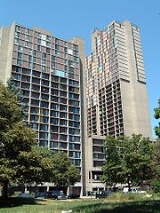
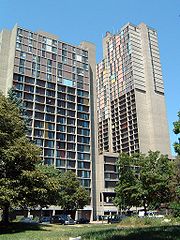
Cedar-Riverside is ethnically diverse, due in large part to the presence of the Riverside Plaza
Riverside Plaza
Riverside Plaza is a modernist and brutalist apartment complex designed by Ralph Rapson that opened in Minneapolis, Minnesota in 1973. Situated on the edge of downtown Minneapolis in the Cedar-Riverside neighborhood, and next to the University of Minnesota's West Bank, the site contains the...
and its 1,300 units. The Riverside Plaza is home to between 2,500 and 3,500 people, many of whom are immigrants. Currently, most immigrants in the neighborhood come from Northeast Africa
Horn of Africa
The Horn of Africa is a peninsula in East Africa that juts hundreds of kilometers into the Arabian Sea and lies along the southern side of the Gulf of Aden. It is the easternmost projection of the African continent...
. The high number of Somali
Somali people
Somalis are an ethnic group located in the Horn of Africa, also known as the Somali Peninsula. The overwhelming majority of Somalis speak the Somali language, which is part of the Cushitic branch of the Afro-Asiatic language family...
immigrants, in particular, has earned the neighborhood the nickname of "Little Somalia
Little Somalia
Little Somalia is a popular nickname for Minneapolis, Minnesota's Cedar-Riverside neighborhood due to the area's large Somali community. The expression was first coined by architect Ralph Rapson specifically with regard to the Riverside Plaza towers, the area's most distinguishable tower complex,...
" or "Little Mogadishu
Mogadishu
Mogadishu , popularly known as Xamar, is the largest city in Somalia and the nation's capital. Located in the coastal Benadir region on the Indian Ocean, the city has served as an important port for centuries....
." Northeast Africans are the latest wave of foreign-born residents, following the Europeans of a century earlier, and the Vietnamese
Vietnamese people
The Vietnamese people are an ethnic group originating from present-day northern Vietnam and southern China. They are the majority ethnic group of Vietnam, comprising 86% of the population as of the 1999 census, and are officially known as Kinh to distinguish them from other ethnic groups in Vietnam...
and other Asians of just twenty years back.
According to census data for 2000 from the City of Minneapolis, over 50% of the families in the neighborhood are considered very low income, and over 60% are low income. Residents of Cedar-Riverside are transitional; out of the 2,838 occupied housing units in the neighborhood, 2,547 are occupied by renters.
Many maps identify the area as the West Bank Theater District because of the many theaters in the area. The neighborhood is well known for its contingent of activists - from the housing co-op organizing in the 60's, anti-Vietnam war organizing, and the worker-owned co-op
Worker cooperative
A worker cooperative is a cooperative owned and democratically managed by its worker-owners. This control may be exercised in a number of ways. A cooperative enterprise may mean a firm where every worker-owner participates in decision making in a democratic fashion, or it may refer to one in which...
organizing from the 70's until today.
History
Germans
The Germans are a Germanic ethnic group native to Central Europe. The English term Germans has referred to the German-speaking population of the Holy Roman Empire since the Late Middle Ages....
, and Bohemians began arriving in large numbers during the late 19th century. The neighborhood has long struggled with poverty and crime and was home base to local hippies, protesters, and other counterculture
Counterculture of the 1960s
The counterculture of the 1960s refers to a cultural movement that mainly developed in the United States and spread throughout much of the western world between 1960 and 1973. The movement gained momentum during the U.S. government's extensive military intervention in Vietnam...
phenomena of the 1960s and early 1970s. During those days, the neighborhood was known as the “Haight-Ashbury of the Midwest.”
The apartment complex at Riverside Plaza
Riverside Plaza
Riverside Plaza is a modernist and brutalist apartment complex designed by Ralph Rapson that opened in Minneapolis, Minnesota in 1973. Situated on the edge of downtown Minneapolis in the Cedar-Riverside neighborhood, and next to the University of Minnesota's West Bank, the site contains the...
was built in the early 1970s. The tall buildings with their signature colored panels are a Minneapolis landmark. Many of the businesses that started during that time — Martha’s Antiques, The Whale Leather Shop, The Five Corners Saloon, Richter’s Drug Store and Smith’s Leather Shop — have gone out of business, but The Depth of Field remains.
The neighborhood’s past still has an influence in the present. Some of the businesses in the area hark back to an earlier time, like the now closed worker-controlled North Country Food Co-op and the punk hangout, Hard Times Café
Hard Times Café
Hard Times Cafe is a collectively owned restaurant in the Cedar-Riverside neighborhood of Minneapolis, Minnesota that is cooperatively-owned by its workers. It is known for its punk and hippie ideology, its gritty ambiance, and its large selection of vegan and vegetarian food...
. In fact some of the businesses, specifically in the Seven Corners district, use the history to promote their own business, such as the "Legend of the Seven Switch-men...."
In the 1940s Cedar-Riverside was heavily Scandinavian. Postwar immigrants from all over Eastern Europe then settled in the area. The junction of Washington Avenue
Washington Avenue (Minneapolis)
Washington Avenue is a major thoroughfare in Minneapolis, Minnesota. Starting north of Lowry Avenue, the street runs straight south, with Interstate 94 running alongside it until just south of West Broadway, when the freeway turns to the west...
, Cedar Avenue, and 19th Avenue was known as Seven Corners. The Cedar-Riverside area had been known as "Snoose Boulevard" (Snusgatan) because so many Scandinavians lived there.
Cedar Avenue became a hub of the Minneapolis Scandinavian community in the late 19th century. Swedish, Norwegian, and Danish were spoken in many of the businesses, and in the early days, stars of Swedish American vaudeville entertained at Dania Hall, Mozart Hall and the Southern Theater
The Southern Theater
The Southern Theater is located in downtown Minneapolis, Minnesota. Built in 1910 as a cultural center and legitimate theater for the burgeoning Scandinavian community centered around Cedar Avenue , the Southern has had a rich and colorful past prior to re-establishing itself as a center for...
. Where men in the community once worked in small businesses, or as skilled tradesmen, and workers for the railroad, flour mills, and breweries, Cedar-Riverside declined as a core community in the 1920s due to the impact of Prohibition on the entertainment district.
There was Samuelsen’s confectionery and soda shop, Hagen's appliance store, Moberg’s Norwegian deli, and a host of other Scandinavian-owned businesses. On Cedar Avenue was Dania hall where the Danish community would meet. An eclectic mix of Gothic and classical styles, the building included a dining hall and kitchen in the basement, commercial space on the first floor, offices for the Society of Dania plus billiard and reading rooms on the second floor. A theater/assembly hall on the third and fourth floors featured Scandinavian vaudeville acts and weekend dances. On the corner next to Dania Hall was the Breezy Point Tavern owned by Oscar Carlsen, a Norwegian immigrant from the turn of the 20th century. Oscar had come to Minnesota working in the lumber camps.
The West Bank, with the locally infamous Seven Corners district, mouldered into a skid row scene in the 1950s, setting the stage for its next phase: in the mid-to-late 1960s, the area became the center of the University-oriented counterculture
Counterculture of the 1960s
The counterculture of the 1960s refers to a cultural movement that mainly developed in the United States and spread throughout much of the western world between 1960 and 1973. The movement gained momentum during the U.S. government's extensive military intervention in Vietnam...
and antiwar movement. A community of hippies — and numerous students and hangers-on who emulated the hippie lifestyle (at least on weekends) — lived in old rental houses in the area and congregated at coffeehouses, such as the Extemporé, The Scholar and the Broken Drum, and at bars, such as the Triangle Bar, the Viking, Caesar's, The Mixers and the Music Bar. (The latter burned down the night Robert Kennedy was assassinated, and eventually was replaced by a "people's park"). The Triangle often featured performers and recording artists Dave Ray, Tony Glover and John Koerner, who had associated to some degree with Bob Dylan during Dylan's brief Minneapolis sojourn.
The West Bank also was home to McCosh's secondhand book store, a center for Beat and Hippie left-leaning bookworms, and later Things, probably the first 'head' shop in the Twin Cities, which sold counterculture curios, antiwar buttons and posters, incense and drug paraphernalia. Marijuana, hashish and LSD were readily available from 'dealers' in the area after about 1967.
Fairview Hospital and St. Mary's Hospital figured prominently in the neighborhood, being only a few blocks away. Fairview and St. Mary's, which merged in 1986, later merged with the University of Minnesota Hospitals, forming a major medical complex straddling the Mississippi River. The organization is now known as University of Minnesota Medical Center
University of Minnesota Medical Center
The University of Minnesota Medical Center, Fairview is the main university hospital for the University of Minnesota Medical School. There are two campuses: one located on the East Bank of the Mississippi River, known as the University Campus, and the other located on the West Bank, known as the...
.
Art culture
Mixed Blood Theatre Company
The Mixed Blood Theatre Company is a professional multiracial theatre company in Minneapolis, Minnesota. It was founded in 1976 by artistic director Jack Reuler. Its core stated values are promoting cultural pluralism, individual equality, and artistic excellence.Its plays range from intimate...
, Bedlam Theater, Theatre in the Round
Theatre in the round
Theatre-in-the-round or arena theatre is any theatre space in which the audience surrounds the stage area...
, and the Southern Theater
The Southern Theater
The Southern Theater is located in downtown Minneapolis, Minnesota. Built in 1910 as a cultural center and legitimate theater for the burgeoning Scandinavian community centered around Cedar Avenue , the Southern has had a rich and colorful past prior to re-establishing itself as a center for...
). There is also a hot music scene, with bands frequenting current local bars like the 400 Bar, the Red Sea, The Acadia Cafe, Palmer's, the Triple Rock Social Club
Triple Rock Social Club
The Triple Rock Social Club is a bar, music venue, and restaurant in Minneapolis, Minnesota, USA, co-owned by Gretchen Funk and Erik Funk of the punk band Dillinger Four...
, and the Cedar Cultural Center
The Cedar Cultural Center
The Cedar Cultural Center is a music venue in Cedar-Riverside neighborhood of Minneapolis, Minnesota, United States. It is a non-profit organization and operated by volunteers.-External links:* **...
.
The West Bank music scene is also known as a catalyst for major musicians such as Bonnie Raitt
Bonnie Raitt
Bonnie Lynn Raitt is an American blues singer-songwriter and a renowned slide guitar player. During the 1970s, Raitt released a series of acclaimed roots-influenced albums which incorporated elements of blues, rock, folk and country, but she is perhaps best known for her more commercially...
, Leo Kottke
Leo Kottke
Leo Kottke is an acoustic guitarist. He is widely known for his innovative fingerpicking style, which draws on influences from blues, jazz, and folk music, and his syncopated, polyphonic melodies...
, Butch Thompson
Butch Thompson
Butch Thompson is an American jazz pianist and clarinetist best known for his ragtime and stride performances....
(Jazz Originals), Peter Ostroushko
Peter Ostroushko
Peter Ostroushko is an American violinist and mandolinist.-Background and career:Of Ukrainian ancestry, Ostroushko grew up in northeast Minneapolis...
(Prairie Home Companion), Dave "Snaker" Ray (Koerner, Ray & Glover
Koerner, Ray & Glover
Koerner, Ray & Glover is the name of a blues band from Minneapolis, Minnesota. The band featured Tony "Little Sun" Glover on harmonica, "Spider" John Koerner on guitar and vocals, and Dave "Snaker" Ray on guitar and vocals. Koerner, Ray & Glover were part of the early folk/blues explosion in the...
), Erik Anderson (The Wallets
The Wallets
The Wallets were a band from the Twin Cities, who recorded on the local Twin/Tone Records label in the 1980s.-History:The Wallets were founded as an experimental group by accordionist Steve Kramer and managed by Bob Hest....
), Sean Blackburn (Prairie Home Companion), Bill Hinkley (Minnesota Music Hall of Fame), and Karen Mueller (Autoharp Hall of Fame).
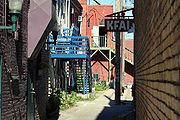
Many of these musicians also taught, performed and/or jammed at West Bank School of Music, a West Bank legacy since 1970. The Cedar Cultural Center, Cafe Extempore, Scholar Coffeehouse, Riverside Cafe, Viking Bar, 400 Bar, 7 Corners, Whisky Junction, Cabooze and also Cedarfest have all been popular music venues in their time. KFAI
KFAI
KFAI is a community radio station in Minnesota. The station broadcasts a wide variety of music, and also airs programming catering to many of the diverse ethnic groups of the region...
community radio (started in 1978) has also been a mainstay at Cedar-Riverside in the Bailey building since 1991.
The arts flavor of the area is enhanced by the presence of the University of Minnesota
University of Minnesota
The University of Minnesota, Twin Cities is a public research university located in Minneapolis and St. Paul, Minnesota, United States. It is the oldest and largest part of the University of Minnesota system and has the fourth-largest main campus student body in the United States, with 52,557...
’s West Bank Arts Quarter, which is home to the University’s arts programs. In fact, the University is the only in the nation with all of its arts disciplines located together in a single district.
Notable establishments
- Riverside Plaza
- KFAI Radio
- Radio K
- Fairview University Medical Center
- Cedar Cultural Center
- The Mixed Blood Theatre
- Southern Theater
- Theatre in the Round
- West Bank School of Music
- Bedlam Theater
- The Cedar
- The Electric FetusElectric FetusThe Electric Fetus is a record store with locations in Minneapolis, Duluth and St. Cloud in Minnesota. It was founded in June 1968 by partners Dan Foley and Ron Korsh. Minnesota Public Radio said of the Electric Fetus that it is "widely regarded as the pre-eminent indie record store in...
(1968 - 1972) - Hard Times CaféHard Times CaféHard Times Cafe is a collectively owned restaurant in the Cedar-Riverside neighborhood of Minneapolis, Minnesota that is cooperatively-owned by its workers. It is known for its punk and hippie ideology, its gritty ambiance, and its large selection of vegan and vegetarian food...
External links
- Minneapolis Neighborhood Profile - Cedar-Riverside
- Cedar-Riverside Business Association
- West Bank Community Coalition
- Cedar Riverside Neighbors Online Forum
- Cedar-Riverside Neighborhood Tour.
- Photos of Seven Corners at the Hennepin County LibraryHennepin County LibraryHennepin County Library is a library system serving the entire population of Hennepin County, Minnesota, USA. The Minneapolis Public Library, a separate system for Minneapolis, existed from its founding by T. B. Walker in 1885 until January 2008...
. - Photos of Samuelson's at the Minnesota Historical SocietyMinnesota Historical SocietyThe Minnesota Historical Society is a private, non-profit educational and cultural institution dedicated to preserving the history of the U.S. state of Minnesota. It was founded by the territorial legislature in 1849, almost a decade before statehood. The Society is named in the Minnesota...
. - Photos of Dania Hall at the Minnesota Historical SocietyMinnesota Historical SocietyThe Minnesota Historical Society is a private, non-profit educational and cultural institution dedicated to preserving the history of the U.S. state of Minnesota. It was founded by the territorial legislature in 1849, almost a decade before statehood. The Society is named in the Minnesota...
. - The Snoose Boulevard Festival
- West Bank Boogie by Cyn Collins. 2006 book about the Cedar-Riverside music scene.
See also
- Cedar-Riverside (Hiawatha Line station)Cedar-Riverside (Hiawatha Line station)Cedar–Riverside is a light rail station on the Hiawatha Line in Minneapolis, Minnesota. It is the sixth stop southbound.This station is located between 15th and 16th Avenues south, in Minneapolis. The station is near the interchange of Interstate 35W, Interstate 94 and Minnesota State Highway 55....
, light railLight railLight rail or light rail transit is a form of urban rail public transportation that generally has a lower capacity and lower speed than heavy rail and metro systems, but higher capacity and higher speed than traditional street-running tram systems...
station on the Hiawatha LineHiawatha LineThe Hiawatha Line is a light rail corridor in Hennepin County, Minnesota that extends from downtown Minneapolis to the southern suburb of Bloomington. It was formerly known as the Hiawatha Line named after Hiawatha Avenue. Major connections on the line include the Minneapolis-St...
.