

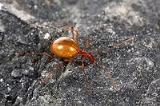
Cave insects

Encyclopedia
Caves are perhaps the most distinct and well-defined of insect
habitats. A number of insects are permanent habitual inhabitants of caves, characterized by marked specializations for the extreme conditions. These are the true cavernicole species. Most caverniculous insect species are severely restricted wholly to certain caves or occur in generally similar caves of the same region. Some cave insects such as grasshoppers
and Collembola are, however, rather widely distributed and may be found in caves in different areas. Most of these true cave dwellers have no closely related groups on the open ground. The caves appear to have become the last refugium
for many ancient types of insects, which are not found any more free in the open above ground in the region. The cave fauna
thus represent, at least in part, relicts. Cave insects, when suddenly exposed to the outside world, often succumb very rapidly.
True caverniculous species are found not only among insects but also in diverse other groups like planarians, Oligochaeta
, Polychaeta, leeches, Mollusca
, fish
, many Crustacea (such as Isopoda
, Amphipoda
, Syncardida, Decapoda, and Copepoda), predatory Chilopoda, mites
, opilionid
s, chermetids, spider
s, etc. Insects are of course very abundant and range from Campodea
and numerous Collembola to Carabidae, Silphidae, Curculionidae
, some Orthoptera
, blattids
, Trichoptera
and Diptera
.
condition changes but very little. Communications with the outside world are on the whole minimum. The river flowing or water seeping in from the outside insures regular quantities of nutritive
material. The bat
s that feed outside but sleep in the cave likewise provide massive deposits of organic matter by way of fecal droppings and dead bodies. In addition to bats, a variety of other animals penetrate caves for sleeping or for over-wintering: butterflies, flies
and other insects, bear
s, hyena
s, and even humans. The cave environment is thus recognized largely by negative characteristics, viz. absence of light, lack of rhythm of day and night and of seasons, scarcity of available food, limitation of living space, restricted freedom of movements, absence of contrast, absence of marked changes in temperature and humidity.
The ultimate source of food for all cave animals lies naturally outside the cave. Rivers carry in cadavers and other organic debris. Fungi which develop on this detritus
provide food for many cave dwellers. Bat guano
represents another source. Lepidoptera
that enter caves for sleeping are preyed upon by cave grasshoppers. The caverniculous Collembola feed on colloidal matter on the water. The Collembola and cave beetle
s are devoured by spiders and myriapods. All these activities go on in total darkness.
s, especially the antennae
, as compensation for loss of eyes. There is also increase and elongation of sensory setae, as for example, in the beetle Scotoplanetes arenstorffianus from Herzegovina
. In contrast, none of the free-living related carabids have such sensory setae on the elytra. True cave insects are generally all characterized by wing reduction. Among the cave beetles the hind wings are reduced or even lost.
The general appearance and attitude of body of cave insects often differ conspicuously from those of free-living relatives. This is particularly observed in Silphidae, through nearly every other cave insect also exhibits this peculiarity. All these are evidence not of selection, as commonly assumed, but of direct functional adaptation and correlation to the immediate environment.
Among the troglobionts insects the most important include Coleoptera, Stenopelmatidae and some Diptera (many of which are perhaps only troglophiles). Nearlly all other insects found in caves are perhaps only trogloxene. The troglobiont grasshoppers of Europe belong to Dolichopoda
and Troglophilus. These species are completely apterous, but are provided with well-developed and pigmented compound eyes. The legs and antennae are markedly elongate as in Dolichopoda. Numerous Carabidae are true caverniculous forms.
On the other hand the conspicuously microphthalmous staphylinids Glyptomerus cavicola, Atheta absoloni, Colydiidae Anommatus titanus, Curculionidae Troglorrhynchus and Absoloniella, some blind carabids, staphylinids and Bathysciinae found commonly in caves in Europe, are really only troglophiles. All true troglobionts are apterous, yellowish-brown or pale reddish-brown, with eyes mostly atrophied or absent. Two European aquatic beetles, Dytiscus balsetensis and Hydroporus aveniovensis, are pale yellowish-brown and with eyes greatly atrophied and unpigmented.
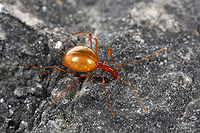 Some important cave insects from Europe include the following: Paraoalyscia wollastoni, Bathysciola fauveli, Trechus (Trichaphaenops) sollandi, Royerella villaridi, Trechus (Trichaphaenops) angulipennis, Trechus (Duvalius) pilosellus stobieckii, etc. The beetle Leptodirus hochenwartii
, found in the Postojna cave
system in Slovenia
, was the first animal to be recognized as a true cave dweller.
The cave insects found in the Atlas Mountains
include blind Trechus jurijurae, Aphaenops iblis, Nebria nudicollis with very long antennae and legs, the staphylinids Paraleptusa cavatica and Apterophaenops longiceps, and the curculionid Troglorrhynchus mairei. The carabid Laemostenus fezzensis is a troglophile. Neaphaenops tellkampfi occurs in caves in Kentucky
. The American stenopelmatid Hadenoecus subterraneus is recorded from Kentucky caves. The remarkable carabid Comstockia subterranea is a true cave species found in Texas
. The exclusively cave-dwelling silphid Adelops hirtus occurs in Kentucky caves and has very minute, unpigmented, atrophied eyes.
Insect
Insects are a class of living creatures within the arthropods that have a chitinous exoskeleton, a three-part body , three pairs of jointed legs, compound eyes, and two antennae...
habitats. A number of insects are permanent habitual inhabitants of caves, characterized by marked specializations for the extreme conditions. These are the true cavernicole species. Most caverniculous insect species are severely restricted wholly to certain caves or occur in generally similar caves of the same region. Some cave insects such as grasshoppers
Grasshoppers
Grasshoppers are insects of the suborder Caelifera.Grasshoppers may also refer to:* Grasshopper , a Hong Kong-based musical group* Grasshopper Club Zürich, a Swiss football club...
and Collembola are, however, rather widely distributed and may be found in caves in different areas. Most of these true cave dwellers have no closely related groups on the open ground. The caves appear to have become the last refugium
Refugium
Refugium may refer to:* Refugium , an appendage to a marine, brackish, or freshwater fish tank that shares the same water supply...
for many ancient types of insects, which are not found any more free in the open above ground in the region. The cave fauna
Fauna
Fauna or faunæ is all of the animal life of any particular region or time. The corresponding term for plants is flora.Zoologists and paleontologists use fauna to refer to a typical collection of animals found in a specific time or place, e.g. the "Sonoran Desert fauna" or the "Burgess shale fauna"...
thus represent, at least in part, relicts. Cave insects, when suddenly exposed to the outside world, often succumb very rapidly.
True caverniculous species are found not only among insects but also in diverse other groups like planarians, Oligochaeta
Oligochaeta
Oligochaeta is a subclass of animals in the biological phylum Annelida, which is made up of many types of aquatic and terrestrial worms, and this includes all of the various earthworms...
, Polychaeta, leeches, Mollusca
Mollusca
The Mollusca , common name molluscs or mollusksSpelled mollusks in the USA, see reasons given in Rosenberg's ; for the spelling mollusc see the reasons given by , is a large phylum of invertebrate animals. There are around 85,000 recognized extant species of molluscs. Mollusca is the largest...
, fish
Fish
Fish are a paraphyletic group of organisms that consist of all gill-bearing aquatic vertebrate animals that lack limbs with digits. Included in this definition are the living hagfish, lampreys, and cartilaginous and bony fish, as well as various extinct related groups...
, many Crustacea (such as Isopoda
Isopoda
Isopods are an order of peracarid crustaceans, including familiar animals such as woodlice and pill bugs. The name Isopoda derives from the Greek roots and...
, Amphipoda
Amphipoda
Amphipoda is an order of malacostracan crustaceans with no carapace and generally with laterally compressed bodies. The name amphipoda means "different-footed", and refers to the different forms of appendages, unlike isopods, where all the legs are alike. Of the 7,000 species, 5,500 are classified...
, Syncardida, Decapoda, and Copepoda), predatory Chilopoda, mites
MITES
MITES, or Minority Introduction to Engineering and Science, is a highly selective six-week summer program for rising high school seniors held at the Massachusetts Institute of Technology. Its purpose is to expose students from minority, or otherwise disadvantaged backgrounds, to the fields of...
, opilionid
Opiliones
Opiliones are an order of arachnids commonly known as harvestmen. , over 6,400 species of harvestmen have been discovered worldwide, although the real number of extant species may exceed 10,000. The order Opiliones can be divided into four suborders: Cyphophthalmi, Eupnoi, Dyspnoi and Laniatores...
s, chermetids, spider
Spider
Spiders are air-breathing arthropods that have eight legs, and chelicerae with fangs that inject venom. They are the largest order of arachnids and rank seventh in total species diversity among all other groups of organisms...
s, etc. Insects are of course very abundant and range from Campodea
Campodea
Campodea is a genus of small, white, bristle-tailed arthropods in the order Diplura. The best known species, Campodea staphylinus, has a wide distribution across much of Europe...
and numerous Collembola to Carabidae, Silphidae, Curculionidae
Curculionidae
Curculionidae is the family of the "true" weevils . It was formerly recognized in 1998 as the largest of any animal family, with over 40,000 species described worldwide at that time...
, some Orthoptera
Orthoptera
Orthoptera is an order of insects with paurometabolous or incomplete metamorphosis, including the grasshoppers, crickets and locusts.Many insects in this order produce sound by rubbing their wings against each other or their legs, the wings or legs containing rows of corrugated bumps...
, blattids
Blattidae
The Blattidae is a family of the order Blattaria . It contains several of the most common household cockroaches.-Selected species:*Oriental cockroach *American cockroach...
, Trichoptera
Trichoptera
The caddisflies are an order, Trichoptera, of insects with approximately 12,000 described species. Also called sedge-flies or rail-flies, they are small moth-like insects having two pairs of hairy membranous wings...
and Diptera
Diptera
Diptera , or true flies, is the order of insects possessing only a single pair of wings on the mesothorax; the metathorax bears a pair of drumstick like structures called the halteres, the remnants of the hind wings. It is a large order, containing an estimated 240,000 species, although under half...
.
The cave environment
The general climate in a cave is remarkably unvaried and without distinction of day and night. The differences between summer and winter conditions are also greatly moderated. Violent winds and storms are unknown, though there are steady air currents. The humidityHumidity
Humidity is a term for the amount of water vapor in the air, and can refer to any one of several measurements of humidity. Formally, humid air is not "moist air" but a mixture of water vapor and other constituents of air, and humidity is defined in terms of the water content of this mixture,...
condition changes but very little. Communications with the outside world are on the whole minimum. The river flowing or water seeping in from the outside insures regular quantities of nutritive
Nutrition
Nutrition is the provision, to cells and organisms, of the materials necessary to support life. Many common health problems can be prevented or alleviated with a healthy diet....
material. The bat
Bat
Bats are mammals of the order Chiroptera "hand" and pteron "wing") whose forelimbs form webbed wings, making them the only mammals naturally capable of true and sustained flight. By contrast, other mammals said to fly, such as flying squirrels, gliding possums, and colugos, glide rather than fly,...
s that feed outside but sleep in the cave likewise provide massive deposits of organic matter by way of fecal droppings and dead bodies. In addition to bats, a variety of other animals penetrate caves for sleeping or for over-wintering: butterflies, flies
Fließ
Fließ is a municipality in the Landeck district and is located5 km south of Landeck on the upper course of the Inn River. It has 9 hamlets and was already populated at the roman age; the village itself was founded around the 6th century. After a conflagration in 1933 Fließ was restored more...
and other insects, bear
Bear
Bears are mammals of the family Ursidae. Bears are classified as caniforms, or doglike carnivorans, with the pinnipeds being their closest living relatives. Although there are only eight living species of bear, they are widespread, appearing in a wide variety of habitats throughout the Northern...
s, hyena
Hyena
Hyenas or Hyaenas are the animals of the family Hyaenidae of suborder feliforms of the Carnivora. It is the fourth smallest biological family in the Carnivora , and one of the smallest in the mammalia...
s, and even humans. The cave environment is thus recognized largely by negative characteristics, viz. absence of light, lack of rhythm of day and night and of seasons, scarcity of available food, limitation of living space, restricted freedom of movements, absence of contrast, absence of marked changes in temperature and humidity.
The ultimate source of food for all cave animals lies naturally outside the cave. Rivers carry in cadavers and other organic debris. Fungi which develop on this detritus
Detritus
Detritus is a biological term used to describe dead or waste organic material.Detritus may also refer to:* Detritus , a geological term used to describe the particles of rock produced by weathering...
provide food for many cave dwellers. Bat guano
Guano
Guano is the excrement of seabirds, cave dwelling bats, and seals. Guano manure is an effective fertilizer due to its high levels of phosphorus and nitrogen and also its lack of odor. It was an important source of nitrates for gunpowder...
represents another source. Lepidoptera
Lepidoptera
Lepidoptera is a large order of insects that includes moths and butterflies . It is one of the most widespread and widely recognizable insect orders in the world, encompassing moths and the three superfamilies of butterflies, skipper butterflies, and moth-butterflies...
that enter caves for sleeping are preyed upon by cave grasshoppers. The caverniculous Collembola feed on colloidal matter on the water. The Collembola and cave beetle
Beetle
Coleoptera is an order of insects commonly called beetles. The word "coleoptera" is from the Greek , koleos, "sheath"; and , pteron, "wing", thus "sheathed wing". Coleoptera contains more species than any other order, constituting almost 25% of all known life-forms...
s are devoured by spiders and myriapods. All these activities go on in total darkness.
Evolutionary characteristics
In individual caves not all the numerous cavernicol insects, the most conspicuous and perhaps also universally met with peculiarity is the reduction in body pigmentation. This is particularly marked in Coleoptera. The reduction or total loss body pigmentation are without doubt correlated with the absence of sunlight. This is demonstrated by the fact that all these unpigmented cave beetles readily develop the characteristic pigment when they are exposed to sunlight. A second peculiarity is the more or less pronounced reduction of eyes in all caverniculous species. Nearly all cave insects are characterized by an abnormal elongation of appendageAppendage
In invertebrate biology, an appendage is an external body part, or natural prolongation, that protrudes from an organism's body . It is a general term that covers any of the homologous body parts that may extend from a body segment...
s, especially the antennae
Antenna (biology)
Antennae in biology have historically been paired appendages used for sensing in arthropods. More recently, the term has also been applied to cilium structures present in most cell types of eukaryotes....
, as compensation for loss of eyes. There is also increase and elongation of sensory setae, as for example, in the beetle Scotoplanetes arenstorffianus from Herzegovina
Herzegovina
Herzegovina is the southern region of Bosnia and Herzegovina. While there is no official border distinguishing it from the Bosnian region, it is generally accepted that the borders of the region are Croatia to the west, Montenegro to the south, the canton boundaries of the Herzegovina-Neretva...
. In contrast, none of the free-living related carabids have such sensory setae on the elytra. True cave insects are generally all characterized by wing reduction. Among the cave beetles the hind wings are reduced or even lost.
The general appearance and attitude of body of cave insects often differ conspicuously from those of free-living relatives. This is particularly observed in Silphidae, through nearly every other cave insect also exhibits this peculiarity. All these are evidence not of selection, as commonly assumed, but of direct functional adaptation and correlation to the immediate environment.
Categorization of cave dwellers
The cave dwellers fall under one of the following categories:- Troglobiont species are true cave dwellers, occurring exclusively in caves and never in the open.
- Troglophile species are insects which can and sometimes occur outside the cave, but prefer the cave habitat.
- TrogloxeneTrogloxeneTrogloxenes are species which live close to caves or at the very entrance of the cave. Cliff swallows, cave swallows, cave swiftlets, reticulated pythons, rats, bats, bears, raccoons and humans are considered to be trogloxenes...
insects are incapable of living long or permanently in caves, but do occasionally penetrate the caves and manage to survive the extreme environment.
Among the troglobionts insects the most important include Coleoptera, Stenopelmatidae and some Diptera (many of which are perhaps only troglophiles). Nearlly all other insects found in caves are perhaps only trogloxene. The troglobiont grasshoppers of Europe belong to Dolichopoda
Rhaphidophoridae
The orthopteran family Rhaphidophoridae includes the cave wetas, cave crickets, camelback crickets, camel crickets, spider crickets and sand treaders, of the suborder Ensifera; in some regions, such as Missouri and Virginia, these crickets are referred to as "Cricket Spiders"...
and Troglophilus. These species are completely apterous, but are provided with well-developed and pigmented compound eyes. The legs and antennae are markedly elongate as in Dolichopoda. Numerous Carabidae are true caverniculous forms.
On the other hand the conspicuously microphthalmous staphylinids Glyptomerus cavicola, Atheta absoloni, Colydiidae Anommatus titanus, Curculionidae Troglorrhynchus and Absoloniella, some blind carabids, staphylinids and Bathysciinae found commonly in caves in Europe, are really only troglophiles. All true troglobionts are apterous, yellowish-brown or pale reddish-brown, with eyes mostly atrophied or absent. Two European aquatic beetles, Dytiscus balsetensis and Hydroporus aveniovensis, are pale yellowish-brown and with eyes greatly atrophied and unpigmented.
Geographical locations
Leptodirus hochenwartii
Leptodirus hochenwartii, or L. hohenwarti, is a cave beetle in the family Leiodidae and the only species in the genus Leptodirus. It is a true troglobite, adapted to the life underground and unable to survive outside. Its distinguishing features are slender thorax, elongated legs and antennae, the...
, found in the Postojna cave
Postojna Cave
Postojna Cave is a 20,570 m long Karst cave system near Postojna, Slovenia. It is the longest cave system in the country as well as one of its top tourism sites.-History:The caves were created by the Pivka River....
system in Slovenia
Slovenia
Slovenia , officially the Republic of Slovenia , is a country in Central and Southeastern Europe touching the Alps and bordering the Mediterranean. Slovenia borders Italy to the west, Croatia to the south and east, Hungary to the northeast, and Austria to the north, and also has a small portion of...
, was the first animal to be recognized as a true cave dweller.
The cave insects found in the Atlas Mountains
Atlas Mountains
The Atlas Mountains is a mountain range across a northern stretch of Africa extending about through Morocco, Algeria, and Tunisia. The highest peak is Toubkal, with an elevation of in southwestern Morocco. The Atlas ranges separate the Mediterranean and Atlantic coastlines from the Sahara Desert...
include blind Trechus jurijurae, Aphaenops iblis, Nebria nudicollis with very long antennae and legs, the staphylinids Paraleptusa cavatica and Apterophaenops longiceps, and the curculionid Troglorrhynchus mairei. The carabid Laemostenus fezzensis is a troglophile. Neaphaenops tellkampfi occurs in caves in Kentucky
Kentucky
The Commonwealth of Kentucky is a state located in the East Central United States of America. As classified by the United States Census Bureau, Kentucky is a Southern state, more specifically in the East South Central region. Kentucky is one of four U.S. states constituted as a commonwealth...
. The American stenopelmatid Hadenoecus subterraneus is recorded from Kentucky caves. The remarkable carabid Comstockia subterranea is a true cave species found in Texas
Texas
Texas is the second largest U.S. state by both area and population, and the largest state by area in the contiguous United States.The name, based on the Caddo word "Tejas" meaning "friends" or "allies", was applied by the Spanish to the Caddo themselves and to the region of their settlement in...
. The exclusively cave-dwelling silphid Adelops hirtus occurs in Kentucky caves and has very minute, unpigmented, atrophied eyes.