

Captaincy General of Cuba

Encyclopedia
The Captaincy General of Cuba was an administrative district of the Spanish Empire
created in 1607 as part of Habsburg Spain
's attempt better to defend the Caribbean against foreign powers, which also involved creating captaincies general in Puerto Rico
, Guatemala
and Yucatán
. The restructuring of the Captaincy General in 1764 was the first example of the Bourbon Reforms
in America. The changes included adding the provinces of Florida
and Louisiana
and granting more autonomy for these provinces. This later change was carried out by the count of Floridablanca
under Charles III
to strengthen the Spanish position vis-a-vis the British in the Caribbean. A new governor-captain general based in Havana
oversaw the administration of the new district. The local governors of the larger Captaincy General had previously been overseen in political and military matters by the president of the Audiencia of Santo Domingo
. This audiencia retained oversight of judicial affairs until the establishment of new audiencias in Puerto Príncipe
(1800) and Havana (1838). In 1825, as a result of the loss of the mainland possessions, the Spanish government granted the governors-captain generals of Cuba extraordinary powers in matters of administration, justice and the treasury and in the second half of the 19th century gave them the title of Governor General.
, who was at the same time, president of the audiencia there. He oversaw the local governor and the Santo Domingo Audiencia heard appeals from the island.
The conquest of Cuba was organized in 1510 by the recently restored Viceroy of the Indies, Diego Colón
, under the command of Diego Velázquez de Cuéllar
, who became Cuba's first governor until his death in 1524. The new settlers did not wish to be under the personal authority of Colón, so Velázquez founded the city of Nuestra Señora de la Asunción de Baracoa
in 1511 and convoked a general cabildo
(a local government
council), which was duly authorized to deal directly with Spain. This legal move removed Velázquez and the settlers from under the authority of Colón, their nominal superior. It was a precedent that would come back to haunt Velázquez during Hernán Cortés
's conquest of Mexico. Other cities were later founded under Velázquez: Bayamo
in 1513; Santísima Trinidad
, Sancti Spíritus and San Cristóbal de La Habana
in 1514; Puerto Príncipe
and Santiago de Cuba
in 1515. After the conquest of Mexico, Cuba experienced an exodus of settlers, and its population remained small for the next two centuries.
In 1565 the Adelantado
Pedro Menéndez de Avilés
, who was also Captain General of the Spanish treasure fleet
which rendezvoused in Havana, established the first permanent Spanish settlement in Florida, San Agustín
, initially bringing the province under the administrative control of Cuba, although due to distance and sea currents, Florida's government was granted the right to correspond directly with the Council of the Indies.
The Church played an important role in the Spanish settlement of the Americas. Furthermore, since governors, as representatives of the King, oversaw church administration due to the crown's right of patronage
, the church and state were tightly intertwined in Spanish America. The first diocese was established in 1518 in Baracoa
and was made suffragan to the Diocese of Seville
. The seat of the Diocese was transferred to Santiago de Cuba in 1522. In 1520 Pope Leo X
established the short lived Diocese of Santiago de la Florida (or "Santiago de la Tierra Florida"). In 1546 the Diocese of Santo Domingo
was elevated to an Archdiocese and the Diocese of Santiago de Cuba was made suffragan to it.
created the Captaincy General of Cuba as part of larger plans to defend the Caribbean against foreign threats
. The first captain general was Pedro Valdés. Around the same time other captaincies general were established in Puerto Rico
(1580) and Central America
(1609). Cuba was divided into two governorships with capitals in Havana and Santiago de Cuba. The governor of Havana was Captain General of the island. In 1650 Cuba received a large influx of refugees when the British conquered Jamaica
and expelled the Spanish residents there.
In 1756 the construction of ships for the Royal Navy
began with the establishment of an Intendancy of the Navy was established in Havana, which functioned as a royal shipyard.
 The British conquest of the island in 1762 during the Seven Years' War
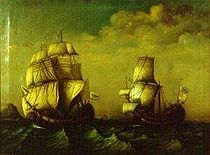
proved to be a turning point in the history of Cuba and Spanish America in general. The British captured Havana after a three month siege and controlled the western part of the island for a year. Britain returned Cuba in exchange for Florida in the Treaty of Paris (1763)
. The events revealed not only the weaknesses of the region's defenses but also proved just how much the Cuban economy had been neglected by the Spanish. During the year they controlled Cuba, the British conducted an unprecedented amount of trade with the island. A year earlier France had secretly ceded Louisiana to Spain in compensation for its losses as its ally during the war.
As a sign of the seriousness with which the government took the problems, the very year the Spanish retook control of Havana construction began on what would become the largest Spanish fort in the New World, San Carlos de la Cabaña
on the eastern side of the entrance to harbor of Havana.
, which provided the basis for the changes. A new emphasis was placed on appointing military men to the governorship-captaincy general of Cuba, many of whom were later rewarded with the post of Viceroy of New Spain. To aid the captain general of Cuba, the governor of Santiago was made captain general of the province and given command of the military forces there. At the same time a new institution, which up until now had only been used in Spain, was introduced into Cuba: the intendancy
. An intendencia de hacienda y guerra was set up in Havana to oversee government and military expenditures and to promote the local economy. The first Intendant, Miguel de Altarriba arrived on March 8, 1765. Other intendancies soon followed: Louisiana (1766), Puerto Príncipe (1786) and Santiago de Cuba (1786). In 1774 the first census of the island was carried out, revealing 171,670 inhabitants, and other measures were taken to improve the local economy.
These reforms, especially the institution of the intendancy, initiated a dramatic social and economic transformation of the island during the last half of the 18th century and early 19th. Cuba went from being a defensive post in the Caribbean sustained by a subsidy from New Spain, the situado, to becoming a self-sustaining and flourishing, sugar-, coffee- and tobacco-exporting colony, which also meant that large number of slaves were imported into Cuba
. The agricultural economy was aided by the gradual opening of Cuban ports to foreign ships, especially after the loss of the mainland due to the independence wars.
Spain recaptured Florida from Britain, which was ratified in the 1783 Treaty of Paris
, but it was later sold to the United States
in 1819 in the Adams-Onís Treaty
.
The transfer of the Spanish part of Santo Domingo
to France
in 1795 in the Treaty of Basel
, made Cuba the main Spanish possession in the Caribbean. The Audiencia of Santo Domingo was formally moved to Santa María del Puerto Príncipe (today, Camagüey) five years later, after temporarily residing in Santiago de Cuba. (It resided in Havana for a few years starting in 1808 before returning to Camagüey.)
The Church also experienced growth. In 1787 a Diocese of San Cristóbal de La Habana
was established, which included Florida and Louisiana in its territory. In 1793 the Diocese of Louisiana and the Two Floridas
was established. Both were suffragan to the Archdiocese of Santo Domingo, but after the Treaty of Basel, it disappeared, so Santiago de Cuba was elevated to an Archdiocese with the above mentioned dioceses suffragan to it, as well as the Diocese of Puerto Rico
.
enacted by the Cádiz Cortes
declared the territory of the Captaincy General an integral part of the Spanish Monarchy and transformed it into a province with its own elected diputación provincial, a governing board with joint administrative and limited legislative powers. Municipalities were also granted locally-elected cabildos
. The provincial deputation and cabildos functioned while the Constitution was in force from 1812 to 1814 and 1820 to 1823. Ultimately the Constitution was abolished by Ferdinand VII.
The death of Ferdinand VII brought about new changes. Regent María Cristina
reconvened the Cortes
, in its traditional form with three estates
. In 1836, Constitutional government was reestablished in Spain, except this time the government in Spain, despite its liberal tendencies, defined the overseas territories as colonies
, which should be governed by special laws. The democratic institutions, such as the Diputación Provincial and the cabildos, established by the 1812 Constitution were removed. The new Constitution of 1837 ratified Cuba's demoted status. Worse still, the "special laws", by which the overseas areas were to be governed, were not drafted until three decades later, when a special Junta Informativa de Reformas de Ultramar (Overseas Informative Reform Board), with representatives from Cuba and Puerto Rico, was convened in 1865. Even then its proposals were never made into laws.
In the 1830s, judicial affairs were restructured. An Audiencia of Havana was created in 1838, with the jurisdiction of the Puerto Príncipe Audiencia limited to the east and center of the island. (The latter was temporarily abolished from 1853 to 1868.)
By mid-century a definite pro-independence movement had coalesced, and Cuba experienced three civil wars in thirty years that culminated in a US intervention and the island's eventual independence: the Ten Years' War
(1868-1878), the Little War
(1879-1880) and the War of Independence, which became the Spanish-American War
. During the last war the issue of autonomy came to a head. In 1895 the Overseas Minister, with approval from the Prime Minister, took the extra-constitutional step in 1897 of writing the Constitución Autonómica, which granted the Caribbean islands autonomy, technically bringing the Captaincy General to an end. Given the urgency of the movement, the government approved this unusual measure. The new government of the island was to consist of "an Island Parliament, divided into two chambers and one Governor-General
, representative of the Metropolis, who will carry out his duties in its name, the supreme Authority." The new government functioned only for a few months before the United States took control of the island.
Spanish Empire
The Spanish Empire comprised territories and colonies administered directly by Spain in Europe, in America, Africa, Asia and Oceania. It originated during the Age of Exploration and was therefore one of the first global empires. At the time of Habsburgs, Spain reached the peak of its world power....
created in 1607 as part of Habsburg Spain
Habsburg Spain
Habsburg Spain refers to the history of Spain over the 16th and 17th centuries , when Spain was ruled by the major branch of the Habsburg dynasty...
's attempt better to defend the Caribbean against foreign powers, which also involved creating captaincies general in Puerto Rico
Captaincy General of Puerto Rico
The Captaincy General of Puerto Rico was an administrative district of the Spanish Empire, created in 1580 to provide better military management of the island of Puerto Rico, previously under the direct rule of a simple governor and the jurisdiction of Audiencia of Santo Domingo...
, Guatemala
Captaincy General of Guatemala
The Captaincy General of Guatemala , also known as the Kingdom of Guatemala , was an administrative division in Spanish America which covered much of Central America, including what are now the nations of Costa Rica, Nicaragua, Honduras, El Salvador and Guatemala, and the Mexican state of Chiapas...
and Yucatán
Captaincy General of Yucatán
The Captaincy General of Yucatán was an administrative district of colonial Spain, created in 1617 to provide more autonomy for the Yucatán Peninsula, previously ruled directly by a simple governor under the jurisdiction of Audiencia of Mexico...
. The restructuring of the Captaincy General in 1764 was the first example of the Bourbon Reforms
Bourbon Reforms
The Bourbon Reforms were a set of economic and political legislation introduced by the Spanish Crown under various kings of the House of Bourbon throughout the 18th century. The reforms were intended to stimulate manufacturing and technology in order to modernize Spain...
in America. The changes included adding the provinces of Florida
Spanish Florida
Spanish Florida refers to the Spanish territory of Florida, which formed part of the Captaincy General of Cuba, the Viceroyalty of New Spain, and the Spanish Empire. Originally extending over what is now the southeastern United States, but with no defined boundaries, la Florida was a component of...
and Louisiana
Louisiana (New Spain)
Louisiana was the name of an administrative district of the Viceroyalty of New Spain from 1764 to 1803 that represented territory west of the Mississippi River basin, plus New Orleans...
and granting more autonomy for these provinces. This later change was carried out by the count of Floridablanca
José Moñino y Redondo, conde de Floridablanca
José Moñino y Redondo, Count of Floridablanca , Spanish statesman. He was the reformist chief minister of King Charles III of Spain, and also served briefly under Charles IV. He was arguably Spain's most effective statesman in the eighteenth century...
under Charles III
Charles III of Spain
Charles III was the King of Spain and the Spanish Indies from 1759 to 1788. He was the eldest son of Philip V of Spain and his second wife, the Princess Elisabeth Farnese...
to strengthen the Spanish position vis-a-vis the British in the Caribbean. A new governor-captain general based in Havana
Havana
Havana is the capital city, province, major port, and leading commercial centre of Cuba. The city proper has a population of 2.1 million inhabitants, and it spans a total of — making it the largest city in the Caribbean region, and the most populous...
oversaw the administration of the new district. The local governors of the larger Captaincy General had previously been overseen in political and military matters by the president of the Audiencia of Santo Domingo
Real Audiencia of Santo Domingo
The Royal Audiencia of Santo Domingo was the first court of the Spanish crown in America. It was created by Ferdinand V of Castile in his decree of 1511, but due to disagreements between the governor of Hispaniola, Diego Colon and the Crown, it was not implemented until it was reestablished by...
. This audiencia retained oversight of judicial affairs until the establishment of new audiencias in Puerto Príncipe
Camagüey
Camagüey is a city and municipality in central Cuba and is the nation's third largest city. It is the capital of the Camagüey Province.After almost continuous attacks from pirates the original city was moved inland in 1528.The new city was built with a confusing lay-out of winding alleys that made...
(1800) and Havana (1838). In 1825, as a result of the loss of the mainland possessions, the Spanish government granted the governors-captain generals of Cuba extraordinary powers in matters of administration, justice and the treasury and in the second half of the 19th century gave them the title of Governor General.
Antecedents
Since the 16th century the island of Cuba had been under the control of the governor-captain general of Santo DomingoColony of Santo Domingo
The Captaincy General of Santo Domingo was the first Spanish colony in the New World, and later became the Dominican Republic. Originally known as "La Española", the colony was organized as the Royal Audiencia of Santo Domingo in 1511. After years of struggles with the French, the Spanish remained...
, who was at the same time, president of the audiencia there. He oversaw the local governor and the Santo Domingo Audiencia heard appeals from the island.
The conquest of Cuba was organized in 1510 by the recently restored Viceroy of the Indies, Diego Colón
Diego Colón
Diego Columbus was the 2nd Admiral of the Indies, 2nd Viceroy of the Indies and 3rd Governor of the Indies. He was the firstborn son of Christopher Columbus and wife Filipa Moniz Perestrelo, and was born in 1479/1480 in Porto Santo, Portugal or 1474 in Lisbon, Portugal. He died February...
, under the command of Diego Velázquez de Cuéllar
Diego Velázquez de Cuéllar
Diego Velázquez de Cuéllar was a Spanish conquistador. He conquered and governed Cuba on behalf of Spain.-Early life:...
, who became Cuba's first governor until his death in 1524. The new settlers did not wish to be under the personal authority of Colón, so Velázquez founded the city of Nuestra Señora de la Asunción de Baracoa
Baracoa
Baracoa is a municipality and city in Guantánamo Province near the eastern tip of Cuba. It was founded by the first governor of Cuba, the Spanish conquistador Diego Velázquez de Cuéllar in 1511...
in 1511 and convoked a general cabildo
Cabildo (council)
For a discussion of the contemporary Spanish and Latin American cabildo, see Ayuntamiento.A cabildo or ayuntamiento was a former Spanish, colonial administrative council that governed a municipality. Cabildos were sometimes appointed, sometimes elected, but were considered to be representative of...
(a local government
Local government
Local government refers collectively to administrative authorities over areas that are smaller than a state.The term is used to contrast with offices at nation-state level, which are referred to as the central government, national government, or federal government...
council), which was duly authorized to deal directly with Spain. This legal move removed Velázquez and the settlers from under the authority of Colón, their nominal superior. It was a precedent that would come back to haunt Velázquez during Hernán Cortés
Hernán Cortés
Hernán Cortés de Monroy y Pizarro, 1st Marquis of the Valley of Oaxaca was a Spanish Conquistador who led an expedition that caused the fall of the Aztec Empire and brought large portions of mainland Mexico under the rule of the King of Castile in the early 16th century...
's conquest of Mexico. Other cities were later founded under Velázquez: Bayamo
Bayamo
Bayamo is the capital city of the Granma Province of Cuba, and one of the largest cities in the Oriente region.The community of Bayamo lies on a plain by the Bayamon River...
in 1513; Santísima Trinidad
Trinidad, Cuba
-External links:* , Online travel guide to Trinidad* , Selected photos of Trinidad* , Photos of Trinidad...
, Sancti Spíritus and San Cristóbal de La Habana
Havana
Havana is the capital city, province, major port, and leading commercial centre of Cuba. The city proper has a population of 2.1 million inhabitants, and it spans a total of — making it the largest city in the Caribbean region, and the most populous...
in 1514; Puerto Príncipe
Camagüey
Camagüey is a city and municipality in central Cuba and is the nation's third largest city. It is the capital of the Camagüey Province.After almost continuous attacks from pirates the original city was moved inland in 1528.The new city was built with a confusing lay-out of winding alleys that made...
and Santiago de Cuba
Santiago de Cuba
Santiago de Cuba is the second largest city of Cuba and capital city of Santiago de Cuba Province in the south-eastern area of the island, some south-east of the Cuban capital of Havana....
in 1515. After the conquest of Mexico, Cuba experienced an exodus of settlers, and its population remained small for the next two centuries.
In 1565 the Adelantado
Adelantado
Adelantado was a military title held by some Spanish conquistadores of the 15th, 16th and 17th centuries.Adelantados were granted directly by the Monarch the right to become governors and justices of a specific region, which they charged with conquering, in exchange for funding and organizing the...
Pedro Menéndez de Avilés
Pedro Menéndez de Avilés
Pedro Menéndez de Avilés was a Spanish admiral and explorer, best remembered for founding St. Augustine, Florida in 1565. This was the first successful Spanish foothold in La Florida and remained the most significant city in the region for several hundred years. St...
, who was also Captain General of the Spanish treasure fleet
Spanish treasure fleet
The Spanish treasure fleets was a convoy system adopted by the Spanish Empire from 1566 to 1790...
which rendezvoused in Havana, established the first permanent Spanish settlement in Florida, San Agustín
St. Augustine, Florida
St. Augustine is a city in the northeast section of Florida and the county seat of St. Johns County, Florida, United States. Founded in 1565 by Spanish explorer and admiral Pedro Menéndez de Avilés, it is the oldest continuously occupied European-established city and port in the continental United...
, initially bringing the province under the administrative control of Cuba, although due to distance and sea currents, Florida's government was granted the right to correspond directly with the Council of the Indies.
The Church played an important role in the Spanish settlement of the Americas. Furthermore, since governors, as representatives of the King, oversaw church administration due to the crown's right of patronage
Ius patronatus
Jus patronatus, also spelt ius patronatus, imitating classical Latin orthography, is the term in Roman Catholic canon law for the "right of patronage"....
, the church and state were tightly intertwined in Spanish America. The first diocese was established in 1518 in Baracoa
Roman Catholic Archdiocese of Santiago de Cuba
The Roman Catholic Archdiocese of Santiago de Cuba is a Metropolitan Archdiocese, responsible for the dioceses of Guantánamo-Baracoa, Holguín and Santisimo Salvador de Bayamo y Manzanillo....
and was made suffragan to the Diocese of Seville
Roman Catholic Archdiocese of Seville
The Archdiocese of Seville is part of the Catholic Church in Seville, Spain. The Diocese of Seville was founded in the 3rd century. It was raised to the level of an archdiocese in the 4th century. The current Archbishop is Juan José Asenjo Pelegrina...
. The seat of the Diocese was transferred to Santiago de Cuba in 1522. In 1520 Pope Leo X
Pope Leo X
Pope Leo X , born Giovanni di Lorenzo de' Medici, was the Pope from 1513 to his death in 1521. He was the last non-priest to be elected Pope. He is known for granting indulgences for those who donated to reconstruct St. Peter's Basilica and his challenging of Martin Luther's 95 Theses...
established the short lived Diocese of Santiago de la Florida (or "Santiago de la Tierra Florida"). In 1546 the Diocese of Santo Domingo
Roman Catholic Archdiocese of Santo Domingo
The Roman Catholic Archdiocese of Santo Domingo is a Metropolitan Archdiocese, in the Dominican Republic. It is responsible for the dioceses of Baní, Barahona, Nuestra Señora de la Altagracia en Higüey, San Juan de la Maguana and San Pedro de Macorís.The see was elevated to an archdiocese on 12...
was elevated to an Archdiocese and the Diocese of Santiago de Cuba was made suffragan to it.
Establishment
In 1607 Philip IIIPhilip III of Spain
Philip III , also known as Philip the Pious, was the King of Spain and King of Portugal and the Algarves, where he ruled as Philip II , from 1598 until his death...
created the Captaincy General of Cuba as part of larger plans to defend the Caribbean against foreign threats
Piracy in the Caribbean
] The era of piracy in the Caribbean began in the 16th century and died out in the 1830s after the navies of the nations of Western Europe and North America with colonies in the Caribbean began combating pirates. The period during which pirates were most successful was from the 1690s until the 1720s...
. The first captain general was Pedro Valdés. Around the same time other captaincies general were established in Puerto Rico
Captaincy General of Puerto Rico
The Captaincy General of Puerto Rico was an administrative district of the Spanish Empire, created in 1580 to provide better military management of the island of Puerto Rico, previously under the direct rule of a simple governor and the jurisdiction of Audiencia of Santo Domingo...
(1580) and Central America
Captaincy General of Guatemala
The Captaincy General of Guatemala , also known as the Kingdom of Guatemala , was an administrative division in Spanish America which covered much of Central America, including what are now the nations of Costa Rica, Nicaragua, Honduras, El Salvador and Guatemala, and the Mexican state of Chiapas...
(1609). Cuba was divided into two governorships with capitals in Havana and Santiago de Cuba. The governor of Havana was Captain General of the island. In 1650 Cuba received a large influx of refugees when the British conquered Jamaica
Jamaica
Jamaica is an island nation of the Greater Antilles, in length, up to in width and 10,990 square kilometres in area. It is situated in the Caribbean Sea, about south of Cuba, and west of Hispaniola, the island harbouring the nation-states Haiti and the Dominican Republic...
and expelled the Spanish residents there.
In 1756 the construction of ships for the Royal Navy
Spanish Navy
The Spanish Navy is the maritime branch of the Spanish Armed Forces, one of the oldest active naval forces in the world. The Armada is responsible for notable achievements in world history such as the discovery of Americas, the first world circumnavigation, and the discovery of a maritime path...
began with the establishment of an Intendancy of the Navy was established in Havana, which functioned as a royal shipyard.
Seven Years' War
The Seven Years' War was a global military war between 1756 and 1763, involving most of the great powers of the time and affecting Europe, North America, Central America, the West African coast, India, and the Philippines...
proved to be a turning point in the history of Cuba and Spanish America in general. The British captured Havana after a three month siege and controlled the western part of the island for a year. Britain returned Cuba in exchange for Florida in the Treaty of Paris (1763)
Treaty of Paris (1763)
The Treaty of Paris, often called the Peace of Paris, or the Treaty of 1763, was signed on 10 February 1763, by the kingdoms of Great Britain, France and Spain, with Portugal in agreement. It ended the French and Indian War/Seven Years' War...
. The events revealed not only the weaknesses of the region's defenses but also proved just how much the Cuban economy had been neglected by the Spanish. During the year they controlled Cuba, the British conducted an unprecedented amount of trade with the island. A year earlier France had secretly ceded Louisiana to Spain in compensation for its losses as its ally during the war.
As a sign of the seriousness with which the government took the problems, the very year the Spanish retook control of Havana construction began on what would become the largest Spanish fort in the New World, San Carlos de la Cabaña
La Cabaña
The Fortaleza de San Carlos de la Cabaña, known as La Cabaña , is an 18th-century fortress complex, the biggest in the Americas, located on the elevated eastern side of the harbor entrance in Havana, Cuba...
on the eastern side of the entrance to harbor of Havana.
The Bourbon Reforms
Starting in 1764 the government apparatus of Cuba was completely reworked. A report on the island was created by Alejandro O'ReillyAlejandro O'Reilly
Alejandro O'Reilly , was a military reformer and Inspector-General of Infantry for the Spanish Empire in the second half of the 18th century...
, which provided the basis for the changes. A new emphasis was placed on appointing military men to the governorship-captaincy general of Cuba, many of whom were later rewarded with the post of Viceroy of New Spain. To aid the captain general of Cuba, the governor of Santiago was made captain general of the province and given command of the military forces there. At the same time a new institution, which up until now had only been used in Spain, was introduced into Cuba: the intendancy
Intendant
The title of intendant has been used in several countries through history. Traditionally, it refers to the holder of a public administrative office...
. An intendencia de hacienda y guerra was set up in Havana to oversee government and military expenditures and to promote the local economy. The first Intendant, Miguel de Altarriba arrived on March 8, 1765. Other intendancies soon followed: Louisiana (1766), Puerto Príncipe (1786) and Santiago de Cuba (1786). In 1774 the first census of the island was carried out, revealing 171,670 inhabitants, and other measures were taken to improve the local economy.
These reforms, especially the institution of the intendancy, initiated a dramatic social and economic transformation of the island during the last half of the 18th century and early 19th. Cuba went from being a defensive post in the Caribbean sustained by a subsidy from New Spain, the situado, to becoming a self-sustaining and flourishing, sugar-, coffee- and tobacco-exporting colony, which also meant that large number of slaves were imported into Cuba
Slavery in the Spanish New World colonies
Slavery in the Spanish colonies began with the enslavement of the local indigenous peoples in their homelands by Spanish settlers. Enslavement and production quotas were used to force the local labor to bring a return on the expedition and colonization investments...
. The agricultural economy was aided by the gradual opening of Cuban ports to foreign ships, especially after the loss of the mainland due to the independence wars.
Territorial gains and losses
During the American Revolutionary WarAmerican Revolutionary War
The American Revolutionary War , the American War of Independence, or simply the Revolutionary War, began as a war between the Kingdom of Great Britain and thirteen British colonies in North America, and ended in a global war between several European great powers.The war was the result of the...
Spain recaptured Florida from Britain, which was ratified in the 1783 Treaty of Paris
Treaty of Paris (1783)
The Treaty of Paris, signed on September 3, 1783, ended the American Revolutionary War between Great Britain on the one hand and the United States of America and its allies on the other. The other combatant nations, France, Spain and the Dutch Republic had separate agreements; for details of...
, but it was later sold to the United States
United States
The United States of America is a federal constitutional republic comprising fifty states and a federal district...
in 1819 in the Adams-Onís Treaty
Adams-Onís Treaty
The Adams–Onís Treaty of 1819, also known as the Transcontinental Treaty or the Purchase of Florida, was a treaty between the United States and Spain in 1819 that gave Florida to the U.S. and set out a boundary between the U.S. and New Spain . It settled a standing border dispute between the two...
.
The transfer of the Spanish part of Santo Domingo
Colony of Santo Domingo
The Captaincy General of Santo Domingo was the first Spanish colony in the New World, and later became the Dominican Republic. Originally known as "La Española", the colony was organized as the Royal Audiencia of Santo Domingo in 1511. After years of struggles with the French, the Spanish remained...
to France
France
The French Republic , The French Republic , The French Republic , (commonly known as France , is a unitary semi-presidential republic in Western Europe with several overseas territories and islands located on other continents and in the Indian, Pacific, and Atlantic oceans. Metropolitan France...
in 1795 in the Treaty of Basel
Treaty of Basel
There were several Treaties of Basel:*Treaty of Basel *Peace of Basel *The Basel Convention on the Control of Transboundary Movements of Hazardous Wastes and Their Disposal...
, made Cuba the main Spanish possession in the Caribbean. The Audiencia of Santo Domingo was formally moved to Santa María del Puerto Príncipe (today, Camagüey) five years later, after temporarily residing in Santiago de Cuba. (It resided in Havana for a few years starting in 1808 before returning to Camagüey.)
The Church also experienced growth. In 1787 a Diocese of San Cristóbal de La Habana
Roman Catholic Archdiocese of San Cristóbal de la Habana
The Roman Catholic Metropolitan Archdiocese of San Cristobal de la Habana is one of three Catholic Archdioceses in Cuba.-History:Erected originally as Santiago de Cuba, this Latin Rite or Roman Rite diocese was erected as the Diocese of Santiago de Cuba on 10 September 1787 by Pope Pius VI...
was established, which included Florida and Louisiana in its territory. In 1793 the Diocese of Louisiana and the Two Floridas
Roman Catholic Archdiocese of New Orleans
The Roman Catholic Archdiocese of New Orleans, officially in Latin Archidioecesis Novae Aureliae, is an ecclesiastical division of the Roman Catholic Church administered from New Orleans, Louisiana...
was established. Both were suffragan to the Archdiocese of Santo Domingo, but after the Treaty of Basel, it disappeared, so Santiago de Cuba was elevated to an Archdiocese with the above mentioned dioceses suffragan to it, as well as the Diocese of Puerto Rico
Roman Catholic Archdiocese of San Juan de Puerto Rico
The Roman Catholic Archdiocese of San Juan de Puerto Rico is an ecclesiastical territory or diocese of the Roman Catholic Church, comprising the northeast portion of the island of Puerto Rico, a commonwealth of the United States...
.
The Nineteenth Century
The Spanish Constitution of 1812Spanish Constitution of 1812
The Spanish Constitution of 1812 was promulgated 19 March 1812 by the Cádiz Cortes, the national legislative assembly of Spain, while in refuge from the Peninsular War...
enacted by the Cádiz Cortes
Cádiz Cortes
The Cádiz Cortes were sessions of the national legislative body which met in the safe haven of Cádiz during the French occupation of Spain during the Napoleonic Wars...
declared the territory of the Captaincy General an integral part of the Spanish Monarchy and transformed it into a province with its own elected diputación provincial, a governing board with joint administrative and limited legislative powers. Municipalities were also granted locally-elected cabildos
Cabildo (council)
For a discussion of the contemporary Spanish and Latin American cabildo, see Ayuntamiento.A cabildo or ayuntamiento was a former Spanish, colonial administrative council that governed a municipality. Cabildos were sometimes appointed, sometimes elected, but were considered to be representative of...
. The provincial deputation and cabildos functioned while the Constitution was in force from 1812 to 1814 and 1820 to 1823. Ultimately the Constitution was abolished by Ferdinand VII.
The death of Ferdinand VII brought about new changes. Regent María Cristina
Maria Christina of the Two Sicilies
Maria Christina of the Two Sicilies was Queen consort of Spain and Regent of Spain .-Early years and first marriage:...
reconvened the Cortes
Cortes Generales
The Cortes Generales is the legislature of Spain. It is a bicameral parliament, composed of the Congress of Deputies and the Senate . The Cortes has power to enact any law and to amend the constitution...
, in its traditional form with three estates
Estates of the realm
The Estates of the realm were the broad social orders of the hierarchically conceived society, recognized in the Middle Ages and Early Modern period in Christian Europe; they are sometimes distinguished as the three estates: the clergy, the nobility, and commoners, and are often referred to by...
. In 1836, Constitutional government was reestablished in Spain, except this time the government in Spain, despite its liberal tendencies, defined the overseas territories as colonies
Colony
In politics and history, a colony is a territory under the immediate political control of a state. For colonies in antiquity, city-states would often found their own colonies. Some colonies were historically countries, while others were territories without definite statehood from their inception....
, which should be governed by special laws. The democratic institutions, such as the Diputación Provincial and the cabildos, established by the 1812 Constitution were removed. The new Constitution of 1837 ratified Cuba's demoted status. Worse still, the "special laws", by which the overseas areas were to be governed, were not drafted until three decades later, when a special Junta Informativa de Reformas de Ultramar (Overseas Informative Reform Board), with representatives from Cuba and Puerto Rico, was convened in 1865. Even then its proposals were never made into laws.
In the 1830s, judicial affairs were restructured. An Audiencia of Havana was created in 1838, with the jurisdiction of the Puerto Príncipe Audiencia limited to the east and center of the island. (The latter was temporarily abolished from 1853 to 1868.)
By mid-century a definite pro-independence movement had coalesced, and Cuba experienced three civil wars in thirty years that culminated in a US intervention and the island's eventual independence: the Ten Years' War
Ten Years' War
The Ten Years' War , also known as the Great War and the War of '68, began on October 10, 1868 when sugar mill owner Carlos Manuel de Céspedes and his followers proclaimed Cuba's independence from Spain...
(1868-1878), the Little War
Little War (Cuba)
The Little War or Small War , was the second of three conflicts in the Cuban War of Independence. It followed the Ten Years' War of 1868–1878 and preceded the War of '95, itself sometimes called the Cuban War of Independence, which bled into the Spanish-American War, ultimately resulting in...
(1879-1880) and the War of Independence, which became the Spanish-American War
Spanish-American War
The Spanish–American War was a conflict in 1898 between Spain and the United States, effectively the result of American intervention in the ongoing Cuban War of Independence...
. During the last war the issue of autonomy came to a head. In 1895 the Overseas Minister, with approval from the Prime Minister, took the extra-constitutional step in 1897 of writing the Constitución Autonómica, which granted the Caribbean islands autonomy, technically bringing the Captaincy General to an end. Given the urgency of the movement, the government approved this unusual measure. The new government of the island was to consist of "an Island Parliament, divided into two chambers and one Governor-General
Governor-General
A Governor-General, is a vice-regal person of a monarch in an independent realm or a major colonial circonscription. Depending on the political arrangement of the territory, a Governor General can be a governor of high rank, or a principal governor ranking above "ordinary" governors.- Current uses...
, representative of the Metropolis, who will carry out his duties in its name, the supreme Authority." The new government functioned only for a few months before the United States took control of the island.
See also
- List of Governors of Cuba
- Piracy in the CaribbeanPiracy in the Caribbean] The era of piracy in the Caribbean began in the 16th century and died out in the 1830s after the navies of the nations of Western Europe and North America with colonies in the Caribbean began combating pirates. The period during which pirates were most successful was from the 1690s until the 1720s...
- British expedition against CubaBritish expedition against CubaThe Battle of Havana was a military action from March to August 1762, as part of the Seven Years' War. British forces besieged and captured the city of Havana, which at the time was an important Spanish naval base in the Caribbean, and dealt a serious blow to the Spanish navy...
- History of CubaHistory of CubaThe known history of Cuba, the largest of the Caribbean islands, predates Christopher Columbus' sighting of the island during his first voyage of discovery on 27 October 1492...