

Cancer of the larynx

Encyclopedia
Laryngeal cancer may also be called cancer of the larynx or laryngeal carcinoma. Most laryngeal cancers are squamous cell carcinoma
s, reflecting their origin from the squamous cells which form the majority of the laryngeal epithelium
.
Cancer
can develop in any part of the larynx
, but the cure rate is affected by the location of the tumour. For the purposes of tumour staging
, the larynx is divided into three anatomical regions: the glottis
(true vocal cords, anterior and posterior commissures); the supraglottis (epiglottis
, arytenoids and aryepiglottic folds, and false cords); and the subglottis.
Most laryngeal cancers originate in the glottis
. Supraglottic cancers are less common, and subglottic tumours are least frequent.
Laryngeal cancer may spread by direct extension to adjacent structures, by metastasis
to regional cervical lymph node
s, or more distantly, through the blood stream. Distant metastates to the lung
are most common.
 Smoking is the most important risk factor for laryngeal cancer. Death from laryngeal cancer is 20 times more likely for heaviest smokers than for nonsmokers. Heavy chronic consumption of alcohol
, particularly alcoholic spirits, is also significant. When combined, these two factors appear to have a synergistic effect.
Some other quoted risk factors are likely, in part, to be related to prolonged alcohol and tobacco consumption. These include low socioeconomic status, male sex, and age greater than 55 years.
People with a history of head and neck cancer are known to be at higher risk (about 25%) of developing a second cancer of the head, neck, or lung. This is mainly because in a significant proportion of these patients, the aerodigestive tract and lung epithelium
have been exposed chronically to the carcinogenic effects of alcohol and tobacco
. In this situation, a field change effect may occur, where the epithelial tissues start to become diffusely dysplastic with a reduced threshold for malignant change. This risk may be reduced by quitting alcohol and tobacco.
Laryngeal cancer is listed as a "rare disease" by the Office of Rare Diseases (ORD) of the National Institutes of Health
(NIH). This means that laryngeal cancer affects fewer than 200,000 people in the U.S.
Each year, about 2,200 people in the U.K. are diagnosed with laryngeal cancer.
, physical examination
, and special investigations which may include a chest x-ray
, CT
or MRI scans, and tissue biopsy. The examination of the larynx requires some expertise, which may require specialist referral.
The physical exam includes a systematic examination of the whole patient to assess general health and to look for signs of associated conditions and metastatic disease. The neck and supraclavicular fossa
are palpated to feel for cervical adenopathy, other masses, and laryngeal crepitus. The oral cavity and oropharynx
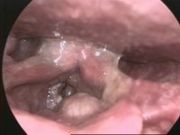
are examined under direct vision. The larynx may be examined by indirect laryngoscopy using a small angled mirror with a long handle (akin to a dentist's mirror) and a strong light. Indirect laryngoscopy can be highly effective, but requires skill and practice for consistent results. For this reason, many specialist clinics now use fibre-optic nasal endoscopy where a thin and flexible endoscope, inserted through the nostril
, is used to clearly visualise the entire pharynx
and larynx. Nasal endoscopy is a quick and easy procedure performed in clinic. Local anaesthetic spray may be used.
If there is a suspicion of cancer, biopsy
is performed, usually under general anaesthetic
. This provides histological proof of cancer type and grade. If the lesion
appears to be small and well localised, the surgeon may undertake excision biopsy, where an attempt is made to completely remove the tumour at the time of first biopsy. In this situation, the pathologist will not only be able to confirm the diagnosis, but can also comment on the completeness of excision, i.e., whether the tumour has been completely removed. A full endoscopic examination of the larynx, trachea
, and esophagus
is often performed at the time of biopsy.
For small glottic tumours further imaging may be unnecessary. In most cases, tumour staging is completed by scanning the head and neck region to assess the local extent of the tumour and any pathologically enlarged cervical lymph node
s.
The final management plan will depend on the site, stage (tumour size, nodal spread, distant metastasis
), and histological type. The overall health and wishes of the patient must also be taken into account.
, radiotherapy, or chemotherapy
, alone or in combination. This is a specialised area which requires the coordinated expertise of ear, nose and throat (ENT) surgeons (otolaryngologists) and oncologists.
Squamous cell carcinoma
Squamous cell carcinoma , occasionally rendered as "squamous-cell carcinoma", is a histologically distinct form of cancer. It arises from the uncontrolled multiplication of malignant cells deriving from epithelium, or showing particular cytological or tissue architectural characteristics of...
s, reflecting their origin from the squamous cells which form the majority of the laryngeal epithelium
Epithelium
Epithelium is one of the four basic types of animal tissue, along with connective tissue, muscle tissue and nervous tissue. Epithelial tissues line the cavities and surfaces of structures throughout the body, and also form many glands. Functions of epithelial cells include secretion, selective...
.
Cancer
Cancer
Cancer , known medically as a malignant neoplasm, is a large group of different diseases, all involving unregulated cell growth. In cancer, cells divide and grow uncontrollably, forming malignant tumors, and invade nearby parts of the body. The cancer may also spread to more distant parts of the...
can develop in any part of the larynx
Larynx
The larynx , commonly called the voice box, is an organ in the neck of amphibians, reptiles and mammals involved in breathing, sound production, and protecting the trachea against food aspiration. It manipulates pitch and volume...
, but the cure rate is affected by the location of the tumour. For the purposes of tumour staging
Cancer staging
The stage of a cancer is a description of the extent the cancer has spread. The stage often takes into account the size of a tumor, how deeply it has penetrated, whether it has invaded adjacent organs, how many lymph nodes it has metastasized to , and whether it has spread to distant organs...
, the larynx is divided into three anatomical regions: the glottis
Glottis
The glottis is defined as the combination of the vocal folds and the space in between the folds .-Function:...
(true vocal cords, anterior and posterior commissures); the supraglottis (epiglottis
Epiglottis
The epiglottis is a flap that is made of elastic cartilage tissue covered with a mucous membrane, attached to the entrance of the larynx. It projects obliquely upwards behind the tongue and the hyoid bone, pointing dorsally. The term, like tonsils, is often incorrectly used to refer to the uvula...
, arytenoids and aryepiglottic folds, and false cords); and the subglottis.
Most laryngeal cancers originate in the glottis
Glottis
The glottis is defined as the combination of the vocal folds and the space in between the folds .-Function:...
. Supraglottic cancers are less common, and subglottic tumours are least frequent.
Laryngeal cancer may spread by direct extension to adjacent structures, by metastasis
Metastasis
Metastasis, or metastatic disease , is the spread of a disease from one organ or part to another non-adjacent organ or part. It was previously thought that only malignant tumor cells and infections have the capacity to metastasize; however, this is being reconsidered due to new research...
to regional cervical lymph node
Lymph node
A lymph node is a small ball or an oval-shaped organ of the immune system, distributed widely throughout the body including the armpit and stomach/gut and linked by lymphatic vessels. Lymph nodes are garrisons of B, T, and other immune cells. Lymph nodes are found all through the body, and act as...
s, or more distantly, through the blood stream. Distant metastates to the lung
Lung
The lung is the essential respiration organ in many air-breathing animals, including most tetrapods, a few fish and a few snails. In mammals and the more complex life forms, the two lungs are located near the backbone on either side of the heart...
are most common.
Risk factors
Alcohol
In chemistry, an alcohol is an organic compound in which the hydroxy functional group is bound to a carbon atom. In particular, this carbon center should be saturated, having single bonds to three other atoms....
, particularly alcoholic spirits, is also significant. When combined, these two factors appear to have a synergistic effect.
Some other quoted risk factors are likely, in part, to be related to prolonged alcohol and tobacco consumption. These include low socioeconomic status, male sex, and age greater than 55 years.
People with a history of head and neck cancer are known to be at higher risk (about 25%) of developing a second cancer of the head, neck, or lung. This is mainly because in a significant proportion of these patients, the aerodigestive tract and lung epithelium
Epithelium
Epithelium is one of the four basic types of animal tissue, along with connective tissue, muscle tissue and nervous tissue. Epithelial tissues line the cavities and surfaces of structures throughout the body, and also form many glands. Functions of epithelial cells include secretion, selective...
have been exposed chronically to the carcinogenic effects of alcohol and tobacco
Tobacco
Tobacco is an agricultural product processed from the leaves of plants in the genus Nicotiana. It can be consumed, used as a pesticide and, in the form of nicotine tartrate, used in some medicines...
. In this situation, a field change effect may occur, where the epithelial tissues start to become diffusely dysplastic with a reduced threshold for malignant change. This risk may be reduced by quitting alcohol and tobacco.
Symptoms
The symptoms of laryngeal cancer depend on the size and location of the tumor. Symptoms may include the following:- Hoarseness or other voice changes
- A lump in the neck
- A sore throatSore throatA sore throat or throat pain is a common physical symptom usually caused by acute pharyngitis, or throat inflammation, though it also occurs in a number of other situations, such as post trauma and in diphtheria. It can cause mild to extreme pain....
or feeling that something is stuck in the throat - Persistent coughCoughA cough is a sudden and often repetitively occurring reflex which helps to clear the large breathing passages from secretions, irritants, foreign particles and microbes...
- StridorStridorStridor is a high pitched wheezing sound resulting from turbulent air flow in the upper airway. Stridor is a physical sign which is produced by narrow or obstructed airway path. It can be inspiratory, expiratory or biphasic . Inspiratory stridor is common...
- Bad breath
- Earache ("referred")
Incidence
Incidence is five in 100,000 (12,500 new cases per year) in the USA. The American Cancer Society estimated that 9,510 men and women (7,700 men and 1,810 women) would be diagnosed with and 3,740 men and women would die of laryngeal cancer in 2006.Laryngeal cancer is listed as a "rare disease" by the Office of Rare Diseases (ORD) of the National Institutes of Health
National Institutes of Health
The National Institutes of Health are an agency of the United States Department of Health and Human Services and are the primary agency of the United States government responsible for biomedical and health-related research. Its science and engineering counterpart is the National Science Foundation...
(NIH). This means that laryngeal cancer affects fewer than 200,000 people in the U.S.
Each year, about 2,200 people in the U.K. are diagnosed with laryngeal cancer.
Diagnosis
Diagnosis is made by the doctor on the basis of a medical historyMedical history
The medical history or anamnesis of a patient is information gained by a physician by asking specific questions, either of the patient or of other people who know the person and can give suitable information , with the aim of obtaining information useful in formulating a diagnosis and providing...
, physical examination
Physical examination
Physical examination or clinical examination is the process by which a doctor investigates the body of a patient for signs of disease. It generally follows the taking of the medical history — an account of the symptoms as experienced by the patient...
, and special investigations which may include a chest x-ray
Chest X-ray
In medicine, a chest radiograph, commonly called a chest X-ray , is a projection radiograph of the chest used to diagnose conditions affecting the chest, its contents, and nearby structures...
, CT
Computed tomography
X-ray computed tomography or Computer tomography , is a medical imaging method employing tomography created by computer processing...
or MRI scans, and tissue biopsy. The examination of the larynx requires some expertise, which may require specialist referral.
The physical exam includes a systematic examination of the whole patient to assess general health and to look for signs of associated conditions and metastatic disease. The neck and supraclavicular fossa
Supraclavicular fossa
The Supraclavicular fossa is an indentation immediately above the clavicle.In terminologia anatomica, it is divided into fossa supraclavicularis major and fossa supraclavicularis minor-External links:*...
are palpated to feel for cervical adenopathy, other masses, and laryngeal crepitus. The oral cavity and oropharynx
Oropharynx
The Oropharynx reaches from the Uvula to the level of the hyoid bone.It opens anteriorly, through the isthmus faucium, into the mouth, while in its lateral wall, between the two palatine arches, is the palatine tonsil....
are examined under direct vision. The larynx may be examined by indirect laryngoscopy using a small angled mirror with a long handle (akin to a dentist's mirror) and a strong light. Indirect laryngoscopy can be highly effective, but requires skill and practice for consistent results. For this reason, many specialist clinics now use fibre-optic nasal endoscopy where a thin and flexible endoscope, inserted through the nostril
Nostril
A nostril is one of the two channels of the nose, from the point where they bifurcate to the external opening. In birds and mammals, they contain branched bones or cartilages called turbinates, whose function is to warm air on inhalation and remove moisture on exhalation...
, is used to clearly visualise the entire pharynx
Pharynx
The human pharynx is the part of the throat situated immediately posterior to the mouth and nasal cavity, and anterior to the esophagus and larynx. The human pharynx is conventionally divided into three sections: the nasopharynx , the oropharynx , and the laryngopharynx...
and larynx. Nasal endoscopy is a quick and easy procedure performed in clinic. Local anaesthetic spray may be used.
If there is a suspicion of cancer, biopsy
Biopsy
A biopsy is a medical test involving sampling of cells or tissues for examination. It is the medical removal of tissue from a living subject to determine the presence or extent of a disease. The tissue is generally examined under a microscope by a pathologist, and can also be analyzed chemically...
is performed, usually under general anaesthetic
General anaesthetic
A general anaesthetic is a drug that brings about a reversible loss of consciousness. These drugs are generally administered by an anaesthesia provider to induce or maintain general anaesthesia to facilitate surgery...
. This provides histological proof of cancer type and grade. If the lesion
Lesion
A lesion is any abnormality in the tissue of an organism , usually caused by disease or trauma. Lesion is derived from the Latin word laesio which means injury.- Types :...
appears to be small and well localised, the surgeon may undertake excision biopsy, where an attempt is made to completely remove the tumour at the time of first biopsy. In this situation, the pathologist will not only be able to confirm the diagnosis, but can also comment on the completeness of excision, i.e., whether the tumour has been completely removed. A full endoscopic examination of the larynx, trachea
Vertebrate trachea
In tetrapod anatomy the trachea, or windpipe, is a tube that connects the pharynx or larynx to the lungs, allowing the passage of air. It is lined with pseudostratified ciliated columnar epithelium cells with goblet cells that produce mucus...
, and esophagus
Esophagus
The esophagus is an organ in vertebrates which consists of a muscular tube through which food passes from the pharynx to the stomach. During swallowing, food passes from the mouth through the pharynx into the esophagus and travels via peristalsis to the stomach...
is often performed at the time of biopsy.
For small glottic tumours further imaging may be unnecessary. In most cases, tumour staging is completed by scanning the head and neck region to assess the local extent of the tumour and any pathologically enlarged cervical lymph node
Lymph node
A lymph node is a small ball or an oval-shaped organ of the immune system, distributed widely throughout the body including the armpit and stomach/gut and linked by lymphatic vessels. Lymph nodes are garrisons of B, T, and other immune cells. Lymph nodes are found all through the body, and act as...
s.
The final management plan will depend on the site, stage (tumour size, nodal spread, distant metastasis
Metastasis
Metastasis, or metastatic disease , is the spread of a disease from one organ or part to another non-adjacent organ or part. It was previously thought that only malignant tumor cells and infections have the capacity to metastasize; however, this is being reconsidered due to new research...
), and histological type. The overall health and wishes of the patient must also be taken into account.
Treatment
Specific treatment depends on the location, type, and stage of the tumour. Treatment may involve surgerySurgery
Surgery is an ancient medical specialty that uses operative manual and instrumental techniques on a patient to investigate and/or treat a pathological condition such as disease or injury, or to help improve bodily function or appearance.An act of performing surgery may be called a surgical...
, radiotherapy, or chemotherapy
Chemotherapy
Chemotherapy is the treatment of cancer with an antineoplastic drug or with a combination of such drugs into a standardized treatment regimen....
, alone or in combination. This is a specialised area which requires the coordinated expertise of ear, nose and throat (ENT) surgeons (otolaryngologists) and oncologists.
External links
- Staging cancer of the larynx
- Cancer Management Handbook: Head and Neck Cancers
- A Video of a Physician Who is a Laryngectomee Discusses his Personal Experiences
- Clinically reviewed laryngeal cancer information for patients, from Cancer Research UKCancer Research UKCancer Research UK is a cancer research and awareness charity in the United Kingdom, formed on 4 February 2002 by the merger of The Cancer Research Campaign and the Imperial Cancer Research Fund. Its aim is to reduce the number of deaths from cancer. As the world's largest independent cancer...
- UK laryngeal cancer statistics from Cancer Research UKCancer Research UKCancer Research UK is a cancer research and awareness charity in the United Kingdom, formed on 4 February 2002 by the merger of The Cancer Research Campaign and the Imperial Cancer Research Fund. Its aim is to reduce the number of deaths from cancer. As the world's largest independent cancer...