

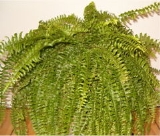
Boston fern

Overview
Fern
A fern is any one of a group of about 12,000 species of plants belonging to the botanical group known as Pteridophyta. Unlike mosses, they have xylem and phloem . They have stems, leaves, and roots like other vascular plants...
in the family Lomariopsidaceae
Lomariopsidaceae
The Lomariopsidaceae is a family of ferns with a largely tropical distribution. The family is here restricted to the cladistic grouping determined by the paper cited below.*Cyclopeltis*Lomariopsis*Nephrolepis...
(sometimes treated in the families Davalliaceae
Davalliaceae
Davalliaceae is a family of ferns in the order Polypodiales. It is sister to the largest family of ferns, Polypodiaceae, and shares some morphological characters with it....
or Oleandraceae, or in its own family, Nephrolepidaceae), native to tropical regions throughout the world. It is common in humid forest
Forest
A forest, also referred to as a wood or the woods, is an area with a high density of trees. As with cities, depending where you are in the world, what is considered a forest may vary significantly in size and have various classification according to how and what of the forest is composed...
s and swamp
Swamp
A swamp is a wetland with some flooding of large areas of land by shallow bodies of water. A swamp generally has a large number of hammocks, or dry-land protrusions, covered by aquatic vegetation, or vegetation that tolerates periodical inundation. The two main types of swamp are "true" or swamp...
s, especially in northern South America
South America
South America is a continent situated in the Western Hemisphere, mostly in the Southern Hemisphere, with a relatively small portion in the Northern Hemisphere. The continent is also considered a subcontinent of the Americas. It is bordered on the west by the Pacific Ocean and on the north and east...
, Mexico
Mexico
The United Mexican States , commonly known as Mexico , is a federal constitutional republic in North America. It is bordered on the north by the United States; on the south and west by the Pacific Ocean; on the southeast by Guatemala, Belize, and the Caribbean Sea; and on the east by the Gulf of...
, Central America
Central America
Central America is the central geographic region of the Americas. It is the southernmost, isthmian portion of the North American continent, which connects with South America on the southeast. When considered part of the unified continental model, it is considered a subcontinent...
, Florida
Florida
Florida is a state in the southeastern United States, located on the nation's Atlantic and Gulf coasts. It is bordered to the west by the Gulf of Mexico, to the north by Alabama and Georgia and to the east by the Atlantic Ocean. With a population of 18,801,310 as measured by the 2010 census, it...
, the West Indies, Polynesia
Polynesia
Polynesia is a subregion of Oceania, made up of over 1,000 islands scattered over the central and southern Pacific Ocean. The indigenous people who inhabit the islands of Polynesia are termed Polynesians and they share many similar traits including language, culture and beliefs...
and Africa
Africa
Africa is the world's second largest and second most populous continent, after Asia. At about 30.2 million km² including adjacent islands, it covers 6% of the Earth's total surface area and 20.4% of the total land area...
. Also known as the Wild Boston fern, Tuber ladder fern or Fishbone fern is in the broader family of sword fern.
The frond
Frond
The term frond refers to a large, divided leaf. In both common usage and botanical nomenclature, the leaves of ferns are referred to as fronds and some botanists restrict the term to this group...
s are 50-250 cm long and 6-15 cm broad, with alternate pinna
Pinna
In animal anatomy, the pinna is the visible part of the ear that resides outside of the head ....
e (the small "leaflets" on either side of the midrib), each pinna being 2-8 cm long.
Unanswered Questions
