


Belgian comics

Encyclopedia
Belgian comics are a distinct subgroup in the comics history, and played a major role in the development of European comics
, alongside France
with whom they share a long common history
. While the comics in the two major language groups and regions of Belgium
(Flanders
with the Dutch language
and Wallonia with French
) each have clearly distinct characteristics, they are constantly influencing one another, and meeting each other in Brussels
and in the bilingual publication tradition of the major editors. As one of the few arts where Belgium has had an international and enduring impact in the twentieth century, comics are known to be "an integral part of Belgian culture".
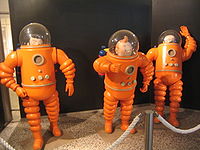 The first large-scale production of comics in Belgium started in the second half of the 1920s. Earlier, illustrated youth pages were still very similar to the Images d'Epinal and the Flemish equivalent, the Mannekensbladen. The comics that were available came from France and were mostly available in parts of Belgium where the French language dominated (Wallonia and Brussels
). The most popular were La Semaine de Suzette
, L'Épatant and Le bon point illustré. French authors like Marijac
contributed to Belgian magazines as well.
The 1920s saw the formation of many new youth magazines, some independent like the bilingual Zonneland / Petits Belges from Catholic publishers Altiora Averbode or scout magazines like Le Boy-Scout Belge, where Hergé
(Georges Remi) debuted; others were published as newspaper supplements. The most famous of these was Le Petit Vingtième
, the weekly youth supplement to the Catholic newspaper Le Vingtième Siècle. Founded in 1928, it employed the young artist Georges Remi as editor-in-chief and main contributor. Remi, better known as Hergé
, launched in January 1929 a new series for the supplement: The Adventures of Tintin
. Initially heavily influenced by the work of French comics authors Alain Saint-Ogan
and Pinchon and the American George McManus
, Hergé soon developed his own style. Tintin soon became very popular, and sales of the newspaper quadrupled on Thursdays, when the supplement was included. It would become the prototype for many Belgian comics to come, in style (the so-called Ligne claire
), appearance rhythm (weekly), use of speech balloons
(whereas comics from other countries like the Netherlands
and Denmark
would keep the text beneath the drawings for decades to come), and the method of using a first appearance in a magazine or newspaper and subsequent albums.
While Tintin was very popular, it would take almost a decade before the next successful comics magazine would appear. In the meantime, an increasing number of youth magazines would publish some pages with comics influenced by Tintin.
George Van Raemdonck
, the first major Flemish comics artist, worked almost exclusively in the Netherlands
until after World War II
. Still, he influenced some of the earliest pre-war Flemish artists like Jan Waterschoot and Buth, and as a newspaper artist with a daily comic strip, he paved the way for the typical publishing method of the Flemish comics when compared to the prevalent Walloon magazine publications.
More situated in the classic arts than in the mainstream comics publishing was Frans Masereel
, a Flemish wood engraver whose 1926 "Passionate Journey", a wordless story told in 165 woodcuts, is sometimes considered as the first graphic novel
.
In the second half of the 1930s, most Walloon youth magazines made room for one or more comics by local artists. Examples are Jijé
in Le Croisé in 1936 and in Petits Belges in 1939, François Gianolla in Jeunesse Ouvrière, and Sirius in Le Patriote Illustré. Dupuis
, a publisher based in Marcinelle
near Charleroi
, was already having success with its two family magazines Le Moustique and Bonnes Soirées. Charles Dupuis, son of the CEO, decided to start a youth magazine centred around a new hero, Spirou
. It debuted on April 21, 1938. French artist Robert Velter
, a former assistant of Martin Branner
, was asked to create the title series, and the rest of the magazine was filled with popular American comics such as Superman
. 8 months later, in an unusual move, the magazine was published in Dutch under the name Robbedoes. This would have a profound influence on the development of the Flemish comics and assured that Belgian comics would have a large part of their development in common. In 1939, Jijé
joined the magazine. He worked there until his death in 1980, and was the driving force of the magazine during and directly after the war. He was responsible for its expansion and success in the next decades, and was as the inspirator for the later generation of comics artists in the 1940s
and 1950s
which is known as the Marcinelle school
. Apart from Hergé, Jijé's main inspiration came from American artists such as Milton Caniff
and Noel Sickles
.
Some Flemish magazines started producing more modern local comics as well, with works by established artists like Frans Van Immerseel in Zonneland and the expressionist
painter Frits Van den Berghe
in Bravo
, or new names like Jan Waterschoot in Zonneland or Eugeen Hermans (aka Pink) in Ons Volkske, a weekly newspaper supplement inspired by Le Petit Vingtième. The most important comics writer for Bravo and Zonneland was John Flanders, who would continue to provide stories for the Flemish magazines until the 1960s.
was dissolved after the German invasion, and Hergé
started working for the collaborating newspaper Le Soir
, where he had to change from a weekly double page of Tintin to a daily strip. Paper shortage also forced him to reduce the number of pages per album from the previous 120 to 62. To compensate for this, the editor Casterman
decided to start publishing the albums in colour instead of black and white. This became the post-war standard for all albums by the Walloon and Brussels publishers: From the 1960s on, almost all Flemish comics have been printed in colour.
Other magazines tried to continue publication, but had to replace the forbidden American comics with local material. This was an opportunity for new talent to emerge. In Spirou, Jijé was joined by Sirius and the young illustrator Maurice Tillieux
.
The Flemish magazine Bravo, started in 1936 with almost exclusively American comics, had to change course in 1940, and created a French language version as well, attracting a number of young Belgian artists like Edgar P. Jacobs, Jacques Laudy
, Raymond Reding and the Flemish Willy Vandersteen
, together with the already well-known illustrator Jean Dratz
.
Another way out for young artists were a number of small animation studios, created when the popular American animated movies of the 1930s might no longer be shown. In Antwerp, Ray Goossens
and Bob de Moor
started with AFIM, and in Brussels, André Franquin
, Eddy Paape
, Peyo
and Morris
worked for CBA.
was a second caesure, with again many magazines disappearing or changing hands, while a huge amount of new magazines appeared now that censure and paper shortage were coming to an end. Spirou, which had disappeared at the end of 1943, reappeared in 1944 with the same authors. Bravo on the other hand got new owners, and the main contributors searched new publishers. The newspaper Le Soir replaced its wartime version and all the staff with the pre-wartime owners and staff, and Hergé was left without a publication outlet for nearly two years while allegations of collaboration with the Germans were investigated.
In 1946, Raymond Leblanc
wanted to start a youth magazine to expand his small publishing house Lombard
, and decided to use the already very popular Tintin as the main hero for Tintin magazine
. It started in 1946 with a French and Dutch language version (the latter called Kuifje), as had become the custom for Belgian comics magazines. A version for France
followed in 1948. The magazine immediately employed mainly Belgian artists, most coming from Bravo: Jacobs (who already had collaborated with Hergé), Laudy, and the young debutant Paul Cuvelier
. It was an instant success, and soon other names joined, including Jacques Martin. To get the same success with the Flemish version (where Tintin was not so well known yet), two of the best new Flemish artists were contacted: Bob de Moor and Willy Vandersteen. De Moor stayed with Hergé and Tintin until the end of his life, but Vandersteen left the magazine again after 11 years.
Many other magazines only survived for a few years, and their best artists then joined either Spirou or Tintin. Magazines like Bimbo, Story
or Wrill mainly had regional success and lacked a truly popular main series. Tillieux worked for Bimbo, Martin for Wrill, André-Paul Duchâteau
started his writing career in the new version of Bravo. Petits Belges / Zonneland continued to be published, but only devoted a few pages to comics. The main artist in these days is Renaat Demoen
, later joined by François Craenhals
.
The main competitor for Tintin and Spirou in this period was Heroic-Albums, which had a different publishing method: instead of a number of continuing stories which often appeared continuously with a rhythm of one page a week, Heroic published one complete long story every week. The main artists were Tillieux, Fred Funcken, Tibet
, François Craenhals
, Greg, ... Due to being censored in France, the magazine finally disappeared in 1956.
In Flanders, there was a similar boom of new magazines, but the most important artists and comics in the long run worked mainly for the newspapers: Marc Sleen
filled many pages in the magazine 't Kapoentje, but his main series Nero appeared in the newspaper Het Volk
from 1947 on. Willy Vandersteen
worked for a whole series of magazines, both in Dutch and French, but his main series Spike and Suzy
appeared in De Standaard
from 1945 on.
These two artists dominated the Flemish comics scene until 1980, but even though Nero gets translated in French and German, the only success outside Flanders was Spike and Suzy
, which became the most popular comic of the Netherlands and got a sizable audience in Wallonia as well, mainly because of the appearance of seven specially created stories in Tintin, which are commonly considered to be the best of the series. Due to this success, Vandersteen opened a Studio which produced hundreds of comics and gave many young local artists a steady job. However, contrary to the School of Marcinelle and to a lesser degree the Studios Hergé
, very few artists had a successful independent career after leaving the studio. One of the major series of the Studio was Bessy, originally made for the Walloon newspaper La Libre Belgique
in 1952, and which would only later find its way to Flanders and finally to a series of more than 1000 comic books in Germany.
Meanwhile, many artists who would later become famous debuted on a small scale in the Walloon newspapers: Peyo
, Greg, Albert Uderzo
, René Goscinny
, ...
In the 1950s, the comics scene in Belgium is dominated by three main publishing methods: the main magazines Tintin and Spirou, coupled with the albums published afterwards by the editors Lombard and Dupuis; the daily newspaper comics in Flanders, with the cheaper black and white albums afterwards by De Standaard and Het Volk: and the weekly newspaper supplements of the French language newspapers, which mainly lacked subsequent albums. The number of other magazines slowly decreased, and the independent comic albums publishers without a magazine disappeared with the exception of Casterman
, publisher of the comics by Hergé and a limited number of other comics.
In this period, the Belgian comics had their Golden Age, a period of constant growth and expansion, with the start and continuation of many of the most popular Belgian series.
Spirou expanded from 12 pages of newspaper quality to 52 full colour pages, and the number of American comics, reintroduced after the end of the war, dwindled to near nil in 1950. Their place was taken by Victor Hubinon
and Jean-Michel Charlier
(Buck Danny
), Maurice Tillieux
(Gil Jourdan
), Eddy Paape
, Will
, and most importantly André Franquin
, Morris
, and Peyo
. Their respective series Gaston Lagaffe
, Lucky Luke
and The Smurfs
became international bestsellers. While the first generation learned much of the art while working with Jijé, many younger artists started their professional career in the Studio Peyo before creating their own series, assuring the continuation of the School of Marcinelle. The humour aspect of the magazine was assured by the editor-in-chief Yvan Delporte
, writer for Franquin, Will and Peyo. Together with the main artists of Tintin, they defined the Franco-Belgian comics
for decades to come.
Tintin had a similar story, with rapid success and expansion. New artists like Jean Graton
(Michel Vaillant
) and Raymond Macherot
reached new audiences. Hergé started his Studio to help him with the work on the Tintin comics, and it defined the style of many artists like Bob de Moor and Roger Leloup
.
The styles of the two magazines were distinctly different, with the Ligne claire
and the more serious, didactic tone of Tintin contrasting with the humorous, more caricatural Marcinelle school
of Spirou.
In Flanders, no local magazine could equal the success of the two translated Walloon magazines, and to survive this period, they disappeared as independent magazines and became weekly newspaper supplements. The most important was 't Kapoentje, which published the work of Buth and Rik Clément, but which had no influence outside Flanders. The only new artist to become truly successful in this period was Jef Nys
with Jommeke
, which debuted in 1955 and became the third major daily newspaper comic in Flanders.
Artists like Pom
, Bob Mau or Renaat Demoen
were less successful and had only a limited audience, while other Flemish artists started working for the French language magazines, following in the footsteps of Morris in Spirou and Bob de Moor in Tintin. The most successful of those in this period was Berck
, who first appeared in this period in Tintin before moving to Spirou.
and Albert Uderzo
, who previously worked for Belgian magazines and newspapers, started their own magazine Pilote
, and the less restrictive atmosphere there attracted some of their main colleagues from Spirou like Morris, Jijé, Charlier and Hubinon. Apart from Morris, they all continued working for Spirou as well, but the decline had started.
Tintin suffered from the lack of new stories by Hergé. Greg became the new editor-in-chief in 1962 and stayed on until 1975, introducing a new, more adult style and content to the magazine, and introducing some major new artists like Hermann Huppen
, William Vance
, Jean Van Hamme
and Dany
. But despite the critical acclaim of these authors, the circulation slowly declined from the record high of 270,000 copies a week in France alone, and the different international editions of Tintin disappeared over the next decade, but not before launching a last major series with Thorgal
by Rosinski.
Spirou as well had to introduce new artists and series to fill the pages and keep their readers. It took many of them until around 1970 to become real stars, with the rise of Raoul Cauvin
as the new main writer of the magazine. The biggest new series of the 1960s was Boule et Bill
by Franquin-collaborator Jean Roba
. It became the most popular series of the magazine together with Gaston Lagaffe after the disappearance of Lucky Luke in 1967. Around 1970, Berck
(Sammy
), Lambil
(Les Tuniques Bleues
), François Walthéry
(Natacha
), and Leloup (Yoko Tsuno
) were the main new artists and series, with Raoul Cauvin as the most important writer. However, the top circulation of about 280,000 copies a week (France and Belgium combined), was no longer reached after 1966.
In Flanders, the situation was very stable, with the limited local publication possibilities all taken by the established authors of the 1940s and 1950s, leaving no room for new talents after the disappearance of most magazines. New artists either started working in the large Studio Vandersteen or tried to get into Spirou and Tintin, thereby strengthening the bond between the comics scenes of both language groups.
Comics fandom, started in the Netherlands and France in the 1960s, emerged in Flanders in 1966 with the different publications by Jan Smet, who also created the first Flemish comics award in 1972. This developed into the Bronzen Adhemar
, the most important comics award of Flanders. In Wallonia, it only seriously commenced in 1971, with the first awards (the Prix Saint-Michel
in Brussels) and fanzine (Rantanplan), both by André Leborgne, and the first specialized shop and republisher of old material, Michel Deligne. The Institut Saint-Luc
in Brussels created a comics department with teachers like Eddy Paape, and was largely responsible for the new, more adult-oriented authors who came to the fore in the 1980s and 1990s. Expositions with the major artists were organized throughout the country, some by amateur enthusiasts, some endorsed by the government.
Reflecting the shift from the dominance of weekly youth comics to longer adult comics was the demise of Tintin and the start of A Suivre
in 1978, the more adult oriented monthly magazine of publisher Casterman
. It published longer "chapters" of the main European authors of graphic novels, with artists like Hugo Pratt
and Jacques Tardi
. Among them, room was still reserved for the best Walloon and Brussels' talents, including Didier Comès
, Benoît Sokal
, and François Schuiten
. The magazine, seen as the more intellectual reply to French magazines like Métal Hurlant
who were more oriented towards graphical innovation, was a big success and had a lot of influence, but turned out to be relatively short-lived. The Dutch language edition, started in 1980, folded in 1989 (the same year Poilote ceased publication), and in 1997 the French language edition disappeared as well, further demonstrating the demise of the magazine format in a market where most people prefer to immediately buy the albums.
In Flanders, a final experiment with a youth comics magazine was started in 1993 with Suske en Wiske Weekblad by Standaard Uitgeverij
: with a mix of classic comics and new series and carried by the most popular Dutch language series and a sizable promotional campaign, it got a sizable audience at first, but slowly lost momentum and disappeared in 2003.
The only comics magazine to survive is Spirou, but with the end of the Dutch version Robbedoes in 2005, when the circulation had dropped to only about 3,000 copies, no mass-market comics magazines for the Flemish audience remained, making it harder for young Flemish artists to gain a larger audience.
Spirou, meanwhile, after a decline during the 1970s and 1980s from 280,000 to 160,000 copies, holds on to a quite steady circulation, and is a mix of a showcase for Dupuis and a method to test new artists and series before doing the sizable investment of an album series. After experiments to target a more mature audience in the late 1970s and in the 1980s with the supplement Le Trombone Illustré and the publication of comics like XIII
and Jeremiah, the focus is again fixed on humour series and an audience of young teenagers. Now famous artists like Bernard Hislaire
, Zep
, Tome
, Janry or Midam
debut or still publish in the magazine.
But next to the magazine, Dupuis, like all the other editors, targets the older audience as well with a collection of graphic novels.
Both Lombard and Dupuis have since been bought by the French media concern Média Participations, but retain a large degree of independence.
In Flanders, this period started with the appearance of two new successful newspaper comics, Bakelandt by Hec Leemans and the extremely successful Kiekeboe
by Merho
. But they seemed to be at the same time the final successes of a slowly dying system, and comics in Flanders are more and more centered around albums as well. Successful series and authors are few and far between, and most, like Urbanus
or F. C. De Kampioenen
, are only a local success. A few peripheral figures like Ever Meulen
, who is mainly an illustrator, or Kamagurka
, who is more of a cartoonist, do become successful in Wallonia, France and the Netherlands, but apart from those exceptions, the main method for Flemish comics artists to become successful is still being published by the three French language publishers.
Some of the most successful of these since the 1960s are William Vance
, Jo-El Azara
, Griffo, Marvano
, Jean-Pol, Jan Bosschaert
and Luc Cromheecke
.
) are made by Belgians or for Belgian magazines. By 1944, 275,000 albums of Tintin had been sold: by 2000, the worldwide sales had multiplied to nearly 200 million.
In 2000, almost 40 million albums were printed in Belgium each year: 75% of those were exported. An estimated 75% of the comics sold in France were made by the three large Belgian comics publishers, Dupuis
, Le Lombard
and Casterman
. Dupuis alone, with a production of 9 to 10 million albums a year and a back catalogue of 1,000 titles, is responsible for one third of the French comics market. The Flemish market is largely monopolized by the giant Standaard Uitgeverij
, whose Spike and Suzy
are produced with 300,000 to 400,000 copies for each new title, half of which are exported to the Netherlands
, and who also publishes Nero, Kiekeboe and Urbanus. Het Volk, who largely existed due to one title, Jommeke
, with a total sales of 50 million copies in 50 years, has sold its comics to Dupuis. Even though most of these editors are now in foreign (mainly French) hands, they still operate from Belgium and are led by Belgian people. Belgium has more than 700 professional comics creators, making it the country with the most comics artists per km².
In 2010, four of the ten bestselling comics authors in France were Belgians: Jean Van Hamme, Hergé, Raoul Cauvin, and Stephen Desberg
. Similarly, six of the ten bestselling comics titles were partly or completely of Belgian origin, with Largo Winch, Lucky Luke, Blake and Mortimer, Le Chat
, Le Petit Spirou
, and Thorgal
. In Flanders, comics make up about 14% of the total number of sales of books, with 5 comics (3 from De Kiekeboes and 2 from FC De Kampioenen) in the top 20 of bestselling books of 2010. Only one translated comic made it into the top 20 of bestselling comics in Flanders, Largo Winch
, indicating that while Francophone comics are still widely translated in Dutch, the major sellers are local Flemish products.
 Belgium has played a major role in the development of the 9th art. In fact, even the designation of comics as the 9th Art is due to a Belgian. Morris
introduced the term in 1964 when he started a series about the history of comics in Spirou Belgium's comic-strip culture has been called by Time
magazine "Europe's richest"., while the Calgary Sun
calls Belgium "the home of the comic strip".
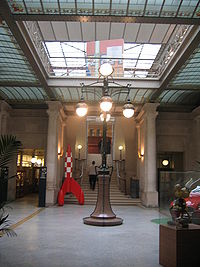
Recognition for the Belgian comics outside the fandom was slow to come, but in the 1970s more and more comics and authors got reviews and articles in newspapers and magazines. The first official stamp picturing a comics hero was made in 1979, showing Tintin, and most famous Belgian comics followed in the next decades. Major expositions were organized from 1969 on, and finally the Belgian Centre for Comic Strip Art
, commonly called the Comics Museum, was opened in Brussels
in 1989 in an old warehouse designed by Victor Horta
. It grew rapidly, with 160,000 visitors in 1994 and 240,000 by 2000. Different Belgian towns have mural paintings and statues of the major comics, and some of the most famous artists have been knighted.
Belgian comics, the authors and the magazines are generally regarded as being central in the development of the European comic. Hergé, with Tintin, and Jijé
, as a comics teacher, are considered as the most influential of the early Belgian authors. French author Tibet
said that the comics artists consider Hergé as God the Father and Jijé as the Godfather. Jijé was not only the teacher of important Belgian authors like André Franquin
, but also of major French authors like Jean Giraud
and Jean-Claude Mézières
. In the Hergé Studio worked French authors like Jacques Martin, and Swiss author Derib
worked for years in the Studio Peyo. The comic magazines Tintin and Spirou were translated in different languages, and the major comics from the magazines were reprinted in the main comics magazines in Italy, Spain, Portugal, Germany, or The Netherlands. Albums of the main series and authors have been translated in dozens of languages, and even many minor series have been translated in different languages in Western Europe. Artists like the Dutch Joost Swarte
, American Chris Ware
, Australian Bill Leak
or Norwegian
Jason are heavily influenced by the ligne claire
of Hergé, while others like the Spanish Daniel Torres, Finnish
Pora and French Yves Chaland
more closely followed the "Atom Style" of Jijé and Franquin. More recent artists like Kamagurka
and Philippe Geluck
are especially popular in France. More recently, Belgian graphic novel
s have been translated in English as well, like Jean-Philippe Stassen
s Deogratias, while many older series are reprinted as well, though often with limited success.
Especially Hergé and Tintin have also had a lot of influence on other artists outside the circle of comics authors, like Roy Lichtenstein
and Andy Warhol
. Hergé has also been recognised by a street and a statue in Angoulême
, France
, and both the French and the Dutch postal offices have issued stamps remembering Tintin.
Video games and animated and live action movies have been made for popular series like XIII, Tintin, Spirou et Fantasio, Spike and Suzy and Lucky Luke, and the long-running Hanna-Barbera
series of The Smurfs became a worldwide success with massive merchandising, and the success continues as evidenced by the ratings animated cartoons based on the adventures of Tintin and Lucky Luke had in Germany and Canada in 2005 and 2006. But also more mature graphic novels like The Wedding Party by Hermann Huppen
and Jean Van Hamme
have been turned into movies.
Most major European comic artists worked for a while, often early in their career, in Belgium: French authors like Albert Uderzo
and René Goscinny
, Jacques Tardi
, Jean Graton
and Claire Bretécher
, a German like Andreas
, the Polish author Grzegorz Rosiński
, the Portuguese Carlos Roque
, Swiss authors Zep
and Cosey... Even the major Italian author Hugo Pratt
created many of his best known later works for Casterman
.
European comics
European comics is a generalized terms for comics produced in Continental Europe. Though technically European, British comics are for historical and cultural reasons considered separate from European comics due to the existence of a well-established domestic market and traditions which more closely...
, alongside France
France
The French Republic , The French Republic , The French Republic , (commonly known as France , is a unitary semi-presidential republic in Western Europe with several overseas territories and islands located on other continents and in the Indian, Pacific, and Atlantic oceans. Metropolitan France...
with whom they share a long common history
Franco-Belgian comics
Franco-Belgian comics are comics that are created in Belgium and France. These countries have a long tradition in comics and comic books, where they are known as BDs, an abbreviation of bande dessinée in French and stripverhalen in Dutch...
. While the comics in the two major language groups and regions of Belgium
Belgium
Belgium , officially the Kingdom of Belgium, is a federal state in Western Europe. It is a founding member of the European Union and hosts the EU's headquarters, and those of several other major international organisations such as NATO.Belgium is also a member of, or affiliated to, many...
(Flanders
Flanders
Flanders is the community of the Flemings but also one of the institutions in Belgium, and a geographical region located in parts of present-day Belgium, France and the Netherlands. "Flanders" can also refer to the northern part of Belgium that contains Brussels, Bruges, Ghent and Antwerp...
with the Dutch language
Dutch language
Dutch is a West Germanic language and the native language of the majority of the population of the Netherlands, Belgium, and Suriname, the three member states of the Dutch Language Union. Most speakers live in the European Union, where it is a first language for about 23 million and a second...
and Wallonia with French
French language
French is a Romance language spoken as a first language in France, the Romandy region in Switzerland, Wallonia and Brussels in Belgium, Monaco, the regions of Quebec and Acadia in Canada, and by various communities elsewhere. Second-language speakers of French are distributed throughout many parts...
) each have clearly distinct characteristics, they are constantly influencing one another, and meeting each other in Brussels
Brussels
Brussels , officially the Brussels Region or Brussels-Capital Region , is the capital of Belgium and the de facto capital of the European Union...
and in the bilingual publication tradition of the major editors. As one of the few arts where Belgium has had an international and enduring impact in the twentieth century, comics are known to be "an integral part of Belgian culture".
Before 1940
Brussels
Brussels , officially the Brussels Region or Brussels-Capital Region , is the capital of Belgium and the de facto capital of the European Union...
). The most popular were La Semaine de Suzette
La Semaine de Suzette
La Semaine de Suzette was a French magazine aimed at girls, which appeared from 1905 until 1960. It contained early comics like Bécassine.-History:...
, L'Épatant and Le bon point illustré. French authors like Marijac
Marijac
Jacques Dumas , better known as Marijac, was a French comics writer, artist and editor.-Biography:Jacques Dumas was born in Paris in 1908. He started his career as a comics artist in te 1930s and used the pen name Marijac. His best known character in this period was the cowboy Jim Boum, which...
contributed to Belgian magazines as well.
The 1920s saw the formation of many new youth magazines, some independent like the bilingual Zonneland / Petits Belges from Catholic publishers Altiora Averbode or scout magazines like Le Boy-Scout Belge, where Hergé
Hergé
Georges Prosper Remi , better known by the pen name Hergé, was a Belgian comics writer and artist. His best known and most substantial work is the 23 completed comic books in The Adventures of Tintin series, which he wrote and illustrated from 1929 until his death in 1983, although he was also...
(Georges Remi) debuted; others were published as newspaper supplements. The most famous of these was Le Petit Vingtième
Le Petit Vingtième
Le Petit Vingtième was the weekly youth supplement to the Belgian newspaper Le Vingtième Siècle from 1928 to 1940. The comics series The Adventures of Tintin first appeared in its pages.-History:...
, the weekly youth supplement to the Catholic newspaper Le Vingtième Siècle. Founded in 1928, it employed the young artist Georges Remi as editor-in-chief and main contributor. Remi, better known as Hergé
Hergé
Georges Prosper Remi , better known by the pen name Hergé, was a Belgian comics writer and artist. His best known and most substantial work is the 23 completed comic books in The Adventures of Tintin series, which he wrote and illustrated from 1929 until his death in 1983, although he was also...
, launched in January 1929 a new series for the supplement: The Adventures of Tintin
The Adventures of Tintin
The Adventures of Tintin is a series of classic comic books created by Belgian artist , who wrote under the pen name of Hergé...
. Initially heavily influenced by the work of French comics authors Alain Saint-Ogan
Alain Saint-Ogan
Alain Saint-Ogan was a French comics author and artist.-Biography:In 1925, he created the well-known comic strip Zig et Puce , which initially appeared in the Dimanche Illustré , the weekly youth supplement of the French daily newspaper, l'Excelsior.His other comic...
and Pinchon and the American George McManus
George McManus
George McManus was an American cartoonist best known as the creator of Irish immigrant Jiggs and his wife Maggie, the central characters in his syndicated comic strip, Bringing Up Father....
, Hergé soon developed his own style. Tintin soon became very popular, and sales of the newspaper quadrupled on Thursdays, when the supplement was included. It would become the prototype for many Belgian comics to come, in style (the so-called Ligne claire
Ligne claire
Ligne claire is a style of drawing pioneered by Hergé, the Belgian creator of The Adventures of Tintin. It uses clear strong lines of uniform importance. Artists working in it do not use hatching, while contrast is downplayed as well...
), appearance rhythm (weekly), use of speech balloons
Speech balloon
Speech balloons are a graphic convention used most commonly in comic books, comic strips and cartoons to allow words to be understood as representing the speech or thoughts of a given character in the comic...
(whereas comics from other countries like the Netherlands
Netherlands
The Netherlands is a constituent country of the Kingdom of the Netherlands, located mainly in North-West Europe and with several islands in the Caribbean. Mainland Netherlands borders the North Sea to the north and west, Belgium to the south, and Germany to the east, and shares maritime borders...
and Denmark
Denmark
Denmark is a Scandinavian country in Northern Europe. The countries of Denmark and Greenland, as well as the Faroe Islands, constitute the Kingdom of Denmark . It is the southernmost of the Nordic countries, southwest of Sweden and south of Norway, and bordered to the south by Germany. Denmark...
would keep the text beneath the drawings for decades to come), and the method of using a first appearance in a magazine or newspaper and subsequent albums.
While Tintin was very popular, it would take almost a decade before the next successful comics magazine would appear. In the meantime, an increasing number of youth magazines would publish some pages with comics influenced by Tintin.
George Van Raemdonck
George Van Raemdonck
George Van Raemdonck was a Belgian comics artist and painter, and is generally considered to be the first Flemish comics author. He mainly worked for left-wing, socialist and anti-fascist magazines and newspapers, creating thousands of political cartoons.-Biography:George van Raemdonck was born in...
, the first major Flemish comics artist, worked almost exclusively in the Netherlands
Netherlands
The Netherlands is a constituent country of the Kingdom of the Netherlands, located mainly in North-West Europe and with several islands in the Caribbean. Mainland Netherlands borders the North Sea to the north and west, Belgium to the south, and Germany to the east, and shares maritime borders...
until after World War II
World War II
World War II, or the Second World War , was a global conflict lasting from 1939 to 1945, involving most of the world's nations—including all of the great powers—eventually forming two opposing military alliances: the Allies and the Axis...
. Still, he influenced some of the earliest pre-war Flemish artists like Jan Waterschoot and Buth, and as a newspaper artist with a daily comic strip, he paved the way for the typical publishing method of the Flemish comics when compared to the prevalent Walloon magazine publications.
More situated in the classic arts than in the mainstream comics publishing was Frans Masereel
Frans Masereel
Frans Masereel was a Flemish painter and graphic artist who worked mainly in France. He is known especially for his woodcuts. His greatest work is generally said to be the wordless graphic novel Mon Livre d'Heures . He completed over 20 other wordless novels in his career...
, a Flemish wood engraver whose 1926 "Passionate Journey", a wordless story told in 165 woodcuts, is sometimes considered as the first graphic novel
Graphic novel
A graphic novel is a narrative work in which the story is conveyed to the reader using sequential art in either an experimental design or in a traditional comics format...
.
In the second half of the 1930s, most Walloon youth magazines made room for one or more comics by local artists. Examples are Jijé
Jijé
Jijé was a Belgian comics artist, best known for being a seminal artist on the Spirou et Fantasio strip and the creator of one of the first major European western strips, Jerry Spring.-Biography:Born Joseph Gillain in Gedinne, Namur, he completed various art studies Jijé (13 January 1914 – 20...
in Le Croisé in 1936 and in Petits Belges in 1939, François Gianolla in Jeunesse Ouvrière, and Sirius in Le Patriote Illustré. Dupuis
Dupuis
Éditions Dupuis S.A. is a Belgian publisher of comic books and magazines.Based in Marcinelle near Charleroi, Dupuis was founded in 1922 by Jean Dupuis, and is mostly famous for its comic albums and magazines. It is originally a French language publisher, but publishes many editions both in French...
, a publisher based in Marcinelle
Marcinelle
Marcinelle is a Walloon town in the Belgian province of Hainaut, it is currently a municipality within the Charleroi borders. Until 1977, the town was a municipality of its own....
near Charleroi
Charleroi
Charleroi is a city and a municipality of Wallonia, located in the province of Hainaut, Belgium. , the total population of Charleroi was 201,593. The metropolitan area, including the outer commuter zone, covers an area of and had a total population of 522,522 as of 1 January 2008, ranking it as...
, was already having success with its two family magazines Le Moustique and Bonnes Soirées. Charles Dupuis, son of the CEO, decided to start a youth magazine centred around a new hero, Spirou
Spirou (magazine)
Spirou magazine is a weekly Belgian comics magazine published by the Dupuis company...
. It debuted on April 21, 1938. French artist Robert Velter
Robert Velter
François Robert Velter , known by his pen-name Rob-Vel, was a French cartoonist. He is best known for creating the character Spirou in 1938.-Biography:...
, a former assistant of Martin Branner
Martin Branner
Martin Michael Branner , known to his friends as Mike Branner, was a cartoonist who created the popular comic strip Winnie Winkle...
, was asked to create the title series, and the rest of the magazine was filled with popular American comics such as Superman
Superman
Superman is a fictional comic book superhero appearing in publications by DC Comics, widely considered to be an American cultural icon. Created by American writer Jerry Siegel and Canadian-born American artist Joe Shuster in 1932 while both were living in Cleveland, Ohio, and sold to Detective...
. 8 months later, in an unusual move, the magazine was published in Dutch under the name Robbedoes. This would have a profound influence on the development of the Flemish comics and assured that Belgian comics would have a large part of their development in common. In 1939, Jijé
Jijé
Jijé was a Belgian comics artist, best known for being a seminal artist on the Spirou et Fantasio strip and the creator of one of the first major European western strips, Jerry Spring.-Biography:Born Joseph Gillain in Gedinne, Namur, he completed various art studies Jijé (13 January 1914 – 20...
joined the magazine. He worked there until his death in 1980, and was the driving force of the magazine during and directly after the war. He was responsible for its expansion and success in the next decades, and was as the inspirator for the later generation of comics artists in the 1940s
1940s
File:1940s decade montage.png|Above title bar: events which happened during World War II : From left to right: Troops in an LCVP landing craft approaching "Omaha" Beach on "D-Day"; Adolf Hitler visits Paris, soon after the Battle of France; The Holocaust occurred during the war as Nazi Germany...
and 1950s
1950s
The 1950s or The Fifties was the decade that began on January 1, 1950 and ended on December 31, 1959. The decade was the sixth decade of the 20th century...
which is known as the Marcinelle school
Marcinelle school
The term "Marcinelle school" refers to a group of Belgian cartoonists formed by Joseph Gillain following World War II...
. Apart from Hergé, Jijé's main inspiration came from American artists such as Milton Caniff
Milton Caniff
Milton Arthur Paul Caniff was an American cartoonist famous for the Terry and the Pirates and Steve Canyon comic strips.-Biography:...
and Noel Sickles
Noel Sickles
Noel Douglas Sickles was an American commercial illustrator and cartoonist, best known for the comic strip Scorchy Smith....
.
Some Flemish magazines started producing more modern local comics as well, with works by established artists like Frans Van Immerseel in Zonneland and the expressionist
Expressionism
Expressionism was a modernist movement, initially in poetry and painting, originating in Germany at the beginning of the 20th century. Its typical trait is to present the world solely from a subjective perspective, distorting it radically for emotional effect in order to evoke moods or ideas...
painter Frits Van den Berghe
Frits Van den Berghe
Frits Van den Berghe was a Belgian expressionist painter.He was born at Ghent. Like his friends Constant Permeke and Gustave De Smet, he first adopted the late-impressionist style of Emile Claus, but converted to expressionism during World War I....
in Bravo
Bravo (magazine)
Bravo is the largest teen magazine within the German-language sphere. The first issue was published in 1956, subtitled as "the magazine for film and television" . Marilyn Monroe's portrait graced the first published issue, the never-published dummy issue cover displayed Elvis Presley.-History:The...
, or new names like Jan Waterschoot in Zonneland or Eugeen Hermans (aka Pink) in Ons Volkske, a weekly newspaper supplement inspired by Le Petit Vingtième. The most important comics writer for Bravo and Zonneland was John Flanders, who would continue to provide stories for the Flemish magazines until the 1960s.
World War II
During the war, many magazines had to stop publication or scale back their activities due to paper shortage and the limitations imposed by the German occupiers. Le Petit VingtièmeLe Petit Vingtième
Le Petit Vingtième was the weekly youth supplement to the Belgian newspaper Le Vingtième Siècle from 1928 to 1940. The comics series The Adventures of Tintin first appeared in its pages.-History:...
was dissolved after the German invasion, and Hergé
Hergé
Georges Prosper Remi , better known by the pen name Hergé, was a Belgian comics writer and artist. His best known and most substantial work is the 23 completed comic books in The Adventures of Tintin series, which he wrote and illustrated from 1929 until his death in 1983, although he was also...
started working for the collaborating newspaper Le Soir
Le Soir
Le Soir is a Berliner Format Belgian newspaper. Le Soir was founded in 1887 by Emile Rossel. It is the most popular Francophone newspaper in Belgium, and considered a newspaper of record.-Editorial stance:...
, where he had to change from a weekly double page of Tintin to a daily strip. Paper shortage also forced him to reduce the number of pages per album from the previous 120 to 62. To compensate for this, the editor Casterman
Casterman
Casterman is a publisher of Franco-Belgian comics, specializing in comic books and children's literature. The company is based in Tournai, Belgium.Founded in 1780, Casterman was originally a printing company and publishing house...
decided to start publishing the albums in colour instead of black and white. This became the post-war standard for all albums by the Walloon and Brussels publishers: From the 1960s on, almost all Flemish comics have been printed in colour.
Other magazines tried to continue publication, but had to replace the forbidden American comics with local material. This was an opportunity for new talent to emerge. In Spirou, Jijé was joined by Sirius and the young illustrator Maurice Tillieux
Maurice Tillieux
Maurice Tillieux was a Belgian writer and comic artist. He is regarded by many as a major figure of post-war Belgian comics.-Early life:...
.
The Flemish magazine Bravo, started in 1936 with almost exclusively American comics, had to change course in 1940, and created a French language version as well, attracting a number of young Belgian artists like Edgar P. Jacobs, Jacques Laudy
Jacques Laudy
Jacques Laudy was a Belgian comics artist, who contributed to the early issues of the weekly Tintin magazine....
, Raymond Reding and the Flemish Willy Vandersteen
Willy Vandersteen
Willy Vandersteen was a Belgian creator of comic books. In a career spanning 50 years, he created a large studio and published more than 1,000 comic albums in over 25 series, selling more than 200 million copies worldwide....
, together with the already well-known illustrator Jean Dratz
Jean Dratz
- Biography :Jean Dratz was born in Mont-Saint-Guibert, Belgium in 1903 as the son and student of Constant Dratz. He studied Law and Economy at the Université Libre de Bruxelles. As an artist, he is best known for his sober, realistic and melancholic Belgian landscapes which show Japanese influences...
.
Another way out for young artists were a number of small animation studios, created when the popular American animated movies of the 1930s might no longer be shown. In Antwerp, Ray Goossens
Ray Goossens
Ray Goossens was a Flemish artist, animator and director best known for creating Musti.-Biography:Ray Goossens was born in Merksem, Belgium in 1924. Interested in animation from before World War II, he created the animation studio AFIM in Antwerp in 1940, together with Jules Luyckx and Henri...
and Bob de Moor
Bob de Moor
Bob de Moor is the pen name of Robert Frans Marie De Moor , a Belgian comics creator. Chiefly noted as an artist, he is considered an early master of the Ligne claire style. He wrote and drew several comics series on his own, but also collaborated with Hergé on several volumes of The Adventures of...
started with AFIM, and in Brussels, André Franquin
André Franquin
André Franquin was an influential Belgian comics artist, whose best known comic strip creations are Gaston and Marsupilami, created while he worked on the Spirou et Fantasio comic strip from 1947 to 1969, during a period seen by many as the series' golden age.-Franquin's beginnings:Franquin was...
, Eddy Paape
Eddy Paape
Eddy Paape is a Franco-Belgian comics artist best known for illustrating the series Luc Orient.-Biography:Eddy Paape was born in Grivegnée , Belgium in 1920...
, Peyo
Peyo
Pierre Culliford , known as Peyo, was a Belgian comics artist, perhaps best known for the creation of The Smurfs comic strip.-Biography:...
and Morris
Morris (comics)
Maurice De Bevere , better known as Morris, was a Belgian cartoonist and the creator of Lucky Luke. His pen name is an alternate spelling of his first name.-Biography:...
worked for CBA.
1944-1958
The end of World War IIWorld War II
World War II, or the Second World War , was a global conflict lasting from 1939 to 1945, involving most of the world's nations—including all of the great powers—eventually forming two opposing military alliances: the Allies and the Axis...
was a second caesure, with again many magazines disappearing or changing hands, while a huge amount of new magazines appeared now that censure and paper shortage were coming to an end. Spirou, which had disappeared at the end of 1943, reappeared in 1944 with the same authors. Bravo on the other hand got new owners, and the main contributors searched new publishers. The newspaper Le Soir replaced its wartime version and all the staff with the pre-wartime owners and staff, and Hergé was left without a publication outlet for nearly two years while allegations of collaboration with the Germans were investigated.
In 1946, Raymond Leblanc
Raymond Leblanc
Raymond Leblanc was a Belgian comic book producer and publisher, best known for publishing The Adventures of Tintin, by Hergé and the magazine Tintin...
wanted to start a youth magazine to expand his small publishing house Lombard
Le Lombard
Le Lombard or Lombard Editions is a Belgian comic book publisher established in 1946 when the Tintin magazine was launched. In 1986 the company was acquired by Média-Participations.-Titles:Lombard's more famous series include:*Clifton...
, and decided to use the already very popular Tintin as the main hero for Tintin magazine
Tintin (magazine)
Le journal de Tintin or Kuifje , was a weekly Belgian comics magazine of the second half of the 20th century...
. It started in 1946 with a French and Dutch language version (the latter called Kuifje), as had become the custom for Belgian comics magazines. A version for France
France
The French Republic , The French Republic , The French Republic , (commonly known as France , is a unitary semi-presidential republic in Western Europe with several overseas territories and islands located on other continents and in the Indian, Pacific, and Atlantic oceans. Metropolitan France...
followed in 1948. The magazine immediately employed mainly Belgian artists, most coming from Bravo: Jacobs (who already had collaborated with Hergé), Laudy, and the young debutant Paul Cuvelier
Paul Cuvelier
Paul Cuvelier was a Belgian comics artist best known for the comic series Corentin, published by Le Lombard, which first appeared in the first issue of Tintin.-Biography:...
. It was an instant success, and soon other names joined, including Jacques Martin. To get the same success with the Flemish version (where Tintin was not so well known yet), two of the best new Flemish artists were contacted: Bob de Moor and Willy Vandersteen. De Moor stayed with Hergé and Tintin until the end of his life, but Vandersteen left the magazine again after 11 years.
Many other magazines only survived for a few years, and their best artists then joined either Spirou or Tintin. Magazines like Bimbo, Story
Story (magazine)
Story was a magazine founded in 1931 by journalist-editor Whit Burnett and his first wife, Martha Foley, in Vienna, Austria. Showcasing short stories by new authors, 67 copies of the debut issue were mimeographed in Vienna, and two years later, Story moved to New York City where Burnett and Foley...
or Wrill mainly had regional success and lacked a truly popular main series. Tillieux worked for Bimbo, Martin for Wrill, André-Paul Duchâteau
André-Paul Duchâteau
André-Paul Duchâteau is a Belgian comics writer and mystery novelist. He worked with Tibet on Ric Hochet. He has also written under the pseudonym Michel Vasseur.-Awards:*1974: Grand Prix de Littérature Policière - French Prize...
started his writing career in the new version of Bravo. Petits Belges / Zonneland continued to be published, but only devoted a few pages to comics. The main artist in these days is Renaat Demoen
Renaat Demoen
Renaat Demoen was a Belgian illustrator and comic book creator.-Biography:Renaat Demoen worked for a number of publishers, including Lannoo, when he met Nonkel Fons, editor-in-chief of the youth publications of Averbode, in 1942...
, later joined by François Craenhals
François Craenhals
François Craenhals was a Belgian comics artist best known for the comic series Chevalier Ardent and Les 4 As.-Biography:...
.
The main competitor for Tintin and Spirou in this period was Heroic-Albums, which had a different publishing method: instead of a number of continuing stories which often appeared continuously with a rhythm of one page a week, Heroic published one complete long story every week. The main artists were Tillieux, Fred Funcken, Tibet
Tibet (comics)
Tibet, the pseudonym of Gilbert Gascard , was a French comics artist and writer in the Franco-Belgian comics genre...
, François Craenhals
François Craenhals
François Craenhals was a Belgian comics artist best known for the comic series Chevalier Ardent and Les 4 As.-Biography:...
, Greg, ... Due to being censored in France, the magazine finally disappeared in 1956.
In Flanders, there was a similar boom of new magazines, but the most important artists and comics in the long run worked mainly for the newspapers: Marc Sleen
Marc Sleen
Marcel Honoree Nestor, Knight Neels , known with his pseudonym Marc Sleen, is a Flemish/Belgian comics artist and cartoonist. He is mostly known for his comic The adventures of Nero and co.-Biography:...
filled many pages in the magazine 't Kapoentje, but his main series Nero appeared in the newspaper Het Volk
Het Volk (newspaper)
Het Volk was a Belgian newspaper that focused on "news with a human undertone".-Mission statement:"You will find what you are looking for in Het Volk, the only newspaper where people really make the news. You will read everything on small and big events in your neighborhoods, your cities and far...
from 1947 on. Willy Vandersteen
Willy Vandersteen
Willy Vandersteen was a Belgian creator of comic books. In a career spanning 50 years, he created a large studio and published more than 1,000 comic albums in over 25 series, selling more than 200 million copies worldwide....
worked for a whole series of magazines, both in Dutch and French, but his main series Spike and Suzy
Spike and Suzy
Spike and Suzy, the British title for Suske en Wiske in Dutch, is a comics series created by the Belgian comics author Willy Vandersteen. The strip is known as Bob et Bobette in French and Willy and Wanda in the U.S. It was first published in De Nieuwe Standaard in 1945 and soon became popular...
appeared in De Standaard
De Standaard
De Standaard is a Flemish daily newspaper published in Belgium by Corelio . Circulation was about 102.280 in 2007. It was traditionally a Christian-Democratic paper, associated with the Christian-Democratic and Flemish Party, and in opposition to the Socialist Flemish daily De Morgen...
from 1945 on.
These two artists dominated the Flemish comics scene until 1980, but even though Nero gets translated in French and German, the only success outside Flanders was Spike and Suzy
Spike and Suzy
Spike and Suzy, the British title for Suske en Wiske in Dutch, is a comics series created by the Belgian comics author Willy Vandersteen. The strip is known as Bob et Bobette in French and Willy and Wanda in the U.S. It was first published in De Nieuwe Standaard in 1945 and soon became popular...
, which became the most popular comic of the Netherlands and got a sizable audience in Wallonia as well, mainly because of the appearance of seven specially created stories in Tintin, which are commonly considered to be the best of the series. Due to this success, Vandersteen opened a Studio which produced hundreds of comics and gave many young local artists a steady job. However, contrary to the School of Marcinelle and to a lesser degree the Studios Hergé
Studios Hergé
The Studios Hergé were, between 1950 and 1986, a SARL grouping comics author Hergé and his collaborators, who assisted him with the creation of The Adventures of Tintin and derived products...
, very few artists had a successful independent career after leaving the studio. One of the major series of the Studio was Bessy, originally made for the Walloon newspaper La Libre Belgique
La Libre Belgique
La Libre Belgique is a Belgian newspaper in French. In Belgium, it can be roughly seen as an equivalent of Flemish De Standaard. The paper is widely perceived as pro-catholic...
in 1952, and which would only later find its way to Flanders and finally to a series of more than 1000 comic books in Germany.
Meanwhile, many artists who would later become famous debuted on a small scale in the Walloon newspapers: Peyo
Peyo
Pierre Culliford , known as Peyo, was a Belgian comics artist, perhaps best known for the creation of The Smurfs comic strip.-Biography:...
, Greg, Albert Uderzo
Albert Uderzo
Albert Uderzo is a French comic book artist, and scriptwriter. He is best known for his work on the Astérix series, but also drew other comics such as Oumpah-pah, also in collaboration with René Goscinny.-Early life:...
, René Goscinny
René Goscinny
René Goscinny was a French comics editor and writer, who is best known for the comic book Astérix, which he created with illustrator Albert Uderzo, and for his work on the comic series Lucky Luke with Morris and Iznogoud with Jean Tabary.-Early life:Goscinny was born in Paris in 1926, to a family...
, ...
In the 1950s, the comics scene in Belgium is dominated by three main publishing methods: the main magazines Tintin and Spirou, coupled with the albums published afterwards by the editors Lombard and Dupuis; the daily newspaper comics in Flanders, with the cheaper black and white albums afterwards by De Standaard and Het Volk: and the weekly newspaper supplements of the French language newspapers, which mainly lacked subsequent albums. The number of other magazines slowly decreased, and the independent comic albums publishers without a magazine disappeared with the exception of Casterman
Casterman
Casterman is a publisher of Franco-Belgian comics, specializing in comic books and children's literature. The company is based in Tournai, Belgium.Founded in 1780, Casterman was originally a printing company and publishing house...
, publisher of the comics by Hergé and a limited number of other comics.
In this period, the Belgian comics had their Golden Age, a period of constant growth and expansion, with the start and continuation of many of the most popular Belgian series.
Spirou expanded from 12 pages of newspaper quality to 52 full colour pages, and the number of American comics, reintroduced after the end of the war, dwindled to near nil in 1950. Their place was taken by Victor Hubinon
Victor Hubinon
Victor Hubinon was a Belgian comic-book artist, best known for the series Buck Danny and Redbeard.-Biography:...
and Jean-Michel Charlier
Jean-Michel Charlier
Jean-Michel Charlier was a Belgian script writer best known as a writer of realistic European comics. He was a co-founder of the famed European comics magazine Pilote.-Biography:...
(Buck Danny
Buck Danny
Buck Danny is a Franco-Belgian comics series about a military flying ace and his two sidekicks serving in the United States Navy or the United States Air Force. The series is noted for its realism both in the drawings and the descriptions of air force procedures as part of the storyline. In...
), Maurice Tillieux
Maurice Tillieux
Maurice Tillieux was a Belgian writer and comic artist. He is regarded by many as a major figure of post-war Belgian comics.-Early life:...
(Gil Jourdan
Gil Jourdan
Gil Jourdan is a Belgian detective comic strip created by Maurice Tillieux. It is considered a great combination of mystery, adventure and humour, and a masterpiece of European comics.-Origin and Premise:...
), Eddy Paape
Eddy Paape
Eddy Paape is a Franco-Belgian comics artist best known for illustrating the series Luc Orient.-Biography:Eddy Paape was born in Grivegnée , Belgium in 1920...
, Will
Will (comics)
Willy Maltaite known by the pseudonym Will, was a comics creator and comics artist in the Franco-Belgian tradition...
, and most importantly André Franquin
André Franquin
André Franquin was an influential Belgian comics artist, whose best known comic strip creations are Gaston and Marsupilami, created while he worked on the Spirou et Fantasio comic strip from 1947 to 1969, during a period seen by many as the series' golden age.-Franquin's beginnings:Franquin was...
, Morris
Morris (comics)
Maurice De Bevere , better known as Morris, was a Belgian cartoonist and the creator of Lucky Luke. His pen name is an alternate spelling of his first name.-Biography:...
, and Peyo
Peyo
Pierre Culliford , known as Peyo, was a Belgian comics artist, perhaps best known for the creation of The Smurfs comic strip.-Biography:...
. Their respective series Gaston Lagaffe
Gaston Lagaffe
Gaston is a comic strip created in 1957 by the Belgian cartoonist André Franquin in the comic strip magazine, Spirou. The series focuses on the every-day life of Gaston Lagaffe, a lazy and accident-prone office junior...
, Lucky Luke
Lucky Luke
Lucky Luke is a Belgian comics series created by Belgian cartoonist, Maurice De Bevere better known as Morris, the original artist, and was for one period written by René Goscinny...
and The Smurfs
The Smurfs (comics)
The Smurfs are a Belgian comic series, created by cartoonist Peyo . The fictional characters of the Smurfs first appeared in Johan and Peewit in 1958, and the first independent Smurf comics appeared in 1959. Twenty-nine Smurf comic albums have been created, 16 of them by Peyo...
became international bestsellers. While the first generation learned much of the art while working with Jijé, many younger artists started their professional career in the Studio Peyo before creating their own series, assuring the continuation of the School of Marcinelle. The humour aspect of the magazine was assured by the editor-in-chief Yvan Delporte
Yvan Delporte
Yvan Delporte was a Belgian comics writer, and was editor-in-chief of Spirou magazine between 1955 and 1968 during a period considered by many the golden age of Franco-Belgian comics...
, writer for Franquin, Will and Peyo. Together with the main artists of Tintin, they defined the Franco-Belgian comics
Franco-Belgian comics
Franco-Belgian comics are comics that are created in Belgium and France. These countries have a long tradition in comics and comic books, where they are known as BDs, an abbreviation of bande dessinée in French and stripverhalen in Dutch...
for decades to come.
Tintin had a similar story, with rapid success and expansion. New artists like Jean Graton
Jean Graton
Jean Graton is a comic book author and cartoonist of French nationality. Graton created the famous character Michel Vaillant and the eponymous series in 1957.-Biography:...
(Michel Vaillant
Michel Vaillant
Michel Vaillant is the title of a Belgian comics series created in 1957 by French cartoonist Jean Graton and published originally by Le Lombard. Later, Graton published the albums by himself when he founded Graton éditeur in 1982...
) and Raymond Macherot
Raymond Macherot
Raymond Macherot was a Belgian cartoonist. Although not nearly as famous as fellow Belgian cartoonists such as Hergé or André Franquin, Macherot's work, both as artist and writer, remains highly regarded among critics and collectors.-The Tintin years:Raymond Macherot was born in Verviers, Belgium...
reached new audiences. Hergé started his Studio to help him with the work on the Tintin comics, and it defined the style of many artists like Bob de Moor and Roger Leloup
Roger Leloup
Roger Leloup is a Belgian comic strip artist, novelist, and a former collaborator of Hergé. He is most famous for the Yoko Tsuno comic series.- Biography :...
.
The styles of the two magazines were distinctly different, with the Ligne claire
Ligne claire
Ligne claire is a style of drawing pioneered by Hergé, the Belgian creator of The Adventures of Tintin. It uses clear strong lines of uniform importance. Artists working in it do not use hatching, while contrast is downplayed as well...
and the more serious, didactic tone of Tintin contrasting with the humorous, more caricatural Marcinelle school
Marcinelle school
The term "Marcinelle school" refers to a group of Belgian cartoonists formed by Joseph Gillain following World War II...
of Spirou.
In Flanders, no local magazine could equal the success of the two translated Walloon magazines, and to survive this period, they disappeared as independent magazines and became weekly newspaper supplements. The most important was 't Kapoentje, which published the work of Buth and Rik Clément, but which had no influence outside Flanders. The only new artist to become truly successful in this period was Jef Nys
Jef Nys
Jozef "Jef" Nys was a Belgian comic book creator. He was best known for his comic strip Jommeke.-Biography:...
with Jommeke
Jommeke
Jommeke is the name of a Flemish comic book series and of its main character. It deals with the adventures of Jommeke, a boy of about 11 years old and his friends. The creator of Jommeke was Jef Nys.-History:...
, which debuted in 1955 and became the third major daily newspaper comic in Flanders.
Artists like Pom
Pom (comics)
Jozef Van Hove, better known as Pom, is a Belgian comics writer and artist, mainly known for the comic strip Piet Pienter en Bert Bibber published in Gazet van Antwerpen. Pom was one of the best known Flemish comics authors of the 1950s. Between 1955 and 1995, 45 comic books were published of his...
, Bob Mau or Renaat Demoen
Renaat Demoen
Renaat Demoen was a Belgian illustrator and comic book creator.-Biography:Renaat Demoen worked for a number of publishers, including Lannoo, when he met Nonkel Fons, editor-in-chief of the youth publications of Averbode, in 1942...
were less successful and had only a limited audience, while other Flemish artists started working for the French language magazines, following in the footsteps of Morris in Spirou and Bob de Moor in Tintin. The most successful of those in this period was Berck
Arthur Berckmans
Arthur Berckmans , better known as Berck, is a Belgian comics author, best known for Sammy.-Biography:Arthur Berckmans was born in Leuven in 1929. He studied drawing at the Art academy of Leuven and at the Saint Lucas Institute in Brussels. His first job as an illustrator was in 1948 for the...
, who first appeared in this period in Tintin before moving to Spirou.
1959-1977
From 1959 on, the dominance of Spirou and Tintin slowly disappeared. The first generation of artists could not continue the publication rhythm of the previous decades, and French magazines reached new audiences, helped by the protectionistic censoring by the French authorities. French artists like René GoscinnyRené Goscinny
René Goscinny was a French comics editor and writer, who is best known for the comic book Astérix, which he created with illustrator Albert Uderzo, and for his work on the comic series Lucky Luke with Morris and Iznogoud with Jean Tabary.-Early life:Goscinny was born in Paris in 1926, to a family...
and Albert Uderzo
Albert Uderzo
Albert Uderzo is a French comic book artist, and scriptwriter. He is best known for his work on the Astérix series, but also drew other comics such as Oumpah-pah, also in collaboration with René Goscinny.-Early life:...
, who previously worked for Belgian magazines and newspapers, started their own magazine Pilote
Pilote
thumb|Cover of the first Pilote teaser issue, #0.Pilote was a French comics periodical published from 1959 to 1989. Showcasing most of the major French or Belgian comics talents of its day the magazine introduced major series such as Astérix le Gaulois, Blueberry, Achille Talon, and Valérian et...
, and the less restrictive atmosphere there attracted some of their main colleagues from Spirou like Morris, Jijé, Charlier and Hubinon. Apart from Morris, they all continued working for Spirou as well, but the decline had started.
Tintin suffered from the lack of new stories by Hergé. Greg became the new editor-in-chief in 1962 and stayed on until 1975, introducing a new, more adult style and content to the magazine, and introducing some major new artists like Hermann Huppen
Hermann Huppen
Hermann Huppen is a Belgian comic book artist. He is better known under his pen-name Hermann. He is most famous for his post-apocalyptic comic Jeremiah which was made into a television series.-Biography:...
, William Vance
William Vance
William Vance, the pen name of William van Cutsem, born 8 September 1935, is a Belgian comics artist widely known throughout a long career for his distinctive style and work in Franco-Belgian comics.- Biography :...
, Jean Van Hamme
Jean Van Hamme
Jean Van Hamme is a Belgian novelist and comic book writer. He has written scripts for a number of Belgian/French comic series, including Histoire sans héros, Thorgal, XIII and Largo Winch.-Early years:...
and Dany
Dany (comics)
Dany, pseudonym for Daniel Henrotin is a Belgian comic book artist, best known for Olivier Rameau and Ça vous intéresse?.-Biography:...
. But despite the critical acclaim of these authors, the circulation slowly declined from the record high of 270,000 copies a week in France alone, and the different international editions of Tintin disappeared over the next decade, but not before launching a last major series with Thorgal
Thorgal
Thorgal is a critically acclaimed Belgian comic book series by the Belgian writer Jean Van Hamme and the Polish graphic artist Grzegorz Rosiński. It first appeared in serial form in the "Tintin" magazine in 1977, and has been published in hardcover volumes by Le Lombard from 1980 on...
by Rosinski.
Spirou as well had to introduce new artists and series to fill the pages and keep their readers. It took many of them until around 1970 to become real stars, with the rise of Raoul Cauvin
Raoul Cauvin
Raoul Cauvin is a Belgian comics author and one of the most popular in the humorist field.-Biography:Raoul Cauvin was born in Antoing, Belgium in 1938. He studied lithography at the Institut Saint-Luc in Tournai, but upon leaving school found that there no jobs available for lithographers...
as the new main writer of the magazine. The biggest new series of the 1960s was Boule et Bill
Boule et Bill
Boule et Bill is a popular comic, created in 1959 by the Belgian writer-artist Jean Roba in collaboration with Maurice Rosy. In 2003 the artistic responsibility of the series was passed on to Roba's former assistant Laurent Verron...
by Franquin-collaborator Jean Roba
Jean Roba
Jean Roba was a Belgian comics author from the Marcinelle school. His best-known work is Boule et Bill.-Biography:...
. It became the most popular series of the magazine together with Gaston Lagaffe after the disappearance of Lucky Luke in 1967. Around 1970, Berck
Arthur Berckmans
Arthur Berckmans , better known as Berck, is a Belgian comics author, best known for Sammy.-Biography:Arthur Berckmans was born in Leuven in 1929. He studied drawing at the Art academy of Leuven and at the Saint Lucas Institute in Brussels. His first job as an illustrator was in 1948 for the...
(Sammy
Sammy (comics)
Sammy is a popular humour Belgian comics series. It first started in 1970 in the weekly comic Spirou magazine, has been published in book form and even been the subject of several omnibus editions by Dupuis...
), Lambil
Lambil
Lambil is a Belgian comic-book artist, best known for the series Les Tuniques Bleues, which has been published in English as "The Blue Tunics" and "The Bluecoats".-Biography:Willy Lambillotte was born in Tamines, Belgium in 1936...
(Les Tuniques Bleues
Les Tuniques Bleues
Les Tuniques Bleues is a Belgian series of bandes dessinées , first featured in Spirou and later published by Dupuis. Created by Louis Salverius, the series was taken up by artist Willy Lambillotte and writer Raoul Cauvin. It follows two United States cavalrymen through a series of battles and...
), François Walthéry
François Walthéry
François Walthéry is a Belgian comics artist, best known for his series featuring an adventurous flight attendant, Natacha.-Biography:...
(Natacha
Natacha (comics)
Natacha is a Franco-Belgian comics series, created by François Walthéry and Gos. Drawn by Walthéry, its stories have been written by several authors including Gos, Peyo, Maurice Tillieux, Raoul Cauvin and Marc Wasterlain. It was first published in the comics magazine Spirou on February 26, 1970...
), and Leloup (Yoko Tsuno
Yoko Tsuno
Yoko Tsuno is a comic book series created by the Belgian writer Roger Leloup published by Dupuis and in Spirou since its debut in 1970. Through twenty-five volumes, the series tell the adventures of Yoko Tsuno, a female electrical engineer of Japanese origin surrounded by her close friends, Vic...
) were the main new artists and series, with Raoul Cauvin as the most important writer. However, the top circulation of about 280,000 copies a week (France and Belgium combined), was no longer reached after 1966.
In Flanders, the situation was very stable, with the limited local publication possibilities all taken by the established authors of the 1940s and 1950s, leaving no room for new talents after the disappearance of most magazines. New artists either started working in the large Studio Vandersteen or tried to get into Spirou and Tintin, thereby strengthening the bond between the comics scenes of both language groups.
Comics fandom, started in the Netherlands and France in the 1960s, emerged in Flanders in 1966 with the different publications by Jan Smet, who also created the first Flemish comics award in 1972. This developed into the Bronzen Adhemar
Bronzen Adhemar
The Bronzen Adhemar is the official Flemish Community Cultural Prize for Comics, given to a Flemish comics author for his body of work. It is awarded by the Flemish Ministry of Culture during Strip Turnhout, the major Flemish comics festival, once every two years...
, the most important comics award of Flanders. In Wallonia, it only seriously commenced in 1971, with the first awards (the Prix Saint-Michel
Prix Saint-Michel
The Prix Saint-Michel is a series of comic awards presented by the city of Brussels, with a focus on Franco-Belgian comics. They were first awarded in 1971, and are the second oldest comics award in Europe still presented, behind the Adamson Awards...
in Brussels) and fanzine (Rantanplan), both by André Leborgne, and the first specialized shop and republisher of old material, Michel Deligne. The Institut Saint-Luc
Institut Saint-Luc
The Institut Saint-Luc is an arts school in Brussels. It consists of six departments, with a total of 2200 students and some 430 employees, divided over five locations in Ixelles and Saint-Gilles.-History:...
in Brussels created a comics department with teachers like Eddy Paape, and was largely responsible for the new, more adult-oriented authors who came to the fore in the 1980s and 1990s. Expositions with the major artists were organized throughout the country, some by amateur enthusiasts, some endorsed by the government.
1978-now
The last decades have shown the further decline of the traditional publication systems of the Belgian comics, and the end of the dominance of the Belgian authors in European comics.Reflecting the shift from the dominance of weekly youth comics to longer adult comics was the demise of Tintin and the start of A Suivre
À Suivre
or was a Franco-Belgian comics magazine published from February 1978 to December 1997 by the Casterman publishing house....
in 1978, the more adult oriented monthly magazine of publisher Casterman
Casterman
Casterman is a publisher of Franco-Belgian comics, specializing in comic books and children's literature. The company is based in Tournai, Belgium.Founded in 1780, Casterman was originally a printing company and publishing house...
. It published longer "chapters" of the main European authors of graphic novels, with artists like Hugo Pratt
Hugo Pratt
Hugo Eugenio Pratt was an Italian comic book creator who was known for combining strong storytelling with extensive historical research on works such as Corto Maltese...
and Jacques Tardi
Jacques Tardi
Jacques Tardi is a French comics artist, born 30 August 1946 in Valence, Drôme. He is often credited solely as Tardi.-Biography:After graduating from the École nationale des Beaux-Arts de Lyon and the École nationale supérieure des arts décoratifs in Paris, he started writing comics in 1969, at the...
. Among them, room was still reserved for the best Walloon and Brussels' talents, including Didier Comès
Didier Comès
Didier Comès is a Belgian comics artist, best known for his graphic novels published in the magazine .-Biography:...
, Benoît Sokal
Benoît Sokal
Benoît Sokal is a Belgian comic artist and video game developer, best known for his comics series Inspector Canardo.-Biography:...
, and François Schuiten
François Schuiten
Baron François Schuiten is a Belgian comic book artist. He is best known for drawing the series Les Cités Obscures.-Biography:François Schuiten was born in Brussels, Belgium in 1956....
. The magazine, seen as the more intellectual reply to French magazines like Métal Hurlant
Métal Hurlant
Métal Hurlant is a French comics anthology of science fiction and horror comics stories, created in December 1974 by comics artists Jean Giraud and Philippe Druillet together with journalist-writer Jean-Pierre Dionnet and financial director Bernard Farkas.The four were collectively known as "Les...
who were more oriented towards graphical innovation, was a big success and had a lot of influence, but turned out to be relatively short-lived. The Dutch language edition, started in 1980, folded in 1989 (the same year Poilote ceased publication), and in 1997 the French language edition disappeared as well, further demonstrating the demise of the magazine format in a market where most people prefer to immediately buy the albums.
In Flanders, a final experiment with a youth comics magazine was started in 1993 with Suske en Wiske Weekblad by Standaard Uitgeverij
Standaard Uitgeverij
Standaard Uitgeverij is a Belgian publisher, and the leading publisher in the Dutch language market of Flanders.-History:In 1919, the Standaard group was created, mainly consisting of a chain of bookshops , a newspaper and a publishing house, the Standaard Uitgeverij...
: with a mix of classic comics and new series and carried by the most popular Dutch language series and a sizable promotional campaign, it got a sizable audience at first, but slowly lost momentum and disappeared in 2003.
The only comics magazine to survive is Spirou, but with the end of the Dutch version Robbedoes in 2005, when the circulation had dropped to only about 3,000 copies, no mass-market comics magazines for the Flemish audience remained, making it harder for young Flemish artists to gain a larger audience.
Spirou, meanwhile, after a decline during the 1970s and 1980s from 280,000 to 160,000 copies, holds on to a quite steady circulation, and is a mix of a showcase for Dupuis and a method to test new artists and series before doing the sizable investment of an album series. After experiments to target a more mature audience in the late 1970s and in the 1980s with the supplement Le Trombone Illustré and the publication of comics like XIII
XIII (comic book)
XIII is a Franco-Belgian comics series written and drawn by Belgians Jean Van Hamme and William Vance, revolving around an amnesiac protagonist who seeks to discover his concealed past. With its plot inspired by Robert Ludlum's book The Bourne Identity, XIII was initially serialised in 1984 in...
and Jeremiah, the focus is again fixed on humour series and an audience of young teenagers. Now famous artists like Bernard Hislaire
Bernard Hislaire
Bernard Hislaire is a Belgian comic book creator. He is also known as Sylaire and as Yslaire, his current artist name.-Biography:...
, Zep
Zep
Zep is the pseudonym of Philippe Chappuis, a comics creator from Switzerland, known for his series Titeuf, a popular character in French-speaking countries, and Tchô!, the associated comics magazine.-Biography:...
, Tome
Philippe Vandevelde
Philippe Vandevelde, working under the pseudonym Tome , is a comic strip script writer. He is known for collaborations with Janry on Spirou et Fantasio and Le Petit Spirou, and with Luc Warnant and later Bruno Gazzotti on Soda...
, Janry or Midam
Midam
Midam is the pseudonym of Michel Ledent, the Belgian comics author best known for Kid Paddle.-Biography:Michel Ledent was born in Etterbeek near Brussels in 1963. He studied illustration and interior decoration at the Institut Saint-Luc in Brussels, and started creating comics in 1989 for the...
debut or still publish in the magazine.
But next to the magazine, Dupuis, like all the other editors, targets the older audience as well with a collection of graphic novels.
Both Lombard and Dupuis have since been bought by the French media concern Média Participations, but retain a large degree of independence.
In Flanders, this period started with the appearance of two new successful newspaper comics, Bakelandt by Hec Leemans and the extremely successful Kiekeboe
Kiekeboe
De Kiekeboes is a comic strip series created by Belgian artist Merho in 1977. The series appears in Dutch. It is first published in the newspapers Gazet van Antwerpen and Het Belang van Limburg and then published as comic books by Standaard Uitgeverij...
by Merho
Merho
Merho , the pseudonym of Robert Merhottein, is a Belgian comic-book writer and artist, best known for creating the comic strip Kiekeboe.-Early life:...
. But they seemed to be at the same time the final successes of a slowly dying system, and comics in Flanders are more and more centered around albums as well. Successful series and authors are few and far between, and most, like Urbanus
Urbanus
Urbain Servranckx , also known as Urbain and Urbanus van Anus, is a Belgian stand-up comedian, actor, singer and comic book writer.-Career:...
or F. C. De Kampioenen
F. C. De Kampioenen
F.C. De Kampioenen, was a long-running Flemish sitcom chronicling the adventures of a fictional local football team...
, are only a local success. A few peripheral figures like Ever Meulen
Ever Meulen
Ever Meulen is a Belgian illustrator and comic strip artist. His work has appeared in Humo, the magazine for which he drew "Balthazar de Groene Steenvreter" and "Piet Peuk"...
, who is mainly an illustrator, or Kamagurka
Kamagurka
Kamagurka, aka Luc Zeebroek, is a Belgian cartoonist, playwright and television producer, known for the absurd nature of his work. He has a big variety of comic figures, but "Bert en Bobje" are the most well-known...
, who is more of a cartoonist, do become successful in Wallonia, France and the Netherlands, but apart from those exceptions, the main method for Flemish comics artists to become successful is still being published by the three French language publishers.
Some of the most successful of these since the 1960s are William Vance
William Vance
William Vance, the pen name of William van Cutsem, born 8 September 1935, is a Belgian comics artist widely known throughout a long career for his distinctive style and work in Franco-Belgian comics.- Biography :...
, Jo-El Azara
Joseph Loeckx
Joseph Franz Hedwig Loeckx is a Belgian comic book artist. He works under the pseudonym of Jo-El Azara. Important series he has worked on include Clifton and Taka Takata.-Biography:...
, Griffo, Marvano
Marvano
-Biography:Born in 1953 in Belgium, he studied interior architecture before working as an illustrator and starting to draw graphic novels. Probably his best known work is the collaboration with Joe Haldeman on the Forever War graphic novel, an adaptation of the award-winning The Forever War novel...
, Jean-Pol, Jan Bosschaert
Jan Bosschaert
Jan Bosschaert is a Belgian comics artist, painter and illustrator, best known for the comic series Sam and Jaguar, and his illustrations for the books of Marc De Bel.-Biography:...
and Luc Cromheecke
Luc Cromheecke
Luc Cromheecke , is a Belgian comics artist best known for the comic series Tom Carbon, Taco Zip, Roboboy and Plunk.-Biography:Luc Cromheecke was born in Antwerp in 1961...
.
Sales
While until 1930 almost all comics published in Belgium were either French or American, due to the success of Tintin in 1950 almost no foreign comics are published in Belgium anymore, and by 1960 many or even most comics read in other Western European countries (excluding the United KingdomUnited Kingdom
The United Kingdom of Great Britain and Northern IrelandIn the United Kingdom and Dependencies, other languages have been officially recognised as legitimate autochthonous languages under the European Charter for Regional or Minority Languages...
) are made by Belgians or for Belgian magazines. By 1944, 275,000 albums of Tintin had been sold: by 2000, the worldwide sales had multiplied to nearly 200 million.
In 2000, almost 40 million albums were printed in Belgium each year: 75% of those were exported. An estimated 75% of the comics sold in France were made by the three large Belgian comics publishers, Dupuis
Dupuis
Éditions Dupuis S.A. is a Belgian publisher of comic books and magazines.Based in Marcinelle near Charleroi, Dupuis was founded in 1922 by Jean Dupuis, and is mostly famous for its comic albums and magazines. It is originally a French language publisher, but publishes many editions both in French...
, Le Lombard
Le Lombard
Le Lombard or Lombard Editions is a Belgian comic book publisher established in 1946 when the Tintin magazine was launched. In 1986 the company was acquired by Média-Participations.-Titles:Lombard's more famous series include:*Clifton...
and Casterman
Casterman
Casterman is a publisher of Franco-Belgian comics, specializing in comic books and children's literature. The company is based in Tournai, Belgium.Founded in 1780, Casterman was originally a printing company and publishing house...
. Dupuis alone, with a production of 9 to 10 million albums a year and a back catalogue of 1,000 titles, is responsible for one third of the French comics market. The Flemish market is largely monopolized by the giant Standaard Uitgeverij
Standaard Uitgeverij
Standaard Uitgeverij is a Belgian publisher, and the leading publisher in the Dutch language market of Flanders.-History:In 1919, the Standaard group was created, mainly consisting of a chain of bookshops , a newspaper and a publishing house, the Standaard Uitgeverij...
, whose Spike and Suzy
Spike and Suzy
Spike and Suzy, the British title for Suske en Wiske in Dutch, is a comics series created by the Belgian comics author Willy Vandersteen. The strip is known as Bob et Bobette in French and Willy and Wanda in the U.S. It was first published in De Nieuwe Standaard in 1945 and soon became popular...
are produced with 300,000 to 400,000 copies for each new title, half of which are exported to the Netherlands
Netherlands
The Netherlands is a constituent country of the Kingdom of the Netherlands, located mainly in North-West Europe and with several islands in the Caribbean. Mainland Netherlands borders the North Sea to the north and west, Belgium to the south, and Germany to the east, and shares maritime borders...
, and who also publishes Nero, Kiekeboe and Urbanus. Het Volk, who largely existed due to one title, Jommeke
Jommeke
Jommeke is the name of a Flemish comic book series and of its main character. It deals with the adventures of Jommeke, a boy of about 11 years old and his friends. The creator of Jommeke was Jef Nys.-History:...
, with a total sales of 50 million copies in 50 years, has sold its comics to Dupuis. Even though most of these editors are now in foreign (mainly French) hands, they still operate from Belgium and are led by Belgian people. Belgium has more than 700 professional comics creators, making it the country with the most comics artists per km².
In 2010, four of the ten bestselling comics authors in France were Belgians: Jean Van Hamme, Hergé, Raoul Cauvin, and Stephen Desberg
Stephen Desberg
Stephen Desberg is a Belgian writer of comics. In 2010, he was the 10th bestselling author of comics in France, with 412,000 copies of all his comics together sold that year.-Biography:...
. Similarly, six of the ten bestselling comics titles were partly or completely of Belgian origin, with Largo Winch, Lucky Luke, Blake and Mortimer, Le Chat
Le Chat
Le Chat is a comic strip by the Belgian cartoonist Philippe Geluck.The title character, Le Chat, first appeared in November 22nd 1983 and is one of the bestselling Franco-Belgian comics series. Le Chat is an adult, human-sized, anthropomorphic cat which often comes up with elaborate reasonings...
, Le Petit Spirou
Le Petit Spirou
Le Petit Spirou is a popular Belgian comic strip created by Tome and Janry in 1987. The series developed from La jeunesse de Spirou , a Spirou et Fantasio album in which Tome and Janry set to imagine Spirou's youth...
, and Thorgal
Thorgal
Thorgal is a critically acclaimed Belgian comic book series by the Belgian writer Jean Van Hamme and the Polish graphic artist Grzegorz Rosiński. It first appeared in serial form in the "Tintin" magazine in 1977, and has been published in hardcover volumes by Le Lombard from 1980 on...
. In Flanders, comics make up about 14% of the total number of sales of books, with 5 comics (3 from De Kiekeboes and 2 from FC De Kampioenen) in the top 20 of bestselling books of 2010. Only one translated comic made it into the top 20 of bestselling comics in Flanders, Largo Winch
Largo Winch
Largo Winch is a Belgian comic book series by Philippe Francq and Jean Van Hamme, published by Dupuis.The principal character is Largo Winch whose birth name is Largo Winczlav. Other important characters include Nerio Winch , senior Group W executives John D. Sullivan and Dwight E...
, indicating that while Francophone comics are still widely translated in Dutch, the major sellers are local Flemish products.
Influence and recognition
Morris (comics)
Maurice De Bevere , better known as Morris, was a Belgian cartoonist and the creator of Lucky Luke. His pen name is an alternate spelling of his first name.-Biography:...
introduced the term in 1964 when he started a series about the history of comics in Spirou Belgium's comic-strip culture has been called by Time
Time (magazine)
Time is an American news magazine. A European edition is published from London. Time Europe covers the Middle East, Africa and, since 2003, Latin America. An Asian edition is based in Hong Kong...
magazine "Europe's richest"., while the Calgary Sun
Calgary Sun
The Calgary Sun is a daily newspaper published in Calgary, Alberta, Canada. It is a division of Sun Media, a Quebecor company.First published in 1980, the tabloid-format daily replaced the long-running broadsheet newspaper, The Albertan soon after it was acquired by the publishers of the Toronto...
calls Belgium "the home of the comic strip".
Recognition for the Belgian comics outside the fandom was slow to come, but in the 1970s more and more comics and authors got reviews and articles in newspapers and magazines. The first official stamp picturing a comics hero was made in 1979, showing Tintin, and most famous Belgian comics followed in the next decades. Major expositions were organized from 1969 on, and finally the Belgian Centre for Comic Strip Art
Belgian Centre for Comic Strip Art
The Belgian Comic Strip Center chronicles the history of Belgian comics...
, commonly called the Comics Museum, was opened in Brussels
Brussels
Brussels , officially the Brussels Region or Brussels-Capital Region , is the capital of Belgium and the de facto capital of the European Union...
in 1989 in an old warehouse designed by Victor Horta
Victor Horta
Victor, Baron Horta was a Belgian architect and designer. John Julius Norwich described him as "undoubtedly the key European Art Nouveau architect." Indeed, Horta is one of the most important names in Art Nouveau architecture; the construction of his Hôtel Tassel in Brussels in 1892-3 means that...
. It grew rapidly, with 160,000 visitors in 1994 and 240,000 by 2000. Different Belgian towns have mural paintings and statues of the major comics, and some of the most famous artists have been knighted.
Belgian comics, the authors and the magazines are generally regarded as being central in the development of the European comic. Hergé, with Tintin, and Jijé
Jijé
Jijé was a Belgian comics artist, best known for being a seminal artist on the Spirou et Fantasio strip and the creator of one of the first major European western strips, Jerry Spring.-Biography:Born Joseph Gillain in Gedinne, Namur, he completed various art studies Jijé (13 January 1914 – 20...
, as a comics teacher, are considered as the most influential of the early Belgian authors. French author Tibet
Tibet (comics)
Tibet, the pseudonym of Gilbert Gascard , was a French comics artist and writer in the Franco-Belgian comics genre...
said that the comics artists consider Hergé as God the Father and Jijé as the Godfather. Jijé was not only the teacher of important Belgian authors like André Franquin
André Franquin
André Franquin was an influential Belgian comics artist, whose best known comic strip creations are Gaston and Marsupilami, created while he worked on the Spirou et Fantasio comic strip from 1947 to 1969, during a period seen by many as the series' golden age.-Franquin's beginnings:Franquin was...
, but also of major French authors like Jean Giraud
Jean Giraud
Jean Henri Gaston Giraud is a French comics artist. Giraud has earned worldwide fame, not only under his own name but also under the pseudonym Moebius, and to a lesser extent Gir, the latter appearing mostly in the form of a boxed signature at the bottom of the artist's paintings, for instance the...
and Jean-Claude Mézières
Jean-Claude Mézières
Jean-Claude Mézières is a French comic strip artist and illustrator. Born and raised in Paris, he was introduced to drawing by his older brother and influenced by comics artists such as Hergé, Andre Franquin and Morris and later by Jijé and Jack Davis...
. In the Hergé Studio worked French authors like Jacques Martin, and Swiss author Derib
Derib
Derib is a Swiss francophone comics creator, one of the most famous in Europe, who started his professional career at Peyo's studio...
worked for years in the Studio Peyo. The comic magazines Tintin and Spirou were translated in different languages, and the major comics from the magazines were reprinted in the main comics magazines in Italy, Spain, Portugal, Germany, or The Netherlands. Albums of the main series and authors have been translated in dozens of languages, and even many minor series have been translated in different languages in Western Europe. Artists like the Dutch Joost Swarte
Joost Swarte
Joost Swarte is a Dutch comic artist and graphic designer. He is best known for his ligne claire or clear line style of drawing, and in fact coined the term....
, American Chris Ware
Chris Ware
Franklin Christenson Ware , is an American comic book artist and cartoonist, widely known for his Acme Novelty Library series and the graphic novel Jimmy Corrigan, the Smartest Kid on Earth. Born in Omaha, Nebraska, he resides in the Chicago area, Illinois...
, Australian Bill Leak
Bill Leak
Bill Leak is a cartoonist and painter, primarily of portraits. He is the daily editorial cartoonist on The Australian newspaper. He has won the Walkley Awards nine times....
or Norwegian
Norway
Norway , officially the Kingdom of Norway, is a Nordic unitary constitutional monarchy whose territory comprises the western portion of the Scandinavian Peninsula, Jan Mayen, and the Arctic archipelago of Svalbard and Bouvet Island. Norway has a total area of and a population of about 4.9 million...
Jason are heavily influenced by the ligne claire
Ligne claire
Ligne claire is a style of drawing pioneered by Hergé, the Belgian creator of The Adventures of Tintin. It uses clear strong lines of uniform importance. Artists working in it do not use hatching, while contrast is downplayed as well...
of Hergé, while others like the Spanish Daniel Torres, Finnish
Finland
Finland , officially the Republic of Finland, is a Nordic country situated in the Fennoscandian region of Northern Europe. It is bordered by Sweden in the west, Norway in the north and Russia in the east, while Estonia lies to its south across the Gulf of Finland.Around 5.4 million people reside...
Pora and French Yves Chaland
Yves Chaland
Yves Chaland was a French cartoonist.During the 1980s, together with Ted Benoît, Serge Clerc and Floc'h, he relaunched the Ligne claire style in French comics.-Biography:Chaland published his first strips in the fanzine Biblipop when he...
more closely followed the "Atom Style" of Jijé and Franquin. More recent artists like Kamagurka
Kamagurka
Kamagurka, aka Luc Zeebroek, is a Belgian cartoonist, playwright and television producer, known for the absurd nature of his work. He has a big variety of comic figures, but "Bert en Bobje" are the most well-known...
and Philippe Geluck
Philippe Geluck
Philippe Geluck is a comedian, humorist and cartoonist. He studied at the INSAS...
are especially popular in France. More recently, Belgian graphic novel
Graphic novel
A graphic novel is a narrative work in which the story is conveyed to the reader using sequential art in either an experimental design or in a traditional comics format...
s have been translated in English as well, like Jean-Philippe Stassen
Jean-Philippe Stassen
Jean-Philippe Stassen, born on 14 March 1966 in Liège is a Belgian comics creator best known for Deogratias, A Tale of Rwanda.-Biography:...
s Deogratias, while many older series are reprinted as well, though often with limited success.
Especially Hergé and Tintin have also had a lot of influence on other artists outside the circle of comics authors, like Roy Lichtenstein
Roy Lichtenstein
Roy Lichtenstein was a prominent American pop artist. During the 1960s his paintings were exhibited at the Leo Castelli Gallery in New York City and along with Andy Warhol, Jasper Johns, James Rosenquist and others he became a leading figure in the new art movement...
and Andy Warhol
Andy Warhol
Andrew Warhola , known as Andy Warhol, was an American painter, printmaker, and filmmaker who was a leading figure in the visual art movement known as pop art...
. Hergé has also been recognised by a street and a statue in Angoulême
Angoulême
-Main sights:In place of its ancient fortifications, Angoulême is encircled by boulevards above the old city walls, known as the Remparts, from which fine views may be obtained in all directions. Within the town the streets are often narrow. Apart from the cathedral and the hôtel de ville, the...
, France
France
The French Republic , The French Republic , The French Republic , (commonly known as France , is a unitary semi-presidential republic in Western Europe with several overseas territories and islands located on other continents and in the Indian, Pacific, and Atlantic oceans. Metropolitan France...
, and both the French and the Dutch postal offices have issued stamps remembering Tintin.
Video games and animated and live action movies have been made for popular series like XIII, Tintin, Spirou et Fantasio, Spike and Suzy and Lucky Luke, and the long-running Hanna-Barbera
Hanna-Barbera
Hanna-Barbera Productions, Inc. was an American animation studio that dominated North American television animation during the second half of the 20th century...
series of The Smurfs became a worldwide success with massive merchandising, and the success continues as evidenced by the ratings animated cartoons based on the adventures of Tintin and Lucky Luke had in Germany and Canada in 2005 and 2006. But also more mature graphic novels like The Wedding Party by Hermann Huppen
Hermann Huppen
Hermann Huppen is a Belgian comic book artist. He is better known under his pen-name Hermann. He is most famous for his post-apocalyptic comic Jeremiah which was made into a television series.-Biography:...
and Jean Van Hamme
Jean Van Hamme
Jean Van Hamme is a Belgian novelist and comic book writer. He has written scripts for a number of Belgian/French comic series, including Histoire sans héros, Thorgal, XIII and Largo Winch.-Early years:...
have been turned into movies.
Most major European comic artists worked for a while, often early in their career, in Belgium: French authors like Albert Uderzo
Albert Uderzo
Albert Uderzo is a French comic book artist, and scriptwriter. He is best known for his work on the Astérix series, but also drew other comics such as Oumpah-pah, also in collaboration with René Goscinny.-Early life:...
and René Goscinny
René Goscinny
René Goscinny was a French comics editor and writer, who is best known for the comic book Astérix, which he created with illustrator Albert Uderzo, and for his work on the comic series Lucky Luke with Morris and Iznogoud with Jean Tabary.-Early life:Goscinny was born in Paris in 1926, to a family...
, Jacques Tardi
Jacques Tardi
Jacques Tardi is a French comics artist, born 30 August 1946 in Valence, Drôme. He is often credited solely as Tardi.-Biography:After graduating from the École nationale des Beaux-Arts de Lyon and the École nationale supérieure des arts décoratifs in Paris, he started writing comics in 1969, at the...
, Jean Graton
Jean Graton
Jean Graton is a comic book author and cartoonist of French nationality. Graton created the famous character Michel Vaillant and the eponymous series in 1957.-Biography:...
and Claire Bretécher
Claire Bretécher
Claire Bretécher is a French cartoonist, known particularly for her portrayals of women and gender issues. Her creations include the Frustrés, and the unimpressed teenager Agrippine.-Biography:...
, a German like Andreas
Andreas (comics)
Andreas, pen name for Andreas Martens, born January 3, 1951 in Weißenfels , studied at the St. Luc comics school in Belgium, assisting Eddy Paape on Udolfo, before relocating to France...
, the Polish author Grzegorz Rosiński
Grzegorz Rosinski
Grzegorz Rosiński is a Polish comic book artist. He is best known for the series Thorgal.-Early life:Grzegorz Rosiński was born in Stalowa Wola in 1941...
, the Portuguese Carlos Roque
Carlos Roque
Carlos Roque was a Portuguese comics artist.Roque was born in Lisbon. He began publishing in 1959, in the Portuguese comic Camarada...
, Swiss authors Zep
Zep
Zep is the pseudonym of Philippe Chappuis, a comics creator from Switzerland, known for his series Titeuf, a popular character in French-speaking countries, and Tchô!, the associated comics magazine.-Biography:...
and Cosey... Even the major Italian author Hugo Pratt
Hugo Pratt
Hugo Eugenio Pratt was an Italian comic book creator who was known for combining strong storytelling with extensive historical research on works such as Corto Maltese...
created many of his best known later works for Casterman
Casterman
Casterman is a publisher of Franco-Belgian comics, specializing in comic books and children's literature. The company is based in Tournai, Belgium.Founded in 1780, Casterman was originally a printing company and publishing house...
.
See also
- Brussels' Comic Book RouteBrussels' Comic Book RouteThe Brussels' Comic Book Route is a path composed by several comic strip murals which deck the walls of several buildings throughout the inner city of Brussels as well as the neighborhoods of Laeken and Auderghem...
- Belgian Comic Strip Center
- Franco-Belgian comicsFranco-Belgian comicsFranco-Belgian comics are comics that are created in Belgium and France. These countries have a long tradition in comics and comic books, where they are known as BDs, an abbreviation of bande dessinée in French and stripverhalen in Dutch...