


Beaumont Palace

Encyclopedia
Oxford
The city of Oxford is the county town of Oxfordshire, England. The city, made prominent by its medieval university, has a population of just under 165,000, with 153,900 living within the district boundary. It lies about 50 miles north-west of London. The rivers Cherwell and Thames run through...
was intended by Henry I
Henry I of England
Henry I was the fourth son of William I of England. He succeeded his elder brother William II as King of England in 1100 and defeated his eldest brother, Robert Curthose, to become Duke of Normandy in 1106...
about 1130 to serve as a royal palace
Palace
A palace is a grand residence, especially a royal residence or the home of a head of state or some other high-ranking dignitary, such as a bishop or archbishop. The word itself is derived from the Latin name Palātium, for Palatine Hill, one of the seven hills in Rome. In many parts of Europe, the...
conveniently close to the royal hunting-lodge at Woodstock
Woodstock, Oxfordshire
Woodstock is a small town northwest of Oxford in Oxfordshire, England. It is the location of Blenheim Palace, a UNESCO World Heritage Site.Winston Churchill was born in Blenheim Palace in 1874 and is buried in the nearby village of Bladon....
(now part of the park of Blenheim Palace
Blenheim Palace
Blenheim Palace is a monumental country house situated in Woodstock, Oxfordshire, England, residence of the dukes of Marlborough. It is the only non-royal non-episcopal country house in England to hold the title of palace. The palace, one of England's largest houses, was built between...
). Its former presence is recorded in Beaumont Street
Beaumont Street
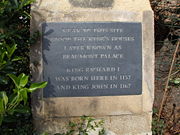
Beaumont Street is a street in the centre of Oxford, England.The street was laid out from 1828 to 1837 with elegant terraced houses in the Regency style. Before that, it was the location of Beaumont Palace, now noted by a plaque near the junction with Walton Street...
, Oxford. Set into a pillar on the north side of the street, near Walton Street
Walton Street
Walton Street is on the eastern edge of the Jericho district of central Oxford, England.- Overview :The street runs north from the western end of Beaumont Street and northern end of Worcester Street by the main entrance of Worcester College. Somerville College, one of the former women's colleges,...
, is a stone with the inscription: Near to this site stood the King's Houses later known as Beaumont Palace. King Richard I
Richard I of England
Richard I was King of England from 6 July 1189 until his death. He also ruled as Duke of Normandy, Duke of Aquitaine, Duke of Gascony, Lord of Cyprus, Count of Anjou, Count of Maine, Count of Nantes, and Overlord of Brittany at various times during the same period...
was born here in 1157 and King John
John of England
John , also known as John Lackland , was King of England from 6 April 1199 until his death...
in 1167. The "King's House" was the range of the palace that contained the king's lodgings.
Henry passed Easter 1133 in the nova aula, his "new hall" at Beaumont in great pomp, celebrating the birth of his grandson, the future Henry II
Henry II of England
Henry II ruled as King of England , Count of Anjou, Count of Maine, Duke of Normandy, Duke of Aquitaine, Duke of Gascony, Count of Nantes, Lord of Ireland and, at various times, controlled parts of Wales, Scotland and western France. Henry, the great-grandson of William the Conqueror, was the...
. Edward I was the last king to sojourn in Beaumont officially as a palace, and in 1275 he granted it to an Italian lawyer, Francesco Accorsi, who had undertaken diplomatic missions for him. When Edward II
Edward II of England
Edward II , called Edward of Caernarfon, was King of England from 1307 until he was deposed by his wife Isabella in January 1327. He was the sixth Plantagenet king, in a line that began with the reign of Henry II...
was put to flight at the battle of Bannockburn
Battle of Bannockburn
The Battle of Bannockburn was a significant Scottish victory in the Wars of Scottish Independence...
in 1314, he is said to have invoked the Virgin Mary and vowed to found a monastery for the Carmelites
Carmelites
The Order of the Brothers of Our Lady of Mount Carmel or Carmelites is a Catholic religious order perhaps founded in the 12th century on Mount Carmel, hence its name. However, historical records about its origin remain uncertain...
(the White Friars) if he might escape safely. In fulfillment of his vow he remanded Beaumont Palace to the Carmelites in 1318.
In 1318, the Palace was the scene for the beginnings of the John Deydras
John Deydras
John Deydras, also John of Powderham, was a pretender to the English throne during the reign of Edward II. He was executed in 1318 by hanging and his body burnt.-Background:...
affair, in which a royal pretender, arguing that he was the rightful king of England, claimed the Palace for his own. John Deydras was ultimately executed for sedition
Sedition
In law, sedition is overt conduct, such as speech and organization, that is deemed by the legal authority to tend toward insurrection against the established order. Sedition often includes subversion of a constitution and incitement of discontent to lawful authority. Sedition may include any...
.
When the White Friars were disbanded at the Reformation
Dissolution of the Monasteries
The Dissolution of the Monasteries, sometimes referred to as the Suppression of the Monasteries, was the set of administrative and legal processes between 1536 and 1541 by which Henry VIII disbanded monasteries, priories, convents and friaries in England, Wales and Ireland; appropriated their...
, most of the structure was dismantled and the building stone reused in Christ Church
Christ Church, Oxford
Christ Church or house of Christ, and thus sometimes known as The House), is one of the largest constituent colleges of the University of Oxford in England...
and St John's College
St John's College, Oxford
__FORCETOC__St John's College is a constituent college of the University of Oxford, one of the larger Oxford colleges with approximately 390 undergraduates, 200 postgraduates and over 100 academic staff. It was founded by Sir Thomas White, a merchant, in 1555, whose heart is buried in the chapel of...
. An engraving of 1785 shows the remains of Beaumont Palace, the last of which were destroyed in the laying out of Beaumont Street in 1829.