Battle of Vartanantz

Encyclopedia
The Battle of Avarayr also known as Battle of Vartanantz, was fought on May 26, 451 on the Avarayr Plain
in Vaspurakan
, between the Armenian Army under Saint Vartan and their Sassanid rulers. Although the Persians were victorious on the battlefield itself, they had heavy casualties and, following subsequent uprisings and guerilla warfare, the Armenians were eventually guaranteed religious freedom.
, in 301 AD under Tiridates III
. In 428, Armenian nobles petitioned Bahram V to depose Artaxias IV. As a result, the country became a Sassanid dependency with a Sassanid governor. The Armenians nobles initially welcomed Persian rule, provided they were allowed to practice Christianity; but Yazdegerd II
, concerned that the Armenian Church was hierarchically dependent to the Latin- and Greek-speaking, Western Christian Church, aligned with Rome rather than the Aramaic-speaking, Persian-backed Nestorian Church, tried to compel the Armenian Church to abandon Rome and Byzantium in favor of the Nestorians or simply convert them to Zoroastrianism
. He summoned the leading Armenian nobles to Ctesiphon
, and pressured them into cutting their ties with the Western Church as he had intended. (Note that Yazdegerd II himself was a Zoroastrian rather than a Christian, and his concern was not enforcing a Nestorian orthodoxy
but securing political loyalty.)
According to Armenian tradition, attempts at demolishing churches and building fire-temples were made and a number of Zoroastrian magi were sent, with Persian military backing, to replace Armenian clergy and suppress Christianity.
But Yazdegerd's policy created, rather than forestalled, a Christian rebellion in Armenia. When news about the compulsion of the nobles reached Armenia, a mass revolt broke out; on their return, the nobility, led by Vartan Mamikonian, joined the rebels. Yazdegerd II, hearing the news, gathered a massive army to attack Armenia. Vartan Mamikonian sent to Constantinople for aid, as he had good personal relations with Theodosius II
, who had made him a general, and he was after all fighting to remain in the Western Church; but this assistance did not arrive in time.
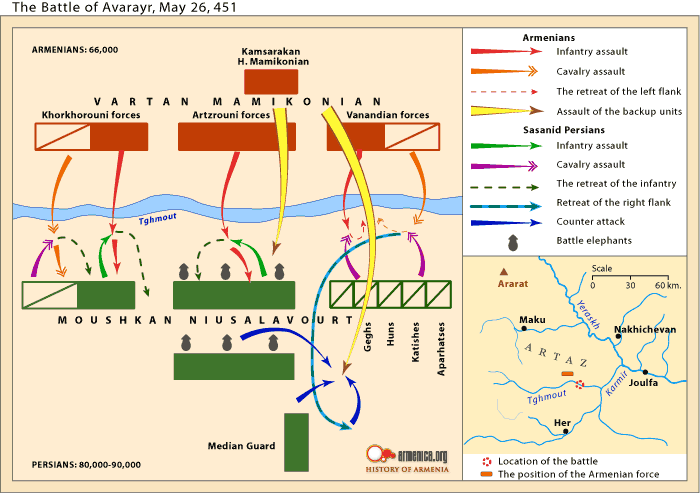
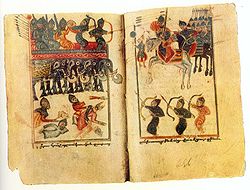 The 66,000-strong Armenian army took Holy Communion before the battle. The army was a popular uprising, rather than a professional force, but the Armenian nobility who led it and their respective retinues were accomplished soldiers, many of them veterans of the Sassanid dynasty's wars with Rome and the nomads of Central Asia. The Armenians were allowed to maintain a core of their national army led by a supreme commander (sparapet) who was traditionally of the Mamikonian noble family. The Armenian cavalry was, at the time, practically an elite force greatly appreciated as a tactical ally by both Persia and Byzantium. In this particular case, both officers and men were additionally motivated by a desire to save their religion and their way of life. The Persian army, said to be three times larger, included war elephants and the famous Savārān
, or New Immortal, cavalry. Several Armenian noblemen with weaker Christian sympathies, led by Vasak Siuni, went over to the Persians before the battle, and fought on their side; in the battle, Vartan won initial successes, but was eventually slain along with eight of his top officers.
The Armenian Church
was also unable to send a delegation to the Council of Chalcedon
, as it was heavily involved in the war. The Armenian Church
would reject the decisions of the Council of Chalcedon, instead adhering to Miaphysitism
.
Armenian resistance continued in the decades following the battle, led by Vartan's successor and nephew, Vahan Mamikonian. In 484 AD, Shah
Peroz I
signed the Nvarsak Treaty
, which guaranteed religious freedom to the Christian Armenians -- who were, however, no longer in communion with Rome or Constantinople -- and granted a general amnesty with permission to construct new churches. Thus, the Armenians see the Battle of Avarayr as a moral victory; May 26 is considered to be a holy day by Armenians, and is one of the most important national and religious days in Armenia.
Avarayr Plain
The Avarayr Plain is the location of the Battle of Avarayr in 451, and is described as being along the banks of the Ṭłmut River , apparently the Armeno-Persian frontier at that time. At the time, the Avarayr plain was part of the Armenian region of Vaspurakan. The plain is located today in...
in Vaspurakan
Vaspurakan
Vaspurakan was the first and biggest province of Greater Armenia, which later became an independent kingdom during the Middle Ages, centered around Lake Van...
, between the Armenian Army under Saint Vartan and their Sassanid rulers. Although the Persians were victorious on the battlefield itself, they had heavy casualties and, following subsequent uprisings and guerilla warfare, the Armenians were eventually guaranteed religious freedom.
Background
The Kingdom of Armenia was the first nation to officially convert to ChristianityChristianity
Christianity is a monotheistic religion based on the life and teachings of Jesus as presented in canonical gospels and other New Testament writings...
, in 301 AD under Tiridates III
Tiridates III of Armenia
Tiridates III or Diritades III was the king of Arsacid Armenia , and is also known as Tiridates the Great ; some scholars incorrectly refer to him as Tiridates IV as a result of the fact that Tiridates I of Armenia reigned twice)...
. In 428, Armenian nobles petitioned Bahram V to depose Artaxias IV. As a result, the country became a Sassanid dependency with a Sassanid governor. The Armenians nobles initially welcomed Persian rule, provided they were allowed to practice Christianity; but Yazdegerd II
Yazdegerd II
Yazdegerd II was the fifteenth Sassanid King of Persia. He was the son of Bahram V and reigned from 438 to 457....
, concerned that the Armenian Church was hierarchically dependent to the Latin- and Greek-speaking, Western Christian Church, aligned with Rome rather than the Aramaic-speaking, Persian-backed Nestorian Church, tried to compel the Armenian Church to abandon Rome and Byzantium in favor of the Nestorians or simply convert them to Zoroastrianism
Zoroastrianism
Zoroastrianism is a religion and philosophy based on the teachings of prophet Zoroaster and was formerly among the world's largest religions. It was probably founded some time before the 6th century BCE in Greater Iran.In Zoroastrianism, the Creator Ahura Mazda is all good, and no evil...
. He summoned the leading Armenian nobles to Ctesiphon
Ctesiphon
Ctesiphon, the imperial capital of the Parthian Arsacids and of the Persian Sassanids, was one of the great cities of ancient Mesopotamia.The ruins of the city are located on the east bank of the Tigris, across the river from the Hellenistic city of Seleucia...
, and pressured them into cutting their ties with the Western Church as he had intended. (Note that Yazdegerd II himself was a Zoroastrian rather than a Christian, and his concern was not enforcing a Nestorian orthodoxy
Nestorianism
Nestorianism is a Christological doctrine advanced by Nestorius, Patriarch of Constantinople from 428–431. The doctrine, which was informed by Nestorius's studies under Theodore of Mopsuestia at the School of Antioch, emphasizes the disunion between the human and divine natures of Jesus...
but securing political loyalty.)
According to Armenian tradition, attempts at demolishing churches and building fire-temples were made and a number of Zoroastrian magi were sent, with Persian military backing, to replace Armenian clergy and suppress Christianity.
But Yazdegerd's policy created, rather than forestalled, a Christian rebellion in Armenia. When news about the compulsion of the nobles reached Armenia, a mass revolt broke out; on their return, the nobility, led by Vartan Mamikonian, joined the rebels. Yazdegerd II, hearing the news, gathered a massive army to attack Armenia. Vartan Mamikonian sent to Constantinople for aid, as he had good personal relations with Theodosius II
Theodosius II
Theodosius II , commonly surnamed Theodosius the Younger, or Theodosius the Calligrapher, was Byzantine Emperor from 408 to 450. He is mostly known for promulgating the Theodosian law code, and for the construction of the Theodosian Walls of Constantinople...
, who had made him a general, and he was after all fighting to remain in the Western Church; but this assistance did not arrive in time.
Battle
Savaran cavalry
The Savārān cavalry were Persian military units and were a division of cavalry during the time of the Sassanid Persian dynasty; they ranged from light cavalry such as horse archers to heavy cavalry such as Cataphracts. Each Savārān unit would have had its own Drafsh...
, or New Immortal, cavalry. Several Armenian noblemen with weaker Christian sympathies, led by Vasak Siuni, went over to the Persians before the battle, and fought on their side; in the battle, Vartan won initial successes, but was eventually slain along with eight of his top officers.
Outcome
Following the victory, Yazdegerd jailed some Armenian priests and nobles and appointed a new governor for Armenia.The Armenian Church
Armenian Apostolic Church
The Armenian Apostolic Church is the world's oldest National Church, is part of Oriental Orthodoxy, and is one of the most ancient Christian communities. Armenia was the first country to adopt Christianity as its official religion in 301 AD, in establishing this church...
was also unable to send a delegation to the Council of Chalcedon
Council of Chalcedon
The Council of Chalcedon was a church council held from 8 October to 1 November, 451 AD, at Chalcedon , on the Asian side of the Bosporus. The council marked a significant turning point in the Christological debates that led to the separation of the church of the Eastern Roman Empire in the 5th...
, as it was heavily involved in the war. The Armenian Church
Armenian Apostolic Church
The Armenian Apostolic Church is the world's oldest National Church, is part of Oriental Orthodoxy, and is one of the most ancient Christian communities. Armenia was the first country to adopt Christianity as its official religion in 301 AD, in establishing this church...
would reject the decisions of the Council of Chalcedon, instead adhering to Miaphysitism
Miaphysitism
Miaphysitism is a Christological formula of the Oriental Orthodox Churches and of the various churches adhering to the first three Ecumenical Councils...
.
Armenian resistance continued in the decades following the battle, led by Vartan's successor and nephew, Vahan Mamikonian. In 484 AD, Shah
Shah
Shāh is the title of the ruler of certain Southwest Asian and Central Asian countries, especially Persia , and derives from the Persian word shah, meaning "king".-History:...
Peroz I
Peroz I
Peroz I Peroz I Peroz I (also Pirooz; Peirozes (Priscus, fr. 33); Perozes (Procopius, De Bello Pers. I. 3 and Agathias iv. 27; the modern form of the name is Perooz, Piruz, or the Arabized Ferooz, Firuz; Persian: پیروز "the Victor"), was the seventeenth Sassanid King of Persia, who ruled from 457...
signed the Nvarsak Treaty
Nvarsak Treaty
The Nvarsak Treaty was signed between the Armenian general Vahan Mamikonian and the representatives of the Persian shah Peroz I at Nvarsak in 484....
, which guaranteed religious freedom to the Christian Armenians -- who were, however, no longer in communion with Rome or Constantinople -- and granted a general amnesty with permission to construct new churches. Thus, the Armenians see the Battle of Avarayr as a moral victory; May 26 is considered to be a holy day by Armenians, and is one of the most important national and religious days in Armenia.
Further reading
- ElisheElisheYeghishe Vardapet was a prominent Armenian historian. He was the author of a history documenting the successful revolt of the Armenians in the 5th century against the rule and religion of the Sassanid Persians.-Life:...
: History of Vardan and the Armenian War, transl. R.W. Thomson, Cambridge, Mass. 1982 - Visions Of Ararat: Writings On Armenia By Christopher J. Walker; Page 3
- Dr. Abd al-Husayn Zarrin’kub "Ruzgaran:tarikh-i Iran az aghz ta saqut saltnat Pahlvi" Sukhan, 1999. ISBN 964-6961-11-8
- Modern Armenia: People, Nation, State By Gerard J. Libaridian
- Vahan KurkjianVahan KurkjianVahan M. Kurkjian was an Armenian author, historian, teacher, and community leader.In 1904, in Cairo, he published the Armenian newspaper Loussaper , in the pages of which he and other intellectuals called for a national union for the Armenian people...
- Period of the Marzbans — Battle of Avarair
External links
- http://www.armenica.org/history/maps/607hsh1-avarayr.gif
- Summary of the battle from A History of Armenia by Vahan M. Kurkjian
- Battle of the Avarayr Field
- St Vartan's life on www.armenianchurch.net
- Vartan Mamikonian's biography in Brockhaus-Efron (in Russian, by Nicholas Marr)
- Sasanid Rule and the Battle of Avarayr
- The Vartanank War The interregnum (428-861)