


Battle of Liège

Encyclopedia
The Battle of Liège was the opening engagement of the German
invasion of Belgium, and the first battle of World War I
. The attack on the city began on 5 August 1914 and lasted until the 16th when the last Belgian fort finally surrendered. The invasion of Belgium was the event that triggered the United Kingdom's entry into the war; the unexpected vigor of the city's defense allowed more time for the western Allies
to organize and prepare their defense of France.
, the Schlieffen plan
was conceived which suggested a quick strike to beat France first (as was done successfully in the Franco-Prussian War
of 1870), and then an eastward turn toward Russia (which was seen as being slower to mobilize). In order to do this, neutral Belgium had to be attacked and crossed within a few days. The highly fortified city of Liège was in the path of the German forces as they advanced through Belgium.
, the crown prince of Austria. As the summer wore on, war became inevitable
. Germany, honoring her alliance with Austria, declared war on Russia on 1 August, she then sent an ultimatum
to France (Russia’s ally via the Triple Entente
) on 2 August.
Another ultimatum also went to King Albert I
of Belgium. Germany’s Schlieffen Plan (developed over the previous two decades), called for a vast sweep of manpower around the concentration of French armies along the Alsace
frontier. That flanking maneuver, designed to bypass both the French forces and the rugged terrain of the Ardennes
, necessitated the German violation of Belgian neutrality. Belgium could have offered no resistance and allowed German troops through her land on their way to France. Indeed, much of the German planning depended on them doing so; anything else would be nothing more than “the rage of dreaming sheep,” according to one Prussian officer. Unfortunately for German plans, Belgium proved all too willing to defend her sovereignty. Unfortunately for the Belgians, their resources did not match their élan.
Belgium’s fixed defenses and planning were dependent on resisting any potential enemy: Germany, France or Britain. At the beginning of August 1914 her armies were on the perimeters of the country, as they had been for years. When Albert received the ultimatum from Berlin, his chief of staff, General Selliers de Moranville, began implementing the standing contingency plan: to concentrate the army in the center of the country while allowing the fortifications at Liège and Namur
to slow-down, if not stop, the German advance. Liège straddled the primary road through Belgium toward France. To the south the ground was rugged, to the north it was open but less than a dozen miles from the Netherlands, which Germany did not want to enter. Both Liège and Namur possessed outstanding fortifications, but also had serious shortcomings.
Liège was surrounded by a dozen forts, designed and built by Henri Alexis Brialmont
, the leading engineer of the latter nineteenth century.) Rejecting the star fort
system of the French master Vauban
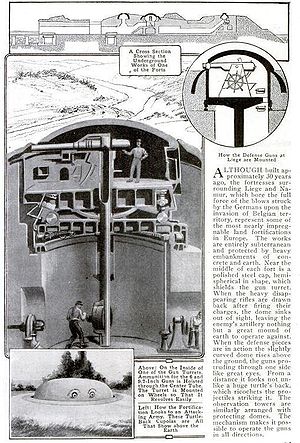
, Brialmont designed forts to resist newer rifled cannon. They existed mainly underground, exposing only mounds of concrete, masonry and soil. Each fort possessed a series of retractable cupolas that held guns ranging in size up to 6 inches. While state-of-the-art upon their completion in 1892, they had not been well maintained. Brialmont also called for smaller fortifications and trench lines to be built linking and protecting the main forts, but the Belgian government had not done that either. Their garrisons were not at full strength and many men were drawn from the local guard units and had received minimal training.
On 2 August King Albert responded to Germany’s ultimatum by ordering that work begin on support works, as well as that the army be mobilized and brought up to proper strength. The commander of the Liège fortresses, Lieutenant General
Gérard Leman
, was ordered to "hold to the end with your division the position which you have been entrusted to defend."
There was little opportunity for the Belgian forces to finish all their preparations, German forces entered the country early on 4 August. The German force detailed to occupy Liège was a provisional unit called the Army of the Meuse, consisting of eight brigades commanded by General Otto von Emmich
. Emmich commanded primarily infantry and cavalry and was detailed to capture the bridges across the Meuse
at Liège and seize the town if it offered any resistance. When his troops reached the river and found many of the bridges destroyed, they began work on pontoon replacements. When these came under fire, the Germans realized that they would indeed be forced to fight for Liège.
 Liège lies at the confluence of the Meuse
and Ourthe
rivers, between the Ardennes Forest to the south and Maastricht
of the Netherlands and the flat plain of Flanders to the north and west. The Meuse flows through a deep ravine at Liège, posing a significant barrier.
The city lies on the main rail line leading from Germany to Brussels
, and eventually to Paris – the same railway that von Schlieffen and von Moltke
had planned to use as transport into France. Massive industrial facilities, factories and other installations would assist in the defense of the city. The main defenses however, were a ring of twelve forts which had been completed in an 6–10 km radius around the city in 1891. The forts overlapped each other's protective zones of fire and were designed so that if any one fort were attacked, its two neighbors could provide artillery support. They were approximately 4 km apart.
The forts were triangular or quadrangular in shape, with a surrounding ditch and barbed-wire entanglements. They were made entirely of concrete and armed with 210 mm howitzers, 150 mm and 120 mm cannons and 57 mm rapid-fire guns for approach defense. The fort was defended from attack by infantry with rifles and machine guns. The main guns were mounted in steel turrets that revolved 360 degrees. Only the 57 mm turret could be elevated. In total the forts had 78 pieces of artillery. They contained magazines for the storage of ammunition, crew quarters for up to 500 men and electric motors for lighting. The forts were not linked together and could only communicate with each other by above-ground telephone or telegraph.
The forts had several other weaknesses. The terrain was difficult to completely cover since many ravines ran between the forts. Interval defenses were constructed just before the battle and were insufficient to stop the Germans from infiltrating the city. The forts were also weak in the rear, the direction from which the German bombardments would eventually come. Ventilation and sanitary conditions were very bad, resulting in a lack of air and terrible odors. Finally, the concrete was not the best quality and the forts were built to withstand assault from 210 mm guns, the largest mobile guns available in 1890. Leman had been personally selected to command the 3rd Division and the Liège fortifications; he was under orders from King Albert to hold the fortress system to the end. Leman had a force of about 30,000 soldiers to defend the intervals and about 6,000 fortress troops, including members of the civic guard.
s and various other formations:
Overall, there were about 36,000 troops and 252 artillery pieces to face the German invasion.
Overall, the force consisted of about 59,800 troops and 100 artillery pieces. These were placed under the command of General Otto von Emmich
, accompanied by Erich Ludendorff
as an observer for the General Staff.
and encountered troops of the 12th Brigade, who had conducted a valiant retreat to the fortress line. German forces were held in check in the north for the night.
The Belgian 3rd Division guarded the town from behind hastily constructed earthworks, on the same day they successfully repulsed attacks by German infantry passing between the forts. An attack against Fort Barchon
was beaten back with heavy losses due to machine-gun and artillery fire. After this failed attack, the Germans carried out one of the first air raid
s in history by using a Zeppelin
to drop bombs on Liège. Meanwhile cavalry moved south from Visé to encircle the town. With the town likely to be invested soon, Leman ordered the 3rd Division to withdraw and rejoin the mobilizing Belgian army to the west.
On 6 August, General Ludendorff rode forward to find that the commander of the 14th Brigade had been killed. He took personal command, ordered up a field howitzer to provide fire support and fought through the village of Queue-du-Bois to a high point from where he could look down into Liège. Ludendorff sent a party forward under a flag of truce to demand Leman's surrender (which was refused). A raiding force that followed was shot down at the door of Leman's HQ. This sally prompted Leman to leave the city and take refuge in Fort Loncin
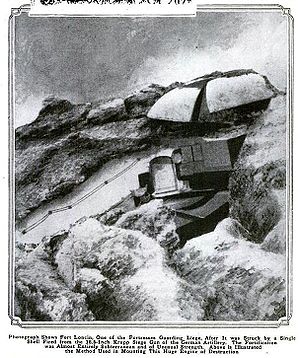
on the western side of the city. The outer ring of forts continued to hold out, blocking the German advance due to their interdiction of the rail lines. The forts endured steady bombardment and attack by the German forces, but most of the forts continued to hold out. Only Fléron
was put out of action, its cupola-hoisting mechanism being destroyed by shell fire. The only fort to be captured by infantry assault would be Fort Barchon, taken on 10 August.
To reduce these fortifications, the Germans would have to employ their massive siege artillery
. These would include the Krupp "Big Bertha
" 420 mm howitzer
and some loaned Austro-Hungarian
305 mm mortars
built by Škoda
. At the time of construction of the forts it was assumed that the largest guns that could be moved overland were 210 mm howitzers, so they had never been designed to withstand the enormous shells from the larger guns. The shells from these guns landed on the forts from directly above, penetrating the concrete sides and then detonating inside by means of a delayed fuse. One by one the forts were pounded into submission, with the last, Fort Boncelles, capitulating on 16 August. On the 15 August Leman was injured at Fort Loncin, he was carried out unconscious to become a prisoner of the Germans. By the morning of the 17th of August, the German First, Second and Third Armies, in accordance with the Schlieffen Plan, were gearing up to move on with a sweeping push through the rest of Belgium, forcing the remains of the Belgian Army towards Antwerp and capturing Brussels without a fight on August 20.
in 1914. Another effect was a reduction in faith with regard to fixed fortifications, felt by all sides, and leading to the weakening of the forts around the city of Verdun, France. This weakening would have an impact on the battle
fought there in 1916.
German Empire
The German Empire refers to Germany during the "Second Reich" period from the unification of Germany and proclamation of Wilhelm I as German Emperor on 18 January 1871, to 1918, when it became a federal republic after defeat in World War I and the abdication of the Emperor, Wilhelm II.The German...
invasion of Belgium, and the first battle of World War I
World War I
World War I , which was predominantly called the World War or the Great War from its occurrence until 1939, and the First World War or World War I thereafter, was a major war centred in Europe that began on 28 July 1914 and lasted until 11 November 1918...
. The attack on the city began on 5 August 1914 and lasted until the 16th when the last Belgian fort finally surrendered. The invasion of Belgium was the event that triggered the United Kingdom's entry into the war; the unexpected vigor of the city's defense allowed more time for the western Allies
Allies of World War I
The Entente Powers were the countries at war with the Central Powers during World War I. The members of the Triple Entente were the United Kingdom, France, and the Russian Empire; Italy entered the war on their side in 1915...
to organize and prepare their defense of France.
The Schlieffen plan
As Imperial Germany feared a long two-front war against France and the Russian EmpireRussian Empire
The Russian Empire was a state that existed from 1721 until the Russian Revolution of 1917. It was the successor to the Tsardom of Russia and the predecessor of the Soviet Union...
, the Schlieffen plan
Schlieffen Plan
The Schlieffen Plan was the German General Staff's early 20th century overall strategic plan for victory in a possible future war in which the German Empire might find itself fighting on two fronts: France to the west and Russia to the east...
was conceived which suggested a quick strike to beat France first (as was done successfully in the Franco-Prussian War
Franco-Prussian War
The Franco-Prussian War or Franco-German War, often referred to in France as the 1870 War was a conflict between the Second French Empire and the Kingdom of Prussia. Prussia was aided by the North German Confederation, of which it was a member, and the South German states of Baden, Württemberg and...
of 1870), and then an eastward turn toward Russia (which was seen as being slower to mobilize). In order to do this, neutral Belgium had to be attacked and crossed within a few days. The highly fortified city of Liège was in the path of the German forces as they advanced through Belgium.
Outbreak of war
The summer of 1914 saw tremendous diplomatic and military activity as a result of the assassination of Archduke Franz FerdinandAssassination of Archduke Franz Ferdinand of Austria
On 28 June 1914, Archduke Franz Ferdinand of Austria, heir presumptive to the Austro-Hungarian throne, and his wife, Sophie, Duchess of Hohenberg, were shot dead in Sarajevo, by Gavrilo Princip, one of a group of six Bosnian Serb assassins coordinated by Danilo Ilić...
, the crown prince of Austria. As the summer wore on, war became inevitable
Causes of World War I
The causes of World War I, which began in central Europe in July 1914, included many intertwined factors, such as the conflicts and hostility of the four decades leading up to the war. Militarism, alliances, imperialism, and nationalism played major roles in the conflict as well...
. Germany, honoring her alliance with Austria, declared war on Russia on 1 August, she then sent an ultimatum
Ultimatum
An ultimatum is a demand whose fulfillment is requested in a specified period of time and which is backed up by a threat to be followed through in case of noncompliance. An ultimatum is generally the final demand in a series of requests...
to France (Russia’s ally via the Triple Entente
Triple Entente
The Triple Entente was the name given to the alliance among Britain, France and Russia after the signing of the Anglo-Russian Entente in 1907....
) on 2 August.
Another ultimatum also went to King Albert I
Albert I of Belgium
Albert I reigned as King of the Belgians from 1909 until 1934.-Early life:Born Albert Léopold Clément Marie Meinrad in Brussels, he was the fifth child and second son of Prince Philippe, Count of Flanders, and his wife, Princess Marie of Hohenzollern-Sigmaringen...
of Belgium. Germany’s Schlieffen Plan (developed over the previous two decades), called for a vast sweep of manpower around the concentration of French armies along the Alsace
Alsace
Alsace is the fifth-smallest of the 27 regions of France in land area , and the smallest in metropolitan France. It is also the seventh-most densely populated region in France and third most densely populated region in metropolitan France, with ca. 220 inhabitants per km²...
frontier. That flanking maneuver, designed to bypass both the French forces and the rugged terrain of the Ardennes
Ardennes
The Ardennes is a region of extensive forests, rolling hills and ridges formed within the Givetian Ardennes mountain range, primarily in Belgium and Luxembourg, but stretching into France , and geologically into the Eifel...
, necessitated the German violation of Belgian neutrality. Belgium could have offered no resistance and allowed German troops through her land on their way to France. Indeed, much of the German planning depended on them doing so; anything else would be nothing more than “the rage of dreaming sheep,” according to one Prussian officer. Unfortunately for German plans, Belgium proved all too willing to defend her sovereignty. Unfortunately for the Belgians, their resources did not match their élan.
Belgium’s fixed defenses and planning were dependent on resisting any potential enemy: Germany, France or Britain. At the beginning of August 1914 her armies were on the perimeters of the country, as they had been for years. When Albert received the ultimatum from Berlin, his chief of staff, General Selliers de Moranville, began implementing the standing contingency plan: to concentrate the army in the center of the country while allowing the fortifications at Liège and Namur
Namur (city)
Namur is a city and municipality in Wallonia, in southern Belgium. It is both the capital of the province of Namur and of Wallonia....
to slow-down, if not stop, the German advance. Liège straddled the primary road through Belgium toward France. To the south the ground was rugged, to the north it was open but less than a dozen miles from the Netherlands, which Germany did not want to enter. Both Liège and Namur possessed outstanding fortifications, but also had serious shortcomings.
Liège was surrounded by a dozen forts, designed and built by Henri Alexis Brialmont
Henri Alexis Brialmont
Henri Alexis Brialmont was a Dutch-born Belgian military engineer. He was one of the leading fortifications engineers in the 19th century....
, the leading engineer of the latter nineteenth century.) Rejecting the star fort
Star fort
A star fort, or trace italienne, is a fortification in the style that evolved during the age of gunpowder, when cannon came to dominate the battlefield, and was first seen in the mid-15th century in Italy....
system of the French master Vauban
Vauban
Sébastien Le Prestre, Seigneur de Vauban and later Marquis de Vauban , commonly referred to as Vauban, was a Marshal of France and the foremost military engineer of his age, famed for his skill in both designing fortifications and breaking through them...
, Brialmont designed forts to resist newer rifled cannon. They existed mainly underground, exposing only mounds of concrete, masonry and soil. Each fort possessed a series of retractable cupolas that held guns ranging in size up to 6 inches. While state-of-the-art upon their completion in 1892, they had not been well maintained. Brialmont also called for smaller fortifications and trench lines to be built linking and protecting the main forts, but the Belgian government had not done that either. Their garrisons were not at full strength and many men were drawn from the local guard units and had received minimal training.
On 2 August King Albert responded to Germany’s ultimatum by ordering that work begin on support works, as well as that the army be mobilized and brought up to proper strength. The commander of the Liège fortresses, Lieutenant General
Lieutenant General
Lieutenant General is a military rank used in many countries. The rank traces its origins to the Middle Ages where the title of Lieutenant General was held by the second in command on the battlefield, who was normally subordinate to a Captain General....
Gérard Leman
Gérard Leman
Gerard Mathieu Leman was a Belgian general. He was responsible for the military education of King Albert I of Belgium. During World War I he was the commander of the forts surrounding the Belgian city of Liège. The German Forces had to use heavy artillery to break through the defences and capture...
, was ordered to "hold to the end with your division the position which you have been entrusted to defend."
There was little opportunity for the Belgian forces to finish all their preparations, German forces entered the country early on 4 August. The German force detailed to occupy Liège was a provisional unit called the Army of the Meuse, consisting of eight brigades commanded by General Otto von Emmich
Otto von Emmich
Albert Theodor Otto Emmich was a Prussian general.Born in Minden, Emmich entered the Prussian Army in 1866. He attained the rank of general of infantry in 1909, and was placed in command of the 10th army corps at Hanover...
. Emmich commanded primarily infantry and cavalry and was detailed to capture the bridges across the Meuse
Meuse
Meuse is a department in northeast France, named after the River Meuse.-History:Meuse is one of the original 83 departments created during the French Revolution on March 4, 1790...
at Liège and seize the town if it offered any resistance. When his troops reached the river and found many of the bridges destroyed, they began work on pontoon replacements. When these came under fire, the Germans realized that they would indeed be forced to fight for Liège.
Fortifications
| Liège Forts (Clockwise from N) |
|---|
| Liers |
| Pontisse |
| Barchon |
| Evegnée |
| Fleron |
| Chaudfontaine |
| Embourg |
| Boncelles |
| Flemalle |
| Hollogne |
| Loncin |
| Lantin |
Meuse River
The Maas or Meuse is a major European river, rising in France and flowing through Belgium and the Netherlands before draining into the North Sea...
and Ourthe
Ourthe
The Ourthe is a 165 km long river in the Ardennes in Wallonia . It is a right tributary to the river Meuse. The Ourthe is formed at the confluence of the Ourthe Occidentale and the Ourthe Orientale , west of Houffalize.The source of the Ourthe Occidentale is near Libramont-Chevigny, in the...
rivers, between the Ardennes Forest to the south and Maastricht
Maastricht
Maastricht is situated on both sides of the Meuse river in the south-eastern part of the Netherlands, on the Belgian border and near the German border...
of the Netherlands and the flat plain of Flanders to the north and west. The Meuse flows through a deep ravine at Liège, posing a significant barrier.
The city lies on the main rail line leading from Germany to Brussels
Brussels
Brussels , officially the Brussels Region or Brussels-Capital Region , is the capital of Belgium and the de facto capital of the European Union...
, and eventually to Paris – the same railway that von Schlieffen and von Moltke
Helmuth von Moltke the Younger
Helmuth Johann Ludwig von Moltke , also known as Moltke the Younger, was a nephew of Field Marshal Count Moltke and served as the Chief of the German General Staff from 1906 to 1914. The two are often differentiated as Moltke the Elder and Moltke the Younger...
had planned to use as transport into France. Massive industrial facilities, factories and other installations would assist in the defense of the city. The main defenses however, were a ring of twelve forts which had been completed in an 6–10 km radius around the city in 1891. The forts overlapped each other's protective zones of fire and were designed so that if any one fort were attacked, its two neighbors could provide artillery support. They were approximately 4 km apart.
The forts were triangular or quadrangular in shape, with a surrounding ditch and barbed-wire entanglements. They were made entirely of concrete and armed with 210 mm howitzers, 150 mm and 120 mm cannons and 57 mm rapid-fire guns for approach defense. The fort was defended from attack by infantry with rifles and machine guns. The main guns were mounted in steel turrets that revolved 360 degrees. Only the 57 mm turret could be elevated. In total the forts had 78 pieces of artillery. They contained magazines for the storage of ammunition, crew quarters for up to 500 men and electric motors for lighting. The forts were not linked together and could only communicate with each other by above-ground telephone or telegraph.
The forts had several other weaknesses. The terrain was difficult to completely cover since many ravines ran between the forts. Interval defenses were constructed just before the battle and were insufficient to stop the Germans from infiltrating the city. The forts were also weak in the rear, the direction from which the German bombardments would eventually come. Ventilation and sanitary conditions were very bad, resulting in a lack of air and terrible odors. Finally, the concrete was not the best quality and the forts were built to withstand assault from 210 mm guns, the largest mobile guns available in 1890. Leman had been personally selected to command the 3rd Division and the Liège fortifications; he was under orders from King Albert to hold the fortress system to the end. Leman had a force of about 30,000 soldiers to defend the intervals and about 6,000 fortress troops, including members of the civic guard.
Belgian order of battle
The 3rd Belgian Division defended Liège; it was commanded by Lieutenant General Gérard Leman. Within the division, there were four brigadeBrigade
A brigade is a major tactical military formation that is typically composed of two to five battalions, plus supporting elements depending on the era and nationality of a given army and could be perceived as an enlarged/reinforced regiment...
s and various other formations:
- 9th Mixed Brigade, including the 9th and 29th Infantry Regiments, along with the 43rd, 44th, and 45th Artillery Batteries.
- 11th Mixed Brigade, including the 11th and 31st Infantry Regiments, along with the 37th, 38th, and 39th Artillery Batteries.
- 12th Mixed Brigade, including the 12th and 32nd Infantry Regiments, along with the 40th, 41st, and 42nd Artillery Batteries.
- 14th Mixed Brigade, including the 14th and 34th Infantry Regiments, along with the 46th, 47th, and 48th Artillery Batteries.
- 15th Mixed Brigade (5 August), including the 1st and 4th Chausseur Regiments, along with the 61st, 62nd, and 63rd Artillery Batteries.
- The Fortress Guards, including the 9th, 11th, 12th, and 14th Reserve Infantry Regiments, an Artillery Regiment, four reserve batteries and various other troops.
- 3rd Artillery Regiment, including the 40th, 49th and 51st Artillery Batteries.
- 3rd Engineer Battalion.
- 3rd Telegraphist Section.
- 2nd Regiment of LancerLancerA lancer was a type of cavalryman who fought with a lance. Lances were used in mounted warfare by the Assyrians as early as and subsequently by Greek, Persian, Gallic, Han-Chinese, nomadic and Roman horsemen...
s.
Overall, there were about 36,000 troops and 252 artillery pieces to face the German invasion.
German order of battle
The German attack force (named The Army of the Meuse) consisted of:- 11th Infantry Brigade of the III Corps, commanded by Major-General Von Watcher.
- 14th Infantry Brigade of the IV Corps, commanded by Major-General Von Wussow.
- 27th Infantry Brigade of the VII Corps, commanded by Colonel Von Massow.
- 34th Infantry Brigade of the IX Corps,commanded by Major-General Von Krawewll.
- 38th Infantry Brigade of the X Corps, commanded by Colonel Von Oertzen.
- 43rd Infantry Brigade of the XI Corps, commanded by Major-General Von Hulsen.
- II Cavalry Corps, commanded by Lieutenant-General Von der Marwitz, consisting of the 2nd2nd Cavalry Division (German Empire)The 2nd Cavalry Division was a unit of the German Army in World War I. The division was formed on mobilization of the German Army in August 1914. The division was disbanded in 1919 during the demobilization of the German Army after World War I.-Combat chronicle:Initially assigned to II Cavalry...
(Major-General Von Krane), 4th4th Cavalry Division (German Empire)The 4th Cavalry Division was a unit of the German Army in World War I. The division was formed on mobilization of the German Army in August 1914...
(Lieutenant General Von Garnier) and 9th9th Cavalry Division (German Empire)The 9th Cavalry Division was a unit of the German Army in World War I. The division was formed on mobilization of the German Army in August 1914. The division was dissolved in March 1918.-Combat chronicle:...
(Major-General Von Bulow) cavalry divisions.
Overall, the force consisted of about 59,800 troops and 100 artillery pieces. These were placed under the command of General Otto von Emmich
Otto von Emmich
Albert Theodor Otto Emmich was a Prussian general.Born in Minden, Emmich entered the Prussian Army in 1866. He attained the rank of general of infantry in 1909, and was placed in command of the 10th army corps at Hanover...
, accompanied by Erich Ludendorff
Erich Ludendorff
Erich Friedrich Wilhelm Ludendorff was a German general, victor of Liège and of the Battle of Tannenberg...
as an observer for the General Staff.
The battle
War was declared on Belgium on the morning of 3 August, the lead elements of 'Army of the Meuse' crossed the border at 0800 on the 4th. The cavalry advanced to the Meuse river, but found that the bridges had been destroyed. By the late afternoon of 4 August, the German cavalry had crossed the Meuse to the north at ViséVisé
Visé is a Walloon municipality and city of Belgium, where it is located on the river Meuse, in the province of Liège.The municipality consists of the former municipalities of Visé, Lanaye, Lixhe, Richelle, Argenteau and Cheratte....
and encountered troops of the 12th Brigade, who had conducted a valiant retreat to the fortress line. German forces were held in check in the north for the night.
The Belgian 3rd Division guarded the town from behind hastily constructed earthworks, on the same day they successfully repulsed attacks by German infantry passing between the forts. An attack against Fort Barchon
Fort de Barchon
The Fort de Barchon is one of twelve forts built as part of the Fortifications of Liège in the late 19th century in Belgium. It was built between 1881 and 1884 according to the plans of General Henri Alexis Brialmont...
was beaten back with heavy losses due to machine-gun and artillery fire. After this failed attack, the Germans carried out one of the first air raid
Airstrike
An air strike is an attack on a specific objective by military aircraft during an offensive mission. Air strikes are commonly delivered from aircraft such as fighters, bombers, ground attack aircraft, attack helicopters, and others...
s in history by using a Zeppelin
Zeppelin
A Zeppelin is a type of rigid airship pioneered by the German Count Ferdinand von Zeppelin in the early 20th century. It was based on designs he had outlined in 1874 and detailed in 1893. His plans were reviewed by committee in 1894 and patented in the United States on 14 March 1899...
to drop bombs on Liège. Meanwhile cavalry moved south from Visé to encircle the town. With the town likely to be invested soon, Leman ordered the 3rd Division to withdraw and rejoin the mobilizing Belgian army to the west.
On 6 August, General Ludendorff rode forward to find that the commander of the 14th Brigade had been killed. He took personal command, ordered up a field howitzer to provide fire support and fought through the village of Queue-du-Bois to a high point from where he could look down into Liège. Ludendorff sent a party forward under a flag of truce to demand Leman's surrender (which was refused). A raiding force that followed was shot down at the door of Leman's HQ. This sally prompted Leman to leave the city and take refuge in Fort Loncin
Fort de Loncin
The Fort de Loncin is one of twelve forts built as part of the Fortifications of Liège in the late 19th century in Belgium. It was constructed between 1881 and 1884 according to the plans of General Henri Alexis Brialmont...
on the western side of the city. The outer ring of forts continued to hold out, blocking the German advance due to their interdiction of the rail lines. The forts endured steady bombardment and attack by the German forces, but most of the forts continued to hold out. Only Fléron
Fort de Fléron
The Fort de Fléron is one of twelve forts built as part of the Fortifications of Liège in the late 19th century in Belgium. It was built between 1881 and 1891 according to the plans of General Henri Alexis Brialmont...
was put out of action, its cupola-hoisting mechanism being destroyed by shell fire. The only fort to be captured by infantry assault would be Fort Barchon, taken on 10 August.
To reduce these fortifications, the Germans would have to employ their massive siege artillery
Siege engine
A siege engine is a device that is designed to break or circumvent city walls and other fortifications in siege warfare. Some have been operated close to the fortifications, while others have been used to attack from a distance. From antiquity, siege engines were constructed largely of wood and...
. These would include the Krupp "Big Bertha
Big Bertha (Howitzer)
Big Bertha Bertha") is the name of a type of super-heavy howitzer developed by the famous armaments manufacturer Krupp in Germany on the eve of World War I...
" 420 mm howitzer
Howitzer
A howitzer is a type of artillery piece characterized by a relatively short barrel and the use of comparatively small propellant charges to propel projectiles at relatively high trajectories, with a steep angle of descent...
and some loaned Austro-Hungarian
Austria-Hungary
Austria-Hungary , more formally known as the Kingdoms and Lands Represented in the Imperial Council and the Lands of the Holy Hungarian Crown of Saint Stephen, was a constitutional monarchic union between the crowns of the Austrian Empire and the Kingdom of Hungary in...
305 mm mortars
Skoda 305 mm Model 1911
The Škoda 30.5 cm Mörser M. 11 was a siege howitzer produced by Škoda Works and used by the Austro-Hungarian Army during World War I.-Development:...
built by Škoda
Škoda Works
Škoda Works was the largest industrial enterprise in Austro-Hungary and later in Czechoslovakia, one of its successor states. It was also one of the largest industrial conglomerates in Europe in the 20th century...
. At the time of construction of the forts it was assumed that the largest guns that could be moved overland were 210 mm howitzers, so they had never been designed to withstand the enormous shells from the larger guns. The shells from these guns landed on the forts from directly above, penetrating the concrete sides and then detonating inside by means of a delayed fuse. One by one the forts were pounded into submission, with the last, Fort Boncelles, capitulating on 16 August. On the 15 August Leman was injured at Fort Loncin, he was carried out unconscious to become a prisoner of the Germans. By the morning of the 17th of August, the German First, Second and Third Armies, in accordance with the Schlieffen Plan, were gearing up to move on with a sweeping push through the rest of Belgium, forcing the remains of the Belgian Army towards Antwerp and capturing Brussels without a fight on August 20.
Aftermath
It is not clear what effect the ten day resistance in and around Liege by Leman and his troops had on the overall timetable of the German Schlieffen Plan. What is evident is that the battle was regarded as a moral victory by the allies. No one had expected the Belgians to fight at all, certainly not to fight so effectively. Could the major powers of Europe not fight to the end if tiny Belgium had? “The triumph was moral—an advertisement to the world that the ancient faiths of country and duty could still nerve the arm for battle, and that the German idol, for all its splendour, had feet of clay”. This regard is further demonstrated by France's awarding the city of Liege with the Légion d'honneurLégion d'honneur
The Legion of Honour, or in full the National Order of the Legion of Honour is a French order established by Napoleon Bonaparte, First Consul of the Consulat which succeeded to the First Republic, on 19 May 1802...
in 1914. Another effect was a reduction in faith with regard to fixed fortifications, felt by all sides, and leading to the weakening of the forts around the city of Verdun, France. This weakening would have an impact on the battle
Battle of Verdun
The Battle of Verdun was one of the major battles during the First World War on the Western Front. It was fought between the German and French armies, from 21 February – 18 December 1916, on hilly terrain north of the city of Verdun-sur-Meuse in north-eastern France...
fought there in 1916.
Publications
- Paul Hamelius, The Siege of Liège: A Personal NarrativeNarrativeA narrative is a constructive format that describes a sequence of non-fictional or fictional events. The word derives from the Latin verb narrare, "to recount", and is related to the adjective gnarus, "knowing" or "skilled"...
(London, 1914) - J. M. Kennedy, "The Campaign around Liège," in Daily Chronicle War Books (London, 1914)