

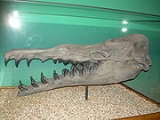
Basilosaurus

Encyclopedia
Basilosaurus is a genus
of cetacean that lived from in the Late Eocene. Its fossil
ized remains were first discovered in the southern United States
(Louisiana
). The American fossils were initially believed to be some sort of reptile, hence the suffix -"saurus", but later found to be a marine mammal. Richard Owen
wished to rename the creature Zeuglodon ("Yoked Tooth"), but, per taxonomic rules, the creature's first name remained permanent. Fossils from at least two other species
of this taxon
have been found in Egypt
and Pakistan
. Basilosaurus averaged about 18 meters (60 ft) in length, and is believed to have been the largest animal to have lived in its time. It displayed an unparalleled degree of elongation compared with modern whales. Their very small vestigial hind limbs have also been a matter of interest for paleontologists. The species is the state fossil
of Mississippi
and Alabama
in the United States.
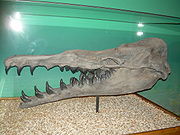 During the early 19th century in the American South, Basilosaurus cetoides fossils were so common (as well as large) that they were regularly used as furniture. Vertebrae were sent to the American Philosophical Society
by a Judge Bly of Arkansas
and Judge John Creagh of Clarke County
, Alabama
. Both fossils ended up in the hands of the anatomist Dr. Richard Harlan
, who requested more examples from Creagh. With some reservation, Harlan speculated that the fossils belonged to a (50 m [166 ft] long) marine reptile, for which he suggested the name Basilosaurus, meaning “King reptile”.
When the British anatomist Sir Richard Owen
studied the spine, mandibular fragments, arms, and ribs (more recently found) he proclaimed them to be mammalian. Owen proposed renaming the find to Zeuglodon cetoides (“whale-like yoke
teeth”), which is now a junior synonym; though the latter is considered by many to be a more fitting name, the first-published name always takes precedence. The name Zeuglodon refers to the double rooted teeth typical of marine mammals.
 In 1845, “Dr.” Albert Koch heard stories of giant bones in Alabama, and went down to cobble together a full skeleton. He eventually created a huge 114 feet (34.7 m) skeleton of a “sea serpent
” he called "Hydrarchos", which he displayed in New York City, and later Europe. It was eventually shown to have come from 5 different individuals, some of which were not Basilosaurus. The remains were eventually destroyed in the Great Chicago Fire
.
In 1894 Smithsonian curator Charles Schuchert went to Alabama and collected fossil bones in order to mount the first scientifically accurate specimen. The mount has been altered several times in response to new discoveries. It is still on display today in the National Museum of Natural History
, the only real specimen currently exhibited in the world. There is a plaster cast on display in the Alabama Museum of Natural History.
Fossil finds of another related species, Basilosaurus isis, have been found in the aptly named Valley of the Whales
in Egypt. The fossils were very well preserved, hind limbs included, and were rather numerous. Paleontologist Philip Gingerich, who organized several expeditions to the valley, speculated that Egyptian crocodile worship may have been inspired by the huge skeletons that lay there. Fossil remains of another species, Basilosaurus drazindai, have been found in Pakistan. Another fossilized species named Basiloterus husseini was its closest known relative, but was not as large or elongated.
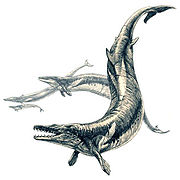 Basilosaurus was highly elongated. It accomplished this through an unparalleled elongation of its vertebrae, and has been described as being the closest a whale ever came to a snake
. It is also believed to have had unusual locomotion, compared with all other cetaceans; similarly sized thoracic, lumbar, sacral and caudal vertebrae imply that Basilosaurus moved in an anguilliform (eel
-like) fashion, only vertically. Even more oddly, paleontologist Philip Gingerich theorized that it may also have moved in a horizontal anguilliform fashion to some degree, something completely unknown in modern cetaceans. The skeletal anatomy
of the tail
suggests that a small fluke was probably present, which would have only aided vertical motion. Most reconstructions show a small, speculative dorsal fin similar to a rorqual whale’s, but other reconstructions show a dorsal ridge.
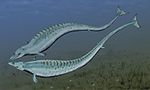 The whale also possessed small, 0.6 meter (2 ft) hind limbs, which clearly cannot aid locomotion on a 15-22 meter (50-72 foot) animal. Analysis has shown that the reduced limbs could only snap between two positions. They appear similar to the reduced leg
s used as copulatory guides on boas, and might have been used in the same manner.
The vertebrae of the whale appear to have been hollow, and it is likely that they were fluid filled as well. This would imply that Basilosaurus typically only functioned in two dimensions at the sea's surface, compared with the three dimensional habit of most other cetaceans. Judging from the relatively weak axial musculature and the thick bone
s in the limbs
, Basilosaurus is not believed to have been capable of sustained swimming or deep diving. It is also believed that the primitive whale was incapable of terrestrial locomotion.
The head of Basilosaurus did not have room for a melon
like modern day toothed whales, and the brain was smaller in comparison as well. It is believed that they therefore did not have the social capabilities of modern whales.
At one point of time it was believed that Basilosaurus had some sort of armor plating, but it was likely the misidentification of turtle shell
s.
Genus
In biology, a genus is a low-level taxonomic rank used in the biological classification of living and fossil organisms, which is an example of definition by genus and differentia...
of cetacean that lived from in the Late Eocene. Its fossil
Fossil
Fossils are the preserved remains or traces of animals , plants, and other organisms from the remote past...
ized remains were first discovered in the southern United States
United States
The United States of America is a federal constitutional republic comprising fifty states and a federal district...
(Louisiana
Louisiana
Louisiana is a state located in the southern region of the United States of America. Its capital is Baton Rouge and largest city is New Orleans. Louisiana is the only state in the U.S. with political subdivisions termed parishes, which are local governments equivalent to counties...
). The American fossils were initially believed to be some sort of reptile, hence the suffix -"saurus", but later found to be a marine mammal. Richard Owen
Richard Owen
Sir Richard Owen, FRS KCB was an English biologist, comparative anatomist and palaeontologist.Owen is probably best remembered today for coining the word Dinosauria and for his outspoken opposition to Charles Darwin's theory of evolution by natural selection...
wished to rename the creature Zeuglodon ("Yoked Tooth"), but, per taxonomic rules, the creature's first name remained permanent. Fossils from at least two other species
Species
In biology, a species is one of the basic units of biological classification and a taxonomic rank. A species is often defined as a group of organisms capable of interbreeding and producing fertile offspring. While in many cases this definition is adequate, more precise or differing measures are...
of this taxon
Taxon
|thumb|270px|[[African elephants]] form a widely-accepted taxon, the [[genus]] LoxodontaA taxon is a group of organisms, which a taxonomist adjudges to be a unit. Usually a taxon is given a name and a rank, although neither is a requirement...
have been found in Egypt
Egypt
Egypt , officially the Arab Republic of Egypt, Arabic: , is a country mainly in North Africa, with the Sinai Peninsula forming a land bridge in Southwest Asia. Egypt is thus a transcontinental country, and a major power in Africa, the Mediterranean Basin, the Middle East and the Muslim world...
and Pakistan
Pakistan
Pakistan , officially the Islamic Republic of Pakistan is a sovereign state in South Asia. It has a coastline along the Arabian Sea and the Gulf of Oman in the south and is bordered by Afghanistan and Iran in the west, India in the east and China in the far northeast. In the north, Tajikistan...
. Basilosaurus averaged about 18 meters (60 ft) in length, and is believed to have been the largest animal to have lived in its time. It displayed an unparalleled degree of elongation compared with modern whales. Their very small vestigial hind limbs have also been a matter of interest for paleontologists. The species is the state fossil
State fossil
Most American states have made a state fossil designation, in many cases during the 1980s. It is common to designate one species in which fossilization has occurred, rather than a single specimen, or a category of fossils not limited to a single species....
of Mississippi
Mississippi
Mississippi is a U.S. state located in the Southern United States. Jackson is the state capital and largest city. The name of the state derives from the Mississippi River, which flows along its western boundary, whose name comes from the Ojibwe word misi-ziibi...
and Alabama
Alabama
Alabama is a state located in the southeastern region of the United States. It is bordered by Tennessee to the north, Georgia to the east, Florida and the Gulf of Mexico to the south, and Mississippi to the west. Alabama ranks 30th in total land area and ranks second in the size of its inland...
in the United States.
Fossil finds
American Philosophical Society
The American Philosophical Society, founded in 1743, and located in Philadelphia, Pa., is an eminent scholarly organization of international reputation, that promotes useful knowledge in the sciences and humanities through excellence in scholarly research, professional meetings, publications,...
by a Judge Bly of Arkansas
Arkansas
Arkansas is a state located in the southern region of the United States. Its name is an Algonquian name of the Quapaw Indians. Arkansas shares borders with six states , and its eastern border is largely defined by the Mississippi River...
and Judge John Creagh of Clarke County
Clarke County, Alabama
-2010:Whereas according to the 2010 U.S. Census Bureau:*54.5% White*43.9% Black*0.4% Native American*0.3% Asian*0.0% Native Hawaiian or Pacific Islander*0.7% Two or more races*1.0% Hispanic or Latino -2000:...
, Alabama
Alabama
Alabama is a state located in the southeastern region of the United States. It is bordered by Tennessee to the north, Georgia to the east, Florida and the Gulf of Mexico to the south, and Mississippi to the west. Alabama ranks 30th in total land area and ranks second in the size of its inland...
. Both fossils ended up in the hands of the anatomist Dr. Richard Harlan
Richard Harlan
Richard Harlan was an American naturalist, zoologist, physicist and paleontologist....
, who requested more examples from Creagh. With some reservation, Harlan speculated that the fossils belonged to a (50 m [166 ft] long) marine reptile, for which he suggested the name Basilosaurus, meaning “King reptile”.
When the British anatomist Sir Richard Owen
Richard Owen
Sir Richard Owen, FRS KCB was an English biologist, comparative anatomist and palaeontologist.Owen is probably best remembered today for coining the word Dinosauria and for his outspoken opposition to Charles Darwin's theory of evolution by natural selection...
studied the spine, mandibular fragments, arms, and ribs (more recently found) he proclaimed them to be mammalian. Owen proposed renaming the find to Zeuglodon cetoides (“whale-like yoke
Yoke
A yoke is a wooden beam, normally used between a pair of oxen or other animals to enable them to pull together on a load when working in pairs, as oxen usually do; some yokes are fitted to individual animals. There are several types of yoke, used in different cultures, and for different types of oxen...
teeth”), which is now a junior synonym; though the latter is considered by many to be a more fitting name, the first-published name always takes precedence. The name Zeuglodon refers to the double rooted teeth typical of marine mammals.
Sea serpent
A sea serpent or sea dragon is a type of sea monster either wholly or partly serpentine.Sightings of sea serpents have been reported for hundreds of years, and continue to be claimed today. Cryptozoologist Bruce Champagne identified more than 1,200 purported sea serpent sightings...
” he called "Hydrarchos", which he displayed in New York City, and later Europe. It was eventually shown to have come from 5 different individuals, some of which were not Basilosaurus. The remains were eventually destroyed in the Great Chicago Fire
Great Chicago Fire
The Great Chicago Fire was a conflagration that burned from Sunday, October 8, to early Tuesday, October 10, 1871, killing hundreds and destroying about in Chicago, Illinois. Though the fire was one of the largest U.S...
.
In 1894 Smithsonian curator Charles Schuchert went to Alabama and collected fossil bones in order to mount the first scientifically accurate specimen. The mount has been altered several times in response to new discoveries. It is still on display today in the National Museum of Natural History
National Museum of Natural History
The National Museum of Natural History is a natural history museum administered by the Smithsonian Institution, located on the National Mall in Washington, D.C., United States. Admission is free and the museum is open 364 days a year....
, the only real specimen currently exhibited in the world. There is a plaster cast on display in the Alabama Museum of Natural History.
Fossil finds of another related species, Basilosaurus isis, have been found in the aptly named Valley of the Whales
Wadi Al-Hitan
Wadi Al-Hitan is a paleontological site in the Al Fayyum Governorate of Egypt, some 150 km southwest of Cairo. It was designated a UNESCO World Heritage Site in July 2005 for its hundreds of fossils of some of the earliest forms of whale, the archaeoceti...
in Egypt. The fossils were very well preserved, hind limbs included, and were rather numerous. Paleontologist Philip Gingerich, who organized several expeditions to the valley, speculated that Egyptian crocodile worship may have been inspired by the huge skeletons that lay there. Fossil remains of another species, Basilosaurus drazindai, have been found in Pakistan. Another fossilized species named Basiloterus husseini was its closest known relative, but was not as large or elongated.
Biology
Snake
Snakes are elongate, legless, carnivorous reptiles of the suborder Serpentes that can be distinguished from legless lizards by their lack of eyelids and external ears. Like all squamates, snakes are ectothermic, amniote vertebrates covered in overlapping scales...
. It is also believed to have had unusual locomotion, compared with all other cetaceans; similarly sized thoracic, lumbar, sacral and caudal vertebrae imply that Basilosaurus moved in an anguilliform (eel
Eel
Eels are an order of fish, which consists of four suborders, 20 families, 111 genera and approximately 800 species. Most eels are predators...
-like) fashion, only vertically. Even more oddly, paleontologist Philip Gingerich theorized that it may also have moved in a horizontal anguilliform fashion to some degree, something completely unknown in modern cetaceans. The skeletal anatomy
Anatomy
Anatomy is a branch of biology and medicine that is the consideration of the structure of living things. It is a general term that includes human anatomy, animal anatomy , and plant anatomy...
of the tail
Tail
The tail is the section at the rear end of an animal's body; in general, the term refers to a distinct, flexible appendage to the torso. It is the part of the body that corresponds roughly to the sacrum and coccyx in mammals, reptiles, and birds...
suggests that a small fluke was probably present, which would have only aided vertical motion. Most reconstructions show a small, speculative dorsal fin similar to a rorqual whale’s, but other reconstructions show a dorsal ridge.
Leg
Łęg may refer to the following places in Poland:*A former name for the town of Ełk *Part of the Czyżyny district of Kraków*Łęg, Pleszew County in Greater Poland Voivodeship...
s used as copulatory guides on boas, and might have been used in the same manner.
The vertebrae of the whale appear to have been hollow, and it is likely that they were fluid filled as well. This would imply that Basilosaurus typically only functioned in two dimensions at the sea's surface, compared with the three dimensional habit of most other cetaceans. Judging from the relatively weak axial musculature and the thick bone
Bone
Bones are rigid organs that constitute part of the endoskeleton of vertebrates. They support, and protect the various organs of the body, produce red and white blood cells and store minerals. Bone tissue is a type of dense connective tissue...
s in the limbs
Limb (anatomy)
A limb is a jointed, or prehensile , appendage of the human or other animal body....
, Basilosaurus is not believed to have been capable of sustained swimming or deep diving. It is also believed that the primitive whale was incapable of terrestrial locomotion.
The head of Basilosaurus did not have room for a melon
Melon (whale)
The melon is an ovoid-shaped, fatty organ found in the forehead of all toothed whales , including dolphins and porpoises and believed to be used in echolocation....
like modern day toothed whales, and the brain was smaller in comparison as well. It is believed that they therefore did not have the social capabilities of modern whales.
At one point of time it was believed that Basilosaurus had some sort of armor plating, but it was likely the misidentification of turtle shell
Turtle shell
The turtle shell is a highly complicated shield for the ventral and dorsal parts of the turtle, completely enclosing all the vital organs of the turtle and in some cases even the head. It is constructed of modified bony elements such as the ribs, parts of the pelvis and other bones found in most...
s.
In popular culture
- Herman MelvilleHerman MelvilleHerman Melville was an American novelist, short story writer, essayist, and poet. He is best known for his novel Moby-Dick and the posthumous novella Billy Budd....
recounts the discovery of the Alabama Basilosaurus and the subsequent discovery that it was a marine cetacean in chapters 104-105 of Moby-DickMoby-DickMoby-Dick; or, The Whale, was written by American author Herman Melville and first published in 1851. It is considered by some to be a Great American Novel and a treasure of world literature. The story tells the adventures of wandering sailor Ishmael, and his voyage on the whaleship Pequod,...
(1851).
- Basilosaurus was featured in the second episode of BBC's Walking with BeastsWalking with BeastsWalking with Beasts is a 2001 six-part television documentary miniseries, produced by the BBC in the United Kingdom, narrated by Kenneth Branagh. In North America it has been retitled Walking with Prehistoric Beasts, and the original Discovery Channel broadcast was narrated by Stockard Channing...
(2001). It featured the breeding cycle of Basilosaurus. First, the featured Basilosaurus mated, after which food ran out in her territory, and she journeyed into a saltwater lagoon. In one instance, she was unsuccessful in hunting a MoeritheriumMoeritheriumMoeritherium is a genus consisting of several species. These prehistoric mammals are related to the elephant and, more distantly, the sea cow...
. In the end, the Basilosaurus dines on baby DorudonDorudonDorudon was a genus of ancient cetacean that lived alongside Basilosaurus 41 to 33 million years ago, in the Eocene. They were about five meters long and were most likely carnivorous, feeding on small fish and mollusks. Dorudontines lived in warm seas around the world...
and is shown with her offspring one year later. In a follow-up to Walking with Beasts called Sea Monsters (2003), the Basilosaurus is the top hazard in the episode “Fourth Most Dangerous Sea of All Time”. It was shown as being more aggressive and territorial than in Walking with BeastsWalking with BeastsWalking with Beasts is a 2001 six-part television documentary miniseries, produced by the BBC in the United Kingdom, narrated by Kenneth Branagh. In North America it has been retitled Walking with Prehistoric Beasts, and the original Discovery Channel broadcast was narrated by Stockard Channing...
.
External links
- Walking with Prehistoric Beasts's profile of Basilosaurus
- Paleos Vertebrates
- Bejder, Lars and Hall, Brian K. Limbs in whales and limblessness in other vertebrates: mechanisms of evolutionary and developmental transformation and loss. Evolution and Development, 2002.
- Zeuglodons in Cryptozoology
- Basilosaurus Primitive Eocene Whales
- Harlan 1834 - Basilosaurus - The plesiosaur that wasn't....
- Basilosaurus at the Smithsonian