

Banking in India

Encyclopedia
Bank of Bombay
Bank of Bombay was the second of the three presidency banks of the Raj period. It was established, pursuant to a charter of the British East India Company, in the year 1868, about a decade after India's First War of Independence. The bank was headquartered in Bombay, now called Mumbai...
and the Bank of Madras
Bank of Madras
The Bank of Madras, one of the three Presidency Banks, the other two being, the Bank of Bengal and the Bank of Bombay, was established on 1 July 1843, and was headquartered in Madras, now Chennai. It is now subsumed in the State Bank of India.-Origin:...
, all three of which were established under charters from the British East India Company. For many years the Presidency banks acted as quasi-central banks, as did their successors. The three banks merged in 1921 to form the Imperial Bank of India
Imperial Bank of India
The Imperial Bank of India was the oldest and the largest commercial bank of the Indian subcontinent, and was subsequently transformed into State Bank of India in 1955.-Origin:...
, which, upon India's independence, became the State Bank of India
State Bank of India
The State Bank of India is the largest Indian banking and financial services company with its headquarters in Mumbai, India. It is state-owned. The bank traces its ancestry to British India, through the Imperial Bank of India, to the founding in 1806 of the Bank of Calcutta, making it the oldest...
.
History
Indian merchants in Calcutta established the Union Bank in 1839, but it failed in 1848 as a consequence of the economic crisis of 1848-49. The Allahabad BankAllahabad Bank
Allahabad Bank , , which began operations in 1865, has its head-quarters in Kolkata. Currently the bank has 2500 branches across the country. The Chairman and Managing Director of the bank is Shri J. P. Dua. The bank has a branch in Hong Kong and a representative office in Shenzen.-19th...
, established in 1865 and still functioning today, is the oldest Joint Stock bank in India.(Joint Stock Bank: A company that issues stock and requires shareholders to be held liable for the company's debt) It was not the first though. That honor belongs to the Bank of Upper India, which was established in 1863, and which survived until 1913, when it failed, with some of its assets and liabilities being transferred to the Alliance Bank of Simla
Alliance Bank of Simla
The Alliance Bank of Simla was a British-run though India-registered bank that commenced operations in Simla in 1874. Early In 1913, it acquired some of the assets and liabilities of the Bank of Upper India, which had been founded in Meerut in 1863 and had been the first joint-stock bank in India....
.
When the American Civil War
American Civil War
The American Civil War was a civil war fought in the United States of America. In response to the election of Abraham Lincoln as President of the United States, 11 southern slave states declared their secession from the United States and formed the Confederate States of America ; the other 25...
stopped the supply of cotton to Lancashire
Lancashire
Lancashire is a non-metropolitan county of historic origin in the North West of England. It takes its name from the city of Lancaster, and is sometimes known as the County of Lancaster. Although Lancaster is still considered to be the county town, Lancashire County Council is based in Preston...
from the Confederate States, promoters opened banks to finance trading in Indian cotton. With large exposure to speculative ventures, most of the banks opened in India during that period failed. The depositors lost money and lost interest in keeping deposits with banks. Subsequently, banking in India remained the exclusive domain of Europeans for next several decades until the beginning of the 20th century.
Foreign banks too started to arrive, particularly in Calcutta
Kolkata
Kolkata , formerly known as Calcutta, is the capital of the Indian state of West Bengal. Located on the east bank of the Hooghly River, it was the commercial capital of East India...
, in the 1860s. The Comptoire d'Escompte de Paris opened a branch in Calcutta in 1860, and another in Bombay
Mumbai
Mumbai , formerly known as Bombay in English, is the capital of the Indian state of Maharashtra. It is the most populous city in India, and the fourth most populous city in the world, with a total metropolitan area population of approximately 20.5 million...
in 1862; branches in Madras
Chennai
Chennai , formerly known as Madras or Madarasapatinam , is the capital city of the Indian state of Tamil Nadu, located on the Coromandel Coast off the Bay of Bengal. Chennai is the fourth most populous metropolitan area and the sixth most populous city in India...
and Pondicherry, then a French colony, followed. HSBC
HSBC
HSBC Holdings plc is a global banking and financial services company headquartered in Canary Wharf, London, United Kingdom. it is the world's second-largest banking and financial services group and second-largest public company according to a composite measure by Forbes magazine...
established itself in Bengal
Bengal
Bengal is a historical and geographical region in the northeast region of the Indian Subcontinent at the apex of the Bay of Bengal. Today, it is mainly divided between the sovereign land of People's Republic of Bangladesh and the Indian state of West Bengal, although some regions of the previous...
in 1869. Calcutta was the most active trading port in India, mainly due to the trade of the British Empire
British Raj
British Raj was the British rule in the Indian subcontinent between 1858 and 1947; The term can also refer to the period of dominion...
, and so became a banking center.
The first entirely Indian joint stock bank was the Oudh Commercial Bank, established in 1881 in Faizabad
Faizabad
City of Faizabad , previous capital of Awadh, is the headquarters of Faizabad District and a municipal board in the state of Uttar Pradesh, India, situated on the banks of river Ghaghra . Faizabad has a twin city of Ayodhya, which is considered to be the birthplace of Rama...
. It failed in 1958. The next was the Punjab National Bank
Punjab National Bank
Punjab National Bank , was founded in 1894 and is currently the second largest state-owned commercial bank in India ahead of Bank of Baroda with about 5000 branches across 764 cities. It serves over 37 million customers. The bank has been ranked 248th biggest bank in the world by the Bankers...
, established in Lahore
Lahore
Lahore is the capital of the Pakistani province of Punjab and the second largest city in the country. With a rich and fabulous history dating back to over a thousand years ago, Lahore is no doubt Pakistan's cultural capital. One of the most densely populated cities in the world, Lahore remains a...
in 1895, which has survived to the present and is now one of the largest banks in India.
Around the turn of the 20th Century, the Indian economy was passing through a relative period of stability. Around five decades had elapsed since the Indian Mutiny
Indian Rebellion of 1857
The Indian Rebellion of 1857 began as a mutiny of sepoys of the British East India Company's army on 10 May 1857, in the town of Meerut, and soon escalated into other mutinies and civilian rebellions largely in the upper Gangetic plain and central India, with the major hostilities confined to...
, and the social, industrial and other infrastructure had improved. Indians had established small banks, most of which served particular ethnic and religious communities.
The presidency banks dominated banking in India but there were also some exchange banks and a number of Indian joint stock
Joint stock company
A joint-stock company is a type of corporation or partnership involving two or more individuals that own shares of stock in the company...
banks. All these banks operated in different segments of the economy. The exchange banks, mostly owned by Europeans, concentrated on financing foreign trade. Indian joint stock banks were generally under capitalized and lacked the experience and maturity to compete with the presidency and exchange banks. This segmentation let Lord Curzon to observe, "In respect of banking it seems we are behind the times. We are like some old fashioned sailing ship, divided by solid wooden bulkheads into separate and cumbersome compartments."
The period between 1906 and 1911, saw the establishment of banks inspired by the Swadeshi movement. The Swadeshi movement inspired local businessmen and political figures to found banks of and for the Indian community. A number of banks established then have survived to the present such as Bank of India
Bank of India
Bank of India is a state-owned commercial bank with headquarters in Mumbai. Government-owned since nationalization in 1969, It is India's 4th largest bank, after State Bank of India, Punjab National Bank and Bank of Baroda. It has 3415 branches, including 29 branches outside India...
, Corporation Bank
Corporation Bank
Corporation Bank is an India-based banking company based in Mangalore, India. The bank was founded with an initial capital of Rs. 5000 , and first day’s canvassed resources of less than one USD 1, has currently 12,724 full time employees, and operates from several branches in India.The Bank is a...
, Indian Bank
Indian Bank
Indian Bank is a major Indian Commercial Bank headquartered in Chennai , India. It has 22,000 employees, 1923 branches and is one of the big public sector banks of India. It has overseas branches in Colombo, Sri Lanka, Singapore, and 229 correspondent banks in 69 countries...
, Bank of Baroda
Bank of Baroda
Bank of Baroda is the third largest bank in India, after the State Bank of India and the Punjab National Bank and ahead of ICICI Bank. BoB is ranked 763 in Forbes Global 2000 list. BoB has total assets in excess of Rs. 3.58 lakh crores, or Rs. 3,583 billion, a network of over 3,409 branches and...
, Canara Bank
Canara Bank
Canara Bank is a state-owned financial services company in India. It was established in 1906, making it one of the oldest banks in the country. As on 2009 November, the bank had a network of 3057 branches, spread across India...
and Central Bank of India
Central Bank of India
Central Bank of India , a government-owned bank, is one of the oldest and largest commercial banks in India. It is based in Mumbai...
.
The fervour of Swadeshi movement lead to establishing of many private banks in Dakshina Kannada
Dakshina Kannada
- Geography :The district geography consists of sea shore in the west and Western Ghats in the east. The major rivers are Netravathi, Kumaradhara, Phalguni, Shambhavi, Nandini or Pavanje and Payaswini which all join Arabian sea. Vast areas of evergreen forests which once covered this district, have...
and Udupi district
Udupi district
Udupi district , ಉಡುಪಿ ಜಿಲ್ಲೆ) in the Karnataka state of India was created in August 1997. The three northern taluks, Udupi, Kundapur and Karkal, were separated from Dakshina Kannada District to form Udupi district. Udupi district is surrounded by Uttara Kannada district in north, Dakshina Kannada...
which were unified earlier and known by the name South Canara ( South Kanara ) district. Four nationalised banks started in this district and also a leading private sector bank. Hence undivided Dakshina Kannada district is known as "Cradle of Indian Banking".
During the First World War (1914–1918) through the end of the Second World War (1939–1945), and two years thereafter until the independence
Indian independence movement
The term Indian independence movement encompasses a wide area of political organisations, philosophies, and movements which had the common aim of ending first British East India Company rule, and then British imperial authority, in parts of South Asia...
of India were challenging for Indian banking. The years of the First World War were turbulent, and it took its toll with banks simply collapsing despite the Indian economy
Economy of India
The Economy of India is the ninth largest in the world by nominal GDP and the fourth largest by purchasing power parity . The country is a part of the G-20 major economies and the BRICS, in addition to being partners of the ASEAN. India has a per capita GDP of $3,608 as per 2010 figures, making it...
gaining indirect boost due to war-related economic activities. At least 94 banks in India failed between 1913 and 1918 as indicated in the following table:
| Years | Number of banks that failed |
Authorised capital (Rs. Lakhs) |
Paid-up Capital (Rs. Lakhs) |
|---|---|---|---|
| 1913 | 12 | 274 | 35 |
| 1914 | 42 | 710 | 109 |
| 1915 | 11 | 56 | 5 |
| 1916 | 13 | 231 | 4 |
| 1917 | 9 | 76 | 25 |
| 1918 | 7 | 209 | 1 |
Post-Independence
The partition of IndiaPartition of India
The Partition of India was the partition of British India on the basis of religious demographics that led to the creation of the sovereign states of the Dominion of Pakistan and the Union of India on 14 and 15...
in 1947 adversely impacted the economies of Punjab and West Bengal
West Bengal
West Bengal is a state in the eastern region of India and is the nation's fourth-most populous. It is also the seventh-most populous sub-national entity in the world, with over 91 million inhabitants. A major agricultural producer, West Bengal is the sixth-largest contributor to India's GDP...
, paralyzing banking activities for months. India's independence marked the end of a regime of the Laissez-faire
Laissez-faire
In economics, laissez-faire describes an environment in which transactions between private parties are free from state intervention, including restrictive regulations, taxes, tariffs and enforced monopolies....
for the Indian banking. The Government of India
Government of India
The Government of India, officially known as the Union Government, and also known as the Central Government, was established by the Constitution of India, and is the governing authority of the union of 28 states and seven union territories, collectively called the Republic of India...
initiated measures to play an active role in the economic life of the nation, and the Industrial Policy Resolution adopted by the government in 1948 envisaged a mixed economy
Mixed economy
Mixed economy is an economic system in which both the state and private sector direct the economy, reflecting characteristics of both market economies and planned economies. Most mixed economies can be described as market economies with strong regulatory oversight, in addition to having a variety...
. This resulted into greater involvement of the state in different segments of the economy including banking and finance. The major steps to regulate banking included:
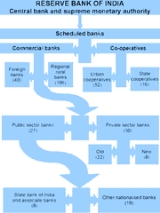
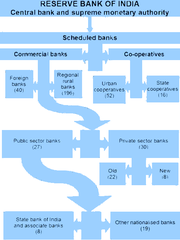
- The Reserve Bank of IndiaReserve Bank of IndiaThe Reserve Bank of India is the central banking institution of India and controls the monetary policy of the rupee as well as US$300.21 billion of currency reserves. The institution was established on 1 April 1935 during the British Raj in accordance with the provisions of the Reserve Bank of...
, India's central banking authority, was nationalized on January 1, 1949 under the terms of the Reserve Bank of India (Transfer to Public Ownership) Act, 1948 (RBI, 2005b).[Reference www.rbi.org.in] - In 1949, the Banking Regulation Act was enacted which empowered the Reserve Bank of India (RBI) "to regulate, control, and inspect the banks in India."
- The Banking Regulation Act also provided that no new bank or branch of an existing bank could be opened without a license from the RBI, and no two banks could have common directors.
Nationalisation
Despite the provisions, control and regulations of Reserve Bank of IndiaReserve Bank of India
The Reserve Bank of India is the central banking institution of India and controls the monetary policy of the rupee as well as US$300.21 billion of currency reserves. The institution was established on 1 April 1935 during the British Raj in accordance with the provisions of the Reserve Bank of...
, banks in India except the State Bank of India
State Bank of India
The State Bank of India is the largest Indian banking and financial services company with its headquarters in Mumbai, India. It is state-owned. The bank traces its ancestry to British India, through the Imperial Bank of India, to the founding in 1806 of the Bank of Calcutta, making it the oldest...
or SBI, continued to be owned and operated by private persons. By the 1960s, the Indian banking industry had become an important tool to facilitate the development of the Indian economy. At the same time, it had emerged as a large employer, and a debate had ensued about the nationalization of the banking industry. Indira Gandhi
Indira Gandhi
Indira Priyadarshini Gandhara was an Indian politician who served as the third Prime Minister of India for three consecutive terms and a fourth term . She was assassinated by Sikh extremists...
, then Prime Minister of India
Prime Minister of India
The Prime Minister of India , as addressed to in the Constitution of India — Prime Minister for the Union, is the chief of government, head of the Council of Ministers and the leader of the majority party in parliament...
, expressed the intention of the Government of India
Government of India
The Government of India, officially known as the Union Government, and also known as the Central Government, was established by the Constitution of India, and is the governing authority of the union of 28 states and seven union territories, collectively called the Republic of India...
in the annual conference of the All India Congress Meeting in a paper entitled "Stray thoughts on Bank Nationalisation." The meeting received the paper with enthusiasm.
Thereafter, her move was swift and sudden. The Government of India issued an ordinance and nationalised the 14 largest commercial banks with effect from the midnight of July 19, 1969. Jayaprakash Narayan
Jayaprakash Narayan
Jayaprakash Narayan , widely known as JP Narayan, Jayaprakash, or Loknayak, was an Indian independence activist and political leader, remembered especially for leading the opposition to Indira Gandhi in the 1970s and for giving a call for peaceful Total Revolution...
, a national leader of India, described the step as a "masterstroke of political sagacity." Within two weeks of the issue of the ordinance, the Parliament
Parliament of India
The Parliament of India is the supreme legislative body in India. Founded in 1919, the Parliament alone possesses legislative supremacy and thereby ultimate power over all political bodies in India. The Parliament of India comprises the President and the two Houses, Lok Sabha and Rajya Sabha...
passed the Banking Companies (Acquisition and Transfer of Undertaking) Bill, and it received the presidential
President of India
The President of India is the head of state and first citizen of India, as well as the Supreme Commander of the Indian Armed Forces. President of India is also the formal head of all the three branches of Indian Democracy - Legislature, Executive and Judiciary...
approval on 9 August 1969.
A second dose of nationalization of 6 more commercial banks followed in 1980. The stated reason for the nationalization was to give the government more control of credit delivery. With the second dose of nationalization, the Government of India controlled around 91% of the banking business of India. Later on, in the year 1993, the government merged New Bank of India with Punjab National Bank
Punjab National Bank
Punjab National Bank , was founded in 1894 and is currently the second largest state-owned commercial bank in India ahead of Bank of Baroda with about 5000 branches across 764 cities. It serves over 37 million customers. The bank has been ranked 248th biggest bank in the world by the Bankers...
. It was the only merger between nationalized banks and resulted in the reduction of the number of nationalised banks from 20 to 19. After this, until the 1990s, the nationalised banks grew at a pace of around 4%, closer to the average growth rate of the Indian economy.
Liberalisation
In the early 1990s, the then Narasimha RaoNarasimha Rao
Narasimha Rao or Narasimharao is one of the Indian names.* Pamulaparthi Venkata Narasimha Rao served as the 10th Prime Minister of India.* Modireddy Venkat Narasimha Rao, is a former Indian cricketer....
government embarked on a policy of liberalization
Liberalization
In general, liberalization refers to a relaxation of previous government restrictions, usually in areas of social or economic policy. In some contexts this process or concept is often, but not always, referred to as deregulation...
, licensing a small number of private banks. These came to be known as New Generation tech-savvy banks, and included Global Trust Bank (the first of such new generation banks to be set up), which later amalgamated with Oriental Bank of Commerce, Axis Bank
Axis Bank
Axis Bank Limited, formerly UTI Bank, is a financial services firm that had begun operations in 1994, after the Government of India allowed new private banks to be established...
(earlier as UTI Bank), ICICI Bank
ICICI Bank
ICICI Bank Ltd. is India's second largest financial services company headquartered in Mumbai, India. It offers a wide range of banking products and financial services to corporate and retail customers through a variety of delivery channels and through its specialised subsidiaries in the areas of...
and HDFC Bank
HDFC Bank
HDFC Bank Limited is a major Indian financial services company based in India, incorporated in August 1994, after the Reserve Bank of India allowed establishing private sector banks. The Bank was promoted by the Housing Development Finance Corporation, a premier housing finance company of India...
. This move, along with the rapid growth in the economy of India
Economy of India
The Economy of India is the ninth largest in the world by nominal GDP and the fourth largest by purchasing power parity . The country is a part of the G-20 major economies and the BRICS, in addition to being partners of the ASEAN. India has a per capita GDP of $3,608 as per 2010 figures, making it...
, revitalized the banking sector in India, which has seen rapid growth with strong contribution from all the three sectors of banks, namely, government banks, private banks and foreign banks.
The next stage for the Indian banking has been set up with the proposed relaxation in the norms for Foreign Direct Investment, where all Foreign Investors in banks may be given voting rights which could exceed the present cap of 10%,at present it has gone up to 74% with some restrictions.
The new policy shook the Banking sector in India
India
India , officially the Republic of India , is a country in South Asia. It is the seventh-largest country by geographical area, the second-most populous country with over 1.2 billion people, and the most populous democracy in the world...
completely. Bankers, till this time, were used to the 4-6-4 method (Borrow at 4%;Lend at 6%;Go home at 4) of functioning. The new wave ushered in a modern outlook and tech-savvy methods of working for traditional banks.All this led to the retail boom in India. People not just demanded more from their banks but also received more.
Currently (2007), banking in India is generally fairly mature in terms of supply, product range and reach-even though reach in rural India still remains a challenge for the private sector and foreign banks. In terms of quality of assets and capital adequacy, Indian banks are considered to have clean, strong and transparent balance sheets relative to other banks in comparable economies in its region. The Reserve Bank of India is an autonomous body, with minimal pressure from the government. The stated policy of the Bank on the Indian Rupee is to manage volatility but without any fixed exchange rate-and this has mostly been true.
With the growth in the Indian economy expected to be strong for quite some time-especially in its services sector-the demand for banking services, especially retail banking
Retail banking
Retail banking is banking in which banking institutions execute transactions directly with consumers, rather than corporations or other banks. Services offered include: savings and transactional accounts, mortgages, personal loans, debit cards, credit cards, and so forth.-Types of...
, mortgages and investment services are expected to be strong. One may also expect M&As, takeovers, and asset sales.
In March 2006, the Reserve Bank of India allowed Warburg Pincus to increase its stake in Kotak Mahindra Bank (a private sector bank) to 10%. This is the first time an investor has been allowed to hold more than 5% in a private sector bank since the RBI announced norms in 2005 that any stake exceeding 5% in the private sector banks would need to be vetted by them.
In recent years critics have charged that the non-government owned banks are too aggressive in their loan recovery efforts in connection with housing, vehicle and personal loans. There are press reports that the banks' loan recovery efforts have driven defaulting borrowers to suicide.
Adoption of banking technology
The IT revolution had a great impact in the Indian banking system. The use of computers had led to introduction of online banking in India. The use of the modern innovation and computerisation of the banking sector of India has increased many fold after the economic liberalisation of 1991 as the country's banking sector has been exposed to the world's market. The Indian banks were finding it difficult to compete with the international banks in terms of the customer service without the use of the information technology and computers.The RBI in 1984 formed Committee on Mechanisation in the Banking Industry (1984) whose chairman was Dr C Rangarajan, Deputy Governor, Reserve Bank of India. The major recommendations of this committee was introducing MICR Technology in the all the banks in the metropolis in India.This provided use of standardized cheque forms and encoders.
In 1988, the RBI set up Committee on Computerisation in Banks (1988) headed by Dr. C.R. Rangarajan which emphasized that settlement operation must be computerized in the clearing houses of RBI in Bhubaneshwar, Guwahati, Jaipur, Patna and Thiruvananthapuram.It further stated that there should be National Clearing of inter-city cheques at Kolkata,Mumbai,Delhi,Chennai and MICR should be made Operational.It also focused on computerisation of branches and increasing connectivity among branches through computers.It also suggested modalities for implementing on-line banking.The committee submitted its reports in 1989 and computerisation began form 1993 with the settlement between IBA and bank employees's association.
IN 1994, Committee on Technology Issues relating to Payments System, Cheque Clearing and Securities Settlement in the Banking Industry (1994) was set up with chairman Shri WS Saraf, Executive Director, Reserve Bank of India. It emphasized on Electronic Funds Transfer (EFT) system, with the BANKNET communications network as its carrier. It also said that MICR clearing should be set up in all branches of all banks with more than 100 branches.
Committee for proposing Legislation On Electronic Funds Transfer and other Electronic Payments (1995) emphasized on EFT system. Electronic banking refers to DOING BANKING by using technologies like computers, internet and networking,MICR,EFT so as to increase efficiency, quick service,productivity and transparency in the transaction.
Apart from the above mentioned innovations the banks have been selling the third party products like Mutual Funds, insurances to its clients.Total numbers of ATMs installed in India by various banks as on end March 2005 is 17,642.The New Private Sector Banks in India is having the largest numbers of ATMs which is followed by SBI Group, Nationalized banks, Old private banks and Foreign banks.The total off site ATM is highest for the SBI and its subsidiaries and then it is followed by New Private Banks, Nationalised banks and Foreign banks. While on site is highest for the Nationalised banks of India.
| BANK GROUP | NUMBER OF BRANCHES | ON SITE ATM | OFF SITE ATM | TOTAL ATM |
|---|---|---|---|---|
| NATIONALISED BANKS | 33627 | 3205 | 1567 | 4772 |
| STATE BANK OF INDIA | 13661 | 1548 | 3672 | 5220 |
| OLD PRIVATE SECTOR BANKS | 4511 | 800 | 441 | 1241 |
| NEW PRIVATE SECTOR BANKS | 1685 | 1883 | 3729 | 5612 |
| FOREIGN BANKS | 242 | 218 | 579 | 797 |
Further reading
- The Evolution of the State Bank of India (The Era of the Imperial Bank of India, 1921-1955) (Volume III)
- Banking Frontiers - a monthly magazine, published by Mumbai based Glocal Infomart. Editor