

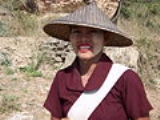
Bamar

Encyclopedia
The Bamar are the dominant ethnic group of Burma (Myanmar), constituting approximately two-thirds of the population. The Bamar live primarily in the Irrawaddy basin, and speak the Burmese language
, which is also the official language of Burma. Bamar customs and identity are closely intertwined with general Burmese customs and identity. The Bamar are frequently, imprecisely called Burmese although the term in modern usage refers to a citizen of Burma of any ethnic background.
, the official language of Burma, is widely spoken by many of the ethnic minorities as well as the majority Bamar. Its core vocabulary consists of Sino-Tibetan words, but many terms associated with Buddhism, arts, sciences, and government have derived from the Indo-European languages
of Pali
and English. The Rakhine
, although culturally distinct from the Bamar, are ethnically related to the Bamar and speak a dialect of Burmese that includes retention of the /r/ sound, which has coalesced into the /j/ sound in standard Burmese (although it is still present in orthography). Additional dialects come from coastal areas of Tanintharyi Division
(including Myeik (Beik) and Dawei
(Tavoyan)) as well as inland and isolated areas, like the Yaw region on the hills of Chin State
and include Yaw. Other dialects are Taungyoe, Danu, and Intha
in Shan State
. English was introduced in the 1800s when the Bamar first came into contact with the British as a trading nation and continued to flourish under subsequent colonial rule.
, and more distantly to Chinese). They migrated from the present day Yunnan
in China into the Ayeyarwady
river valley in Upper Burma
about 1200–1500 years ago. Over the last millennium, they have largely replaced/absorbed the Mon
and the earlier Pyu
, ethnic groups that originally dominated the Ayeyarwady valley.
. Women wear a type of sarong known as htamain , while men wear a sarong sewn into a tube, called a longyi, or, more formally, a single long piece wrapped around the hips, known in Burmese as a paso . Formal attire often consists of gold jewellery, silk scarves, and jackets. On formal occasions, men often wear cloth turbans called gaung baung and Mandarin collared jackets
called taikpon , while women wear blouses. Both genders wear velvet sandals called gadiba phanat
The Bamar are the dominant ethnic group of Burma (Myanmar), constituting approximately two-thirds of the population. The Bamar live primarily in the Irrawaddy basin, and speak the Burmese language
, which is also the official language of Burma. Bamar customs and identity are closely intertwined with general Burmese customs and identity. The Bamar are frequently, imprecisely called Burmese although the term in modern usage refers to a citizen of Burma of any ethnic background.
, the official language of Burma, is widely spoken by many of the ethnic minorities as well as the majority Bamar. Its core vocabulary consists of Sino-Tibetan words, but many terms associated with Buddhism, arts, sciences, and government have derived from the Indo-European languages
of Pali
and English. The Rakhine
, although culturally distinct from the Bamar, are ethnically related to the Bamar and speak a dialect of Burmese that includes retention of the /r/ sound, which has coalesced into the /j/ sound in standard Burmese (although it is still present in orthography). Additional dialects come from coastal areas of Tanintharyi Division
(including Myeik (Beik) and Dawei
(Tavoyan)) as well as inland and isolated areas, like the Yaw region on the hills of Chin State
and include Yaw. Other dialects are Taungyoe, Danu, and Intha
in Shan State
. English was introduced in the 1800s when the Bamar first came into contact with the British as a trading nation and continued to flourish under subsequent colonial rule.
, and more distantly to Chinese). They migrated from the present day Yunnan
in China into the Ayeyarwady
river valley in Upper Burma
about 1200–1500 years ago. Over the last millennium, they have largely replaced/absorbed the Mon
and the earlier Pyu
, ethnic groups that originally dominated the Ayeyarwady valley.
. Women wear a type of sarong known as htamain , while men wear a sarong sewn into a tube, called a longyi, or, more formally, a single long piece wrapped around the hips, known in Burmese as a paso . Formal attire often consists of gold jewellery, silk scarves, and jackets. On formal occasions, men often wear cloth turbans called gaung baung and Mandarin collared jackets
called taikpon , while women wear blouses. Both genders wear velvet sandals called gadiba phanat
The Bamar are the dominant ethnic group of Burma (Myanmar), constituting approximately two-thirds of the population. The Bamar live primarily in the Irrawaddy basin, and speak the Burmese language
, which is also the official language of Burma. Bamar customs and identity are closely intertwined with general Burmese customs and identity. The Bamar are frequently, imprecisely called Burmese although the term in modern usage refers to a citizen of Burma of any ethnic background.
, the official language of Burma, is widely spoken by many of the ethnic minorities as well as the majority Bamar. Its core vocabulary consists of Sino-Tibetan words, but many terms associated with Buddhism, arts, sciences, and government have derived from the Indo-European languages
of Pali
and English. The Rakhine
, although culturally distinct from the Bamar, are ethnically related to the Bamar and speak a dialect of Burmese that includes retention of the /r/ sound, which has coalesced into the /j/ sound in standard Burmese (although it is still present in orthography). Additional dialects come from coastal areas of Tanintharyi Division
(including Myeik (Beik) and Dawei
(Tavoyan)) as well as inland and isolated areas, like the Yaw region on the hills of Chin State
and include Yaw. Other dialects are Taungyoe, Danu, and Intha
in Shan State
. English was introduced in the 1800s when the Bamar first came into contact with the British as a trading nation and continued to flourish under subsequent colonial rule.
, and more distantly to Chinese). They migrated from the present day Yunnan
in China into the Ayeyarwady
river valley in Upper Burma
about 1200–1500 years ago. Over the last millennium, they have largely replaced/absorbed the Mon
and the earlier Pyu
, ethnic groups that originally dominated the Ayeyarwady valley.
. Women wear a type of sarong known as htamain , while men wear a sarong sewn into a tube, called a longyi, or, more formally, a single long piece wrapped around the hips, known in Burmese as a paso . Formal attire often consists of gold jewellery, silk scarves, and jackets. On formal occasions, men often wear cloth turbans called gaung baung and Mandarin collared jackets
called taikpon , while women wear blouses. Both genders wear velvet sandals called gadiba phanat
The Bamar are the dominant ethnic group of Burma (Myanmar), constituting approximately two-thirds of the population. The Bamar live primarily in the Irrawaddy basin, and speak the Burmese language
, which is also the official language of Burma. Bamar customs and identity are closely intertwined with general Burmese customs and identity. The Bamar are frequently, imprecisely called Burmese although the term in modern usage refers to a citizen of Burma of any ethnic background.
, the official language of Burma, is widely spoken by many of the ethnic minorities as well as the majority Bamar. Its core vocabulary consists of Sino-Tibetan words, but many terms associated with Buddhism, arts, sciences, and government have derived from the Indo-European languages
of Pali
and English. The Rakhine
, although culturally distinct from the Bamar, are ethnically related to the Bamar and speak a dialect of Burmese that includes retention of the /r/ sound, which has coalesced into the /j/ sound in standard Burmese (although it is still present in orthography). Additional dialects come from coastal areas of Tanintharyi Division
(including Myeik (Beik) and Dawei
(Tavoyan)) as well as inland and isolated areas, like the Yaw region on the hills of Chin State
and include Yaw. Other dialects are Taungyoe, Danu, and Intha
in Shan State
. English was introduced in the 1800s when the Bamar first came into contact with the British as a trading nation and continued to flourish under subsequent colonial rule.
, and more distantly to Chinese). They migrated from the present day Yunnan
in China into the Ayeyarwady
river valley in Upper Burma
about 1200–1500 years ago. Over the last millennium, they have largely replaced/absorbed the Mon
and the earlier Pyu
, ethnic groups that originally dominated the Ayeyarwady valley.
. Women wear a type of sarong known as htamain , while men wear a sarong sewn into a tube, called a longyi, or, more formally, a single long piece wrapped around the hips, known in Burmese as a paso . Formal attire often consists of gold jewellery, silk scarves, and jackets. On formal occasions, men often wear cloth turbans called gaung baung and Mandarin collared jackets
called taikpon , while women wear blouses. Both genders wear velvet sandals called gadiba phanat
The Bamar are the dominant ethnic group of Burma (Myanmar), constituting approximately two-thirds of the population. The Bamar live primarily in the Irrawaddy basin, and speak the Burmese language
, which is also the official language of Burma. Bamar customs and identity are closely intertwined with general Burmese customs and identity. The Bamar are frequently, imprecisely called Burmese although the term in modern usage refers to a citizen of Burma of any ethnic background.
, the official language of Burma, is widely spoken by many of the ethnic minorities as well as the majority Bamar. Its core vocabulary consists of Sino-Tibetan words, but many terms associated with Buddhism, arts, sciences, and government have derived from the Indo-European languages
of Pali
and English. The Rakhine
, although culturally distinct from the Bamar, are ethnically related to the Bamar and speak a dialect of Burmese that includes retention of the /r/ sound, which has coalesced into the /j/ sound in standard Burmese (although it is still present in orthography). Additional dialects come from coastal areas of Tanintharyi Division
(including Myeik (Beik) and Dawei
(Tavoyan)) as well as inland and isolated areas, like the Yaw region on the hills of Chin State
and include Yaw. Other dialects are Taungyoe, Danu, and Intha
in Shan State
. English was introduced in the 1800s when the Bamar first came into contact with the British as a trading nation and continued to flourish under subsequent colonial rule.
, and more distantly to Chinese). They migrated from the present day Yunnan
in China into the Ayeyarwady
river valley in Upper Burma
about 1200–1500 years ago. Over the last millennium, they have largely replaced/absorbed the Mon
and the earlier Pyu
, ethnic groups that originally dominated the Ayeyarwady valley.
. Women wear a type of sarong known as htamain , while men wear a sarong sewn into a tube, called a longyi, or, more formally, a single long piece wrapped around the hips, known in Burmese as a paso . Formal attire often consists of gold jewellery, silk scarves, and jackets. On formal occasions, men often wear cloth turbans called gaung baung and Mandarin collared jackets
called taikpon , while women wear blouses. Both genders wear velvet sandals called gadiba phanat
The Bamar are the dominant ethnic group of Burma (Myanmar), constituting approximately two-thirds of the population. The Bamar live primarily in the Irrawaddy basin, and speak the Burmese language
, which is also the official language of Burma. Bamar customs and identity are closely intertwined with general Burmese customs and identity. The Bamar are frequently, imprecisely called Burmese although the term in modern usage refers to a citizen of Burma of any ethnic background.
, the official language of Burma, is widely spoken by many of the ethnic minorities as well as the majority Bamar. Its core vocabulary consists of Sino-Tibetan words, but many terms associated with Buddhism, arts, sciences, and government have derived from the Indo-European languages
of Pali
and English. The Rakhine
, although culturally distinct from the Bamar, are ethnically related to the Bamar and speak a dialect of Burmese that includes retention of the /r/ sound, which has coalesced into the /j/ sound in standard Burmese (although it is still present in orthography). Additional dialects come from coastal areas of Tanintharyi Division
(including Myeik (Beik) and Dawei
(Tavoyan)) as well as inland and isolated areas, like the Yaw region on the hills of Chin State
and include Yaw. Other dialects are Taungyoe, Danu, and Intha
in Shan State
. English was introduced in the 1800s when the Bamar first came into contact with the British as a trading nation and continued to flourish under subsequent colonial rule.
, and more distantly to Chinese). They migrated from the present day Yunnan
in China into the Ayeyarwady
river valley in Upper Burma
about 1200–1500 years ago. Over the last millennium, they have largely replaced/absorbed the Mon
and the earlier Pyu
, ethnic groups that originally dominated the Ayeyarwady valley.
. Women wear a type of sarong known as htamain , while men wear a sarong sewn into a tube, called a longyi, or, more formally, a single long piece wrapped around the hips, known in Burmese as a paso . Formal attire often consists of gold jewellery, silk scarves, and jackets. On formal occasions, men often wear cloth turbans called gaung baung and Mandarin collared jackets
called taikpon , while women wear blouses. Both genders wear velvet sandals called gadiba phanat
The Bamar are the dominant ethnic group of Burma (Myanmar), constituting approximately two-thirds of the population. The Bamar live primarily in the Irrawaddy basin, and speak the Burmese language
, which is also the official language of Burma. Bamar customs and identity are closely intertwined with general Burmese customs and identity. The Bamar are frequently, imprecisely called Burmese although the term in modern usage refers to a citizen of Burma of any ethnic background.
, the official language of Burma, is widely spoken by many of the ethnic minorities as well as the majority Bamar. Its core vocabulary consists of Sino-Tibetan words, but many terms associated with Buddhism, arts, sciences, and government have derived from the Indo-European languages
of Pali
and English. The Rakhine
, although culturally distinct from the Bamar, are ethnically related to the Bamar and speak a dialect of Burmese that includes retention of the /r/ sound, which has coalesced into the /j/ sound in standard Burmese (although it is still present in orthography). Additional dialects come from coastal areas of Tanintharyi Division
(including Myeik (Beik) and Dawei
(Tavoyan)) as well as inland and isolated areas, like the Yaw region on the hills of Chin State
and include Yaw. Other dialects are Taungyoe, Danu, and Intha
in Shan State
. English was introduced in the 1800s when the Bamar first came into contact with the British as a trading nation and continued to flourish under subsequent colonial rule.
, and more distantly to Chinese). They migrated from the present day Yunnan
in China into the Ayeyarwady
river valley in Upper Burma
about 1200–1500 years ago. Over the last millennium, they have largely replaced/absorbed the Mon
and the earlier Pyu
, ethnic groups that originally dominated the Ayeyarwady valley.
. Women wear a type of sarong known as htamain , while men wear a sarong sewn into a tube, called a longyi, or, more formally, a single long piece wrapped around the hips, known in Burmese as a paso . Formal attire often consists of gold jewellery, silk scarves, and jackets. On formal occasions, men often wear cloth turbans called gaung baung and Mandarin collared jackets
called taikpon , while women wear blouses. Both genders wear velvet sandals called gadiba phanat
The Bamar are the dominant ethnic group of Burma (Myanmar), constituting approximately two-thirds of the population. The Bamar live primarily in the Irrawaddy basin, and speak the Burmese language
, which is also the official language of Burma. Bamar customs and identity are closely intertwined with general Burmese customs and identity. The Bamar are frequently, imprecisely called Burmese although the term in modern usage refers to a citizen of Burma of any ethnic background.
, the official language of Burma, is widely spoken by many of the ethnic minorities as well as the majority Bamar. Its core vocabulary consists of Sino-Tibetan words, but many terms associated with Buddhism, arts, sciences, and government have derived from the Indo-European languages
of Pali
and English. The Rakhine
, although culturally distinct from the Bamar, are ethnically related to the Bamar and speak a dialect of Burmese that includes retention of the /r/ sound, which has coalesced into the /j/ sound in standard Burmese (although it is still present in orthography). Additional dialects come from coastal areas of Tanintharyi Division
(including Myeik (Beik) and Dawei
(Tavoyan)) as well as inland and isolated areas, like the Yaw region on the hills of Chin State
and include Yaw. Other dialects are Taungyoe, Danu, and Intha
in Shan State
. English was introduced in the 1800s when the Bamar first came into contact with the British as a trading nation and continued to flourish under subsequent colonial rule.
, and more distantly to Chinese). They migrated from the present day Yunnan
in China into the Ayeyarwady
river valley in Upper Burma
about 1200–1500 years ago. Over the last millennium, they have largely replaced/absorbed the Mon
and the earlier Pyu
, ethnic groups that originally dominated the Ayeyarwady valley.
. Women wear a type of sarong known as htamain , while men wear a sarong sewn into a tube, called a longyi, or, more formally, a single long piece wrapped around the hips, known in Burmese as a paso . Formal attire often consists of gold jewellery, silk scarves, and jackets. On formal occasions, men often wear cloth turbans called gaung baung and Mandarin collared jackets
called taikpon , while women wear blouses. Both genders wear velvet sandals called gadiba phanat
The Bamar are the dominant ethnic group of Burma (Myanmar), constituting approximately two-thirds of the population. The Bamar live primarily in the Irrawaddy basin, and speak the Burmese language
, which is also the official language of Burma. Bamar customs and identity are closely intertwined with general Burmese customs and identity. The Bamar are frequently, imprecisely called Burmese although the term in modern usage refers to a citizen of Burma of any ethnic background.
, the official language of Burma, is widely spoken by many of the ethnic minorities as well as the majority Bamar. Its core vocabulary consists of Sino-Tibetan words, but many terms associated with Buddhism, arts, sciences, and government have derived from the Indo-European languages
of Pali
and English. The Rakhine
, although culturally distinct from the Bamar, are ethnically related to the Bamar and speak a dialect of Burmese that includes retention of the /r/ sound, which has coalesced into the /j/ sound in standard Burmese (although it is still present in orthography). Additional dialects come from coastal areas of Tanintharyi Division
(including Myeik (Beik) and Dawei
(Tavoyan)) as well as inland and isolated areas, like the Yaw region on the hills of Chin State
and include Yaw. Other dialects are Taungyoe, Danu, and Intha
in Shan State
. English was introduced in the 1800s when the Bamar first came into contact with the British as a trading nation and continued to flourish under subsequent colonial rule.
, and more distantly to Chinese). They migrated from the present day Yunnan
in China into the Ayeyarwady
river valley in Upper Burma
about 1200–1500 years ago. Over the last millennium, they have largely replaced/absorbed the Mon
and the earlier Pyu
, ethnic groups that originally dominated the Ayeyarwady valley.
. Women wear a type of sarong known as htamain , while men wear a sarong sewn into a tube, called a longyi, or, more formally, a single long piece wrapped around the hips, known in Burmese as a paso . Formal attire often consists of gold jewellery, silk scarves, and jackets. On formal occasions, men often wear cloth turbans called gaung baung and Mandarin collared jackets
called taikpon , while women wear blouses. Both genders wear velvet sandals called gadiba phanat
(, also called Mandalay phanat), although leather, rubber and plastic sandals (, lit. Japanese shoes) are also worn. In cities and urban areas, Western dress, including T-shirts, jeans and sports shoes or trainers, has become popular, especially among the younger generation. Talismanic tattoos, earrings, and long hair tied in a knot were once common among Bamar men, but have ceased to be fashionable since after World War II; men in shorts and sporting ponytails, as well as both sexes with bleached hair, have made their appearance in Yangon
and Mandalay
more recently, especially in the anything-goes atmosphere of the Burmese New Year holiday known as Thingyan
. Westernization mostly comes via Japan and Singapore
. The Bamar of both sexes and all ages also wear thanaka
, especially on their faces, although the practice is largely confined to women, children and young, unmarried men. Western makeup and cosmetics have long enjoyed a popularity in urban areas. However, thanaka is not exclusively worn by the Bamar, as many other ethnic groups throughout Burma utilize this cosmetic.
Bamar cuisine contains many regional elements, such as stir frying
techniques and curries which can be hot but lightly spiced otherwise, almost always with fish paste
as well as onions, garlic, ginger, dried chilli and turmeric. Rice ( htamin) is the staple, although noodles ( hkauk swè), salad
s ( a thouk), and breads ( paung mont) are also eaten. Green tea
is often the beverage of choice, but tea is also traditionally pickled and eaten as a salad called lahpet
. The most well-known Bamar-originated dish is mohinga
, rice noodles in a fish broth. Dishes from other ethnic minorities (Shan, Chinese, Indian) are also consumed.
Traditional Bamar music consists of an orchestra mainly of percussion and wind instruments but the saung gauk
, a boat-shaped harp, is often symbolic of the Bamar. Modern Bamar music is typically Westernized, with influences particularly from American country music
. However, rap and hip-hop have also gained popularity. Traditional Bamar dancing is similar to Thai dancing, and is known as yodaya aka (, lit. Thai dance). Puppetry is also a popular form of entertainment and is often performed at pwés, which is a generic term for shows, celebrations and festivals. In urban areas, movies from both Bollywood
and Hollywood have long been popular, but more recently Korean and Chinese films, especially DVDs, have become increasingly popular.
Rites of passage
are also of cultural importance to the Bamar. These include shinbyu
, a novitiation ceremony for Buddhist boys, and na htwin , an ear-piercing ceremony for girls.
Buddhist festivals and holidays are widely celebrated among the Bamar. Thingyan
, the Water Festival, which marks the beginning of the Burmese New Year in April, is one such example. Thadingyut, which marks the end of the Buddhist lent
, is celebrated with the Festival of Lights in October. Kathina
or robe offering ceremony for monks is held at the start of Lent in July and again in November.
tradition. People are expected to keep the basic five precepts and practise dana
(charity), Śīla
(morality), and bavana
(meditation). Most villages have a monastery and often a pagoda
maintained and supported by the layfolk. Annual pagoda festivals usually fall on a full moon day, and robe offering ceremonies for monks are held both at the beginning and after the Buddhist lent
which coincides with the monsoons, and during which uposatha
(sabbath) is generally observed once a week. Children used to be educated by monks before secular state schools came into being. A shinbyu
ceremony by which young boys become novice monks for a short period is the most important duty of Buddhist parents. Christian missionaries had made little impact on the Bamar despite the popularity of missionary schools in cities.
The Bamar practise Buddhism along with nat
worship which predated Buddhism. It involves rituals relating to a pantheon of 37 Nats designated by King Anawrahta
, although many minor nats are also worshipped. In villages, many houses have outdoors altars to honor nats, called nat ein (), in addition to one outside the village known as nat sin () often under a bo tree. Indoors in many households, one may find a coconut called nat oun up the main post for the Eindwin Min Mahagiri , one of the most important of the Nats.
are designated to certain days, from which the Bamar choose names. They are chosen as follows:
In the past, the Bamar typically had shorter names, usually limited to one or two syllables. However, the trend of adopting longer names (4 or 5 for females and 3 for males) has become popular. Bamar names also frequently make use of Pali-derived loan words.
Burmese language
The Burmese language is the official language of Burma. Although the constitution officially recognizes it as the Myanmar language, most English speakers continue to refer to the language as Burmese. Burmese is the native language of the Bamar and related sub-ethnic groups of the Bamar, as well as...
, which is also the official language of Burma. Bamar customs and identity are closely intertwined with general Burmese customs and identity. The Bamar are frequently, imprecisely called Burmese although the term in modern usage refers to a citizen of Burma of any ethnic background.
Language
The Burmese languageBurmese language
The Burmese language is the official language of Burma. Although the constitution officially recognizes it as the Myanmar language, most English speakers continue to refer to the language as Burmese. Burmese is the native language of the Bamar and related sub-ethnic groups of the Bamar, as well as...
, the official language of Burma, is widely spoken by many of the ethnic minorities as well as the majority Bamar. Its core vocabulary consists of Sino-Tibetan words, but many terms associated with Buddhism, arts, sciences, and government have derived from the Indo-European languages
Indo-European languages
The Indo-European languages are a family of several hundred related languages and dialects, including most major current languages of Europe, the Iranian plateau, and South Asia and also historically predominant in Anatolia...
of Pali
Páli
- External links :* *...
and English. The Rakhine
Rakhine people
The Rakhine , is a nationality in Myanmar forming the majority along the coastal region of present day Rakhine State or Arakan State. They possibly constitute 5.53% or more of Myanmar's total population but no accurate census figures exist. Rakhine people also live in the southeastern parts of...
, although culturally distinct from the Bamar, are ethnically related to the Bamar and speak a dialect of Burmese that includes retention of the /r/ sound, which has coalesced into the /j/ sound in standard Burmese (although it is still present in orthography). Additional dialects come from coastal areas of Tanintharyi Division
Tanintharyi Division
Tanintharyi Region , is an administrative region of Myanmar, covering the long narrow southern part of the country on the Kra Isthmus. It borders with the Andaman Sea to the west and with the Tenasserim Hills, beyond which lies Thailand, to the east. To the north is the Mon State. The capital of...
(including Myeik (Beik) and Dawei
Dawei
-Transport:Only recently Dawei was connected to the rest of Myanmar by road and rail. There are plans to construct a deepwater port in Dawei. In November 2010, the Myanmar Port Authority signed a USD $8.6 billion deal with Italian-Thai Development to develop a deep sea port at Dawei...
(Tavoyan)) as well as inland and isolated areas, like the Yaw region on the hills of Chin State
Chin State
Chin State is a state located in western Burma . The Chin State is bordered by Rakhine State in the south, Bangladesh in south-west, Sagaing Division and Magway Division in the east, Indian state of Manipur in the north and Indian state of Mizoram in the west. The Chin ethnic group make up the...
and include Yaw. Other dialects are Taungyoe, Danu, and Intha
Intha people
The Intha are members of a Tibeto-Burman ethnic group living around Inle Lake. They speak an archaic dialect of Burmese, and are believed to have come from the Dawei area. They often live on Inle Lake, and support themselves through the tending of vegetable farms on floating gardens...
in Shan State
Shan State
Shan State is a state of Burma . Shan State borders China to the north, Laos to the east, and Thailand to the south, and five administrative divisions of Burma in the west. Largest of the 14 administrative divisions by land area, Shan State covers 155,800 km², almost a quarter of the total...
. English was introduced in the 1800s when the Bamar first came into contact with the British as a trading nation and continued to flourish under subsequent colonial rule.
Origins
The Bamar are of East Asian descent, and speak a Sino-Tibetan language (related to TibetanTibetan language
The Tibetan languages are a cluster of mutually-unintelligible Tibeto-Burman languages spoken primarily by Tibetan peoples who live across a wide area of eastern Central Asia bordering the Indian subcontinent, including the Tibetan Plateau and the northern Indian subcontinent in Baltistan, Ladakh,...
, and more distantly to Chinese). They migrated from the present day Yunnan
Yunnan
Yunnan is a province of the People's Republic of China, located in the far southwest of the country spanning approximately and with a population of 45.7 million . The capital of the province is Kunming. The province borders Burma, Laos, and Vietnam.Yunnan is situated in a mountainous area, with...
in China into the Ayeyarwady
Ayeyarwady
Ayeyarwady can mean:*Irrawaddy River, the primary river of Myanmar*Ayeyarwady Region, an administrative division of Myanmar...
river valley in Upper Burma
Upper Burma
Upper Burma refers to a geographic region of Burma , traditionally encompassing Mandalay and its periphery , or more broadly speaking, Kachin and Shan States....
about 1200–1500 years ago. Over the last millennium, they have largely replaced/absorbed the Mon
Mon people
The Mon are an ethnic group from Burma , living mostly in Mon State, Bago Division, the Irrawaddy Delta, and along the southern Thai–Burmese border. One of the earliest peoples to reside in Southeast Asia, the Mon were responsible for the spread of Theravada Buddhism in Burma and Thailand...
and the earlier Pyu
Pyu
Pyu city states were a group of city-states that existed from c. 2nd century BCE to late 9th century CE in present-day Upper Burma . The city-states were founded as part of the southward migration by the Tibeto-Burman-speaking Pyu, the earliest inhabitants of Burma of whom records are extant...
, ethnic groups that originally dominated the Ayeyarwady valley.
Distribution
The Bamar are most numerous in Burma, constituting the majority ethnic group. Many have settled in Europe, particularly in Great Britain. The Burmese diaspora, which is a recent phenomenon in historical terms and began at the start of World War II, has been mainly brought about by a protracted period of military rule and reflects the ethnic diversity of Burma. Firstly, the Anglo-Burmese following Burmese independence in 1948 began moving to the United Kingdom, Australia, New Zealand and North America, to be followed by the Bamar themselves. It is by no means confined to the West; Malaysia, Singapore, Hong Kong, Taiwan, Australia, Korea and Japan are also popular destinations. Burmese settled in Australia, New Zealand and the UK tend to be overwhelmingly of Anglo-Burmese origins.Culture and society
The Bamar traditionally wear sarongs, known in Burmese as longyiLongyi
A longyi is a sheet of cloth widely worn in Burma. It is approximately 2 m long and 80 cm wide. The cloth is often sewn into a cylindrical shape. It is worn around the waist, running to the feet. It is held in place by folding fabric over, without a knot. It is also sometimes folded up to...
. Women wear a type of sarong known as htamain , while men wear a sarong sewn into a tube, called a longyi, or, more formally, a single long piece wrapped around the hips, known in Burmese as a paso . Formal attire often consists of gold jewellery, silk scarves, and jackets. On formal occasions, men often wear cloth turbans called gaung baung and Mandarin collared jackets
Mandarin collar
A mandarin collar is a short unfolded stand-up collar style on a shirt or jacket. Mandarin collars start at the neckline and typically rise vertically two to five centimeters. The style originated from Western interpretation of dresses worn by Mandarins in Imperial China.The length along a...
called taikpon , while women wear blouses. Both genders wear velvet sandals called gadiba phanat
Hnyat-phanat
Hnyat-phanat is a Burmese traditional sandal. Although it refers to almost any sandal worn by the people of Myanmar, it is mostly used to refer to the traditional Mandalay velvet slippers that originate in Upper Burma ....
The Bamar are the dominant ethnic group of Burma (Myanmar), constituting approximately two-thirds of the population. The Bamar live primarily in the Irrawaddy basin, and speak the Burmese language
Burmese language
The Burmese language is the official language of Burma. Although the constitution officially recognizes it as the Myanmar language, most English speakers continue to refer to the language as Burmese. Burmese is the native language of the Bamar and related sub-ethnic groups of the Bamar, as well as...
, which is also the official language of Burma. Bamar customs and identity are closely intertwined with general Burmese customs and identity. The Bamar are frequently, imprecisely called Burmese although the term in modern usage refers to a citizen of Burma of any ethnic background.
Language
The Burmese languageBurmese language
The Burmese language is the official language of Burma. Although the constitution officially recognizes it as the Myanmar language, most English speakers continue to refer to the language as Burmese. Burmese is the native language of the Bamar and related sub-ethnic groups of the Bamar, as well as...
, the official language of Burma, is widely spoken by many of the ethnic minorities as well as the majority Bamar. Its core vocabulary consists of Sino-Tibetan words, but many terms associated with Buddhism, arts, sciences, and government have derived from the Indo-European languages
Indo-European languages
The Indo-European languages are a family of several hundred related languages and dialects, including most major current languages of Europe, the Iranian plateau, and South Asia and also historically predominant in Anatolia...
of Pali
Páli
- External links :* *...
and English. The Rakhine
Rakhine people
The Rakhine , is a nationality in Myanmar forming the majority along the coastal region of present day Rakhine State or Arakan State. They possibly constitute 5.53% or more of Myanmar's total population but no accurate census figures exist. Rakhine people also live in the southeastern parts of...
, although culturally distinct from the Bamar, are ethnically related to the Bamar and speak a dialect of Burmese that includes retention of the /r/ sound, which has coalesced into the /j/ sound in standard Burmese (although it is still present in orthography). Additional dialects come from coastal areas of Tanintharyi Division
Tanintharyi Division
Tanintharyi Region , is an administrative region of Myanmar, covering the long narrow southern part of the country on the Kra Isthmus. It borders with the Andaman Sea to the west and with the Tenasserim Hills, beyond which lies Thailand, to the east. To the north is the Mon State. The capital of...
(including Myeik (Beik) and Dawei
Dawei
-Transport:Only recently Dawei was connected to the rest of Myanmar by road and rail. There are plans to construct a deepwater port in Dawei. In November 2010, the Myanmar Port Authority signed a USD $8.6 billion deal with Italian-Thai Development to develop a deep sea port at Dawei...
(Tavoyan)) as well as inland and isolated areas, like the Yaw region on the hills of Chin State
Chin State
Chin State is a state located in western Burma . The Chin State is bordered by Rakhine State in the south, Bangladesh in south-west, Sagaing Division and Magway Division in the east, Indian state of Manipur in the north and Indian state of Mizoram in the west. The Chin ethnic group make up the...
and include Yaw. Other dialects are Taungyoe, Danu, and Intha
Intha people
The Intha are members of a Tibeto-Burman ethnic group living around Inle Lake. They speak an archaic dialect of Burmese, and are believed to have come from the Dawei area. They often live on Inle Lake, and support themselves through the tending of vegetable farms on floating gardens...
in Shan State
Shan State
Shan State is a state of Burma . Shan State borders China to the north, Laos to the east, and Thailand to the south, and five administrative divisions of Burma in the west. Largest of the 14 administrative divisions by land area, Shan State covers 155,800 km², almost a quarter of the total...
. English was introduced in the 1800s when the Bamar first came into contact with the British as a trading nation and continued to flourish under subsequent colonial rule.
Origins
The Bamar are of East Asian descent, and speak a Sino-Tibetan language (related to TibetanTibetan language
The Tibetan languages are a cluster of mutually-unintelligible Tibeto-Burman languages spoken primarily by Tibetan peoples who live across a wide area of eastern Central Asia bordering the Indian subcontinent, including the Tibetan Plateau and the northern Indian subcontinent in Baltistan, Ladakh,...
, and more distantly to Chinese). They migrated from the present day Yunnan
Yunnan
Yunnan is a province of the People's Republic of China, located in the far southwest of the country spanning approximately and with a population of 45.7 million . The capital of the province is Kunming. The province borders Burma, Laos, and Vietnam.Yunnan is situated in a mountainous area, with...
in China into the Ayeyarwady
Ayeyarwady
Ayeyarwady can mean:*Irrawaddy River, the primary river of Myanmar*Ayeyarwady Region, an administrative division of Myanmar...
river valley in Upper Burma
Upper Burma
Upper Burma refers to a geographic region of Burma , traditionally encompassing Mandalay and its periphery , or more broadly speaking, Kachin and Shan States....
about 1200–1500 years ago. Over the last millennium, they have largely replaced/absorbed the Mon
Mon people
The Mon are an ethnic group from Burma , living mostly in Mon State, Bago Division, the Irrawaddy Delta, and along the southern Thai–Burmese border. One of the earliest peoples to reside in Southeast Asia, the Mon were responsible for the spread of Theravada Buddhism in Burma and Thailand...
and the earlier Pyu
Pyu
Pyu city states were a group of city-states that existed from c. 2nd century BCE to late 9th century CE in present-day Upper Burma . The city-states were founded as part of the southward migration by the Tibeto-Burman-speaking Pyu, the earliest inhabitants of Burma of whom records are extant...
, ethnic groups that originally dominated the Ayeyarwady valley.
Distribution
The Bamar are most numerous in Burma, constituting the majority ethnic group. Many have settled in Europe, particularly in Great Britain. The Burmese diaspora, which is a recent phenomenon in historical terms and began at the start of World War II, has been mainly brought about by a protracted period of military rule and reflects the ethnic diversity of Burma. Firstly, the Anglo-Burmese following Burmese independence in 1948 began moving to the United Kingdom, Australia, New Zealand and North America, to be followed by the Bamar themselves. It is by no means confined to the West; Malaysia, Singapore, Hong Kong, Taiwan, Australia, Korea and Japan are also popular destinations. Burmese settled in Australia, New Zealand and the UK tend to be overwhelmingly of Anglo-Burmese origins.Culture and society
The Bamar traditionally wear sarongs, known in Burmese as longyiLongyi
A longyi is a sheet of cloth widely worn in Burma. It is approximately 2 m long and 80 cm wide. The cloth is often sewn into a cylindrical shape. It is worn around the waist, running to the feet. It is held in place by folding fabric over, without a knot. It is also sometimes folded up to...
. Women wear a type of sarong known as htamain , while men wear a sarong sewn into a tube, called a longyi, or, more formally, a single long piece wrapped around the hips, known in Burmese as a paso . Formal attire often consists of gold jewellery, silk scarves, and jackets. On formal occasions, men often wear cloth turbans called gaung baung and Mandarin collared jackets
Mandarin collar
A mandarin collar is a short unfolded stand-up collar style on a shirt or jacket. Mandarin collars start at the neckline and typically rise vertically two to five centimeters. The style originated from Western interpretation of dresses worn by Mandarins in Imperial China.The length along a...
called taikpon , while women wear blouses. Both genders wear velvet sandals called gadiba phanat
Hnyat-phanat
Hnyat-phanat is a Burmese traditional sandal. Although it refers to almost any sandal worn by the people of Myanmar, it is mostly used to refer to the traditional Mandalay velvet slippers that originate in Upper Burma ....
The Bamar are the dominant ethnic group of Burma (Myanmar), constituting approximately two-thirds of the population. The Bamar live primarily in the Irrawaddy basin, and speak the Burmese language
Burmese language
The Burmese language is the official language of Burma. Although the constitution officially recognizes it as the Myanmar language, most English speakers continue to refer to the language as Burmese. Burmese is the native language of the Bamar and related sub-ethnic groups of the Bamar, as well as...
, which is also the official language of Burma. Bamar customs and identity are closely intertwined with general Burmese customs and identity. The Bamar are frequently, imprecisely called Burmese although the term in modern usage refers to a citizen of Burma of any ethnic background.
Language
The Burmese languageBurmese language
The Burmese language is the official language of Burma. Although the constitution officially recognizes it as the Myanmar language, most English speakers continue to refer to the language as Burmese. Burmese is the native language of the Bamar and related sub-ethnic groups of the Bamar, as well as...
, the official language of Burma, is widely spoken by many of the ethnic minorities as well as the majority Bamar. Its core vocabulary consists of Sino-Tibetan words, but many terms associated with Buddhism, arts, sciences, and government have derived from the Indo-European languages
Indo-European languages
The Indo-European languages are a family of several hundred related languages and dialects, including most major current languages of Europe, the Iranian plateau, and South Asia and also historically predominant in Anatolia...
of Pali
Páli
- External links :* *...
and English. The Rakhine
Rakhine people
The Rakhine , is a nationality in Myanmar forming the majority along the coastal region of present day Rakhine State or Arakan State. They possibly constitute 5.53% or more of Myanmar's total population but no accurate census figures exist. Rakhine people also live in the southeastern parts of...
, although culturally distinct from the Bamar, are ethnically related to the Bamar and speak a dialect of Burmese that includes retention of the /r/ sound, which has coalesced into the /j/ sound in standard Burmese (although it is still present in orthography). Additional dialects come from coastal areas of Tanintharyi Division
Tanintharyi Division
Tanintharyi Region , is an administrative region of Myanmar, covering the long narrow southern part of the country on the Kra Isthmus. It borders with the Andaman Sea to the west and with the Tenasserim Hills, beyond which lies Thailand, to the east. To the north is the Mon State. The capital of...
(including Myeik (Beik) and Dawei
Dawei
-Transport:Only recently Dawei was connected to the rest of Myanmar by road and rail. There are plans to construct a deepwater port in Dawei. In November 2010, the Myanmar Port Authority signed a USD $8.6 billion deal with Italian-Thai Development to develop a deep sea port at Dawei...
(Tavoyan)) as well as inland and isolated areas, like the Yaw region on the hills of Chin State
Chin State
Chin State is a state located in western Burma . The Chin State is bordered by Rakhine State in the south, Bangladesh in south-west, Sagaing Division and Magway Division in the east, Indian state of Manipur in the north and Indian state of Mizoram in the west. The Chin ethnic group make up the...
and include Yaw. Other dialects are Taungyoe, Danu, and Intha
Intha people
The Intha are members of a Tibeto-Burman ethnic group living around Inle Lake. They speak an archaic dialect of Burmese, and are believed to have come from the Dawei area. They often live on Inle Lake, and support themselves through the tending of vegetable farms on floating gardens...
in Shan State
Shan State
Shan State is a state of Burma . Shan State borders China to the north, Laos to the east, and Thailand to the south, and five administrative divisions of Burma in the west. Largest of the 14 administrative divisions by land area, Shan State covers 155,800 km², almost a quarter of the total...
. English was introduced in the 1800s when the Bamar first came into contact with the British as a trading nation and continued to flourish under subsequent colonial rule.
Origins
The Bamar are of East Asian descent, and speak a Sino-Tibetan language (related to TibetanTibetan language
The Tibetan languages are a cluster of mutually-unintelligible Tibeto-Burman languages spoken primarily by Tibetan peoples who live across a wide area of eastern Central Asia bordering the Indian subcontinent, including the Tibetan Plateau and the northern Indian subcontinent in Baltistan, Ladakh,...
, and more distantly to Chinese). They migrated from the present day Yunnan
Yunnan
Yunnan is a province of the People's Republic of China, located in the far southwest of the country spanning approximately and with a population of 45.7 million . The capital of the province is Kunming. The province borders Burma, Laos, and Vietnam.Yunnan is situated in a mountainous area, with...
in China into the Ayeyarwady
Ayeyarwady
Ayeyarwady can mean:*Irrawaddy River, the primary river of Myanmar*Ayeyarwady Region, an administrative division of Myanmar...
river valley in Upper Burma
Upper Burma
Upper Burma refers to a geographic region of Burma , traditionally encompassing Mandalay and its periphery , or more broadly speaking, Kachin and Shan States....
about 1200–1500 years ago. Over the last millennium, they have largely replaced/absorbed the Mon
Mon people
The Mon are an ethnic group from Burma , living mostly in Mon State, Bago Division, the Irrawaddy Delta, and along the southern Thai–Burmese border. One of the earliest peoples to reside in Southeast Asia, the Mon were responsible for the spread of Theravada Buddhism in Burma and Thailand...
and the earlier Pyu
Pyu
Pyu city states were a group of city-states that existed from c. 2nd century BCE to late 9th century CE in present-day Upper Burma . The city-states were founded as part of the southward migration by the Tibeto-Burman-speaking Pyu, the earliest inhabitants of Burma of whom records are extant...
, ethnic groups that originally dominated the Ayeyarwady valley.
Distribution
The Bamar are most numerous in Burma, constituting the majority ethnic group. Many have settled in Europe, particularly in Great Britain. The Burmese diaspora, which is a recent phenomenon in historical terms and began at the start of World War II, has been mainly brought about by a protracted period of military rule and reflects the ethnic diversity of Burma. Firstly, the Anglo-Burmese following Burmese independence in 1948 began moving to the United Kingdom, Australia, New Zealand and North America, to be followed by the Bamar themselves. It is by no means confined to the West; Malaysia, Singapore, Hong Kong, Taiwan, Australia, Korea and Japan are also popular destinations. Burmese settled in Australia, New Zealand and the UK tend to be overwhelmingly of Anglo-Burmese origins.Culture and society
The Bamar traditionally wear sarongs, known in Burmese as longyiLongyi
A longyi is a sheet of cloth widely worn in Burma. It is approximately 2 m long and 80 cm wide. The cloth is often sewn into a cylindrical shape. It is worn around the waist, running to the feet. It is held in place by folding fabric over, without a knot. It is also sometimes folded up to...
. Women wear a type of sarong known as htamain , while men wear a sarong sewn into a tube, called a longyi, or, more formally, a single long piece wrapped around the hips, known in Burmese as a paso . Formal attire often consists of gold jewellery, silk scarves, and jackets. On formal occasions, men often wear cloth turbans called gaung baung and Mandarin collared jackets
Mandarin collar
A mandarin collar is a short unfolded stand-up collar style on a shirt or jacket. Mandarin collars start at the neckline and typically rise vertically two to five centimeters. The style originated from Western interpretation of dresses worn by Mandarins in Imperial China.The length along a...
called taikpon , while women wear blouses. Both genders wear velvet sandals called gadiba phanat
Hnyat-phanat
Hnyat-phanat is a Burmese traditional sandal. Although it refers to almost any sandal worn by the people of Myanmar, it is mostly used to refer to the traditional Mandalay velvet slippers that originate in Upper Burma ....
The Bamar are the dominant ethnic group of Burma (Myanmar), constituting approximately two-thirds of the population. The Bamar live primarily in the Irrawaddy basin, and speak the Burmese language
Burmese language
The Burmese language is the official language of Burma. Although the constitution officially recognizes it as the Myanmar language, most English speakers continue to refer to the language as Burmese. Burmese is the native language of the Bamar and related sub-ethnic groups of the Bamar, as well as...
, which is also the official language of Burma. Bamar customs and identity are closely intertwined with general Burmese customs and identity. The Bamar are frequently, imprecisely called Burmese although the term in modern usage refers to a citizen of Burma of any ethnic background.
Language
The Burmese languageBurmese language
The Burmese language is the official language of Burma. Although the constitution officially recognizes it as the Myanmar language, most English speakers continue to refer to the language as Burmese. Burmese is the native language of the Bamar and related sub-ethnic groups of the Bamar, as well as...
, the official language of Burma, is widely spoken by many of the ethnic minorities as well as the majority Bamar. Its core vocabulary consists of Sino-Tibetan words, but many terms associated with Buddhism, arts, sciences, and government have derived from the Indo-European languages
Indo-European languages
The Indo-European languages are a family of several hundred related languages and dialects, including most major current languages of Europe, the Iranian plateau, and South Asia and also historically predominant in Anatolia...
of Pali
Páli
- External links :* *...
and English. The Rakhine
Rakhine people
The Rakhine , is a nationality in Myanmar forming the majority along the coastal region of present day Rakhine State or Arakan State. They possibly constitute 5.53% or more of Myanmar's total population but no accurate census figures exist. Rakhine people also live in the southeastern parts of...
, although culturally distinct from the Bamar, are ethnically related to the Bamar and speak a dialect of Burmese that includes retention of the /r/ sound, which has coalesced into the /j/ sound in standard Burmese (although it is still present in orthography). Additional dialects come from coastal areas of Tanintharyi Division
Tanintharyi Division
Tanintharyi Region , is an administrative region of Myanmar, covering the long narrow southern part of the country on the Kra Isthmus. It borders with the Andaman Sea to the west and with the Tenasserim Hills, beyond which lies Thailand, to the east. To the north is the Mon State. The capital of...
(including Myeik (Beik) and Dawei
Dawei
-Transport:Only recently Dawei was connected to the rest of Myanmar by road and rail. There are plans to construct a deepwater port in Dawei. In November 2010, the Myanmar Port Authority signed a USD $8.6 billion deal with Italian-Thai Development to develop a deep sea port at Dawei...
(Tavoyan)) as well as inland and isolated areas, like the Yaw region on the hills of Chin State
Chin State
Chin State is a state located in western Burma . The Chin State is bordered by Rakhine State in the south, Bangladesh in south-west, Sagaing Division and Magway Division in the east, Indian state of Manipur in the north and Indian state of Mizoram in the west. The Chin ethnic group make up the...
and include Yaw. Other dialects are Taungyoe, Danu, and Intha
Intha people
The Intha are members of a Tibeto-Burman ethnic group living around Inle Lake. They speak an archaic dialect of Burmese, and are believed to have come from the Dawei area. They often live on Inle Lake, and support themselves through the tending of vegetable farms on floating gardens...
in Shan State
Shan State
Shan State is a state of Burma . Shan State borders China to the north, Laos to the east, and Thailand to the south, and five administrative divisions of Burma in the west. Largest of the 14 administrative divisions by land area, Shan State covers 155,800 km², almost a quarter of the total...
. English was introduced in the 1800s when the Bamar first came into contact with the British as a trading nation and continued to flourish under subsequent colonial rule.
Origins
The Bamar are of East Asian descent, and speak a Sino-Tibetan language (related to TibetanTibetan language
The Tibetan languages are a cluster of mutually-unintelligible Tibeto-Burman languages spoken primarily by Tibetan peoples who live across a wide area of eastern Central Asia bordering the Indian subcontinent, including the Tibetan Plateau and the northern Indian subcontinent in Baltistan, Ladakh,...
, and more distantly to Chinese). They migrated from the present day Yunnan
Yunnan
Yunnan is a province of the People's Republic of China, located in the far southwest of the country spanning approximately and with a population of 45.7 million . The capital of the province is Kunming. The province borders Burma, Laos, and Vietnam.Yunnan is situated in a mountainous area, with...
in China into the Ayeyarwady
Ayeyarwady
Ayeyarwady can mean:*Irrawaddy River, the primary river of Myanmar*Ayeyarwady Region, an administrative division of Myanmar...
river valley in Upper Burma
Upper Burma
Upper Burma refers to a geographic region of Burma , traditionally encompassing Mandalay and its periphery , or more broadly speaking, Kachin and Shan States....
about 1200–1500 years ago. Over the last millennium, they have largely replaced/absorbed the Mon
Mon people
The Mon are an ethnic group from Burma , living mostly in Mon State, Bago Division, the Irrawaddy Delta, and along the southern Thai–Burmese border. One of the earliest peoples to reside in Southeast Asia, the Mon were responsible for the spread of Theravada Buddhism in Burma and Thailand...
and the earlier Pyu
Pyu
Pyu city states were a group of city-states that existed from c. 2nd century BCE to late 9th century CE in present-day Upper Burma . The city-states were founded as part of the southward migration by the Tibeto-Burman-speaking Pyu, the earliest inhabitants of Burma of whom records are extant...
, ethnic groups that originally dominated the Ayeyarwady valley.
Distribution
The Bamar are most numerous in Burma, constituting the majority ethnic group. Many have settled in Europe, particularly in Great Britain. The Burmese diaspora, which is a recent phenomenon in historical terms and began at the start of World War II, has been mainly brought about by a protracted period of military rule and reflects the ethnic diversity of Burma. Firstly, the Anglo-Burmese following Burmese independence in 1948 began moving to the United Kingdom, Australia, New Zealand and North America, to be followed by the Bamar themselves. It is by no means confined to the West; Malaysia, Singapore, Hong Kong, Taiwan, Australia, Korea and Japan are also popular destinations. Burmese settled in Australia, New Zealand and the UK tend to be overwhelmingly of Anglo-Burmese origins.Culture and society
The Bamar traditionally wear sarongs, known in Burmese as longyiLongyi
A longyi is a sheet of cloth widely worn in Burma. It is approximately 2 m long and 80 cm wide. The cloth is often sewn into a cylindrical shape. It is worn around the waist, running to the feet. It is held in place by folding fabric over, without a knot. It is also sometimes folded up to...
. Women wear a type of sarong known as htamain , while men wear a sarong sewn into a tube, called a longyi, or, more formally, a single long piece wrapped around the hips, known in Burmese as a paso . Formal attire often consists of gold jewellery, silk scarves, and jackets. On formal occasions, men often wear cloth turbans called gaung baung and Mandarin collared jackets
Mandarin collar
A mandarin collar is a short unfolded stand-up collar style on a shirt or jacket. Mandarin collars start at the neckline and typically rise vertically two to five centimeters. The style originated from Western interpretation of dresses worn by Mandarins in Imperial China.The length along a...
called taikpon , while women wear blouses. Both genders wear velvet sandals called gadiba phanat
Hnyat-phanat
Hnyat-phanat is a Burmese traditional sandal. Although it refers to almost any sandal worn by the people of Myanmar, it is mostly used to refer to the traditional Mandalay velvet slippers that originate in Upper Burma ....
The Bamar are the dominant ethnic group of Burma (Myanmar), constituting approximately two-thirds of the population. The Bamar live primarily in the Irrawaddy basin, and speak the Burmese language
Burmese language
The Burmese language is the official language of Burma. Although the constitution officially recognizes it as the Myanmar language, most English speakers continue to refer to the language as Burmese. Burmese is the native language of the Bamar and related sub-ethnic groups of the Bamar, as well as...
, which is also the official language of Burma. Bamar customs and identity are closely intertwined with general Burmese customs and identity. The Bamar are frequently, imprecisely called Burmese although the term in modern usage refers to a citizen of Burma of any ethnic background.
Language
The Burmese languageBurmese language
The Burmese language is the official language of Burma. Although the constitution officially recognizes it as the Myanmar language, most English speakers continue to refer to the language as Burmese. Burmese is the native language of the Bamar and related sub-ethnic groups of the Bamar, as well as...
, the official language of Burma, is widely spoken by many of the ethnic minorities as well as the majority Bamar. Its core vocabulary consists of Sino-Tibetan words, but many terms associated with Buddhism, arts, sciences, and government have derived from the Indo-European languages
Indo-European languages
The Indo-European languages are a family of several hundred related languages and dialects, including most major current languages of Europe, the Iranian plateau, and South Asia and also historically predominant in Anatolia...
of Pali
Páli
- External links :* *...
and English. The Rakhine
Rakhine people
The Rakhine , is a nationality in Myanmar forming the majority along the coastal region of present day Rakhine State or Arakan State. They possibly constitute 5.53% or more of Myanmar's total population but no accurate census figures exist. Rakhine people also live in the southeastern parts of...
, although culturally distinct from the Bamar, are ethnically related to the Bamar and speak a dialect of Burmese that includes retention of the /r/ sound, which has coalesced into the /j/ sound in standard Burmese (although it is still present in orthography). Additional dialects come from coastal areas of Tanintharyi Division
Tanintharyi Division
Tanintharyi Region , is an administrative region of Myanmar, covering the long narrow southern part of the country on the Kra Isthmus. It borders with the Andaman Sea to the west and with the Tenasserim Hills, beyond which lies Thailand, to the east. To the north is the Mon State. The capital of...
(including Myeik (Beik) and Dawei
Dawei
-Transport:Only recently Dawei was connected to the rest of Myanmar by road and rail. There are plans to construct a deepwater port in Dawei. In November 2010, the Myanmar Port Authority signed a USD $8.6 billion deal with Italian-Thai Development to develop a deep sea port at Dawei...
(Tavoyan)) as well as inland and isolated areas, like the Yaw region on the hills of Chin State
Chin State
Chin State is a state located in western Burma . The Chin State is bordered by Rakhine State in the south, Bangladesh in south-west, Sagaing Division and Magway Division in the east, Indian state of Manipur in the north and Indian state of Mizoram in the west. The Chin ethnic group make up the...
and include Yaw. Other dialects are Taungyoe, Danu, and Intha
Intha people
The Intha are members of a Tibeto-Burman ethnic group living around Inle Lake. They speak an archaic dialect of Burmese, and are believed to have come from the Dawei area. They often live on Inle Lake, and support themselves through the tending of vegetable farms on floating gardens...
in Shan State
Shan State
Shan State is a state of Burma . Shan State borders China to the north, Laos to the east, and Thailand to the south, and five administrative divisions of Burma in the west. Largest of the 14 administrative divisions by land area, Shan State covers 155,800 km², almost a quarter of the total...
. English was introduced in the 1800s when the Bamar first came into contact with the British as a trading nation and continued to flourish under subsequent colonial rule.
Origins
The Bamar are of East Asian descent, and speak a Sino-Tibetan language (related to TibetanTibetan language
The Tibetan languages are a cluster of mutually-unintelligible Tibeto-Burman languages spoken primarily by Tibetan peoples who live across a wide area of eastern Central Asia bordering the Indian subcontinent, including the Tibetan Plateau and the northern Indian subcontinent in Baltistan, Ladakh,...
, and more distantly to Chinese). They migrated from the present day Yunnan
Yunnan
Yunnan is a province of the People's Republic of China, located in the far southwest of the country spanning approximately and with a population of 45.7 million . The capital of the province is Kunming. The province borders Burma, Laos, and Vietnam.Yunnan is situated in a mountainous area, with...
in China into the Ayeyarwady
Ayeyarwady
Ayeyarwady can mean:*Irrawaddy River, the primary river of Myanmar*Ayeyarwady Region, an administrative division of Myanmar...
river valley in Upper Burma
Upper Burma
Upper Burma refers to a geographic region of Burma , traditionally encompassing Mandalay and its periphery , or more broadly speaking, Kachin and Shan States....
about 1200–1500 years ago. Over the last millennium, they have largely replaced/absorbed the Mon
Mon people
The Mon are an ethnic group from Burma , living mostly in Mon State, Bago Division, the Irrawaddy Delta, and along the southern Thai–Burmese border. One of the earliest peoples to reside in Southeast Asia, the Mon were responsible for the spread of Theravada Buddhism in Burma and Thailand...
and the earlier Pyu
Pyu
Pyu city states were a group of city-states that existed from c. 2nd century BCE to late 9th century CE in present-day Upper Burma . The city-states were founded as part of the southward migration by the Tibeto-Burman-speaking Pyu, the earliest inhabitants of Burma of whom records are extant...
, ethnic groups that originally dominated the Ayeyarwady valley.
Distribution
The Bamar are most numerous in Burma, constituting the majority ethnic group. Many have settled in Europe, particularly in Great Britain. The Burmese diaspora, which is a recent phenomenon in historical terms and began at the start of World War II, has been mainly brought about by a protracted period of military rule and reflects the ethnic diversity of Burma. Firstly, the Anglo-Burmese following Burmese independence in 1948 began moving to the United Kingdom, Australia, New Zealand and North America, to be followed by the Bamar themselves. It is by no means confined to the West; Malaysia, Singapore, Hong Kong, Taiwan, Australia, Korea and Japan are also popular destinations. Burmese settled in Australia, New Zealand and the UK tend to be overwhelmingly of Anglo-Burmese origins.Culture and society
The Bamar traditionally wear sarongs, known in Burmese as longyiLongyi
A longyi is a sheet of cloth widely worn in Burma. It is approximately 2 m long and 80 cm wide. The cloth is often sewn into a cylindrical shape. It is worn around the waist, running to the feet. It is held in place by folding fabric over, without a knot. It is also sometimes folded up to...
. Women wear a type of sarong known as htamain , while men wear a sarong sewn into a tube, called a longyi, or, more formally, a single long piece wrapped around the hips, known in Burmese as a paso . Formal attire often consists of gold jewellery, silk scarves, and jackets. On formal occasions, men often wear cloth turbans called gaung baung and Mandarin collared jackets
Mandarin collar
A mandarin collar is a short unfolded stand-up collar style on a shirt or jacket. Mandarin collars start at the neckline and typically rise vertically two to five centimeters. The style originated from Western interpretation of dresses worn by Mandarins in Imperial China.The length along a...
called taikpon , while women wear blouses. Both genders wear velvet sandals called gadiba phanat
Hnyat-phanat
Hnyat-phanat is a Burmese traditional sandal. Although it refers to almost any sandal worn by the people of Myanmar, it is mostly used to refer to the traditional Mandalay velvet slippers that originate in Upper Burma ....
The Bamar are the dominant ethnic group of Burma (Myanmar), constituting approximately two-thirds of the population. The Bamar live primarily in the Irrawaddy basin, and speak the Burmese language
Burmese language
The Burmese language is the official language of Burma. Although the constitution officially recognizes it as the Myanmar language, most English speakers continue to refer to the language as Burmese. Burmese is the native language of the Bamar and related sub-ethnic groups of the Bamar, as well as...
, which is also the official language of Burma. Bamar customs and identity are closely intertwined with general Burmese customs and identity. The Bamar are frequently, imprecisely called Burmese although the term in modern usage refers to a citizen of Burma of any ethnic background.
Language
The Burmese languageBurmese language
The Burmese language is the official language of Burma. Although the constitution officially recognizes it as the Myanmar language, most English speakers continue to refer to the language as Burmese. Burmese is the native language of the Bamar and related sub-ethnic groups of the Bamar, as well as...
, the official language of Burma, is widely spoken by many of the ethnic minorities as well as the majority Bamar. Its core vocabulary consists of Sino-Tibetan words, but many terms associated with Buddhism, arts, sciences, and government have derived from the Indo-European languages
Indo-European languages
The Indo-European languages are a family of several hundred related languages and dialects, including most major current languages of Europe, the Iranian plateau, and South Asia and also historically predominant in Anatolia...
of Pali
Páli
- External links :* *...
and English. The Rakhine
Rakhine people
The Rakhine , is a nationality in Myanmar forming the majority along the coastal region of present day Rakhine State or Arakan State. They possibly constitute 5.53% or more of Myanmar's total population but no accurate census figures exist. Rakhine people also live in the southeastern parts of...
, although culturally distinct from the Bamar, are ethnically related to the Bamar and speak a dialect of Burmese that includes retention of the /r/ sound, which has coalesced into the /j/ sound in standard Burmese (although it is still present in orthography). Additional dialects come from coastal areas of Tanintharyi Division
Tanintharyi Division
Tanintharyi Region , is an administrative region of Myanmar, covering the long narrow southern part of the country on the Kra Isthmus. It borders with the Andaman Sea to the west and with the Tenasserim Hills, beyond which lies Thailand, to the east. To the north is the Mon State. The capital of...
(including Myeik (Beik) and Dawei
Dawei
-Transport:Only recently Dawei was connected to the rest of Myanmar by road and rail. There are plans to construct a deepwater port in Dawei. In November 2010, the Myanmar Port Authority signed a USD $8.6 billion deal with Italian-Thai Development to develop a deep sea port at Dawei...
(Tavoyan)) as well as inland and isolated areas, like the Yaw region on the hills of Chin State
Chin State
Chin State is a state located in western Burma . The Chin State is bordered by Rakhine State in the south, Bangladesh in south-west, Sagaing Division and Magway Division in the east, Indian state of Manipur in the north and Indian state of Mizoram in the west. The Chin ethnic group make up the...
and include Yaw. Other dialects are Taungyoe, Danu, and Intha
Intha people
The Intha are members of a Tibeto-Burman ethnic group living around Inle Lake. They speak an archaic dialect of Burmese, and are believed to have come from the Dawei area. They often live on Inle Lake, and support themselves through the tending of vegetable farms on floating gardens...
in Shan State
Shan State
Shan State is a state of Burma . Shan State borders China to the north, Laos to the east, and Thailand to the south, and five administrative divisions of Burma in the west. Largest of the 14 administrative divisions by land area, Shan State covers 155,800 km², almost a quarter of the total...
. English was introduced in the 1800s when the Bamar first came into contact with the British as a trading nation and continued to flourish under subsequent colonial rule.
Origins
The Bamar are of East Asian descent, and speak a Sino-Tibetan language (related to TibetanTibetan language
The Tibetan languages are a cluster of mutually-unintelligible Tibeto-Burman languages spoken primarily by Tibetan peoples who live across a wide area of eastern Central Asia bordering the Indian subcontinent, including the Tibetan Plateau and the northern Indian subcontinent in Baltistan, Ladakh,...
, and more distantly to Chinese). They migrated from the present day Yunnan
Yunnan
Yunnan is a province of the People's Republic of China, located in the far southwest of the country spanning approximately and with a population of 45.7 million . The capital of the province is Kunming. The province borders Burma, Laos, and Vietnam.Yunnan is situated in a mountainous area, with...
in China into the Ayeyarwady
Ayeyarwady
Ayeyarwady can mean:*Irrawaddy River, the primary river of Myanmar*Ayeyarwady Region, an administrative division of Myanmar...
river valley in Upper Burma
Upper Burma
Upper Burma refers to a geographic region of Burma , traditionally encompassing Mandalay and its periphery , or more broadly speaking, Kachin and Shan States....
about 1200–1500 years ago. Over the last millennium, they have largely replaced/absorbed the Mon
Mon people
The Mon are an ethnic group from Burma , living mostly in Mon State, Bago Division, the Irrawaddy Delta, and along the southern Thai–Burmese border. One of the earliest peoples to reside in Southeast Asia, the Mon were responsible for the spread of Theravada Buddhism in Burma and Thailand...
and the earlier Pyu
Pyu
Pyu city states were a group of city-states that existed from c. 2nd century BCE to late 9th century CE in present-day Upper Burma . The city-states were founded as part of the southward migration by the Tibeto-Burman-speaking Pyu, the earliest inhabitants of Burma of whom records are extant...
, ethnic groups that originally dominated the Ayeyarwady valley.
Distribution
The Bamar are most numerous in Burma, constituting the majority ethnic group. Many have settled in Europe, particularly in Great Britain. The Burmese diaspora, which is a recent phenomenon in historical terms and began at the start of World War II, has been mainly brought about by a protracted period of military rule and reflects the ethnic diversity of Burma. Firstly, the Anglo-Burmese following Burmese independence in 1948 began moving to the United Kingdom, Australia, New Zealand and North America, to be followed by the Bamar themselves. It is by no means confined to the West; Malaysia, Singapore, Hong Kong, Taiwan, Australia, Korea and Japan are also popular destinations. Burmese settled in Australia, New Zealand and the UK tend to be overwhelmingly of Anglo-Burmese origins.Culture and society
The Bamar traditionally wear sarongs, known in Burmese as longyiLongyi
A longyi is a sheet of cloth widely worn in Burma. It is approximately 2 m long and 80 cm wide. The cloth is often sewn into a cylindrical shape. It is worn around the waist, running to the feet. It is held in place by folding fabric over, without a knot. It is also sometimes folded up to...
. Women wear a type of sarong known as htamain , while men wear a sarong sewn into a tube, called a longyi, or, more formally, a single long piece wrapped around the hips, known in Burmese as a paso . Formal attire often consists of gold jewellery, silk scarves, and jackets. On formal occasions, men often wear cloth turbans called gaung baung and Mandarin collared jackets
Mandarin collar
A mandarin collar is a short unfolded stand-up collar style on a shirt or jacket. Mandarin collars start at the neckline and typically rise vertically two to five centimeters. The style originated from Western interpretation of dresses worn by Mandarins in Imperial China.The length along a...
called taikpon , while women wear blouses. Both genders wear velvet sandals called gadiba phanat
Hnyat-phanat
Hnyat-phanat is a Burmese traditional sandal. Although it refers to almost any sandal worn by the people of Myanmar, it is mostly used to refer to the traditional Mandalay velvet slippers that originate in Upper Burma ....
The Bamar are the dominant ethnic group of Burma (Myanmar), constituting approximately two-thirds of the population. The Bamar live primarily in the Irrawaddy basin, and speak the Burmese language
Burmese language
The Burmese language is the official language of Burma. Although the constitution officially recognizes it as the Myanmar language, most English speakers continue to refer to the language as Burmese. Burmese is the native language of the Bamar and related sub-ethnic groups of the Bamar, as well as...
, which is also the official language of Burma. Bamar customs and identity are closely intertwined with general Burmese customs and identity. The Bamar are frequently, imprecisely called Burmese although the term in modern usage refers to a citizen of Burma of any ethnic background.
Language
The Burmese languageBurmese language
The Burmese language is the official language of Burma. Although the constitution officially recognizes it as the Myanmar language, most English speakers continue to refer to the language as Burmese. Burmese is the native language of the Bamar and related sub-ethnic groups of the Bamar, as well as...
, the official language of Burma, is widely spoken by many of the ethnic minorities as well as the majority Bamar. Its core vocabulary consists of Sino-Tibetan words, but many terms associated with Buddhism, arts, sciences, and government have derived from the Indo-European languages
Indo-European languages
The Indo-European languages are a family of several hundred related languages and dialects, including most major current languages of Europe, the Iranian plateau, and South Asia and also historically predominant in Anatolia...
of Pali
Páli
- External links :* *...
and English. The Rakhine
Rakhine people
The Rakhine , is a nationality in Myanmar forming the majority along the coastal region of present day Rakhine State or Arakan State. They possibly constitute 5.53% or more of Myanmar's total population but no accurate census figures exist. Rakhine people also live in the southeastern parts of...
, although culturally distinct from the Bamar, are ethnically related to the Bamar and speak a dialect of Burmese that includes retention of the /r/ sound, which has coalesced into the /j/ sound in standard Burmese (although it is still present in orthography). Additional dialects come from coastal areas of Tanintharyi Division
Tanintharyi Division
Tanintharyi Region , is an administrative region of Myanmar, covering the long narrow southern part of the country on the Kra Isthmus. It borders with the Andaman Sea to the west and with the Tenasserim Hills, beyond which lies Thailand, to the east. To the north is the Mon State. The capital of...
(including Myeik (Beik) and Dawei
Dawei
-Transport:Only recently Dawei was connected to the rest of Myanmar by road and rail. There are plans to construct a deepwater port in Dawei. In November 2010, the Myanmar Port Authority signed a USD $8.6 billion deal with Italian-Thai Development to develop a deep sea port at Dawei...
(Tavoyan)) as well as inland and isolated areas, like the Yaw region on the hills of Chin State
Chin State
Chin State is a state located in western Burma . The Chin State is bordered by Rakhine State in the south, Bangladesh in south-west, Sagaing Division and Magway Division in the east, Indian state of Manipur in the north and Indian state of Mizoram in the west. The Chin ethnic group make up the...
and include Yaw. Other dialects are Taungyoe, Danu, and Intha
Intha people
The Intha are members of a Tibeto-Burman ethnic group living around Inle Lake. They speak an archaic dialect of Burmese, and are believed to have come from the Dawei area. They often live on Inle Lake, and support themselves through the tending of vegetable farms on floating gardens...
in Shan State
Shan State
Shan State is a state of Burma . Shan State borders China to the north, Laos to the east, and Thailand to the south, and five administrative divisions of Burma in the west. Largest of the 14 administrative divisions by land area, Shan State covers 155,800 km², almost a quarter of the total...
. English was introduced in the 1800s when the Bamar first came into contact with the British as a trading nation and continued to flourish under subsequent colonial rule.
Origins
The Bamar are of East Asian descent, and speak a Sino-Tibetan language (related to TibetanTibetan language
The Tibetan languages are a cluster of mutually-unintelligible Tibeto-Burman languages spoken primarily by Tibetan peoples who live across a wide area of eastern Central Asia bordering the Indian subcontinent, including the Tibetan Plateau and the northern Indian subcontinent in Baltistan, Ladakh,...
, and more distantly to Chinese). They migrated from the present day Yunnan
Yunnan
Yunnan is a province of the People's Republic of China, located in the far southwest of the country spanning approximately and with a population of 45.7 million . The capital of the province is Kunming. The province borders Burma, Laos, and Vietnam.Yunnan is situated in a mountainous area, with...
in China into the Ayeyarwady
Ayeyarwady
Ayeyarwady can mean:*Irrawaddy River, the primary river of Myanmar*Ayeyarwady Region, an administrative division of Myanmar...
river valley in Upper Burma
Upper Burma
Upper Burma refers to a geographic region of Burma , traditionally encompassing Mandalay and its periphery , or more broadly speaking, Kachin and Shan States....
about 1200–1500 years ago. Over the last millennium, they have largely replaced/absorbed the Mon
Mon people
The Mon are an ethnic group from Burma , living mostly in Mon State, Bago Division, the Irrawaddy Delta, and along the southern Thai–Burmese border. One of the earliest peoples to reside in Southeast Asia, the Mon were responsible for the spread of Theravada Buddhism in Burma and Thailand...
and the earlier Pyu
Pyu
Pyu city states were a group of city-states that existed from c. 2nd century BCE to late 9th century CE in present-day Upper Burma . The city-states were founded as part of the southward migration by the Tibeto-Burman-speaking Pyu, the earliest inhabitants of Burma of whom records are extant...
, ethnic groups that originally dominated the Ayeyarwady valley.
Distribution
The Bamar are most numerous in Burma, constituting the majority ethnic group. Many have settled in Europe, particularly in Great Britain. The Burmese diaspora, which is a recent phenomenon in historical terms and began at the start of World War II, has been mainly brought about by a protracted period of military rule and reflects the ethnic diversity of Burma. Firstly, the Anglo-Burmese following Burmese independence in 1948 began moving to the United Kingdom, Australia, New Zealand and North America, to be followed by the Bamar themselves. It is by no means confined to the West; Malaysia, Singapore, Hong Kong, Taiwan, Australia, Korea and Japan are also popular destinations. Burmese settled in Australia, New Zealand and the UK tend to be overwhelmingly of Anglo-Burmese origins.Culture and society
The Bamar traditionally wear sarongs, known in Burmese as longyiLongyi
A longyi is a sheet of cloth widely worn in Burma. It is approximately 2 m long and 80 cm wide. The cloth is often sewn into a cylindrical shape. It is worn around the waist, running to the feet. It is held in place by folding fabric over, without a knot. It is also sometimes folded up to...
. Women wear a type of sarong known as htamain , while men wear a sarong sewn into a tube, called a longyi, or, more formally, a single long piece wrapped around the hips, known in Burmese as a paso . Formal attire often consists of gold jewellery, silk scarves, and jackets. On formal occasions, men often wear cloth turbans called gaung baung and Mandarin collared jackets
Mandarin collar
A mandarin collar is a short unfolded stand-up collar style on a shirt or jacket. Mandarin collars start at the neckline and typically rise vertically two to five centimeters. The style originated from Western interpretation of dresses worn by Mandarins in Imperial China.The length along a...
called taikpon , while women wear blouses. Both genders wear velvet sandals called gadiba phanat
Hnyat-phanat
Hnyat-phanat is a Burmese traditional sandal. Although it refers to almost any sandal worn by the people of Myanmar, it is mostly used to refer to the traditional Mandalay velvet slippers that originate in Upper Burma ....
The Bamar are the dominant ethnic group of Burma (Myanmar), constituting approximately two-thirds of the population. The Bamar live primarily in the Irrawaddy basin, and speak the Burmese language
Burmese language
The Burmese language is the official language of Burma. Although the constitution officially recognizes it as the Myanmar language, most English speakers continue to refer to the language as Burmese. Burmese is the native language of the Bamar and related sub-ethnic groups of the Bamar, as well as...
, which is also the official language of Burma. Bamar customs and identity are closely intertwined with general Burmese customs and identity. The Bamar are frequently, imprecisely called Burmese although the term in modern usage refers to a citizen of Burma of any ethnic background.
Language
The Burmese languageBurmese language
The Burmese language is the official language of Burma. Although the constitution officially recognizes it as the Myanmar language, most English speakers continue to refer to the language as Burmese. Burmese is the native language of the Bamar and related sub-ethnic groups of the Bamar, as well as...
, the official language of Burma, is widely spoken by many of the ethnic minorities as well as the majority Bamar. Its core vocabulary consists of Sino-Tibetan words, but many terms associated with Buddhism, arts, sciences, and government have derived from the Indo-European languages
Indo-European languages
The Indo-European languages are a family of several hundred related languages and dialects, including most major current languages of Europe, the Iranian plateau, and South Asia and also historically predominant in Anatolia...
of Pali
Páli
- External links :* *...
and English. The Rakhine
Rakhine people
The Rakhine , is a nationality in Myanmar forming the majority along the coastal region of present day Rakhine State or Arakan State. They possibly constitute 5.53% or more of Myanmar's total population but no accurate census figures exist. Rakhine people also live in the southeastern parts of...
, although culturally distinct from the Bamar, are ethnically related to the Bamar and speak a dialect of Burmese that includes retention of the /r/ sound, which has coalesced into the /j/ sound in standard Burmese (although it is still present in orthography). Additional dialects come from coastal areas of Tanintharyi Division
Tanintharyi Division
Tanintharyi Region , is an administrative region of Myanmar, covering the long narrow southern part of the country on the Kra Isthmus. It borders with the Andaman Sea to the west and with the Tenasserim Hills, beyond which lies Thailand, to the east. To the north is the Mon State. The capital of...
(including Myeik (Beik) and Dawei
Dawei
-Transport:Only recently Dawei was connected to the rest of Myanmar by road and rail. There are plans to construct a deepwater port in Dawei. In November 2010, the Myanmar Port Authority signed a USD $8.6 billion deal with Italian-Thai Development to develop a deep sea port at Dawei...
(Tavoyan)) as well as inland and isolated areas, like the Yaw region on the hills of Chin State
Chin State
Chin State is a state located in western Burma . The Chin State is bordered by Rakhine State in the south, Bangladesh in south-west, Sagaing Division and Magway Division in the east, Indian state of Manipur in the north and Indian state of Mizoram in the west. The Chin ethnic group make up the...
and include Yaw. Other dialects are Taungyoe, Danu, and Intha
Intha people
The Intha are members of a Tibeto-Burman ethnic group living around Inle Lake. They speak an archaic dialect of Burmese, and are believed to have come from the Dawei area. They often live on Inle Lake, and support themselves through the tending of vegetable farms on floating gardens...
in Shan State
Shan State
Shan State is a state of Burma . Shan State borders China to the north, Laos to the east, and Thailand to the south, and five administrative divisions of Burma in the west. Largest of the 14 administrative divisions by land area, Shan State covers 155,800 km², almost a quarter of the total...
. English was introduced in the 1800s when the Bamar first came into contact with the British as a trading nation and continued to flourish under subsequent colonial rule.
Origins
The Bamar are of East Asian descent, and speak a Sino-Tibetan language (related to TibetanTibetan language
The Tibetan languages are a cluster of mutually-unintelligible Tibeto-Burman languages spoken primarily by Tibetan peoples who live across a wide area of eastern Central Asia bordering the Indian subcontinent, including the Tibetan Plateau and the northern Indian subcontinent in Baltistan, Ladakh,...
, and more distantly to Chinese). They migrated from the present day Yunnan
Yunnan
Yunnan is a province of the People's Republic of China, located in the far southwest of the country spanning approximately and with a population of 45.7 million . The capital of the province is Kunming. The province borders Burma, Laos, and Vietnam.Yunnan is situated in a mountainous area, with...
in China into the Ayeyarwady
Ayeyarwady
Ayeyarwady can mean:*Irrawaddy River, the primary river of Myanmar*Ayeyarwady Region, an administrative division of Myanmar...
river valley in Upper Burma
Upper Burma
Upper Burma refers to a geographic region of Burma , traditionally encompassing Mandalay and its periphery , or more broadly speaking, Kachin and Shan States....
about 1200–1500 years ago. Over the last millennium, they have largely replaced/absorbed the Mon
Mon people
The Mon are an ethnic group from Burma , living mostly in Mon State, Bago Division, the Irrawaddy Delta, and along the southern Thai–Burmese border. One of the earliest peoples to reside in Southeast Asia, the Mon were responsible for the spread of Theravada Buddhism in Burma and Thailand...
and the earlier Pyu
Pyu
Pyu city states were a group of city-states that existed from c. 2nd century BCE to late 9th century CE in present-day Upper Burma . The city-states were founded as part of the southward migration by the Tibeto-Burman-speaking Pyu, the earliest inhabitants of Burma of whom records are extant...
, ethnic groups that originally dominated the Ayeyarwady valley.
Distribution
The Bamar are most numerous in Burma, constituting the majority ethnic group. Many have settled in Europe, particularly in Great Britain. The Burmese diaspora, which is a recent phenomenon in historical terms and began at the start of World War II, has been mainly brought about by a protracted period of military rule and reflects the ethnic diversity of Burma. Firstly, the Anglo-Burmese following Burmese independence in 1948 began moving to the United Kingdom, Australia, New Zealand and North America, to be followed by the Bamar themselves. It is by no means confined to the West; Malaysia, Singapore, Hong Kong, Taiwan, Australia, Korea and Japan are also popular destinations. Burmese settled in Australia, New Zealand and the UK tend to be overwhelmingly of Anglo-Burmese origins.Culture and society
The Bamar traditionally wear sarongs, known in Burmese as longyiLongyi
A longyi is a sheet of cloth widely worn in Burma. It is approximately 2 m long and 80 cm wide. The cloth is often sewn into a cylindrical shape. It is worn around the waist, running to the feet. It is held in place by folding fabric over, without a knot. It is also sometimes folded up to...
. Women wear a type of sarong known as htamain , while men wear a sarong sewn into a tube, called a longyi, or, more formally, a single long piece wrapped around the hips, known in Burmese as a paso . Formal attire often consists of gold jewellery, silk scarves, and jackets. On formal occasions, men often wear cloth turbans called gaung baung and Mandarin collared jackets
Mandarin collar
A mandarin collar is a short unfolded stand-up collar style on a shirt or jacket. Mandarin collars start at the neckline and typically rise vertically two to five centimeters. The style originated from Western interpretation of dresses worn by Mandarins in Imperial China.The length along a...
called taikpon , while women wear blouses. Both genders wear velvet sandals called gadiba phanat
Hnyat-phanat
Hnyat-phanat is a Burmese traditional sandal. Although it refers to almost any sandal worn by the people of Myanmar, it is mostly used to refer to the traditional Mandalay velvet slippers that originate in Upper Burma ....
The Bamar are the dominant ethnic group of Burma (Myanmar), constituting approximately two-thirds of the population. The Bamar live primarily in the Irrawaddy basin, and speak the Burmese language
Burmese language
The Burmese language is the official language of Burma. Although the constitution officially recognizes it as the Myanmar language, most English speakers continue to refer to the language as Burmese. Burmese is the native language of the Bamar and related sub-ethnic groups of the Bamar, as well as...
, which is also the official language of Burma. Bamar customs and identity are closely intertwined with general Burmese customs and identity. The Bamar are frequently, imprecisely called Burmese although the term in modern usage refers to a citizen of Burma of any ethnic background.
Language
The Burmese languageBurmese language
The Burmese language is the official language of Burma. Although the constitution officially recognizes it as the Myanmar language, most English speakers continue to refer to the language as Burmese. Burmese is the native language of the Bamar and related sub-ethnic groups of the Bamar, as well as...
, the official language of Burma, is widely spoken by many of the ethnic minorities as well as the majority Bamar. Its core vocabulary consists of Sino-Tibetan words, but many terms associated with Buddhism, arts, sciences, and government have derived from the Indo-European languages
Indo-European languages
The Indo-European languages are a family of several hundred related languages and dialects, including most major current languages of Europe, the Iranian plateau, and South Asia and also historically predominant in Anatolia...
of Pali
Páli
- External links :* *...
and English. The Rakhine
Rakhine people
The Rakhine , is a nationality in Myanmar forming the majority along the coastal region of present day Rakhine State or Arakan State. They possibly constitute 5.53% or more of Myanmar's total population but no accurate census figures exist. Rakhine people also live in the southeastern parts of...
, although culturally distinct from the Bamar, are ethnically related to the Bamar and speak a dialect of Burmese that includes retention of the /r/ sound, which has coalesced into the /j/ sound in standard Burmese (although it is still present in orthography). Additional dialects come from coastal areas of Tanintharyi Division
Tanintharyi Division
Tanintharyi Region , is an administrative region of Myanmar, covering the long narrow southern part of the country on the Kra Isthmus. It borders with the Andaman Sea to the west and with the Tenasserim Hills, beyond which lies Thailand, to the east. To the north is the Mon State. The capital of...
(including Myeik (Beik) and Dawei
Dawei
-Transport:Only recently Dawei was connected to the rest of Myanmar by road and rail. There are plans to construct a deepwater port in Dawei. In November 2010, the Myanmar Port Authority signed a USD $8.6 billion deal with Italian-Thai Development to develop a deep sea port at Dawei...
(Tavoyan)) as well as inland and isolated areas, like the Yaw region on the hills of Chin State
Chin State
Chin State is a state located in western Burma . The Chin State is bordered by Rakhine State in the south, Bangladesh in south-west, Sagaing Division and Magway Division in the east, Indian state of Manipur in the north and Indian state of Mizoram in the west. The Chin ethnic group make up the...
and include Yaw. Other dialects are Taungyoe, Danu, and Intha
Intha people
The Intha are members of a Tibeto-Burman ethnic group living around Inle Lake. They speak an archaic dialect of Burmese, and are believed to have come from the Dawei area. They often live on Inle Lake, and support themselves through the tending of vegetable farms on floating gardens...
in Shan State
Shan State
Shan State is a state of Burma . Shan State borders China to the north, Laos to the east, and Thailand to the south, and five administrative divisions of Burma in the west. Largest of the 14 administrative divisions by land area, Shan State covers 155,800 km², almost a quarter of the total...
. English was introduced in the 1800s when the Bamar first came into contact with the British as a trading nation and continued to flourish under subsequent colonial rule.
Origins
The Bamar are of East Asian descent, and speak a Sino-Tibetan language (related to TibetanTibetan language
The Tibetan languages are a cluster of mutually-unintelligible Tibeto-Burman languages spoken primarily by Tibetan peoples who live across a wide area of eastern Central Asia bordering the Indian subcontinent, including the Tibetan Plateau and the northern Indian subcontinent in Baltistan, Ladakh,...
, and more distantly to Chinese). They migrated from the present day Yunnan
Yunnan
Yunnan is a province of the People's Republic of China, located in the far southwest of the country spanning approximately and with a population of 45.7 million . The capital of the province is Kunming. The province borders Burma, Laos, and Vietnam.Yunnan is situated in a mountainous area, with...
in China into the Ayeyarwady
Ayeyarwady
Ayeyarwady can mean:*Irrawaddy River, the primary river of Myanmar*Ayeyarwady Region, an administrative division of Myanmar...
river valley in Upper Burma
Upper Burma
Upper Burma refers to a geographic region of Burma , traditionally encompassing Mandalay and its periphery , or more broadly speaking, Kachin and Shan States....
about 1200–1500 years ago. Over the last millennium, they have largely replaced/absorbed the Mon
Mon people
The Mon are an ethnic group from Burma , living mostly in Mon State, Bago Division, the Irrawaddy Delta, and along the southern Thai–Burmese border. One of the earliest peoples to reside in Southeast Asia, the Mon were responsible for the spread of Theravada Buddhism in Burma and Thailand...
and the earlier Pyu
Pyu
Pyu city states were a group of city-states that existed from c. 2nd century BCE to late 9th century CE in present-day Upper Burma . The city-states were founded as part of the southward migration by the Tibeto-Burman-speaking Pyu, the earliest inhabitants of Burma of whom records are extant...
, ethnic groups that originally dominated the Ayeyarwady valley.
Distribution
The Bamar are most numerous in Burma, constituting the majority ethnic group. Many have settled in Europe, particularly in Great Britain. The Burmese diaspora, which is a recent phenomenon in historical terms and began at the start of World War II, has been mainly brought about by a protracted period of military rule and reflects the ethnic diversity of Burma. Firstly, the Anglo-Burmese following Burmese independence in 1948 began moving to the United Kingdom, Australia, New Zealand and North America, to be followed by the Bamar themselves. It is by no means confined to the West; Malaysia, Singapore, Hong Kong, Taiwan, Australia, Korea and Japan are also popular destinations. Burmese settled in Australia, New Zealand and the UK tend to be overwhelmingly of Anglo-Burmese origins.Culture and society
The Bamar traditionally wear sarongs, known in Burmese as longyiLongyi
A longyi is a sheet of cloth widely worn in Burma. It is approximately 2 m long and 80 cm wide. The cloth is often sewn into a cylindrical shape. It is worn around the waist, running to the feet. It is held in place by folding fabric over, without a knot. It is also sometimes folded up to...
. Women wear a type of sarong known as htamain , while men wear a sarong sewn into a tube, called a longyi, or, more formally, a single long piece wrapped around the hips, known in Burmese as a paso . Formal attire often consists of gold jewellery, silk scarves, and jackets. On formal occasions, men often wear cloth turbans called gaung baung and Mandarin collared jackets
Mandarin collar
A mandarin collar is a short unfolded stand-up collar style on a shirt or jacket. Mandarin collars start at the neckline and typically rise vertically two to five centimeters. The style originated from Western interpretation of dresses worn by Mandarins in Imperial China.The length along a...
called taikpon , while women wear blouses. Both genders wear velvet sandals called gadiba phanat
Hnyat-phanat
Hnyat-phanat is a Burmese traditional sandal. Although it refers to almost any sandal worn by the people of Myanmar, it is mostly used to refer to the traditional Mandalay velvet slippers that originate in Upper Burma ....
(, also called Mandalay phanat), although leather, rubber and plastic sandals (, lit. Japanese shoes) are also worn. In cities and urban areas, Western dress, including T-shirts, jeans and sports shoes or trainers, has become popular, especially among the younger generation. Talismanic tattoos, earrings, and long hair tied in a knot were once common among Bamar men, but have ceased to be fashionable since after World War II; men in shorts and sporting ponytails, as well as both sexes with bleached hair, have made their appearance in Yangon
Yangon
Yangon is a former capital of Burma and the capital of Yangon Region . Although the military government has officially relocated the capital to Naypyidaw since March 2006, Yangon, with a population of over four million, continues to be the country's largest city and the most important commercial...
and Mandalay
Mandalay
Mandalay is the second-largest city and the last royal capital of Burma. Located north of Yangon on the east bank of the Irrawaddy River, the city has a population of one million, and is the capital of Mandalay Region ....
more recently, especially in the anything-goes atmosphere of the Burmese New Year holiday known as Thingyan
Thingyan
Thingyan is the Burmese New Year Water Festival and usually falls around mid-April . It is a Buddhist festival celebrated over a period of four to five days culminating in the new year...
. Westernization mostly comes via Japan and Singapore
Singapore
Singapore , officially the Republic of Singapore, is a Southeast Asian city-state off the southern tip of the Malay Peninsula, north of the equator. An island country made up of 63 islands, it is separated from Malaysia by the Straits of Johor to its north and from Indonesia's Riau Islands by the...
. The Bamar of both sexes and all ages also wear thanaka
Thanaka
Thanaka is a yellowish-white cosmetic paste made from ground bark. It is a distinctive feature of Myanmar seen commonly applied to the face and sometimes the arms of women and girls and to a lesser extent men and boys...
, especially on their faces, although the practice is largely confined to women, children and young, unmarried men. Western makeup and cosmetics have long enjoyed a popularity in urban areas. However, thanaka is not exclusively worn by the Bamar, as many other ethnic groups throughout Burma utilize this cosmetic.
Bamar cuisine contains many regional elements, such as stir frying
Stir frying
Stir frying is an umbrella term used to describe two Chinese cooking techniques for preparing food in a wok: chǎo and bào . The term stir-fry was introduced into the English language by Buwei Yang Chao, in her book How to Cook and Eat in Chinese, to describe the chǎo technique...
techniques and curries which can be hot but lightly spiced otherwise, almost always with fish paste
Fish paste
-Fermented products:* Ngapi: a fish paste used in the Cuisine of Burma* Petis Ikan: a salty dark fish paste used in the Cuisine of Indonesia, mostly Madurese....
as well as onions, garlic, ginger, dried chilli and turmeric. Rice ( htamin) is the staple, although noodles ( hkauk swè), salad
Salad
Salad is any of a wide variety of dishes, including vegetable salads; salads of pasta, legumes, eggs, or grains; mixed salads incorporating meat, poultry, or seafood; and fruit salads. They may include a mixture of cold and hot, often including raw vegetables or fruits.Green salads include leaf...
s ( a thouk), and breads ( paung mont) are also eaten. Green tea
Green tea
Green tea is made solely from the leaves of Camellia sinensis that have undergone minimal oxidation during processing. Green tea originates from China and has become associated with many cultures throughout Asia. It has recently become more widespread in the West, where black tea is traditionally...
is often the beverage of choice, but tea is also traditionally pickled and eaten as a salad called lahpet
Lahpet
Lahpet, also spelt laphet :"Of all the fruit, the mango's the best; Of all the meat, pork's the best; Of all the leaves, lahpets the best".-Etymology:...
. The most well-known Bamar-originated dish is mohinga
Mohinga
Mohinga is Rice noodles in fish soup and considered by many to be the national dish of Burma. It is readily available in most parts of the country. In major cities, street hawkers and roadside stalls sell dozens of dishes of mohinga to the locals and passers-by...
, rice noodles in a fish broth. Dishes from other ethnic minorities (Shan, Chinese, Indian) are also consumed.
Traditional Bamar music consists of an orchestra mainly of percussion and wind instruments but the saung gauk
Saung
The saung is an arched harp used in traditional Burmese music. The saung is regarded as a national musical instrument of Burma. The saung is unique in that it is a very ancient harp tradition and the only surviving harp in Asia today.- Description :...
, a boat-shaped harp, is often symbolic of the Bamar. Modern Bamar music is typically Westernized, with influences particularly from American country music
Country music
Country music is a popular American musical style that began in the rural Southern United States in the 1920s. It takes its roots from Western cowboy and folk music...
. However, rap and hip-hop have also gained popularity. Traditional Bamar dancing is similar to Thai dancing, and is known as yodaya aka (, lit. Thai dance). Puppetry is also a popular form of entertainment and is often performed at pwés, which is a generic term for shows, celebrations and festivals. In urban areas, movies from both Bollywood
Bollywood
Bollywood is the informal term popularly used for the Hindi-language film industry based in Mumbai , Maharashtra, India. The term is often incorrectly used to refer to the whole of Indian cinema; it is only a part of the total Indian film industry, which includes other production centers producing...
and Hollywood have long been popular, but more recently Korean and Chinese films, especially DVDs, have become increasingly popular.
Rites of passage
Rites of Passage
Rites of Passage is an African American History program sponsored by the Stamford, Connecticut US public schools. The program consists of an extra day of schooling on Saturday for 12 weeks, service projects, and a culminating educational trip to Gambia and Senegal. Gambia and Senegal are the...
are also of cultural importance to the Bamar. These include shinbyu
Shinbyu
Shinbyu is the Burmese term for a novitiation ceremony in the tradition of Theravada Buddhism, referring to the celebrations marking the samanera ordination of a boy under the age of 20....
, a novitiation ceremony for Buddhist boys, and na htwin , an ear-piercing ceremony for girls.
Buddhist festivals and holidays are widely celebrated among the Bamar. Thingyan
Thingyan
Thingyan is the Burmese New Year Water Festival and usually falls around mid-April . It is a Buddhist festival celebrated over a period of four to five days culminating in the new year...
, the Water Festival, which marks the beginning of the Burmese New Year in April, is one such example. Thadingyut, which marks the end of the Buddhist lent
Vassa
Vassa , also called Rains Retreat, or Buddhist Lent, is the three-month annual retreat observed by Theravada practitioners...
, is celebrated with the Festival of Lights in October. Kathina
Kathina
Kathina is a Buddhist festival which comes at the end of Vassa, the three-month rainy season retreat for Theravada Buddhists. The season during which a monastery may hold a Kathina festival is one month long, beginning after the full moon of the eleventh month in the Lunar calendar .It is a time...
or robe offering ceremony for monks is held at the start of Lent in July and again in November.
Religion
The majority of Bamar are Buddhists of the TheravadaTheravada
Theravada ; literally, "the Teaching of the Elders" or "the Ancient Teaching", is the oldest surviving Buddhist school. It was founded in India...
tradition. People are expected to keep the basic five precepts and practise dana
Dana (Buddhism)
Dāna is generosity or giving. In Hinduism and Buddhism, it is the practice of cultivating generosity. Ultimately, the practice culminates in one of the perfections : the perfection of giving - dāna-pāramitā...
(charity), Śīla
Sila
Śīla or sīla in Buddhism and its non-sectarian offshoots, is a code of conduct that embraces self-restraint with a value on non-harming. It has been variously described as virtue, good conduct, morality, moral discipline and precept. It is an action that is an intentional effort...
(morality), and bavana
Vipassana
Vipassanā or vipaśyanā in the Buddhist tradition means insight into the true nature of reality. A regular practitioner of Vipassana is known as a Vipassi . Vipassana is one of the world's most ancient techniques of meditation, the inception of which is attributed to Gautama Buddha...
(meditation). Most villages have a monastery and often a pagoda
Stupa
A stupa is a mound-like structure containing Buddhist relics, typically the remains of Buddha, used by Buddhists as a place of worship....
maintained and supported by the layfolk. Annual pagoda festivals usually fall on a full moon day, and robe offering ceremonies for monks are held both at the beginning and after the Buddhist lent
Vassa
Vassa , also called Rains Retreat, or Buddhist Lent, is the three-month annual retreat observed by Theravada practitioners...
which coincides with the monsoons, and during which uposatha
Uposatha
The Uposatha is Buddhist day of observance, in existence from the Buddha's time , and still being kept today in Buddhist countries. The Buddha taught that the Uposatha day is for "the cleansing of the defiled mind," resulting in inner calm and joy...
(sabbath) is generally observed once a week. Children used to be educated by monks before secular state schools came into being. A shinbyu
Shinbyu
Shinbyu is the Burmese term for a novitiation ceremony in the tradition of Theravada Buddhism, referring to the celebrations marking the samanera ordination of a boy under the age of 20....
ceremony by which young boys become novice monks for a short period is the most important duty of Buddhist parents. Christian missionaries had made little impact on the Bamar despite the popularity of missionary schools in cities.
The Bamar practise Buddhism along with nat
Nat (spirit)
The nats are spirits worshipped in Burma in conjunction with Buddhism. They are divided between the 37 Great Nats and all the rest . Almost all of the 37 Great Nats were human beings who met violent deaths . They may thus also be called nat sein...
worship which predated Buddhism. It involves rituals relating to a pantheon of 37 Nats designated by King Anawrahta
Anawrahta
Anawrahta Minsaw was the founder of the Pagan Empire. Considered the father of the Burmese nation, Anawrahta turned a small principality in the dry zone of Upper Burma into the first Burmese Empire that formed the basis of modern-day Burma...
, although many minor nats are also worshipped. In villages, many houses have outdoors altars to honor nats, called nat ein (), in addition to one outside the village known as nat sin () often under a bo tree. Indoors in many households, one may find a coconut called nat oun up the main post for the Eindwin Min Mahagiri , one of the most important of the Nats.
Naming
The Bamar typically use the day of birth (traditional 8-day calendar, which includes Yahu, Wednesday afternoon) as the basis for naming. Letters from groups within the Burmese alphabetBurmese alphabet
The Burmese script is an abugida in the Brahmic family used for writing Burmese. Furthermore, various other scripts share some aspect and letters of the Burmese script, though they should not be considered strictly Burmese, including Mon, Shan, S'gaw Karen, Eastern and Western Pwo Karen and Geba...
are designated to certain days, from which the Bamar choose names. They are chosen as follows:
| Day | Letters |
|---|---|
| Monday | (ka), (hka), (ga), (ga), (nga) |
| Tuesday | (sa), (hsa), (za), (za), (nya) |
| Wednesday | (la), (wa) |
| Yahu | (ya), (ya, ra) |
| Thursday | (pa), (hpa), (ba), (ba), (ma) |
| Friday | (tha), (ha) |
| Saturday | (ta), (hta), (da), (da), (na) |
| Sunday | (a) |
In the past, the Bamar typically had shorter names, usually limited to one or two syllables. However, the trend of adopting longer names (4 or 5 for females and 3 for males) has become popular. Bamar names also frequently make use of Pali-derived loan words.
See also
- Burmese people
- Culture of Burma
- :Category:Burmese people
- Demographics of Burma
- Danu peopleDanu peopleThe Danu people are a sub-ethnic group of the Bamar, predominantly populating the areas near Pindaya Caves, in Shan State of Burma. They speak an archaic dialect of Burmese.-External links:*...
- Rakhine peopleRakhine peopleThe Rakhine , is a nationality in Myanmar forming the majority along the coastal region of present day Rakhine State or Arakan State. They possibly constitute 5.53% or more of Myanmar's total population but no accurate census figures exist. Rakhine people also live in the southeastern parts of...