

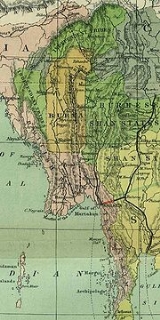
Upper Burma

Encyclopedia
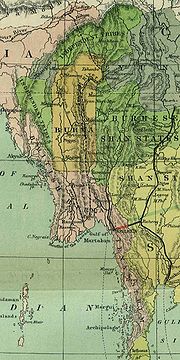
Mandalay
Mandalay is the second-largest city and the last royal capital of Burma. Located north of Yangon on the east bank of the Irrawaddy River, the city has a population of one million, and is the capital of Mandalay Region ....
and its periphery (modern Mandalay, Sagaing, Magway Regions), or more broadly speaking, Kachin
Kachin State
Kachin State , is the northernmost state of Burma. It is bordered by China to the north and east; Shan State to the south; and Sagaing Division and India to the west. It lies between north latitude 23° 27' and 28° 25' longitude 96° 0' and 98° 44'. The area of Kachin State is . The capital of the...
and Shan State
Shan State
Shan State is a state of Burma . Shan State borders China to the north, Laos to the east, and Thailand to the south, and five administrative divisions of Burma in the west. Largest of the 14 administrative divisions by land area, Shan State covers 155,800 km², almost a quarter of the total...
s.
The term was first used by the British
United Kingdom of Great Britain and Ireland
The United Kingdom of Great Britain and Ireland was the formal name of the United Kingdom during the period when what is now the Republic of Ireland formed a part of it....
to refer to the central and northern area of what is now the country of Myanmar
Myanmar
Burma , officially the Republic of the Union of Myanmar , is a country in Southeast Asia. Burma is bordered by China on the northeast, Laos on the east, Thailand on the southeast, Bangladesh on the west, India on the northwest, the Bay of Bengal to the southwest, and the Andaman Sea on the south....
(Burma). After the Second Anglo-Burmese War
Second Anglo-Burmese War
The Second Anglo-Burmese War was the second of the three wars fought between the Burmese and the British Empire during the 19th century, with the outcome of the gradual extinction of Burmese sovereignty and independence....
of 1852, Lower Burma
Lower Burma
Lower Burma is a geographic region of Burma and includes the low-lying Irrawaddy delta , as well as coastal regions of the country ....
was annexed by the British Empire
British Empire
The British Empire comprised the dominions, colonies, protectorates, mandates and other territories ruled or administered by the United Kingdom. It originated with the overseas colonies and trading posts established by England in the late 16th and early 17th centuries. At its height, it was the...
, while Upper Burma remained independent under the Kingdom of Burma
Konbaung dynasty
The Konbaung Dynasty was the last dynasty that ruled Burma from 1752 to 1885. The dynasty created the second largest empire in Burmese history, and continued the administrative reforms begun by the Toungoo dynasty, laying the foundations of modern state of Burma...
until the Third Anglo-Burmese War
Third Anglo-Burmese War
The Third Anglo-Burmese War was a conflict that took place during 7–29 November 1885, with sporadic resistance and insurgency continuing into 1887. It was the final of three wars fought in the 19th century between the Burmese and the British...
of 1885. Upper Burma was also known as Burma proper and the Kingdom of Ava
Ava
Innwa is a city in the Mandalay Division of Burma , situated just to the south of Amarapura on the Ayeyarwady River. Its formal title is Ratanapura , which means City of Gems in Pali. The name Innwa means mouth of the lake, which comes from in , meaning lake, and wa , which means mouth...
. Historically, Upper Burma was predominantly Bamar
Bamar
The Bamar are the dominant ethnic group of Burma , constituting approximately two-thirds of the population. The Bamar live primarily in the Irrawaddy basin, and speak the Burmese language, which is also the official language of Burma. Bamar customs and identity are closely intertwined with general...
(whereas Lower Burma was historically Mon
Mon language
The Mon language is an Austroasiatic language spoken by the Mon, who live in Burma and Thailand. Mon, like the related language Cambodian—but unlike most languages in Mainland Southeast Asia—is not tonal. Mon is spoken by more than a million people today. In recent years, usage of Mon has...
-speaking until the early 1800s), while the Frontier Areas, as designated by the colonial administration, included ethnic minority areas, such as the Shan States
Shan States
The Shan States were the princely states that ruled large areas of today's Burma , Yunnan Province in China, Laos and Thailand from the late 13th century until mid-20th century...
and modern Kachin State
Kachin State
Kachin State , is the northernmost state of Burma. It is bordered by China to the north and east; Shan State to the south; and Sagaing Division and India to the west. It lies between north latitude 23° 27' and 28° 25' longitude 96° 0' and 98° 44'. The area of Kachin State is . The capital of the...
.
This distinction between Upper and Lower Burma is also found in some government departments (for instance, the Ministry of Education
Ministry of Education (Burma)
The Ministry of Education is the Myanmar government agency responsible for Education in Myanmar.- Departmental Bodies :* The Office Staff* Department of Higher Education * Department of Basic Education * Myanmar Language Commission...
has departments assigned to Upper or Lower Burma), while some newspapers make a distinction between the two bodies. The Burmese language edition of the The Myanmar Times is an example; the newspaper devotes a section to news from Upper Burma. In terms of linguistic differences, there are minute differences between the variants of Burmese
Burmese dialects
There are a number of mutually intelligible Burmese dialects in the Burmese language, with a largely uniform standard dialect used by most Burmese speakers, who live throughout the Irrawaddy River valley and more distinctive non-standard dialects that emerge as one toward peripheral areas of the...
spoken by Upper Burmese
Burmese language
The Burmese language is the official language of Burma. Although the constitution officially recognizes it as the Myanmar language, most English speakers continue to refer to the language as Burmese. Burmese is the native language of the Bamar and related sub-ethnic groups of the Bamar, as well as...
, especially in vocabulary choice (such as kinship terms that differentiate the maternal and paternal sides of a family, which doesn't appear in Lower Burmese speech). However, there is remarkable uniformity in the Burmese spoken throughout the Irrawaddy River valley, which also includes the delta-lying and coastal region of Lower Burma.