

Baltimore Light Rail

Encyclopedia
_light_rail_station.jpg)
Light rail
Light rail or light rail transit is a form of urban rail public transportation that generally has a lower capacity and lower speed than heavy rail and metro systems, but higher capacity and higher speed than traditional street-running tram systems...
system serving Baltimore
Baltimore
Baltimore is the largest independent city in the United States and the largest city and cultural center of the US state of Maryland. The city is located in central Maryland along the tidal portion of the Patapsco River, an arm of the Chesapeake Bay. Baltimore is sometimes referred to as Baltimore...
, Maryland
Maryland
Maryland is a U.S. state located in the Mid Atlantic region of the United States, bordering Virginia, West Virginia, and the District of Columbia to its south and west; Pennsylvania to its north; and Delaware to its east...
, United States
United States
The United States of America is a federal constitutional republic comprising fifty states and a federal district...
, and the surrounding suburbs.
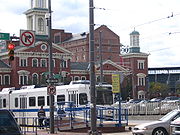
In downtown Baltimore it uses city streets
Street running
On-street running or street running is when a railroad track or tramway track runs directly along city streets, without any separation. The rails are embedded in the road....
. Outside the central portions of the city the line is built on private rights-of-way, mostly from the defunct Northern Central Railway
Northern Central Railway
The Northern Central Railway was a Class I Railroad connecting Baltimore, Maryland with Sunbury, Pennsylvania. Completed in 1858, the line came under the control of the Pennsylvania Railroad in 1861, when the PRR acquired a controlling interest in the Northern Central's stock to compete with the...
, Baltimore and Annapolis Railroad
Baltimore and Annapolis Railroad
The Baltimore & Annapolis Railroad, now defunct, was an American railroad of central Maryland built in the 19th century. The railroad, the second to serve Annapolis, ran between Annapolis and Clifford along the north shore of the Severn River...
, and Washington, Baltimore and Annapolis Electric Railway
Washington, Baltimore and Annapolis Electric Railway
The Washington, Baltimore and Annapolis Electric Railway , now defunct, was an American railroad of central Maryland and Washington, DC built in the 19th and 20th century. The WB&A absorbed two older railroads, the Annapolis and Elk Ridge Railroad and the Baltimore & Annapolis Short Line, and...
. It is operated by the Maryland Transit Administration
Maryland Transit Administration
The Maryland Transit Administration is a state-operated mass transit administration in Maryland, and is part of the Maryland Department of Transportation. It is better known as MTA Maryland to avoid confusion with other cities' transit agencies who share the initials MTA. The MTA operates a...
(MTA). In the fourth quarter of 2010, it had a daily ridership of 36,300.
History
The origins of the Light Rail ultimately lie in a transit plan drawn up for the Baltimore area in 1966 that envisioned six rapid transit lines radiating out from the city center. By 1983, only a single line had been built: the "Northwest" line, which became the current Baltimore Metro SubwayBaltimore Metro Subway
The Baltimore Metro Subway, known locally as the Metro Subway, The Subway, or Baltimore Metro is a rapid transit line serving the greater Baltimore, Maryland, United States area and operated by the Maryland Transit Administration...
. However, much of the plan's "North" and "South" lines ran along right-of-way
Right-of-way (railroad)
A right-of-way is a strip of land that is granted, through an easement or other mechanism, for transportation purposes, such as for a trail, driveway, rail line or highway. A right-of-way is reserved for the purposes of maintenance or expansion of existing services with the right-of-way...
that was once used by interurban streetcar and commuter rail routes—the Northern Central Railway
Northern Central Railway
The Northern Central Railway was a Class I Railroad connecting Baltimore, Maryland with Sunbury, Pennsylvania. Completed in 1858, the line came under the control of the Pennsylvania Railroad in 1861, when the PRR acquired a controlling interest in the Northern Central's stock to compete with the...
, Washington, Baltimore and Annapolis Electric Railway
Washington, Baltimore and Annapolis Electric Railway
The Washington, Baltimore and Annapolis Electric Railway , now defunct, was an American railroad of central Maryland and Washington, DC built in the 19th and 20th century. The WB&A absorbed two older railroads, the Annapolis and Elk Ridge Railroad and the Baltimore & Annapolis Short Line, and...
, and Baltimore and Annapolis Railroad
Baltimore and Annapolis Railroad
The Baltimore & Annapolis Railroad, now defunct, was an American railroad of central Maryland built in the 19th century. The railroad, the second to serve Annapolis, ran between Annapolis and Clifford along the north shore of the Severn River...
—that still remained available for transit development.
Beginning in the late 1980s, Governor William Donald Schaefer
William Donald Schaefer
William Donald Schaefer was an American politician who served in public office for 50 years at both the state and local level in Maryland. A Democrat, he was mayor of Baltimore from 1971 to 1987, the 58th Governor of Maryland from January 21, 1987 to January 18, 1995, and the Comptroller of...
(a former mayor of Baltimore) pushed for building a transit line along this corridor, motivated in part by a desire to establish a rail transit link to the new downtown baseball park being built at Camden Yards
Oriole Park at Camden Yards
Oriole Park at Camden Yards is a Major League Baseball ballpark located in Baltimore, Maryland. Home field of the Baltimore Orioles, it is the first of the "retro" major league ballparks constructed during the 1990s and early 2000s, and remains one of the most highly praised. The park was...
for the Baltimore Orioles
Baltimore Orioles
The Baltimore Orioles are a professional baseball team based in Baltimore, Maryland in the United States. They are a member of the Eastern Division of Major League Baseball's American League. One of the American League's eight charter franchises in 1901, it spent its first year as a major league...
. The Light Rail line was built relatively quickly and cheaply, and without money from the U.S. federal government, a rarity in late 20th century U.S. transit projects. The initial system was a single 22.5 miles (36.2 km) line, all at grade except for a bridge over the Middle Branch of the Patapsco River
Patapsco River
The Patapsco River is a river in central Maryland which flows into Chesapeake Bay. The river's tidal portion forms the harbor for the city of Baltimore...
just south of downtown Baltimore. The line ran from Timonium in Baltimore County
Baltimore County, Maryland
Baltimore County is a county located in the northern part of the US state of Maryland. In 2010, its population was 805,029. It is part of the Baltimore-Washington Metropolitan Area. Its county seat is Towson. The name of the county was derived from the barony of the Proprietor of the Maryland...
in the north to Glen Burnie
Glen Burnie, Maryland
Glen Burnie is a census-designated place in Anne Arundel County, Maryland, United States, and is a suburb of Baltimore. The population was 67,639 at the 2010 census...
in Anne Arundel County
Anne Arundel County, Maryland
Anne Arundel County is a county located in the U.S. state of Maryland. It is named for Anne Arundell , a member of the ancient family of Arundells in Cornwall, England and the wife of Cæcilius Calvert, 2nd Baron Baltimore. Its county seat is Annapolis, which is also the capital of the state...
in the south. The Light Rail began service in April 1992, the same month that the Orioles began play at Camden Yards.
Three extensions to the system were added in 1997. In September of that year, the line was extended north 4.5 miles (7.2 km) to Hunt Valley
Hunt Valley, Maryland
Hunt Valley is an affluent unincorporated community in Baltimore County, Maryland, United States. It lies just north of the city of Baltimore, along Highway 145 off Interstate 83. Loch Raven Reservoir...
, adding five stations that served a major business park
Business park
A business park or office park is an area of land in which many office buildings are grouped together. All of the work that goes on is commercial, not industrial or residential....
and a mall. In December, two short but important spurs were added to the system: one a 0.34 mile (550 m) spur in Baltimore that provided a link to Penn Station, a transit hub also served by MARC
MARC Train
MARC , known prior to 1984 as Maryland Rail Commuter Service, is a regional rail system comprising three lines in the Baltimore-Washington Metropolitan Area. MARC is administered by the Maryland Transit Administration , a Maryland Department of Transportation agency, and is operated under contract...
and Amtrak
Amtrak
The National Railroad Passenger Corporation, doing business as Amtrak , is a government-owned corporation that was organized on May 1, 1971, to provide intercity passenger train service in the United States. "Amtrak" is a portmanteau of the words "America" and "track". It is headquartered at Union...
trains, and the other a 2.7 miles (4.3 km) link that brought trains to the terminal of BWI Airport
Baltimore-Washington International Thurgood Marshall Airport
Baltimore/Washington International Thurgood Marshall Airport is an international airport serving the Baltimore-Washington Metropolitan Area in the United States. It is commonly called BWI, BWI Airport or BWI Marshall, BWI being an initialism for "Baltimore/Washington International" and the...
.
In 1998, the Hamburg Street station opened as an infill station between the existing Westport
Westport, Baltimore
Westport is a neighborhood in south Baltimore, Maryland. It borders the Middle Branch River on the east, Cherry Hill and Lansdowne to the south, Hollins Ferry Road to the west, and Interstate 95 to the north...
and Camden Yards stations. Adjacent to M&T Bank Stadium
M&T Bank Stadium
M&T Bank Stadium is a multi-purpose football stadium located in Baltimore, Maryland. It is the home of the Baltimore Ravens of the National Football League. The stadium is immediately adjacent to Oriole Park at Camden Yards, the home of the Baltimore Orioles. Served by the Hamburg Street station of...
, it was initially only open during Ravens
Baltimore Ravens
The Baltimore Ravens are a professional football franchise based in Baltimore, Maryland.The Baltimore Ravens are officially a quasi-expansion franchise, having originated in 1995 with the Cleveland Browns relocation controversy after Art Modell, then owner of the Cleveland Browns, announced his...
games and other major stadium events; however, in 2005, it became a full-time stop.
To save money, much of the system was built as single-track. While this allowed the Light Rail to be built and opened quickly, it made it difficult to build flexibility into the system: much of the line was restricted to 17-minute headway
Headway
Headway is a measurement of the distance/time between vehicles in a transit system. The precise definition varies depending on the application, but it is most commonly measured as the distance from the tip of one vehicle to the tip of the next one behind it, expressed as the time it will take for...
s, with no way to reduce headways during peak hours. Federal money was acquired to make the vast majority of the system double-tracked; much of the line south of downtown Baltimore was shut down in 2004 and north of downtown shut down in 2005 in order to complete this project. Much of the northern section reopened in December 2005; the rest opened in February 2006.
Routing and schedules
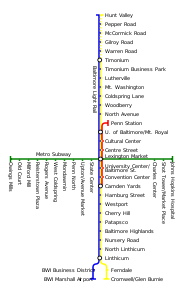
The Light Rail network consists of a main north-south line that serves 28 of the system's 33 stops; a spur in Baltimore city that connects a single stop (Penn StationPennsylvania Station (Baltimore)
Pennsylvania Station is the main train station in Baltimore, Maryland. Designed by New York architect Kenneth MacKenzie Murchison , it was constructed in 1911 in the Beaux-Arts style of architecture for the Pennsylvania Railroad. It is located at 1515 N...
) to the main line; and two branches at the south end of the line that serve two stops apiece. Because of the track arrangement, trains can only enter the Penn Station spur from the mainline heading north and leave it heading south; there are still single-track sections north of Timonium, limiting headways in that section to 15 minutes.
Various routing strategies have been used on the network. Currently, there are three basic services:
- BWI Airport to Hunt Valley
- Camden Yards to Penn Station
- Cromwell/Glen Burnie to Timonium (peak)
- Cromwell/Glen Burnie to Hunt Valley (off peak)
- Cromwell/Glen Burnie to North Avenue (trains going out of service)
Although these routes are colored blue, red and yellow respectively on some MTA maps and schedules, they do not have official names as such. Some trains heading north from either BWI Airport or Cromwell/Glenn Burnie may terminate at North Avenue
North Avenue (Baltimore Light Rail station)
The North Avenue Light Rail Stop is one of 33 stops on the Baltimore Light Rail. The station is located along North Avenue near the I-83 interchange, and is served by bus route 13. The stop has 37 spaces for commuters. During the light rail's double-tracking project, when the northern section of...
to go out of service until peak operation hours resume. During these times, ridership is not high enough to send trains all the way through. Passengers must check train destination signs before boarding.
The light rail operates 6:00 a.m.–12:00 a.m. on weekdays and Saturdays, and 11 a.m.–7 p.m. on Sundays. At peak hours on weekdays (from the first trains of the day until 10 a.m., and from 4 p.m. to 6 p.m.), the BWI-Hunt Valley and Cromwell/Glen Burnie-Timonium routes see 20-minute headways; at other times on weekdays and all day on weekends, there are 30-minute headways on both routes (with Glen Burnie trains traveling all the way to Hunt Valley). The Camden Yards-Penn Station route sees 30-minute headways at all times. Because there is significant overlap on these routes, most of the system sees 10-minute peak and 15-minute off-peak headways; stations in the downtown section between Mt. Royal and Camden Yards are served by six trains an hour off-peak and eight trains an hour at peak. (Paradoxically, the Timonium-Hunt Valley section actually sees longer headways at peak hours.)
Most of the light rail's route is on a dedicated right-of-way
Right-of-way (railroad)
A right-of-way is a strip of land that is granted, through an easement or other mechanism, for transportation purposes, such as for a trail, driveway, rail line or highway. A right-of-way is reserved for the purposes of maintenance or expansion of existing services with the right-of-way...
, with occasional grade crossings
Level crossing
A level crossing occurs where a railway line is intersected by a road or path onone level, without recourse to a bridge or tunnel. It is a type of at-grade intersection. The term also applies when a light rail line with separate right-of-way or reserved track crosses a road in the same fashion...
equipped with crossing gates
Boom barrier
A boom barrier is a bar, or pole pivoted in such a way as to allow the boom to block vehicular access through a controlled point. Typically the tip of a boom gate rises in a vertical arc to a near vertical position. Boom gates are often counterweighted, so the pole is easily tipped...
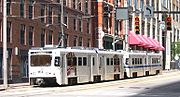
. However, on the downtown portion of the route that runs along Howard Street (between the University of Baltimore/Mt. Royal and Camden Yards stations), trains mix with automobile traffic, and their movement is controlled by traffic signals. In 2007, a transit signal priority system was implemented on this portion of the route, resulting in time savings of 25%.
The space mean speed between Hunt Valley and BWI (based on a scheduled running time of 1:20 and a distance of 30 miles) is about 22 miles per hour.
Fares and transit connections
MTA fares are identical for the Metro Subway, the Light Rail, and local buses: a one-way trip costs $1.60. Daily, weekly, and monthly unlimited-ride passes are also available that are good on all three transit modes. A passenger with a one-way ticket can change Light Rail trains if necessary to complete their journey — the only instance where a one-way MTA ticket is good for a ride on more than one vehicle — but transferring to a bus or the Metro Subway requires a new one-way fare or a pass. Automated ticket machines that sell tickets and passes are available at all Light Rail stations.The Light Rail's ticketing is based on a proof-of-payment
Proof-of-payment
Proof-of-payment or POP is an honor-based fare collection approach used on many public transportation systems. Instead of checking each passenger as they enter a fare control zone, proof-of-payment requires that each passenger carry a ticket or pass proving that they have paid the fare. Ticket...
system, similar to that used in mass transit in Berlin
Berlin
Berlin is the capital city of Germany and is one of the 16 states of Germany. With a population of 3.45 million people, Berlin is Germany's largest city. It is the second most populous city proper and the seventh most populous urban area in the European Union...
. Passengers must have a ticket or pass before boarding. Maryland Transit Administration Police
Maryland Transit Administration Police
The Maryland Transit Administration Police is the law enforcement branch of the Maryland Transit Administration directed to patrol public transportation and related facilities in and around the Baltimore, Maryland, area...
officers ride some trains and spot-check passengers to make sure that they are carrying a valid ticket or pass, and can issue criminal citation
Criminal citation
Criminal citations are used by police in some jurisdictions in order to charge a person with a crime without the need of making a physical arrest. They are generally used for non-violent, fineable offences and those that carry little incarceration time...
s for those without one. Civilian Fare Inspectors also conduct ticket checks, alighting those without fare.
Most Light Rail stations are served by several MTA bus routes, and passengers can make platform-to-platform transfers with the MARC Camden Line at Camden Yards and with the MARC Penn Line at Penn Station. There are no cross-platform connections with the Metro Subway. The Lexington Market subway and light rail stations are a block apart and connected only via surface streets. There are plans to cover the sidewalk between the two stations.
Rolling stock
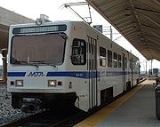
Baltimore's Light Rail vehicles (LRVs) were built by ABB Traction, the U.S. division of Asea Brown BoveriAsea Brown Boveri
ABB is a Swiss-Swedish multinational corporation headquartered in Zürich, Switzerland, and best known for its robotics. ABB operates mainly in the power and automation technology areas. It ranked 143rd in Forbes Ranking ....
. The initial set was delivered in 1991-1992 as the line was being built; a supplemental order of essentially identical cars was delivered in 1997 when the extensions came into service.
Baltimore LRVs are quite large—much larger than traditional streetcars and bigger even than those used on San Francisco's Muni Metro
Muni Metro
Muni Metro is a light rail system serving San Francisco, California, operated by the San Francisco Municipal Railway , a division of the San Francisco Municipal Transportation Agency...
or Boston
Boston
Boston is the capital of and largest city in Massachusetts, and is one of the oldest cities in the United States. The largest city in New England, Boston is regarded as the unofficial "Capital of New England" for its economic and cultural impact on the entire New England region. The city proper had...
's Green Line
Green Line (MBTA)
The Green Line is a streetcar system run by the Massachusetts Bay Transportation Authority in the Boston, Massachusetts area of the United States. It is the oldest line of Boston's subway, which is known locally as the 'T'. The Green Line runs underground downtown and on the surface in outlying...
. Articulated cars are 95 feet (29 m) long and 9.5 feet (2.9 m) wide, and can accommodate 85 seated and 91 standing passengers. These cars operate on standard (4 ft 8½ in or 1435 mm) gauge track. 1-, 2- and 3-car trains are all routinely seen in service. Trains are powered by an overhead pantograph
Pantograph (rail)
A pantograph for rail lines is a hinged electric-rod device that collects electric current from overhead lines for electric trains or trams. The pantograph typically connects to a one-wire line, with the track acting as the ground wire...
and have a maximum speed of 60 miles per hour (97 km/h).
The MTA currently own 53 individual Light Rail cars. During typical weekday peak-time service, approximately 30 to 35 cars are required; a somewhat higher number of cars are put into service immediately after Orioles and Ravens games. For weekday service, as well as on days of Orioles games or events at the First Mariner Arena
1st Mariner Arena
1st Mariner Arena is an arena located in Baltimore, Maryland. In 2003, it was renamed by 1st Mariner Bank, which purchased naming rights to the arena for 10 years. It was reported that 1st Mariner Bank will need to pay the city $75,000 for the next ten years to keep the naming rights to the complex...
or Baltimore Convention Center
Baltimore Convention Center
The Baltimore Convention Center is a convention and exhibition hall located in downtown Baltimore, Maryland. The Center is a municiple building owned and operated by the City of Baltimore...
, trains going from Hunt Valley to Cromwell and BWI Airport are generally run with two cars, while three-car trains are put into service for Ravens games and major downtown events. Usually the Penn Station-Camden Yards shuttle is operated with one-car trains. The MTA also owns a variety of maintenance of way equipment, which can use diesel power in emergencies.
Several industry spurs are accessible through light rail trackage only, so freight is shunted during off hours.
There are plans to perform a mid-life upgrade of the light rail vehicles, possibly incorporating wheel shrouds.
Future
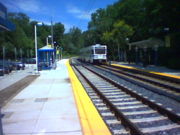
There are no immediate plans to add track length to the current Light Rail system. An independent commission on Baltimore-area transit made a number of suggestions in a 2002 report for new lines and expansions of existing lines. One proposal was to create a branch of the Light Rail system that would head southeast from the main line at Timonium, run through Towson
Towson, Maryland
Towson is an unincorporated community and a census-designated place in Baltimore County, Maryland, United States. The population was 55,197 at the 2010 census...
and Baltimore, and reconnect to the existing line at Camden Yards. However, this proposal is not being actively pursued at present.
There is the possibility of adding an infill station at Texas, between the existing Timonium and Warren Road stations. A set of platforms was built at this point on the line in conjunction with the 2005 double-tracking work to provide a turn-back point for trains not going all the way to Hunt Valley; it would be relatively simple to convert this into a revenue station, and reports indicate that the MTA is considering doing so.
There are plans that show the Lexington Market station platforms; currently non-adjacent outer platforms, one to the north and one to the south of Lexington Street; being consolidated into a single inner platform between Saratoga Street and Lexington Street.
The Red Line
Red Line (Baltimore)
The Red Line is a proposed east-west mass transit light rail line for Baltimore, Maryland. It is still in the planning stages and has been granted federal approval to enter the preliminary engineering phase...
, a planned light rail line traveling east-west that would intersect with the existing Light Rail downtown, is scheduled to begin service in 2016; this would be a separate service, with no track connection to the existing Light Rail.
See also
- List of Baltimore Light Rail stations
- Light railLight railLight rail or light rail transit is a form of urban rail public transportation that generally has a lower capacity and lower speed than heavy rail and metro systems, but higher capacity and higher speed than traditional street-running tram systems...
- List of tram and light-rail transit systems
- List of rail transit systems in the United States