

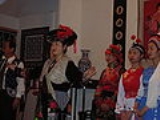
Bai

Encyclopedia
The Bai or Baip are one of the 56 ethnic groups officially recognized by the People's Republic of China
. They numbered 1,858,063 as of 2000.
The Bai People hold the white colour in high esteem and call themselves "Baipzix (Baizi)", "Baip'ho (Baihuo)", "Baip yinl (Baini)", or "Miep jiax". Baip people literarily means white people in Chinese. In 1956, of their own will they were named the Bai Nationality by Chinese Authorities.
 Bai people live mostly in the provinces of Yunnan
(Dali area), and in neighboring Guizhou
(Bijie
area) and Hunan
(Sangzhi area) provinces. Of the 2 million Bai people, eighty percent live in concentrated communities in the Dali Bai Autonomous Prefecture
in Yunnan Province.
in all its varieties. The tongue is either a member of the Sinitic branch
or the Tibeto-Burman branch
of the Sino-Tibetan language family
or possibly part of an independent branch of this family. The Bai call themselves Baizi, Baini, or Baihuo. They have 60 other names, including the Han term Minjia (for the Bai in Dali). The Bai are the most assimilated ethnic group in China and therefore borrow 60% of their language from the Chinese language. In the Tang and Song Dynasty, the Bai created the ancient language Bowen. The word-formation is similar to the Japanese language. The language was reformed into Latin characters in 1957 and was revised in 1993.
 Although the Bai people believe in Buddhism
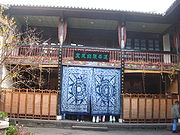
, they also respectively worship their village god ('Benzhu'), Nature god, the Prince of the Nanzhao regime, or even a hero of folklore. The Bai people believe in many different religions. Some of them believe in Daoism and Christianity. Most people believe in Buddhism and Benzhu Wish. Benzhu Wish is a village god that is considered to be the guardian of the village.
There are a number of villages in Yunnan whose residents, based on their language and customs, would be considered Bai, if not for the fact that they are Muslim. These people are officially classified by PRC authorities as belonging to the Hui nationality
, and call themselves Bai Hui ("Bai Muslims"). They usually say that their ancestors were Hui people
, who fled to Bai communities after the defeat of the Panthay Rebellion in the 1860s, and have since assimilated to the Bai language and culture.
, San Dao Cha 三道茶 (Three Course Tea), is most popular among the Bai in the Dali
area and is a common sight at festivals and marriages. It is both a cultural ceremony and method of honouring a guest. The ceremony is often described in Mandarin
as, 'Yiku, ertian, sanhuiwei' 一苦二甜三回味 (First is bitter, Second is sweet, Third brings reflection (aftertaste)).
The first tea course starts with baking the tea leaves in a clay pot over a small flame, shaking the leaves often whilst they bake. When the leaves turn slightly brown and give off a distinct fragrance heated water is added to the pot. The water should immediately begin bubbling, when the bubbling ceases a small amount of bitterly fragrant, concentrated tea remains. Due to the sound the hot water makes when it enters the clay pot the first course tea was, in previous times, also known as Lei Xiang Cha 雷响茶 (Sound of Thunder Tea).
The second course is sweet tea. Pieces of walnut kernel and roasted ru shan 乳扇 (a dairy product specific to the Dali region) are put in to a tea cup with brown sugar and other ingredients. Boiling water is added and the tea is then offered to the guest. This tea is sweet without being oily, so the guest can easily drink it.
The third tea is made by mixing honey, sichuan pepper
, slices of ginger and cassia together in a china cup with hot Cangshan
Xue green tea. The product is a tea, which is sweet, coarse and spicy all at once. This Dali specialty has a noticeable aftertaste, which meant it was known as Hui Wei Cha 回味茶 (Reflection Tea).
The 18 procedures of the tea ceremony are governed by strict etiquette, which follows the principles of etiquette, honesty and beauty. As such, the tea ceremony is considered by some to perfectly embody the hospitable Bai people's current customs.
The modern Bai are also famous for their tie dyes and use them for different purposes from wall hangings, to table decorations to clothing.
in Dali between the fifteenth and the twentieth day of the third lunar month. Originally it was religious activity to rally and pay homage, but it gradually evolved into a fair including performances of traditional sports and dance, as well as the trade of merchandise from different regions. Another important festival is the Torch Festival
, held on the 25th day of the sixth lunar month to wish both health and a good harvest. On that evening, the countryside will be decorated with banners with auspicious words written upon them. Villagers will then light torches in front of their gates, then walk around the fields while holding yet more torches in order to catch pests.
is a way of using cormorant
birds for fishing and is practiced among the Bai fishermen.
People's Republic of China
China , officially the People's Republic of China , is the most populous country in the world, with over 1.3 billion citizens. Located in East Asia, the country covers approximately 9.6 million square kilometres...
. They numbered 1,858,063 as of 2000.
The Bai People hold the white colour in high esteem and call themselves "Baipzix (Baizi)", "Baip'ho (Baihuo)", "Baip yinl (Baini)", or "Miep jiax". Baip people literarily means white people in Chinese. In 1956, of their own will they were named the Bai Nationality by Chinese Authorities.
Location
Yunnan
Yunnan is a province of the People's Republic of China, located in the far southwest of the country spanning approximately and with a population of 45.7 million . The capital of the province is Kunming. The province borders Burma, Laos, and Vietnam.Yunnan is situated in a mountainous area, with...
(Dali area), and in neighboring Guizhou
Guizhou
' is a province of the People's Republic of China located in the southwestern part of the country. Its provincial capital city is Guiyang.- History :...
(Bijie
Bijie
Bijie is a prefecture-level city in northwestern Guizhou province, People's Republic of China.The Daotianhe Reservoir, located to the north of the town was commissioned in 1965 with a rated annual capacity of 6.5 million cubic meters....
area) and Hunan
Hunan
' is a province of South-Central China, located to the south of the middle reaches of the Yangtze River and south of Lake Dongting...
(Sangzhi area) provinces. Of the 2 million Bai people, eighty percent live in concentrated communities in the Dali Bai Autonomous Prefecture
Dali Bai Autonomous Prefecture
Dali Bai Autonomous Prefecture is an autonomous prefecture of Yunnan Province, China. Dali has an area of 29,460 km² and its capital is Xiaguan.-Subdivisions:...
in Yunnan Province.
Language
An estimated 1,240,000 (as of 2003) of the Bai speak the Bai languageBai (language)
The Bai/Baip language is a language spoken in China, primarily in Yunnan province, by the Bai people, one of the 56 ethnic groups officially recognized by the People's Republic of China. The language has over a million speakers and is divided into three main dialects. It is a tonal language with...
in all its varieties. The tongue is either a member of the Sinitic branch
Sinitic languages
The Sinitic languages, often called the Chinese languages or the Chinese language, are a language family frequently postulated as one of two primary branches of Sino-Tibetan...
or the Tibeto-Burman branch
Tibeto-Burman languages
The Tibeto-Burman languages are the non-Chinese members of the Sino-Tibetan language family, over 400 of which are spoken thoughout the highlands of southeast Asia, as well as lowland areas in Burma ....
of the Sino-Tibetan language family
Sino-Tibetan languages
The Sino-Tibetan languages are a language family comprising, at least, the Chinese and the Tibeto-Burman languages, including some 250 languages of East Asia, Southeast Asia and parts of South Asia. They are second only to the Indo-European languages in terms of the number of native speakers...
or possibly part of an independent branch of this family. The Bai call themselves Baizi, Baini, or Baihuo. They have 60 other names, including the Han term Minjia (for the Bai in Dali). The Bai are the most assimilated ethnic group in China and therefore borrow 60% of their language from the Chinese language. In the Tang and Song Dynasty, the Bai created the ancient language Bowen. The word-formation is similar to the Japanese language. The language was reformed into Latin characters in 1957 and was revised in 1993.
Religion
Buddhism
Buddhism is a religion and philosophy encompassing a variety of traditions, beliefs and practices, largely based on teachings attributed to Siddhartha Gautama, commonly known as the Buddha . The Buddha lived and taught in the northeastern Indian subcontinent some time between the 6th and 4th...
, they also respectively worship their village god ('Benzhu'), Nature god, the Prince of the Nanzhao regime, or even a hero of folklore. The Bai people believe in many different religions. Some of them believe in Daoism and Christianity. Most people believe in Buddhism and Benzhu Wish. Benzhu Wish is a village god that is considered to be the guardian of the village.
There are a number of villages in Yunnan whose residents, based on their language and customs, would be considered Bai, if not for the fact that they are Muslim. These people are officially classified by PRC authorities as belonging to the Hui nationality
Hui people
The Hui people are an ethnic group in China, defined as Chinese speaking people descended from foreign Muslims. They are typically distinguished by their practice of Islam, however some also practice other religions, and many are direct descendants of Silk Road travelers.In modern People's...
, and call themselves Bai Hui ("Bai Muslims"). They usually say that their ancestors were Hui people
Hui people
The Hui people are an ethnic group in China, defined as Chinese speaking people descended from foreign Muslims. They are typically distinguished by their practice of Islam, however some also practice other religions, and many are direct descendants of Silk Road travelers.In modern People's...
, who fled to Bai communities after the defeat of the Panthay Rebellion in the 1860s, and have since assimilated to the Bai language and culture.
Food
The Bai diet typically comprises sharp, cold and spicy flavours. Cured ham or fish with rice is a common dish; though for some groups based in mountain areas corn is a staple food.Tea Ceremony
The Bai tea ceremonyTea ceremony
A tea ceremony is a ritualised form of making tea. The term generally refers to either chayi Chinese tea ceremony, chado Japanese tea ceremony, tarye Korean tea ceremony. The Japanese tea ceremony is more well known, and was influenced by the Chinese tea ceremony during ancient and medieval times....
, San Dao Cha 三道茶 (Three Course Tea), is most popular among the Bai in the Dali
Dali
-Places:*Dali City, Yunnan , a city in Yunnan province in the People's Republic of China*Dali Bai Autonomous Prefecture , prefecture in Yunnan, China*Kingdom of Dali , centered in modern Yunnan...
area and is a common sight at festivals and marriages. It is both a cultural ceremony and method of honouring a guest. The ceremony is often described in Mandarin
Mandarin
-Officials:* Mandarin , a bureaucrat of Imperial China , Vietnam, and by analogy, any senior government bureaucrat-Language:...
as, 'Yiku, ertian, sanhuiwei' 一苦二甜三回味 (First is bitter, Second is sweet, Third brings reflection (aftertaste)).
The first tea course starts with baking the tea leaves in a clay pot over a small flame, shaking the leaves often whilst they bake. When the leaves turn slightly brown and give off a distinct fragrance heated water is added to the pot. The water should immediately begin bubbling, when the bubbling ceases a small amount of bitterly fragrant, concentrated tea remains. Due to the sound the hot water makes when it enters the clay pot the first course tea was, in previous times, also known as Lei Xiang Cha 雷响茶 (Sound of Thunder Tea).
The second course is sweet tea. Pieces of walnut kernel and roasted ru shan 乳扇 (a dairy product specific to the Dali region) are put in to a tea cup with brown sugar and other ingredients. Boiling water is added and the tea is then offered to the guest. This tea is sweet without being oily, so the guest can easily drink it.
The third tea is made by mixing honey, sichuan pepper
Sichuan Pepper
Sichuan pepper is the outer pod of the tiny fruit of a number of species in the genus Zanthoxylum , widely grown and consumed in Asia as a spice. Despite the name, it is not related to black pepper or to chili peppers...
, slices of ginger and cassia together in a china cup with hot Cangshan
Cangshan
Cangshan is a mountain range immediately west of Dali City in Yunnan province of Southwest China.The highest summit, Malong, is 4,122 m, but the mountain includes another 18 peaks all over 3,500 m altitude...
Xue green tea. The product is a tea, which is sweet, coarse and spicy all at once. This Dali specialty has a noticeable aftertaste, which meant it was known as Hui Wei Cha 回味茶 (Reflection Tea).
The 18 procedures of the tea ceremony are governed by strict etiquette, which follows the principles of etiquette, honesty and beauty. As such, the tea ceremony is considered by some to perfectly embody the hospitable Bai people's current customs.
Clothes
The Bai people, as their name would suggest, favor white clothes and decorations. Women generally wear white dresses, sleeveless jackets of red, blue or black color, embroidered belts, loose trousers, embroidered shoes of white cloth, and jewelry made of gold or silver. Women in Dali traditionally wear a white coat trimmed with a black or purple collar, loose blue trousers; embroidered shoes, silver bracelets and earrings. Unmarried women wear a single pigtail on the top of the head, while married women roll their hair. The men wear white jackets, black-collared coats, and dark loose shorts. Their headwear and costume reflect the Bai symbols: the snow, the moon, the flower, and the wind.The modern Bai are also famous for their tie dyes and use them for different purposes from wall hangings, to table decorations to clothing.
Festivals
The grandest festival of the Bai people is the Third Month Fair, held annually at the foot of Mt. CangshanCangshan
Cangshan is a mountain range immediately west of Dali City in Yunnan province of Southwest China.The highest summit, Malong, is 4,122 m, but the mountain includes another 18 peaks all over 3,500 m altitude...
in Dali between the fifteenth and the twentieth day of the third lunar month. Originally it was religious activity to rally and pay homage, but it gradually evolved into a fair including performances of traditional sports and dance, as well as the trade of merchandise from different regions. Another important festival is the Torch Festival
Torch Festival
The Torch Festival or Fire Festival is one of the main holidays of the Yi people of southwest China, and is also celebrated by other ethnic groups of the region. It is celebrated on the 24th or 25th day of the sixth month of the Yi calendar, corresponding to August in the Gregorian calendar...
, held on the 25th day of the sixth lunar month to wish both health and a good harvest. On that evening, the countryside will be decorated with banners with auspicious words written upon them. Villagers will then light torches in front of their gates, then walk around the fields while holding yet more torches in order to catch pests.
Cormorant fishing
Cormorant fishingCormorant fishing
Cormorant fishing is a traditional fishing method in which fishermen use trained cormorants to fish in rivers. Historically, cormorant fishing has taken place in Japan and China from around 960 AD.and recorded from other places throughout the world....
is a way of using cormorant
Cormorant
The bird family Phalacrocoracidae is represented by some 40 species of cormorants and shags. Several different classifications of the family have been proposed recently, and the number of genera is disputed.- Names :...
birds for fishing and is practiced among the Bai fishermen.
Architecture
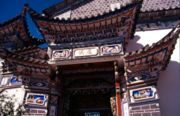
The Bai architecture is characterized by three houses forming a U and a fourth wall as a screen. The middle has a courtyard. The houses are usually brick and wood, and the main room is in the middle (opposite the screen wall). The screen wall is built with brick and stone. The house is painted in white with black tile paintings depicting animals and other natural images. The detailing usually is made of clay sculpture, woodcarving, colored drawing, stone inscription, marble screend and dark brink. It produces a very striking and elegant effect. Dali is also well known for its marble and the name for marble is actually Dali marble in Chinese and does get use in modern architecture by the Bai.Notable Bai
- Duan SipingDuan SipingDuan Siping was a statesman of Bai origin and eventual founder and ruler of the Kingdom of Dali. The Kingdom retained independence from unified China until the Mongol invasion in 1253 C.E....
(段思平) - founder of the Kingdom of DaliKingdom of DaliDali or Great Li was a Bai kingdom centred in what is now Yunnan Province of China. Established by Duan Siping in 937, it was ruled by a succession of 22 kings until the year 1253, when it was conquered by an invasion of the Mongol Empire. The capital city was at Dali.- History :The Kingdom of... - Zhang Le Qiu Jin (张乐求进) - legendary ancestor of the Bai
- Zhao Fan (趙藩) - scholar, calligrapher and poet
- Zhao Shiming (赵式铭) - scholar
- Zhang Jiebao (张结宝) - bandit leader
- Yang LipingYang LipingYang Liping is the director, choreographer and star of a performance art show called "Dynamic Yunnan" that has drawn sellout crowds all over China. She toured Europe and the United States in 2005. Between 2004 and 2008, Yang Liping directed and choreographed a trilogy: "Dynamic Yunnan", "Echoes...
(杨丽萍) - dancer - Yang Yuntao (楊雲濤) - dancer
- Zhang Lizhu (张丽珠) - gynecological scientist
- Wang Xiji (王希季) - space scientist
- Xu Lin (徐琳) - linguist
- Zhao yansun (赵衍荪) - linguist
- Zhou BaozhongZhou BaozhongZhou Baozhong was a commander of the Northeast Anti-Japanese United Army resisting the pacification of Manchukuo by the Empire of Japan....
(周保中) - military general