


Asiatic Society of Bombay

Encyclopedia
Learned society
A learned society is an organization that exists to promote an academic discipline/profession, as well a group of disciplines. Membership may be open to all, may require possession of some qualification, or may be an honor conferred by election, as is the case with the oldest learned societies,...
in the field of Asian studies
Asian studies
Asian studies, a term used usually in the United States for Oriental studies and is concerned with the Asian peoples, their cultures, languages, history and politics...
, is based in Mumbai
Mumbai
Mumbai , formerly known as Bombay in English, is the capital of the Indian state of Maharashtra. It is the most populous city in India, and the fourth most populous city in the world, with a total metropolitan area population of approximately 20.5 million...
, India
India
India , officially the Republic of India , is a country in South Asia. It is the seventh-largest country by geographical area, the second-most populous country with over 1.2 billion people, and the most populous democracy in the world...
. It can trace its origin to the Literary Society of Bombay which first met in Mumbai on November 26, 1804, and was founded by Sir James Mackintosh. It was formed with the intention of "promoting useful knowledge, particularly such as is now immediately connected with India". After the Royal Asiatic Society of Great Britain and Ireland
Royal Asiatic Society
The Royal Asiatic Society of Great Britain and Ireland was established, according to its Royal Charter of 11 August 1824, to further "the investigation of subjects connected with and for the encouragement of science, literature and the arts in relation to Asia." From its incorporation the Society...
was established in London
London
London is the capital city of :England and the :United Kingdom, the largest metropolitan area in the United Kingdom, and the largest urban zone in the European Union by most measures. Located on the River Thames, London has been a major settlement for two millennia, its history going back to its...
in 1823, the Literary Society of Bombay became affiliated with it and was known as the Bombay Branch of the Royal Asiatic Society (BBRAS) since 1830. The Bombay Geographical Society merged with it in 1873, followed by the Anthropological Society of Bombay in 1896. In 1954, it was separated from the Royal Asiatic Society and renamed the Asiatic Society of Bombay. In 2002, it acquired its present name. It is funded by an annual grant from the Central Government of India.
Holdings
Persian language
Persian is an Iranian language within the Indo-Iranian branch of the Indo-European languages. It is primarily spoken in Iran, Afghanistan, Tajikistan and countries which historically came under Persian influence...
, Sanskrit
Sanskrit
Sanskrit , is a historical Indo-Aryan language and the primary liturgical language of Hinduism, Jainism and Buddhism.Buddhism: besides Pali, see Buddhist Hybrid Sanskrit Today, it is listed as one of the 22 scheduled languages of India and is an official language of the state of Uttarakhand...
and Prakrit
Prakrit
Prakrit is the name for a group of Middle Indic, Indo-Aryan languages, derived from Old Indic dialects. The word itself has a flexible definition, being defined sometimes as, "original, natural, artless, normal, ordinary, usual", or "vernacular", in contrast to the literary and religious...
, mostly on paper but some on palm leaf. The numismatic collection of 11,829 coins includes a gold coin of Kumaragupta I, a rare gold mohur
Mohur
A Mohur is a gold coin that was formerly minted by several governments including British India , the Moghul Empire, Nepal, and Afghanistan. It was usually equivalent in value to fifteen silver rupees. It was last minted in British India in 1918, but some princely states issued them until...
of Akbar and coins issued by Shivaji. Its map collection comprises 1300 maps.
The collection of the Society include:
- One of only two known original copies of DanteDANTEDelivery of Advanced Network Technology to Europe is a not-for-profit organisation that plans, builds and operates the international networks that interconnect the various national research and education networks in Europe and surrounding regions...
's Divine Comedy - The manuscript of Vasupujyacharita (1242), a Sanskrit text on the life of the Jain Tirthankara VasupujyaVasupujyaVasupujya Swami was the twelve Jain Tirthankar of the present age . According to Jain beliefs, he became a siddha, a liberated soul which has destroyed all of its karma. Vasupujya was born to King Vasupujya Raja and Queen Jaya Devi Rani at Champapuri in the Ikshvaku clan...
- The manscript of Shahnama of Firdausi (1853), written in PersianPersian languagePersian is an Iranian language within the Indo-Iranian branch of the Indo-European languages. It is primarily spoken in Iran, Afghanistan, Tajikistan and countries which historically came under Persian influence...
- The Aranyakaparvan (16th century) manuscript contains illustrated text from the Mahabharat and is written in Sanskrit.
- Five Buddhist caskets excavated in the ancient port town of SoparaSoparaSopara or Soparaka was an ancient port town and the capital of the ancient Aparanta. The site of this ancient town is located near the present day Nala Sopara town in the Thane district of the state Maharashtra, India.Nala Sopara is one of the busiest western suburbs of Mumbai city...
near the suburb of Nala SoparaNala SoparaNala Sopara is one of the suburbs of Mumbai city. It is a town within the Mumbai Conurbation. The town lies in Thane district of Maharashtra state in India. The population of the city is 184,664 . It is also the name of a railway station on the Mumbai suburban railway on the Western Railway ...
.
The Divine Comedy
The manuscript of the Divine Comedy, a poem composed by Dante AlighieriDante Alighieri
Durante degli Alighieri, mononymously referred to as Dante , was an Italian poet, prose writer, literary theorist, moral philosopher, and political thinker. He is best known for the monumental epic poem La commedia, later named La divina commedia ...
in the 14th century, was written in the second half of fifteenth century. It is a beautiful codex on parchment and richly illustrated. It was given to the Society by Mountstuart Elphinstone
Mountstuart Elphinstone
Mountstuart Elphinstone was a Scottish statesman and historian, associated with the government of British India. He later became the Governor of Bombay where he is credited with the opening of several educational institutions accessible to the Indian population...
, governor of Bombay and President of the Society from 1819–1827 and bears his signature.
In 1930, the Italian
Italy
Italy , officially the Italian Republic languages]] under the European Charter for Regional or Minority Languages. In each of these, Italy's official name is as follows:;;;;;;;;), is a unitary parliamentary republic in South-Central Europe. To the north it borders France, Switzerland, Austria and...
government under Benito Mussolini
Benito Mussolini
Benito Amilcare Andrea Mussolini was an Italian politician who led the National Fascist Party and is credited with being one of the key figures in the creation of Fascism....
offered the society one million pounds
Pound sterling
The pound sterling , commonly called the pound, is the official currency of the United Kingdom, its Crown Dependencies and the British Overseas Territories of South Georgia and the South Sandwich Islands, British Antarctic Territory and Tristan da Cunha. It is subdivided into 100 pence...
, calling the book a national treasure. Mussolini believed that the offer could not be refused, but to his shock, the Society turned down his request stating that it was donated by an ex-member of the Society and hence it was their property.
The book is leather bound and is in a good condition as also a visit to the Society by the Italian Minister of Culture in 2002 confirmed.
Functions of the society
- Holding: Preserving, conserving, cataloguing and documenting holdings
- Research: Generating supporting and disseminating research in its chosen fields
- Public interface: Providing a forum for debate and discussions on topics of public interest.
The adopt-a-book scheme was recently introduced by the Society which allows patrons to fund the upkeep of rare books. The Society is financially in the red with a loss of Rs 1 crore (10 million). Due to the availability of information from the internet
Internet
The Internet is a global system of interconnected computer networks that use the standard Internet protocol suite to serve billions of users worldwide...
, membership has dropped significantly in recent years.
Journal
Initially, the Literary Society of Bombay published its transacations under the title, Transactions of the Literary Society of Bombay. In 1841, the Asiatic Society of Bombay commenced publishing its journal titled, Journal of the Bombay Branch of the Royal Asiatic Society. From 1955 to 2002, it published its journal under the name, Journal of the Asiatic Society of Bombay and from 2002, its journal has been published under the name, Journal of the Asiatic Society of Mumbai.Town Hall
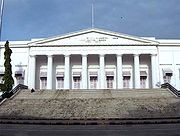
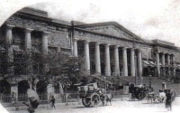
The Town Hall (colloquially Called "Tondal" in the 19th century) that houses the Asiatic Society of Bombay was not built in 1804, the year in which the Literary Society of Bombay was formed. Though Sir James Mackintosh mooted the proposal for a grand edifice, it was not completed until the year 1830 (year to be confirmed with tablet on the entrance) after many fits and starts, when the Bombay Government agreed to make up for the shortfall in funds in return for office-space. The after-effects of this compromise can still be seen in the unseemly crowds gathered at the Stamp Office and other government departments in the Town Hall.It is now classified a heritage structure, heavily influenced by Greek and Roman architecture. It has a portico with eight Doric columns. A flight of 30 steps lead up to the town hall and a wrought iron
Wrought iron
thumb|The [[Eiffel tower]] is constructed from [[puddle iron]], a form of wrought ironWrought iron is an iron alloy with a very low carbon...
divided Regency staircase leads to the vestibule. In 1830 Sir John Malcolm
John Malcolm
Major-general Sir John Malcolm was a Scottish soldier, statesman, and historian-Early life:Born at Burnfoot, Dumfriesshire, Malcolm was the son of George Malcolm, a gentleman farmer of Eskdale and Burnfoot. Jock, as he was then known, was one of the four Malcolm brothers who attained knighthoods...
, governor of Bombay
Bombay Presidency
The Bombay Presidency was a province of British India. It was established in the 17th century as a trading post for the English East India Company, but later grew to encompass much of western and central India, as well as parts of post-partition Pakistan and the Arabian Peninsula.At its greatest...
stated: "It is the most magnificent structure that taste and munificence combined have as yet erected in India."
The edifice is in the prime Fort area of South Mumbai
South Mumbai
South Mumbai , sometimes incorrectly referred to by English Media as "SoBo" , the southern-most precinct of the city of Mumbai, India, comprises the city's main business localities and its adjoining areas...
overlooking the Horniman Circle Gardens
Horniman Circle Gardens
The Horniman Circle Gardens is a large park in South Mumbai, India which encompasses an area of . It is situated in the Fort district of Mumbai, and is surrounded by office complexes housing the country's premier banks...
and the Reserve Bank of India
Reserve Bank of India
The Reserve Bank of India is the central banking institution of India and controls the monetary policy of the rupee as well as US$300.21 billion of currency reserves. The institution was established on 1 April 1935 during the British Raj in accordance with the provisions of the Reserve Bank of...
.