

Taphrinomycotina

Encyclopedia
Taphrinomycotina is one of three subphyla constituting the Ascomycota
(fungi that form their spore
s in a sac-like ascus
) and is more or less synonymous with the slightly older invalid name Archiascomycetes (sometimes spelled Archaeascomycetes). Recent molecular
studies suggest that the group is monophyletic and basal to the rest of the Ascomycota.
The Schizosaccharomycetes
are yeast
s (e.g. Schizosaccharomyces
) that reproduce by fission rather than budding unlike most other yeasts, many of which are in the subphylum Saccharomycotina
.
The Taphrinomycetes
are dimorphic
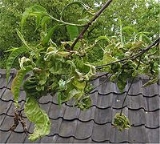
plant parasites (e.g. Taphrina
) with both a yeast state and a filamentous (hyphal) state in infected plants. They characteristically infect leaves, catkins and branches, not roots.
The Neolectomycetes are species in a single genus, Neolecta
, which are the only members of the subphylum that form fruiting bodies, and which specifically grow out of root tips. They may have a yeast state (ascospores bud in the asci).
The Pneumocystidomycetes
also encompasses only one genus, Pneumocystis
, one of which causes Pneumocystis pneumonia (PCP) in humans. All species infect mammalian lungs and are yeast
s.
None have ascogenous hyphae giving rise to the asci.
Ascomycota
The Ascomycota are a Division/Phylum of the kingdom Fungi, and subkingdom Dikarya. Its members are commonly known as the Sac fungi. They are the largest phylum of Fungi, with over 64,000 species...
(fungi that form their spore
Spore
In biology, a spore is a reproductive structure that is adapted for dispersal and surviving for extended periods of time in unfavorable conditions. Spores form part of the life cycles of many bacteria, plants, algae, fungi and some protozoa. According to scientist Dr...
s in a sac-like ascus
Ascus
An ascus is the sexual spore-bearing cell produced in ascomycete fungi. On average, asci normally contain eight ascospores, produced by a meiotic cell division followed, in most species, by a mitotic cell division. However, asci in some genera or species can number one , two, four, or multiples...
) and is more or less synonymous with the slightly older invalid name Archiascomycetes (sometimes spelled Archaeascomycetes). Recent molecular
Molecular phylogeny
Molecular phylogenetics is the analysis of hereditary molecular differences, mainly in DNA sequences, to gain information on an organism's evolutionary relationships. The result of a molecular phylogenetic analysis is expressed in a phylogenetic tree...
studies suggest that the group is monophyletic and basal to the rest of the Ascomycota.
The Schizosaccharomycetes
Schizosaccharomycetes
Schizosaccharomycetes is a class in the kingdom of fungi. It contains the order Schizosaccharomycetales, the fission yeasts....
are yeast
Yeast
Yeasts are eukaryotic micro-organisms classified in the kingdom Fungi, with 1,500 species currently described estimated to be only 1% of all fungal species. Most reproduce asexually by mitosis, and many do so by an asymmetric division process called budding...
s (e.g. Schizosaccharomyces
Schizosaccharomyces
Schizosaccharomyces is a genus of fission yeasts. The most well-studied species is S. pombe. At present four Schizosaccharomyces species have been described . Like the distantly related Saccharomyces cerevisiae, S. pombe is a significant model organism in the study of eukaryotic cell biology...
) that reproduce by fission rather than budding unlike most other yeasts, many of which are in the subphylum Saccharomycotina
Saccharomycotina
Saccharomycotina is a subphylum of the phylum Ascomycota , and consists of yeasts - they form no ascocarps , their asci are naked, and they can reproduce asexually by budding....
.
The Taphrinomycetes
Taphrinomycetes
The Taphrinomycetes are a class of ascomycete fungi belonging to the subdivion Taphrinomycotina. It includes the single order Taphrinales, which includes 2 families, 8 genera and 140 species....
are dimorphic
Phenotypic switching
Phenotypic switching is switching between two cell-types. An example is Candida albicans, which, when it infects host tissue, switches from the usual unicellular yeast-like form of into an invasive, multicellular filamentous form. This switching between two cell-types is known as...
plant parasites (e.g. Taphrina
Taphrina
Taphrina is a fungal genus within the Ascomycota that causes leaf and catkin curl diseases and witch's brooms of certain flowering plants. One of the more commonly observed species causes peach leaf curl...
) with both a yeast state and a filamentous (hyphal) state in infected plants. They characteristically infect leaves, catkins and branches, not roots.
The Neolectomycetes are species in a single genus, Neolecta
Neolecta
Neolecta is a genus of ascomycetous fungi that have fruiting bodies in the shape of unbranched to lobed bright yellowish, orangish to pale yellow-green colored, club-shaped, smooth, fleshy columns up to about 7 cm tall. The species share the English designation "Earth tongues" along with some...
, which are the only members of the subphylum that form fruiting bodies, and which specifically grow out of root tips. They may have a yeast state (ascospores bud in the asci).
The Pneumocystidomycetes
Pneumocystis pneumonia
Pneumocystis pneumonia or pneumocystosis is a form of pneumonia, caused by the yeast-like fungus Pneumocystis jirovecii...
also encompasses only one genus, Pneumocystis
Pneumocystis pneumonia
Pneumocystis pneumonia or pneumocystosis is a form of pneumonia, caused by the yeast-like fungus Pneumocystis jirovecii...
, one of which causes Pneumocystis pneumonia (PCP) in humans. All species infect mammalian lungs and are yeast
Yeast
Yeasts are eukaryotic micro-organisms classified in the kingdom Fungi, with 1,500 species currently described estimated to be only 1% of all fungal species. Most reproduce asexually by mitosis, and many do so by an asymmetric division process called budding...
s.
None have ascogenous hyphae giving rise to the asci.