

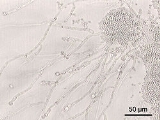
Saccharomycotina

Encyclopedia
Saccharomycotina is a subphylum of the phylum Ascomycota
(fungi
which form their sexual spores in sac-like asci
), and consists of yeast
s - they form no ascocarps (fruiting bodies), their asci are naked, and they can reproduce asexually by budding.
The only class in this subphylum is Saccharomycetes
.
It includes the well-known Baker's Yeast Saccharomyces cerevisiae
and the genus Candida
which infects humans.
Ascomycota
The Ascomycota are a Division/Phylum of the kingdom Fungi, and subkingdom Dikarya. Its members are commonly known as the Sac fungi. They are the largest phylum of Fungi, with over 64,000 species...
(fungi
Fungus
A fungus is a member of a large group of eukaryotic organisms that includes microorganisms such as yeasts and molds , as well as the more familiar mushrooms. These organisms are classified as a kingdom, Fungi, which is separate from plants, animals, and bacteria...
which form their sexual spores in sac-like asci
Ascus
An ascus is the sexual spore-bearing cell produced in ascomycete fungi. On average, asci normally contain eight ascospores, produced by a meiotic cell division followed, in most species, by a mitotic cell division. However, asci in some genera or species can number one , two, four, or multiples...
), and consists of yeast
Yeast
Yeasts are eukaryotic micro-organisms classified in the kingdom Fungi, with 1,500 species currently described estimated to be only 1% of all fungal species. Most reproduce asexually by mitosis, and many do so by an asymmetric division process called budding...
s - they form no ascocarps (fruiting bodies), their asci are naked, and they can reproduce asexually by budding.
The only class in this subphylum is Saccharomycetes
Saccharomycetes
Saccharomycetes is a class in the kingdom of fungi. It contains the order Saccharomycetales, the budding yeasts. Hemiascomycetes is a more or less synonymous name.-External links:*...
.
It includes the well-known Baker's Yeast Saccharomyces cerevisiae
Saccharomyces cerevisiae
Saccharomyces cerevisiae is a species of yeast. It is perhaps the most useful yeast, having been instrumental to baking and brewing since ancient times. It is believed that it was originally isolated from the skin of grapes...
and the genus Candida
Candida (genus)
Candida is a genus of yeasts. Many species are harmless commensals or endosymbionts of animal hosts including humans, but other species, or harmless species in the wrong location, can cause disease. Candida albicans can cause infections in humans and other animals, especially in immunocompromised...
which infects humans.