

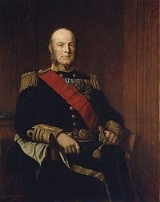
Arthur Hood, 1st Baron Hood of Avalon

Encyclopedia
Admiral Arthur William Acland Hood, 1st Baron Hood of Avalon GCB
(14 July 1824 – 15 November 1901), was an officer of the Royal Navy
who held command during the Crimean War
and later served as First Naval Lord
.
, was killed in action during the French Revolutionary Wars
; he fell whilst in command of HMS Mars
, in action with the French 74-gun ship Hercule on 21 April 1798.
, and whilst still a boy saw active service on the north coast of Spain
, and afterwards on the coast of Syria
. He went out to the Cape of Good Hope
as gunnery mate of the President, the flagship of Rear Admiral James Richard Dacres. On 9 January 1846, Dacres promoted him to lieutenant. As gunnery lieutenant Hood continued in the President till 1849; and in the following year was appointed to the frigate Arethusa.
The outbreak of the Crimean War made the commission a very long one; and on 27 November 1854 Hood was promoted to Commander in recognition of his service with the Naval Brigade
before Sebastopol. In 1856 he commissioned the brig Acorn for the China Station
, and arrived in time to take part in the destruction of the junks in the Battle of Fatshan Creek
on 1 June 1857, and in the capture of Canton
in the following December, for which, in February 1858, he received his commission as a post-captain
.
From 1862 to 1866 he commanded the HMS Pylades on the North American station, and was then appointed to the command of the HMS Excellent and the government of the Royal Naval College
at Portsmouth
. This was essentially a gunnery appointment, and on the expiration of three years Hood was made Director of Naval Ordnance. In June 1874 he was appointed to the command of the HMS Monarch
in the Channel Fleet
, from which he was relieved in March 1876 by his promotion to flag rank. From 1877 to 1879 he was Second Naval Lord
, and from 1880 to 1882 he commanded the Channel Fleet
, becoming vice-admiral on 23 July 1880.
In June 1885 he was appointed First Naval Lord
of the Admiralty
. He was promoted to full Admiral in July 1885. In July 1889, on attaining the age of sixty-five, he was placed on the retired list and resigned his post at the Admiralty.
in September 1889; and in February 1892 was raised to the peerage as Baron Hood of Avalon, in the County of Somerset. The title became extinct on his death.
Order of the Bath
The Most Honourable Order of the Bath is a British order of chivalry founded by George I on 18 May 1725. The name derives from the elaborate mediæval ceremony for creating a knight, which involved bathing as one of its elements. The knights so created were known as Knights of the Bath...
(14 July 1824 – 15 November 1901), was an officer of the Royal Navy
Royal Navy
The Royal Navy is the naval warfare service branch of the British Armed Forces. Founded in the 16th century, it is the oldest service branch and is known as the Senior Service...
who held command during the Crimean War
Crimean War
The Crimean War was a conflict fought between the Russian Empire and an alliance of the French Empire, the British Empire, the Ottoman Empire, and the Kingdom of Sardinia. The war was part of a long-running contest between the major European powers for influence over territories of the declining...
and later served as First Naval Lord
First Sea Lord
The First Sea Lord is the professional head of the Royal Navy and the whole Naval Service; it was formerly known as First Naval Lord. He also holds the title of Chief of Naval Staff, and is known by the abbreviations 1SL/CNS...
.
Early life
Hood was the younger son of Sir Alexander Hood, 2nd Baronet, of St Audries, Somerset. His grandfather, Captain Alexander HoodAlexander Hood (captain)
Captain Alexander Hood was an officer of the Royal Navy, one of several members of the Hood family to serve at sea.-Career:...
, was killed in action during the French Revolutionary Wars
French Revolutionary Wars
The French Revolutionary Wars were a series of major conflicts, from 1792 until 1802, fought between the French Revolutionary government and several European states...
; he fell whilst in command of HMS Mars
HMS Mars (1794)
HMS Mars was a 74-gun third-rate ship of the line of the Royal Navy, launched on 25 October 1794 at Deptford Dockyard.-Career:In the early part of the French Revolutionary Wars she was assigned to the Channel Fleet. In 1797 under Captain Alexander Hood she was prominent in the Spithead mutiny...
, in action with the French 74-gun ship Hercule on 21 April 1798.
Naval career
At the age of twelve Hood entered the Royal NavyRoyal Navy
The Royal Navy is the naval warfare service branch of the British Armed Forces. Founded in the 16th century, it is the oldest service branch and is known as the Senior Service...
, and whilst still a boy saw active service on the north coast of Spain
Spain
Spain , officially the Kingdom of Spain languages]] under the European Charter for Regional or Minority Languages. In each of these, Spain's official name is as follows:;;;;;;), is a country and member state of the European Union located in southwestern Europe on the Iberian Peninsula...
, and afterwards on the coast of Syria
Syria
Syria , officially the Syrian Arab Republic , is a country in Western Asia, bordering Lebanon and the Mediterranean Sea to the West, Turkey to the north, Iraq to the east, Jordan to the south, and Israel to the southwest....
. He went out to the Cape of Good Hope
Cape of Good Hope
The Cape of Good Hope is a rocky headland on the Atlantic coast of the Cape Peninsula, South Africa.There is a misconception that the Cape of Good Hope is the southern tip of Africa, because it was once believed to be the dividing point between the Atlantic and Indian Oceans. In fact, the...
as gunnery mate of the President, the flagship of Rear Admiral James Richard Dacres. On 9 January 1846, Dacres promoted him to lieutenant. As gunnery lieutenant Hood continued in the President till 1849; and in the following year was appointed to the frigate Arethusa.
The outbreak of the Crimean War made the commission a very long one; and on 27 November 1854 Hood was promoted to Commander in recognition of his service with the Naval Brigade
Naval Brigade
A Naval Brigade is a body of sailors serving in a ground combat role to augment land forces.-Royal Navy:Within the Royal Navy, a Naval Brigade is a large temporary detachment of Royal Marines and of seamen from the Royal Navy formed to undertake operations on shore, particularly during the mid- to...
before Sebastopol. In 1856 he commissioned the brig Acorn for the China Station
China Station
The China Station was a historical formation of the British Royal Navy. It was formally the units and establishments responsible to the Commander-in-Chief, China....
, and arrived in time to take part in the destruction of the junks in the Battle of Fatshan Creek
Battle of Fatshan Creek
The Battle of Fatshan Creek was a naval engagement fought between the United Kingdom's Royal Navy and Chinese pirates on June 1, 1857. Commodore Henry Keppel sought out and destroyed the Chinese fleet before advancing to the city of Canton for its capture....
on 1 June 1857, and in the capture of Canton
Guangzhou
Guangzhou , known historically as Canton or Kwangchow, is the capital and largest city of the Guangdong province in the People's Republic of China. Located in southern China on the Pearl River, about north-northwest of Hong Kong, Guangzhou is a key national transportation hub and trading port...
in the following December, for which, in February 1858, he received his commission as a post-captain
Post-Captain
Post-captain is an obsolete alternative form of the rank of captain in the Royal Navy.The term served to distinguish those who were captains by rank from:...
.
From 1862 to 1866 he commanded the HMS Pylades on the North American station, and was then appointed to the command of the HMS Excellent and the government of the Royal Naval College
Royal Naval Academy
The Royal Naval Academy was established at Portsmouth Dockyard as a facility to train officers for the Royal Navy. The founders' intentions were to provide an alternative means to recruit officers and to provide standardised training, education and admission.-Training:In 1773, a shore side...
at Portsmouth
Portsmouth
Portsmouth is the second largest city in the ceremonial county of Hampshire on the south coast of England. Portsmouth is notable for being the United Kingdom's only island city; it is located mainly on Portsea Island...
. This was essentially a gunnery appointment, and on the expiration of three years Hood was made Director of Naval Ordnance. In June 1874 he was appointed to the command of the HMS Monarch
HMS Monarch (1868)
HMS Monarch was the first sea-going warship to carry her guns in turrets, and the first British warship to carry guns of calibre.-Design:...
in the Channel Fleet
Channel Fleet
The Channel Fleet was the Royal Navy formation of warships that defended the waters of the English Channel from 1690 to 1909.-History:The Channel Fleet dates back at least to 1690 when its role was to defend England against the French threat under the leadership of Edward Russell, 1st Earl of...
, from which he was relieved in March 1876 by his promotion to flag rank. From 1877 to 1879 he was Second Naval Lord
Second Sea Lord
The Second Sea Lord and Commander-in-Chief Naval Home Command , commonly just known as the Second Sea Lord , is one of the most senior admirals of the British Royal Navy , and is responsible for personnel and naval shore establishments.-History:In 1805, for the first time, specific functions were...
, and from 1880 to 1882 he commanded the Channel Fleet
Channel Fleet
The Channel Fleet was the Royal Navy formation of warships that defended the waters of the English Channel from 1690 to 1909.-History:The Channel Fleet dates back at least to 1690 when its role was to defend England against the French threat under the leadership of Edward Russell, 1st Earl of...
, becoming vice-admiral on 23 July 1880.
In June 1885 he was appointed First Naval Lord
First Sea Lord
The First Sea Lord is the professional head of the Royal Navy and the whole Naval Service; it was formerly known as First Naval Lord. He also holds the title of Chief of Naval Staff, and is known by the abbreviations 1SL/CNS...
of the Admiralty
Admiralty
The Admiralty was formerly the authority in the Kingdom of England, and later in the United Kingdom, responsible for the command of the Royal Navy...
. He was promoted to full Admiral in July 1885. In July 1889, on attaining the age of sixty-five, he was placed on the retired list and resigned his post at the Admiralty.
Later years
After two years of continued ill-health, he died on 15 November 1901, and was buried at Butleigh on the 23rd. He had been made KCB in December 1885, GCBOrder of the Bath
The Most Honourable Order of the Bath is a British order of chivalry founded by George I on 18 May 1725. The name derives from the elaborate mediæval ceremony for creating a knight, which involved bathing as one of its elements. The knights so created were known as Knights of the Bath...
in September 1889; and in February 1892 was raised to the peerage as Baron Hood of Avalon, in the County of Somerset. The title became extinct on his death.