

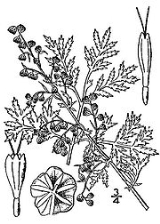
Artemisia annua

Encyclopedia
Artemisia annua, also known as Sweet Wormwood, Sweet Annie, Sweet Sagewort or Annual Wormwood , is a common type of wormwood
that is native to temperate Asia, but naturalized throughout the world.
, bright yellow flower
s, and a camphor
-like scent. Its height averages about 2 m tall, and the plant has a single stem, alternating branches, and alternating leaves which range 2.5–5 cm in length. It is cross-pollinated
by wind or insects. It is a diploid plant with chromosome number, 2n=18.
).
(formerly referred to as arteannuin), was isolated and its chemical structure described. Artemisinin may be extracted using a low boiling point solvent
such as diethylether and is found in the glandular trichomes of the leaves, stems, and inflorescences, and it is concentrated in the upper portions of plant within new growth.
lactone
with an endoperoxide bridge and has been produced semi-synthetically as an antimalarial drug. The efficacy of tea made from A. annua in the treatment of malaria is contentious. According to some authors, artemesinin is not soluble in water and the concentrations in these infusions are considered insufficient to treatment malaria. Other researchers have claimed that Artemisia annua contains a cocktail of anti-malarial substances, and insist that clinical trials be conducted to demonstrate scientifically that artemisia tea is effective in treating malaria. This simpler use may be a cheaper alternative to commercial pharmaceuticals, and may enable health dispensaries in the tropics to be more self-reliant in their malaria treatment. In 2004, the Ethiopian Ministry of Health changed Ethiopia’s first line anti-malaria drug from Fansidar, a sulfadoxine
agent which has an average 36% treatment failure rate, to Coartem
, a drug therapy containing artemesinin which is 100% effective when used correctly, despite a worldwide shortage at the time of the needed derivative from A. annua.
receptors pathways.
in the cells of the parasite. Malaria is caused by Apicomplexans, primarily Plasmodium falciparum
, which largely resides in red blood cells and itself contains iron-rich heme
-groups (in the from of hemozoin
).
, specifically Hubei Province
, the stems of this wormwood are used as food in a salad-like form. The final product, literally termed "cold-mixed wormwood", is a slightly bitter salad with strong acid overtones from the spiced rice vinegar used as a marinade. It is considered a delicacy and is typically more expensive to buy than meat.
Artemisia (plant)
Artemisia is a large, diverse genus of plants with between 200 to 400 species belonging to the daisy family Asteraceae. It comprises hardy herbs and shrubs known for their volatile oils. They grow in temperate climates of the Northern Hemisphere and Southern Hemisphere, usually in dry or semi-dry...
that is native to temperate Asia, but naturalized throughout the world.
Characteristics
It has fern-like leavesLeaf
A leaf is an organ of a vascular plant, as defined in botanical terms, and in particular in plant morphology. Foliage is a mass noun that refers to leaves as a feature of plants....
, bright yellow flower
Flower
A flower, sometimes known as a bloom or blossom, is the reproductive structure found in flowering plants . The biological function of a flower is to effect reproduction, usually by providing a mechanism for the union of sperm with eggs...
s, and a camphor
Camphor
Camphor is a waxy, white or transparent solid with a strong, aromatic odor. It is a terpenoid with the chemical formula C10H16O. It is found in wood of the camphor laurel , a large evergreen tree found in Asia and also of Dryobalanops aromatica, a giant of the Bornean forests...
-like scent. Its height averages about 2 m tall, and the plant has a single stem, alternating branches, and alternating leaves which range 2.5–5 cm in length. It is cross-pollinated
Outcrossing
Outcrossing is the practice of introducing unrelated genetic material into a breeding line. It increases genetic diversity, thus reducing the probability of all individuals being subject to disease or reducing genetic abnormalities...
by wind or insects. It is a diploid plant with chromosome number, 2n=18.
Medicinal uses
Sweet Wormwood was used by Chinese herbalists in ancient times to treat fever, but had fallen out of common use, but was rediscovered in 1970's when the Chinese Handbook of Prescriptions for Emergency Treatments (340 AD) was found. This pharmacopeia contained recipes for a tea from dried leaves, prescribed for fevers (not specifically malariaMalaria
Malaria is a mosquito-borne infectious disease of humans and other animals caused by eukaryotic protists of the genus Plasmodium. The disease results from the multiplication of Plasmodium parasites within red blood cells, causing symptoms that typically include fever and headache, in severe cases...
).
Extractions
In 1971, scientists demonstrated that the plant extracts had antimalarial activity in primate models, and in 1972 the active ingredient, artemisininArtemisinin
Artemisinin , also known as Qinghaosu , and its derivatives are a group of drugs that possess the most rapid action of all current drugs against falciparum malaria. Treatments containing an artemisinin derivative are now standard treatment worldwide for falciparum malaria...
(formerly referred to as arteannuin), was isolated and its chemical structure described. Artemisinin may be extracted using a low boiling point solvent
Solvent
A solvent is a liquid, solid, or gas that dissolves another solid, liquid, or gaseous solute, resulting in a solution that is soluble in a certain volume of solvent at a specified temperature...
such as diethylether and is found in the glandular trichomes of the leaves, stems, and inflorescences, and it is concentrated in the upper portions of plant within new growth.
Parasite treatment
It is commonly used in tropical nations which can afford it, preferentially as part of a combination-cocktail with other antimalarials in order to prevent the development of parasite resistance.Malaria treatment
Artemisinin itself is a sesquiterpeneSesquiterpene
Sesquiterpenes are a class of terpenes that consist of three isoprene units and have the molecular formula C15H24. Like monoterpenes, sesquiterpenes may be acyclic or contain rings, including many unique combinations...
lactone
Lactone
In chemistry, a lactone is a cyclic ester which can be seen as the condensation product of an alcohol group -OH and a carboxylic acid group -COOH in the same molecule...
with an endoperoxide bridge and has been produced semi-synthetically as an antimalarial drug. The efficacy of tea made from A. annua in the treatment of malaria is contentious. According to some authors, artemesinin is not soluble in water and the concentrations in these infusions are considered insufficient to treatment malaria. Other researchers have claimed that Artemisia annua contains a cocktail of anti-malarial substances, and insist that clinical trials be conducted to demonstrate scientifically that artemisia tea is effective in treating malaria. This simpler use may be a cheaper alternative to commercial pharmaceuticals, and may enable health dispensaries in the tropics to be more self-reliant in their malaria treatment. In 2004, the Ethiopian Ministry of Health changed Ethiopia’s first line anti-malaria drug from Fansidar, a sulfadoxine
Sulfadoxine
Sulfadoxine is an ultra-long-lasting sulfonamide often used in combination with pyrimethamine to treat or prevent malaria....
agent which has an average 36% treatment failure rate, to Coartem
Coartem
The combination artemether/lumefantrine is an artemisinin-based combination therapy indicated for the treatment of acute uncomplicated plasmodium falciparum malaria. Coartem is produced by the Swiss pharmaceutical company, Novartis.Artemether is a derivative of artemisinin, and lumefantrine is...
, a drug therapy containing artemesinin which is 100% effective when used correctly, despite a worldwide shortage at the time of the needed derivative from A. annua.
Other medicinal Uses
A. annua has sedative effects on mice. Possibly mediated via benzodiazepineBenzodiazepine
A benzodiazepine is a psychoactive drug whose core chemical structure is the fusion of a benzene ring and a diazepine ring...
receptors pathways.
Mechanism
The proposed mechanism of action of artemisinin involves cleavage of endoperoxide bridges by iron producing free radicals (hypervalent iron-oxo species, epoxides, aldehydes, and dicarbonyl compounds) which damage biological macromolecules causing oxidative stressOxidative stress
Oxidative stress represents an imbalance between the production and manifestation of reactive oxygen species and a biological system's ability to readily detoxify the reactive intermediates or to repair the resulting damage...
in the cells of the parasite. Malaria is caused by Apicomplexans, primarily Plasmodium falciparum
Plasmodium falciparum
Plasmodium falciparum is a protozoan parasite, one of the species of Plasmodium that cause malaria in humans. It is transmitted by the female Anopheles mosquito. Malaria caused by this species is the most dangerous form of malaria, with the highest rates of complications and mortality...
, which largely resides in red blood cells and itself contains iron-rich heme
Heme
A heme or haem is a prosthetic group that consists of an iron atom contained in the center of a large heterocyclic organic ring called a porphyrin. Not all porphyrins contain iron, but a substantial fraction of porphyrin-containing metalloproteins have heme as their prosthetic group; these are...
-groups (in the from of hemozoin
Hemozoin
Hemozoin is a disposal product formed from the digestion of blood by some blood-feeding parasites. These hematophagous organisms such as Malaria parasites , Rhodnius and Schistosoma digest hemoglobin and release high quantities of free heme, which is the non-protein component of hemoglobin...
).
Other uses
In modern-day central ChinaChina
Chinese civilization may refer to:* China for more general discussion of the country.* Chinese culture* Greater China, the transnational community of ethnic Chinese.* History of China* Sinosphere, the area historically affected by Chinese culture...
, specifically Hubei Province
Hubei
' Hupeh) is a province in Central China. The name of the province means "north of the lake", referring to its position north of Lake Dongting...
, the stems of this wormwood are used as food in a salad-like form. The final product, literally termed "cold-mixed wormwood", is a slightly bitter salad with strong acid overtones from the spiced rice vinegar used as a marinade. It is considered a delicacy and is typically more expensive to buy than meat.
External links
- Scientific information about the plant
- University of Washington article regarding anti-cancer properties
- Anamed.net Charity that trains people in the Tropics to cultivate Artemisia annua and to use their harvest in the form of tea to treat malaria and other diseases, as practiced in China for centuries.
- Distribution of Artemisinin in Artemisia annua
- Project to improve artemesinin yield at the University of York (UK)