


Anti-Atlas

Encyclopedia
Morocco
Morocco , officially the Kingdom of Morocco , is a country located in North Africa. It has a population of more than 32 million and an area of 710,850 km², and also primarily administers the disputed region of the Western Sahara...
, a part of the Atlas mountains
Atlas Mountains
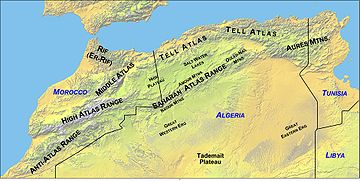
The Atlas Mountains is a mountain range across a northern stretch of Africa extending about through Morocco, Algeria, and Tunisia. The highest peak is Toubkal, with an elevation of in southwestern Morocco. The Atlas ranges separate the Mediterranean and Atlantic coastlines from the Sahara Desert...
in the northwest of Africa. The Anti-Atlas extends from the Atlantic Ocean
Atlantic Ocean
The Atlantic Ocean is the second-largest of the world's oceanic divisions. With a total area of about , it covers approximately 20% of the Earth's surface and about 26% of its water surface area...
in the southwest toward the northeast, to the heights of Ouarzazate
Ouarzazate
-See also:* Tizi n'Tichka: The mountain pass that leads to Ouarzazate* List of Movies shot in Morocco-External links:* at IMDb...
and further east to the city of Tafilalt
Tafilalt
Tafilalt or Tafilet is a region and the most important oasis of the Moroccan Sahara; it is also considered one of the largest oases in the world, the oasis is entirely located along the Ziz River. The oasis is ten days' journey south of Fez, across the Atlas Mountains...
, altogether a distance of approximately 500 km. The range borders on the Sahara
Sahara
The Sahara is the world's second largest desert, after Antarctica. At over , it covers most of Northern Africa, making it almost as large as Europe or the United States. The Sahara stretches from the Red Sea, including parts of the Mediterranean coasts, to the outskirts of the Atlantic Ocean...
to the south.
The easternmost point of the Anti-Atlas is the Djebel Sarhro mountains, and its eastern boundary is set by sections of the High Atlas range
High Atlas
High Atlas, also called the Grand Atlas Mountains is a mountain range in central Morocco in Northern Africa.The High Atlas rises in the west at the Atlantic Ocean and stretches in an eastern direction to the Moroccan-Algerian border. At the Atlantic and to the southwest the range drops abruptly...
. On the heights of Ouarzazate
Ouarzazate
-See also:* Tizi n'Tichka: The mountain pass that leads to Ouarzazate* List of Movies shot in Morocco-External links:* at IMDb...
, the massif
Massif
In geology, a massif is a section of a planet's crust that is demarcated by faults or flexures. In the movement of the crust, a massif tends to retain its internal structure while being displaced as a whole...
is cut through by the Draa valley, opening towards the south. In this world of rocks, the contrasts are extreme. Most of the land is dry and barren, but water gathers and runs in some remote places, forming clear basins. Most villages are limited to a few small houses surrounded by palm trees.
In some contexts, the Anti-Atlas are considered separate from the Atlas mountains, as the term "anti" implies.
Creation of the Anti-Atlas Range
The base rock of Africa (the African plateAfrican Plate
The African Plate is a tectonic plate which includes the continent of Africa, as well as oceanic crust which lies between the continent and various surrounding ocean ridges.-Boundaries:...
) was formed in the Precambrian
Precambrian
The Precambrian is the name which describes the large span of time in Earth's history before the current Phanerozoic Eon, and is a Supereon divided into several eons of the geologic time scale...
(approximately 4,500 to 550 million years ago), and is much older than the Atlas mountains. The Anti-Atlas range developed even later.
The Anti-Atlas range formed in the Paleozoic
Paleozoic
The Paleozoic era is the earliest of three geologic eras of the Phanerozoic eon, spanning from roughly...
(~300 million years ago), as a result of continental collisions. North America, Europe and Africa were connected as part of two former continents
Supercontinent
In geology, a supercontinent is a landmass comprising more than one continental core, or craton. The assembly of cratons and accreted terranes that form Eurasia qualifies as a supercontinent today.-History:...
, Euramerica
Euramerica
Euramerica was a minor supercontinent created in the Devonian as the result of a collision between the Laurentian, Baltica, and Avalonia cratons .300 million years ago in the Late Carboniferous tropical rainforests lay over the equator of Euramerica...
and Gondwana
Gondwana
In paleogeography, Gondwana , originally Gondwanaland, was the southernmost of two supercontinents that later became parts of the Pangaea supercontinent. It existed from approximately 510 to 180 million years ago . Gondwana is believed to have sutured between ca. 570 and 510 Mya,...
, which ground against one another to create the former Central Pangean Mountains
Central Pangean Mountains
The Central Pangean Mountains were an extensive northeast-southwest trending mountain range in the central portion of the supercontinent Pangaea during the Triassic period. They were formed as a result of collision between the minor supercontinents Laurussia and Gondwana during the formation of...
. Evidence shows that the Anti-Atlas mountains were originally formed as part of the Alleghenian orogeny
Alleghenian orogeny
The Alleghenian orogeny or Appalachian orogeny is one of the geological mountain-forming events that formed the Appalachian Mountains and Allegheny Mountains. The term and spelling Alleghany orogeny was originally proposed by H.P. Woodward in 1957....
that also formed the Appalachians, formed when Gondwana (including Africa) and Euramerica (America) collided. There are indications they were once a chain of mountains far higher than the Himalayas are today.
More recently, in the Tertiary period (65 millions to ~1.8 million years ago), the remaining mountain chains that today comprise the Atlas were uplifted as the land masses of Europe and Africa collided at the southern end of the Iberian peninsula
Iberian Peninsula
The Iberian Peninsula , sometimes called Iberia, is located in the extreme southwest of Europe and includes the modern-day sovereign states of Spain, Portugal and Andorra, as well as the British Overseas Territory of Gibraltar...
. Erosion continued to reduce the Anti-Atlas range so that it is today less massive than the High Atlas range to the north.
Profile and climate
The summits of the Anti-Atlas reach average heights of 2,500-2,700 m (8200–8850 ft), with a few peaks reaching higher. To the north lies a plateau at 1700–1800 m in height. To the south lie the Sahara highlands at approximately 700 m. One peak, Djebel Siroua, of volcanic origin, reaches 3304 m. The range is strongly fissured, particularly in a southerly direction.In the Anti-Atlas, the precipitation annually is typically below 200 mm, while the climatic conditions on the north and west slopes are locally more wet and agriculturally favorable. Climatically, the mountains are separated from the Mediterranean's influence by the High Atlas
High Atlas
High Atlas, also called the Grand Atlas Mountains is a mountain range in central Morocco in Northern Africa.The High Atlas rises in the west at the Atlantic Ocean and stretches in an eastern direction to the Moroccan-Algerian border. At the Atlantic and to the southwest the range drops abruptly...
to its north, and therefore they belong to the Saharan climate zone.
Flora
In the least dry areas to the west and the north, much of the land is covered with thymeThyme
Thyme is a culinary and medicinal herb of the genus Thymus.-History:Ancient Egyptians used thyme for embalming. The ancient Greeks used it in their baths and burnt it as incense in their temples, believing it was a source of courage...
, rosemary
Rosemary
Rosemary, , is a woody, perennial herb with fragrant, evergreen, needle-like leaves and white, pink, purple or blue flowers, native to the Mediterranean region. It is a member of the mint family Lamiaceae, which includes many other herbs, and is one of two species in the genus Rosmarinus...
and other low-water-demand plants, such as argan
Argan
The Argan is a species of tree endemic to the calcareous semi-desert Sous valley of southwestern Morocco and to the Algerian region of Tindouf in the western Mediterranean region. It is the sole species in the genus Argania....
. The quilt-like cover is endangered by overgrazing, and in the south little but thorn shrubs remain. The transition to the desert is gradual towards the south.
Landscape
The landscape is marked by picturesque kasbahKasbah
A kasbah or qassabah is a type of medina, Islamic city, or fortress .It was a place for the local leader to live and a defense when a city was under attack. A kasbah has high walls, usually without windows. Sometimes, they were built on hilltops so that they could be more easily defended...
(small castles) in many places in the region. In former times, the kasbah was important as a place of shelter and as a supply depot for kinsmen. Close to these settlements, terrace
Terrace (agriculture)
Terraces are used in farming to cultivate sloped land. Graduated terrace steps are commonly used to farm on hilly or mountainous terrain. Terraced fields decrease erosion and surface runoff, and are effective for growing crops requiring much water, such as rice...
d fields with dry-stone retaining wall
Retaining wall
Retaining walls are built in order to hold back earth which would otherwise move downwards. Their purpose is to stabilize slopes and provide useful areas at different elevations, e.g...
s cover the landscape. However, increasingly houses are vacated and fields are left uncultivated. With the continued migration from the land, the irrigation systems necessary for agriculture are also decaying.
See also
- TataTata, MoroccoTata is a town in Morocco with a population of around 15,192.It is situated on the Sahara plain, southeast of Agadir and Taroudannt, close to the Algerian border and the mountain range Anti Atlas at the foot of Jebel Bani....
