

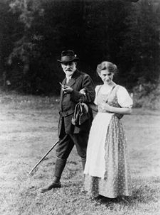
Anna Freud

Encyclopedia
Anna Freud was the sixth and last child
of Sigmund
and Martha Freud. Born in Vienna
, she followed the path of her father and contributed to the newly born field of psychoanalysis
. Alongside Melanie Klein
, she may be considered the founder of psychoanalytic child psychology: as her father put it, child analysis 'had received a powerful impetus through "the work of Frau Melanie Klein and of my daughter, Anna Freud"'. Compared to her father, her work emphasized the importance of the ego and its ability to be trained socially.
s, specifically with her sister Sophie Freud (as well as troubles with her cousin Sonja Trierweiler, a "bad influence" on her). Her sister, Sophie, who was the more attractive child, represented a threat in the struggle for the affection of their father: 'the two young Freuds developed their version of a common sisterly division of territories: "beauty" and "brains"', and their father once spoke of her 'age-old jealousy of Sophie'.
As well as this rivalry between the two sisters, Anna had other difficulties growing up - 'a somewhat troubled youngster who complained to her father in candid letters how all sorts of unreasonable thoughts and feelings plagued her'. It seems that 'in general, she was relentlessly competitive with her siblings...and was repeatedly sent to health farms for thorough rest, salutary walks, and some extra pounds to fill out her all too slender shape': she may have suffered from a depression
which caused eating disorder
s. The relationship between Anna and her father was different from the rest of her family
; they were very close. She was a lively child with a reputation for mischief. Freud
wrote to his friend Wilhelm Fliess
in 1899: 'Anna has become downright beautiful through naughtiness'. Freud is said to refer to her in his diaries more than others in the family.
Later on Anna Freud would say that she didn’t learn much in school; instead she learned from her father and his guests at home. This was how she picked up Hebrew
, German
, English
, French
and Italian
. At the age of 15, she started reading her father’s work: a dream she had 'at the age of nineteen months...[appeared in] The Interpretation of Dreams
, and commentators have noted how 'in the dream of little Anna...little Anna only hallucinates forbidden objects'. Anna finished her education at the Cottage Lyceum in Vienna in 1912. Suffering from a depression, she was very insecure about what to do in the future. Subsequently, she went to Italy
to stay with her grandmother, and there is evidence that 'In 1914 she travelled alone to England to improve her English', but was forced to leave shortly after arriving because war was declared.
In 1914 she passed the test to be a trainee at her old school, the Cottage Lyceum. From 1915 to 1917, she was a trainee, and then a teacher from 1917 to 1920. She finally quit her teaching career because of tuberculosis. In 1918, her father started psychoanalysis
on her and she became seriously involved with this new profession. Her analysis was completed in 1922 and thereupon she presented the paper "The Relation of Beating Fantasies to a Daydream" to the Vienna Psychoanalytical Society, subsequently becoming a member. In 1923, Freud began her own psychoanalytical practice with children and two years later she was teaching at the Vienna Psychoanalytic Training Institute on the technique of child analysis. From 1925 until 1934, she was the Secretary of the International Psychoanalytical Association
while she continued child analysis and seminars and conferences on the subject. In 1935, Freud became director of the Vienna Psychoanalytical Training Institute and in the following year she published her influential study of the "ways and means by which the ego wards off displeasure and anxiety", The Ego and the Mechanisms of Defence. It became a founding work of ego psychology
and established Freud’s reputation as a pioneering theoretician.
as a consequence of the Nazis' intensifying harassment of Jews in Vienna following the Anschluss
by Germany. Her father's health had deteriorated severely due to jaw cancer, so she had to organize the family's emigration to London. Here she continued her work and took care of her father, who finally died in the autumn of 1939. When Anna arrived in London, a conflict came to a head between her and Melanie Klein regarding developmental theories of children, culminating in the Controversial discussions
.
The war gave Freud opportunity to observe the effect of deprivation of parental care on children. She set up a centre for young war victims, called "The Hampstead War Nursery". Here the children got foster care although mothers were encouraged to visit as often as possible. The underlying idea was to give children the opportunity to form attachments by providing continuity of relationships. This was continued, after the war, at the Bulldogs Bank Home, which was an orphanage, run by colleagues of Freud, that took care of children who survived concentration camps. Based on these observations Anna published a series of studies with her longtime friend, Dorothy Burlingham-Tiffany
on the impact of stress
on children and the ability to find substitute affections among peers when parents cannot give them.
From the 1950s until the end of her life Freud travelled regularly to the United States to lecture, to teach and to visit friends. During the 1970s she was concerned with the problems of emotionally deprived and socially disadvantaged children, and she studied deviations and delays in development. At Yale Law School
, she taught seminars on crime and the family: this led to a transatlantic collaboration with Joseph Goldstein and Albert Solnit on children and the law, published as Beyond the Best Interests of the Child (1973).
Freud died in London
on 9 October 1982. She was cremated at Golders Green Crematorium
and her ashes placed in a marble
shelf next to her parents' ancient Greek
funeral urn. Her lifelong friend Dorothy Burlingham and several other members of the Freud family also rest there.
One year after Freud's death a publication of her collected works appeared. She was mentioned as "a passionate and inspirational teacher" and in 1984 the Hampstead Clinic was renamed the Anna Freud Centre. Furthermore her home in London for forty years was in 1986, as she had wished, transformed into the Freud Museum, dedicated to her father and the psychoanalytical society.
'Her views on child development, which she expounded in 1927 in her first book, An Introduction to the Technique of Child Analysis, clashed with those of Melanie Klein...[who] was departing from the developmental schedule that Freud, and his analyst daughter, found most plausible'. In particular, Anna Freud's belief that 'In children's analysis, the transference plays a different role... and the analyst not only "represents mother" but is still an original second mother in the life of the child' became something of an orthodoxy over much of the psychoanalytic world.
For her next major work in 1936, her 'classic monograph on ego psychology and defense mechanisms, Anna Freud drew on her own clinical experience, but relied on her father's writings as the principal and authoritative source of her theoretical insights'. Here her 'cataloguing of regression, repression, reaction formation, isolation, undoing, projection, introjection, turning against the self, reversal and sublimation' helped establish the importance of the ego functions and the concept of defense mechanisms, continuing the greater emphasis on the ego of her father — 'We should like to learn more about the ego' — during his final decades.
Special attention was paid in it to later childhood and adolescent developments — 'I have always been more attracted to the latency period than the pre-Oedipal phases' - emphasising how the 'increased intellectual, scientific, and philosophical interests of this period represent attempts at mastering the drives'. The problem posed by physiological maturation has been stated forcefully by Anna Freud. "Aggressive impulses are intensified to the point of complete unruliness, hunger becomes voracity... The reaction-formations, which seemed to be firmly established in the structure of the ego, threaten to fall to pieces".
Selma Fraiberg
's tribute of 1959 that 'The writings of Anna Freud on ego psychology and her studies in early child development have illuminated the world of childhood for workers in the most varied professions and have been for me my introduction and most valuable guide spoke at that time for most of psychoanalysis outside the Kleinian heartland.
Arguably, however, it was in Anna Freud's London years 'that she wrote her most distinguished psychoanalytic papers — including "About Losing and Being Lost", which everyone should read regardless of their interest in psychoanalysis'. Her description therein of 'simultaneous urges to remain loyal to the dead and to turn towards new ties with the living' may perhaps reflect her own mourning process after her father's recent death.
Focusing thereafter on research, observation and treatment of children, Anna Freud established a group of prominent child developmental analysts (which included Erik Erikson
, Edith Jacobson
and Margaret Mahler
) who noticed that children's symptoms were ultimately analogue to personality disorders among adults and thus often related to developmental stages. Her book Normality and Pathology in Childhood (1965) summarised 'the use of developmental lines charting theoretical normal growth "from dependency to emotional self-reliance"'. Through these then revolutionary ideas Anna provided us with a comprehensive developmental theory and the concept of developmental lines
, which combined her father's important drive model with more recent object relations theories emphasizing the importance of parents in child development processes.
Nevertheless her basic loyalty to her father's work remained unimpaired, and it might indeed be said that 'she devoted her life to protecting her father's legacy... In her theoretical work there would be little criticism of him, and she would make what is still the finest contribution to the psychoanalytic understanding of passivity', or what she termed 'altruistic surrender... excessive concern and anxiety for the lives of his love objects'. Jacques Lacan
called 'Anna Freud the plumb line of psychoanalysis. Well, the plumb line doesn't make a building... [but] it allows us to gauge the vertical of certain problems'; and by preserving so much of Freud's legacy and standards she may indeed have served as something of a living yardstick.
With psychoanalysis continuing to move away from classical Freudianism to other concerns, it may still be salutary to heed Anna Freud's warning about the potential loss of her father's 'emphasis on conflict within the individual person, the aims, ideas and ideals battling with the drives to keep the individual within a civilized community. It has become modern to water this down to every individual's longing for perfect unity with his mother... There is an enormous amount that gets lost this way'.
You asked me what I consider essential personal qualities in a future psychoanalyst. The answer is comparatively simple. If you want to be a real psychoanalyst you have to have a great love of the truth, scientific truth as well as personal truth, and you have to place this appreciation of truth higher than any discomfort at meeting unpleasant facts, whether they belong to the world outside or to your own inner person.
Further, I think that a psychoanalyst should have... interests... beyond the limits of the medical field... in facts that belong to sociology, religion, literature, [and] history,... [otherwise] his outlook on... his patient will remain too narrow. This point contains... the necessary preparations beyond the requirements made on candidates of psychoanalysis in the institutes. You ought to be a great reader and become acquainted with the literature of many countries and cultures. In the great literary figures you will find people who know at least as much of human nature as the psychiatrists and psychologists try to do.
Does that answer your question?"
In perhaps not dissimilar vein, she wrote in 1954 that 'With due respect for the necessary strictest handling and interpretation of the transference, I feel still that we should leave room somewhere for the realization that analyst and patient are also two real people, of equal adult status, in a real personal relationship to each other'.
Freud family
The family of Sigmund Freud, the pioneer of psychoanalysis, lived in Austria and Germany until the 1930s before emigrating to England, Canada and the United States...
of Sigmund
Sigmund Freud
Sigmund Freud , born Sigismund Schlomo Freud , was an Austrian neurologist who founded the discipline of psychoanalysis...
and Martha Freud. Born in Vienna
Vienna
Vienna is the capital and largest city of the Republic of Austria and one of the nine states of Austria. Vienna is Austria's primary city, with a population of about 1.723 million , and is by far the largest city in Austria, as well as its cultural, economic, and political centre...
, she followed the path of her father and contributed to the newly born field of psychoanalysis
Psychoanalysis
Psychoanalysis is a psychological theory developed in the late 19th and early 20th centuries by Austrian neurologist Sigmund Freud. Psychoanalysis has expanded, been criticized and developed in different directions, mostly by some of Freud's former students, such as Alfred Adler and Carl Gustav...
. Alongside Melanie Klein
Melanie Klein
Melanie Reizes Klein was an Austrian-born British psychoanalyst who devised novel therapeutic techniques for children that had an impact on child psychology and contemporary psychoanalysis...
, she may be considered the founder of psychoanalytic child psychology: as her father put it, child analysis 'had received a powerful impetus through "the work of Frau Melanie Klein and of my daughter, Anna Freud"'. Compared to her father, her work emphasized the importance of the ego and its ability to be trained socially.
The Vienna years
Anna Freud appears to have had a comparatively unhappy childhood, in which she 'never made a close or pleasureable relationship with her mother, and was really nurtured by their Catholic nurse Josephine'. She had difficulties getting along with her siblingSibling
Siblings are people who share at least one parent. A male sibling is called a brother; and a female sibling is called a sister. In most societies throughout the world, siblings usually grow up together and spend a good deal of their childhood socializing with one another...
s, specifically with her sister Sophie Freud (as well as troubles with her cousin Sonja Trierweiler, a "bad influence" on her). Her sister, Sophie, who was the more attractive child, represented a threat in the struggle for the affection of their father: 'the two young Freuds developed their version of a common sisterly division of territories: "beauty" and "brains"', and their father once spoke of her 'age-old jealousy of Sophie'.
As well as this rivalry between the two sisters, Anna had other difficulties growing up - 'a somewhat troubled youngster who complained to her father in candid letters how all sorts of unreasonable thoughts and feelings plagued her'. It seems that 'in general, she was relentlessly competitive with her siblings...and was repeatedly sent to health farms for thorough rest, salutary walks, and some extra pounds to fill out her all too slender shape': she may have suffered from a depression
Clinical depression
Major depressive disorder is a mental disorder characterized by an all-encompassing low mood accompanied by low self-esteem, and by loss of interest or pleasure in normally enjoyable activities...
which caused eating disorder
Eating disorder
Eating disorders refer to a group of conditions defined by abnormal eating habits that may involve either insufficient or excessive food intake to the detriment of an individual's physical and mental health. Bulimia nervosa, anorexia nervosa, and binge eating disorder are the most common specific...
s. The relationship between Anna and her father was different from the rest of her family
Freud family
The family of Sigmund Freud, the pioneer of psychoanalysis, lived in Austria and Germany until the 1930s before emigrating to England, Canada and the United States...
; they were very close. She was a lively child with a reputation for mischief. Freud
Sigmund Freud
Sigmund Freud , born Sigismund Schlomo Freud , was an Austrian neurologist who founded the discipline of psychoanalysis...
wrote to his friend Wilhelm Fliess
Wilhelm Fliess
Wilhelm Fliess was a German Jewish otolaryngologist who practised in Berlin. On Josef Breuer's suggestion, Fliess attended several "conferences" with Sigmund Freud beginning in 1887 in Vienna, and the two soon formed a strong friendship...
in 1899: 'Anna has become downright beautiful through naughtiness'. Freud is said to refer to her in his diaries more than others in the family.
Later on Anna Freud would say that she didn’t learn much in school; instead she learned from her father and his guests at home. This was how she picked up Hebrew
Hebrew language
Hebrew is a Semitic language of the Afroasiatic language family. Culturally, is it considered by Jews and other religious groups as the language of the Jewish people, though other Jewish languages had originated among diaspora Jews, and the Hebrew language is also used by non-Jewish groups, such...
, German
German language
German is a West Germanic language, related to and classified alongside English and Dutch. With an estimated 90 – 98 million native speakers, German is one of the world's major languages and is the most widely-spoken first language in the European Union....
, English
English language
English is a West Germanic language that arose in the Anglo-Saxon kingdoms of England and spread into what was to become south-east Scotland under the influence of the Anglian medieval kingdom of Northumbria...
, French
French language
French is a Romance language spoken as a first language in France, the Romandy region in Switzerland, Wallonia and Brussels in Belgium, Monaco, the regions of Quebec and Acadia in Canada, and by various communities elsewhere. Second-language speakers of French are distributed throughout many parts...
and Italian
Italian language
Italian is a Romance language spoken mainly in Europe: Italy, Switzerland, San Marino, Vatican City, by minorities in Malta, Monaco, Croatia, Slovenia, France, Libya, Eritrea, and Somalia, and by immigrant communities in the Americas and Australia...
. At the age of 15, she started reading her father’s work: a dream she had 'at the age of nineteen months...[appeared in] The Interpretation of Dreams
The Interpretation of Dreams
The Interpretation of Dreams is a book by psychoanalyst Sigmund Freud. The first edition begins:.The book introduces Freud's theory of the unconscious with respect to dream interpretation...
, and commentators have noted how 'in the dream of little Anna...little Anna only hallucinates forbidden objects'. Anna finished her education at the Cottage Lyceum in Vienna in 1912. Suffering from a depression, she was very insecure about what to do in the future. Subsequently, she went to Italy
Italy
Italy , officially the Italian Republic languages]] under the European Charter for Regional or Minority Languages. In each of these, Italy's official name is as follows:;;;;;;;;), is a unitary parliamentary republic in South-Central Europe. To the north it borders France, Switzerland, Austria and...
to stay with her grandmother, and there is evidence that 'In 1914 she travelled alone to England to improve her English', but was forced to leave shortly after arriving because war was declared.
In 1914 she passed the test to be a trainee at her old school, the Cottage Lyceum. From 1915 to 1917, she was a trainee, and then a teacher from 1917 to 1920. She finally quit her teaching career because of tuberculosis. In 1918, her father started psychoanalysis
Psychoanalysis
Psychoanalysis is a psychological theory developed in the late 19th and early 20th centuries by Austrian neurologist Sigmund Freud. Psychoanalysis has expanded, been criticized and developed in different directions, mostly by some of Freud's former students, such as Alfred Adler and Carl Gustav...
on her and she became seriously involved with this new profession. Her analysis was completed in 1922 and thereupon she presented the paper "The Relation of Beating Fantasies to a Daydream" to the Vienna Psychoanalytical Society, subsequently becoming a member. In 1923, Freud began her own psychoanalytical practice with children and two years later she was teaching at the Vienna Psychoanalytic Training Institute on the technique of child analysis. From 1925 until 1934, she was the Secretary of the International Psychoanalytical Association
International Psychoanalytical Association
The International Psychoanalytical Association is an association including 12,000 psychoanalysts as members and works with 70 constituent organizations. It was founded in 1910 by Sigmund Freud, on an idea proposed by Sándor Ferenczi...
while she continued child analysis and seminars and conferences on the subject. In 1935, Freud became director of the Vienna Psychoanalytical Training Institute and in the following year she published her influential study of the "ways and means by which the ego wards off displeasure and anxiety", The Ego and the Mechanisms of Defence. It became a founding work of ego psychology
Ego psychology
Ego psychology is a school of psychoanalysis rooted in Sigmund Freud's structural id-ego-superego model of the mind.An individual interacts with the external world as well as responds to internal forces. Many psychoanalysts use a theoretical construct called the ego to explain how that is done...
and established Freud’s reputation as a pioneering theoretician.
The London years
In 1938 the Freuds had to flee from AustriaAustria
Austria , officially the Republic of Austria , is a landlocked country of roughly 8.4 million people in Central Europe. It is bordered by the Czech Republic and Germany to the north, Slovakia and Hungary to the east, Slovenia and Italy to the south, and Switzerland and Liechtenstein to the...
as a consequence of the Nazis' intensifying harassment of Jews in Vienna following the Anschluss
Anschluss
The Anschluss , also known as the ', was the occupation and annexation of Austria into Nazi Germany in 1938....
by Germany. Her father's health had deteriorated severely due to jaw cancer, so she had to organize the family's emigration to London. Here she continued her work and took care of her father, who finally died in the autumn of 1939. When Anna arrived in London, a conflict came to a head between her and Melanie Klein regarding developmental theories of children, culminating in the Controversial discussions
Controversial discussions
The Controversial discussions were a protracted series of 'Scientific Meetings' of the British Psychoanalytical Society which took place between October 1942 and February 1944 between the Viennese school and the supporters of Melanie Klein...
.
The war gave Freud opportunity to observe the effect of deprivation of parental care on children. She set up a centre for young war victims, called "The Hampstead War Nursery". Here the children got foster care although mothers were encouraged to visit as often as possible. The underlying idea was to give children the opportunity to form attachments by providing continuity of relationships. This was continued, after the war, at the Bulldogs Bank Home, which was an orphanage, run by colleagues of Freud, that took care of children who survived concentration camps. Based on these observations Anna published a series of studies with her longtime friend, Dorothy Burlingham-Tiffany
Dorothy Burlingham-Tiffany
Dorothy Trimble Tiffany Burlingham was an American child psychoanalyst and educator. A lifelong friend and partner of child psychoanalyst Anna Freud, Burlingham is known for her joint work with Freud on the analysis of children...
on the impact of stress
Stress (medicine)
Stress is a term in psychology and biology, borrowed from physics and engineering and first used in the biological context in the 1930s, which has in more recent decades become commonly used in popular parlance...
on children and the ability to find substitute affections among peers when parents cannot give them.
From the 1950s until the end of her life Freud travelled regularly to the United States to lecture, to teach and to visit friends. During the 1970s she was concerned with the problems of emotionally deprived and socially disadvantaged children, and she studied deviations and delays in development. At Yale Law School
Yale Law School
Yale Law School, or YLS, is the law school of Yale University in New Haven, Connecticut, United States. Established in 1824, it offers the J.D., LL.M., J.S.D. and M.S.L. degrees in law. It also hosts visiting scholars, visiting researchers and a number of legal research centers...
, she taught seminars on crime and the family: this led to a transatlantic collaboration with Joseph Goldstein and Albert Solnit on children and the law, published as Beyond the Best Interests of the Child (1973).
Freud died in London
London
London is the capital city of :England and the :United Kingdom, the largest metropolitan area in the United Kingdom, and the largest urban zone in the European Union by most measures. Located on the River Thames, London has been a major settlement for two millennia, its history going back to its...
on 9 October 1982. She was cremated at Golders Green Crematorium
Golders Green Crematorium
Golders Green Crematorium and Mausoleum was the first crematorium to be opened in London, and one of the oldest crematoria in Britain. The land for the crematorium was purchased in 1900, costing £6,000, and was opened in 1902 by Sir Henry Thompson....
and her ashes placed in a marble
Marble
Marble is a metamorphic rock composed of recrystallized carbonate minerals, most commonly calcite or dolomite.Geologists use the term "marble" to refer to metamorphosed limestone; however stonemasons use the term more broadly to encompass unmetamorphosed limestone.Marble is commonly used for...
shelf next to her parents' ancient Greek
Ancient Greece
Ancient Greece is a civilization belonging to a period of Greek history that lasted from the Archaic period of the 8th to 6th centuries BC to the end of antiquity. Immediately following this period was the beginning of the Early Middle Ages and the Byzantine era. Included in Ancient Greece is the...
funeral urn. Her lifelong friend Dorothy Burlingham and several other members of the Freud family also rest there.
One year after Freud's death a publication of her collected works appeared. She was mentioned as "a passionate and inspirational teacher" and in 1984 the Hampstead Clinic was renamed the Anna Freud Centre. Furthermore her home in London for forty years was in 1986, as she had wished, transformed into the Freud Museum, dedicated to her father and the psychoanalytical society.
Major contributions to psychoanalysis
Anna Freud's first article, 'on beating fantasies, drew in part on her own inner life, but th[at]...made her contribution no less scientific'. In it she explained how 'Daydreaming, which consciously may be designed to suppress masturbation, is mainly unconsciously an elaboration of the original masturbatory fantasies'. Freud had earlier covered very similar ground in '"A Child is Being Beaten"' - 'they both used material from her analysis as clinical illustration in their sometimes complementary papers' - in which he highlighted a female case where 'an elaborate superstructure of day-dreams, which was of great significance for the life of the person concerned, had grown up over the masochistic beating-phantasy...[one] which almost rose to the level of a work of art'.'Her views on child development, which she expounded in 1927 in her first book, An Introduction to the Technique of Child Analysis, clashed with those of Melanie Klein...[who] was departing from the developmental schedule that Freud, and his analyst daughter, found most plausible'. In particular, Anna Freud's belief that 'In children's analysis, the transference plays a different role... and the analyst not only "represents mother" but is still an original second mother in the life of the child' became something of an orthodoxy over much of the psychoanalytic world.
For her next major work in 1936, her 'classic monograph on ego psychology and defense mechanisms, Anna Freud drew on her own clinical experience, but relied on her father's writings as the principal and authoritative source of her theoretical insights'. Here her 'cataloguing of regression, repression, reaction formation, isolation, undoing, projection, introjection, turning against the self, reversal and sublimation' helped establish the importance of the ego functions and the concept of defense mechanisms, continuing the greater emphasis on the ego of her father — 'We should like to learn more about the ego' — during his final decades.
Special attention was paid in it to later childhood and adolescent developments — 'I have always been more attracted to the latency period than the pre-Oedipal phases' - emphasising how the 'increased intellectual, scientific, and philosophical interests of this period represent attempts at mastering the drives'. The problem posed by physiological maturation has been stated forcefully by Anna Freud. "Aggressive impulses are intensified to the point of complete unruliness, hunger becomes voracity... The reaction-formations, which seemed to be firmly established in the structure of the ego, threaten to fall to pieces".
Selma Fraiberg
Selma Fraiberg
Selma Fraiberg was a child psychoanalyst, author and social worker. She studied infants with congenital blindness in the 1970s. She found that blind babies had three problems to overcome: learning to recognize parents from sound alone, learning about permanence of objects, acquiring a typical or...
's tribute of 1959 that 'The writings of Anna Freud on ego psychology and her studies in early child development have illuminated the world of childhood for workers in the most varied professions and have been for me my introduction and most valuable guide spoke at that time for most of psychoanalysis outside the Kleinian heartland.
Arguably, however, it was in Anna Freud's London years 'that she wrote her most distinguished psychoanalytic papers — including "About Losing and Being Lost", which everyone should read regardless of their interest in psychoanalysis'. Her description therein of 'simultaneous urges to remain loyal to the dead and to turn towards new ties with the living' may perhaps reflect her own mourning process after her father's recent death.
Focusing thereafter on research, observation and treatment of children, Anna Freud established a group of prominent child developmental analysts (which included Erik Erikson
Erik Erikson
Erik Erikson was a Danish-German-American developmental psychologist and psychoanalyst known for his theory on social development of human beings. He may be most famous for coining the phrase identity crisis. His son, Kai T...
, Edith Jacobson
Edith Jacobson
Edith Jacobson was a German psychoanalyst. Her major contributions to psychoanalytic thinking dealt with the development of the sense of identity and self-esteem and with an understanding of depression and psychosis...
and Margaret Mahler
Margaret Mahler
Margaret Schönberger Mahler was a Hungarian physician, who later became interested in psychiatry. She was a central figure on the world stage of psychoanalysis...
) who noticed that children's symptoms were ultimately analogue to personality disorders among adults and thus often related to developmental stages. Her book Normality and Pathology in Childhood (1965) summarised 'the use of developmental lines charting theoretical normal growth "from dependency to emotional self-reliance"'. Through these then revolutionary ideas Anna provided us with a comprehensive developmental theory and the concept of developmental lines
Developmental lines
Developmental lines is a metaphor of Anna Freud from her developmental theory to stress the continuous and cumulative character of childhood development. It emphasises the interactions and interdependencies between maturational and environmental determinants in developmental steps...
, which combined her father's important drive model with more recent object relations theories emphasizing the importance of parents in child development processes.
Nevertheless her basic loyalty to her father's work remained unimpaired, and it might indeed be said that 'she devoted her life to protecting her father's legacy... In her theoretical work there would be little criticism of him, and she would make what is still the finest contribution to the psychoanalytic understanding of passivity', or what she termed 'altruistic surrender... excessive concern and anxiety for the lives of his love objects'. Jacques Lacan
Jacques Lacan
Jacques Marie Émile Lacan was a French psychoanalyst and psychiatrist who made prominent contributions to psychoanalysis and philosophy, and has been called "the most controversial psycho-analyst since Freud". Giving yearly seminars in Paris from 1953 to 1981, Lacan influenced France's...
called 'Anna Freud the plumb line of psychoanalysis. Well, the plumb line doesn't make a building... [but] it allows us to gauge the vertical of certain problems'; and by preserving so much of Freud's legacy and standards she may indeed have served as something of a living yardstick.
With psychoanalysis continuing to move away from classical Freudianism to other concerns, it may still be salutary to heed Anna Freud's warning about the potential loss of her father's 'emphasis on conflict within the individual person, the aims, ideas and ideals battling with the drives to keep the individual within a civilized community. It has become modern to water this down to every individual's longing for perfect unity with his mother... There is an enormous amount that gets lost this way'.
About essential personal qualities in psychoanalysts
"Dear John ...,You asked me what I consider essential personal qualities in a future psychoanalyst. The answer is comparatively simple. If you want to be a real psychoanalyst you have to have a great love of the truth, scientific truth as well as personal truth, and you have to place this appreciation of truth higher than any discomfort at meeting unpleasant facts, whether they belong to the world outside or to your own inner person.
Further, I think that a psychoanalyst should have... interests... beyond the limits of the medical field... in facts that belong to sociology, religion, literature, [and] history,... [otherwise] his outlook on... his patient will remain too narrow. This point contains... the necessary preparations beyond the requirements made on candidates of psychoanalysis in the institutes. You ought to be a great reader and become acquainted with the literature of many countries and cultures. In the great literary figures you will find people who know at least as much of human nature as the psychiatrists and psychologists try to do.
Does that answer your question?"
In perhaps not dissimilar vein, she wrote in 1954 that 'With due respect for the necessary strictest handling and interpretation of the transference, I feel still that we should leave room somewhere for the realization that analyst and patient are also two real people, of equal adult status, in a real personal relationship to each other'.
Publications
- Freud, Anna (1966–1980). The Writings of Anna Freud: 8 Volumes. New York: Indiana University of PennsylvaniaIndiana University of PennsylvaniaIndiana University of Pennsylvania is a public university in Indiana County, Pennsylvania, USA. The university is northeast of Pittsburgh. It is the largest university in the Pennsylvania State System of Higher Education and is the commonwealth's fifth largest university...
(These volumes include most of Freud's papers.)- Vol. 1. Introduction to Psychoanalysis: Lectures for Child Analysts and Teachers (1922–1935)
- Vol. 2. Ego and the Mechanisms of Defense (1936); (Revised edition: 1966 (US), 1968 (UK))
- Vol. 3. Infants Without Families Reports on the Hampstead Nurseries by Anna Freud
- Vol. 4. Indications for Child Analysis and Other Papers (1945–1956)
- Vol. 5. Research at the Hampstead Child-Therapy Clinic and Other Papers: (1956–1965)
- Vol. 6. Normality and Pathology in Childhood: Assessments of Development (1965)
- Vol. 7. Problems of Psychoanalytic Training, Diagnosis, and the Technique of Therapy (1966–1970)
- Vol. 8. Psychoanalytic Psychology of Normal Development
- Freud in collaboration with Sophie Dann: An Experiment in Group Upbringing, in: The Psychoanalytic Study of the Child, VI, 1951. A group of six three-year-old former Terezin children is observed as regards group behavior, psychological problems and adaption. (Information taken from Biography Erna FurmanErna FurmanErna Furman was an Austrian-born American child psychoanalyst, psychologist and teacher....
)