


Andalusian Spanish

Encyclopedia
The Andalusian varieties of Spanish
(Spanish: andaluz, andaˈluθ) are spoken in Andalusia
, Ceuta
, Melilla
and Gibraltar
. They include perhaps the most distinct of the southern variants of peninsular Spanish
, differing in many respects from northern varieties, and also from Standard Spanish
. Due to the large population of Andalusia, the Andalusian dialect is the second most spoken dialect in Spain
, after the transitional variants
between Castilian
and Andalusian (for example the one from Madrid). Due to massive emigration from Andalusia to the Spanish colonies in the Americas
and elsewhere, most American Spanish
dialects share some fundamental characteristics with Western Andalusian Spanish, such as the use of ustedes instead of vosotros for the second person plural, and seseo. Many varieties of Spanish, such as Canarian Spanish
, Caribbean Spanish
and Latin American Spanish are popularly thought of as being based on Andalusian Spanish.
, syntactic and lexical
features. However, not all of these are unique to Andalusian, nor are all of these features found in all areas where Andalusian is spoken, but in any one area, most of these features will be present.
and Old Castilian origin occur in Andalusian which are not found in other dialects in Spain (but many of these may occur in South American dialects due to the greater influence of Andalusian there). For example: chispenear instead of standard lloviznar or chispear ('to drizzle'), babucha instead of zapatilla ('slipper'), chavea or antié for anteayer ('the day before yesterday').
Many words of Andalusi Arabic
origin that have become archaisms or unknown in general Spanish can be found, together with multitude of sayings: eg. haciendo morisquetas (from the word morisco
, meaning pulling faces and gesticulating, historically associated with Muslim prayers). There are some doublets of Arabic-Latinate synonyms with the Arabic
form being more common in Andalusian like Andalusian alcoba for standard habitación or dormitorio ('bedroom') or alhaja for standard joya ('jewel').
Examples are juerga ("debauchery", or "partying") that is the Andalusian pronunciation of huelga (originally "period without work", now "work strike
").
The Flamenco
lexicon incorporates many Andalusisms: cantaor, tocaor, bailaor which is another example of the dropped "d", example "cantador" becomes "cantaor" (where the same non-Flamenco-specific terms are cantante, músico, bailarín). Note that, when referring to the Flamenco terms, the correct spelling drops the "d" (a Flamenco cantaor is written this way, not cantador).
In another cases, the dropped "d" may also be included as a real word. An example occurs with "pescaíto frito" (little fried fish), which in Standard Spanish is spelled "pescadito frito". However, the word is written without the "d" in many parts of Spain, but only when referring to the Andalusian version (in Andalusia, fried fish is really popular).
Llanito
, the vernacular
of the British overseas territory of Gibraltar
, mainly originates from British English
and Andalusian among others.
Spanish language
Spanish , also known as Castilian , is a Romance language in the Ibero-Romance group that evolved from several languages and dialects in central-northern Iberia around the 9th century and gradually spread with the expansion of the Kingdom of Castile into central and southern Iberia during the...
(Spanish: andaluz, andaˈluθ) are spoken in Andalusia
Andalusia
Andalusia is the most populous and the second largest in area of the autonomous communities of Spain. The Andalusian autonomous community is officially recognised as a nationality of Spain. The territory is divided into eight provinces: Huelva, Seville, Cádiz, Córdoba, Málaga, Jaén, Granada and...
, Ceuta
Ceuta
Ceuta is an autonomous city of Spain and an exclave located on the north coast of North Africa surrounded by Morocco. Separated from the Iberian peninsula by the Strait of Gibraltar, Ceuta lies on the border of the Mediterranean Sea and the Atlantic Ocean. Ceuta along with the other Spanish...
, Melilla
Melilla
Melilla is a autonomous city of Spain and an exclave on the north coast of Morocco. Melilla, along with the Spanish exclave Ceuta, is one of the two Spanish territories located in mainland Africa...
and Gibraltar
Gibraltar
Gibraltar is a British overseas territory located on the southern end of the Iberian Peninsula at the entrance of the Mediterranean. A peninsula with an area of , it has a northern border with Andalusia, Spain. The Rock of Gibraltar is the major landmark of the region...
. They include perhaps the most distinct of the southern variants of peninsular Spanish
Peninsular Spanish
Peninsular Spanish, also known as European Spanish, refers to the varieties of the Spanish language spoken in the Iberian Peninsula, as opposed to the Spanish spoken in the Americas and in the Canary Islands....
, differing in many respects from northern varieties, and also from Standard Spanish
Standard Spanish
Standard Spanish or neutral Spanish is a linguistic variety, or lect, that is considered a correct educated standard for the Spanish language. Standard Spanish is not merely Spanish adjusted to fit in prescriptive molds dictated by a linguistic overseeing authority, but also a form of language that...
. Due to the large population of Andalusia, the Andalusian dialect is the second most spoken dialect in Spain
Spain
Spain , officially the Kingdom of Spain languages]] under the European Charter for Regional or Minority Languages. In each of these, Spain's official name is as follows:;;;;;;), is a country and member state of the European Union located in southwestern Europe on the Iberian Peninsula...
, after the transitional variants
Dialect continuum
A dialect continuum, or dialect area, was defined by Leonard Bloomfield as a range of dialects spoken across some geographical area that differ only slightly between neighboring areas, but as one travels in any direction, these differences accumulate such that speakers from opposite ends of the...
between Castilian
Castilian Spanish
Castilian Spanish is a term related to the Spanish language, but its exact meaning can vary even in that language. In English Castilian Spanish usually refers to the variety of European Spanish spoken in north and central Spain or as the language standard for radio and TV speakers...
and Andalusian (for example the one from Madrid). Due to massive emigration from Andalusia to the Spanish colonies in the Americas
Americas
The Americas, or America , are lands in the Western hemisphere, also known as the New World. In English, the plural form the Americas is often used to refer to the landmasses of North America and South America with their associated islands and regions, while the singular form America is primarily...
and elsewhere, most American Spanish
American Spanish
Spanish language in the Americas, also known as American Spanish, refers to the Spanish spoken in the Americas, as opposed to European Spanish. Linguistically, this grouping is somewhat arbitrary, akin to having a term for "overseas British" encompassing variants spoken in the US, Canada, India,...
dialects share some fundamental characteristics with Western Andalusian Spanish, such as the use of ustedes instead of vosotros for the second person plural, and seseo. Many varieties of Spanish, such as Canarian Spanish
Canarian Spanish
Canarian Spanish is a variant of standard Spanish spoken in the Canary Islands by the Canarian people, and in the southeastern section of Louisiana in Isleño communities that emigrated to the Americas as early as the 18th century...
, Caribbean Spanish
Caribbean Spanish
Caribbean Spanish is the general name of the Spanish dialects spoken in the Caribbean region. It closely resembles the Spanish spoken in the Canary Islands and Andalusia....
and Latin American Spanish are popularly thought of as being based on Andalusian Spanish.
Features
Andalusian has a number of distinguishing phonological, morphologicalMorphology (linguistics)
In linguistics, morphology is the identification, analysis and description, in a language, of the structure of morphemes and other linguistic units, such as words, affixes, parts of speech, intonation/stress, or implied context...
, syntactic and lexical
Lexical semantics
Lexical semantics is a subfield of linguistic semantics. It is the study of how and what the words of a language denote . Words may either be taken to denote things in the world, or concepts, depending on the particular approach to lexical semantics.The units of meaning in lexical semantics are...
features. However, not all of these are unique to Andalusian, nor are all of these features found in all areas where Andalusian is spoken, but in any one area, most of these features will be present.
Phonological features
- Most Spanish dialects in Spain differentiate between the sounds represented in traditional spelling by ‹z› and ‹c› (before ‹e› and ‹i›), pronounced /θ/, and that of ‹s›, pronounced /s/. However, in many Andalusian-speaking areas, the two phonemes have merged and are pronounced as ‹s› /s/, which is known as seseo /seˈseo/. In other areas, the two phonemes have merged as /θ/, which is known as ceceoCeceoIn Spanish dialectology, the terms distinción, seseo and ceceo are used to describe the opposition between dialects that distinguish the phonemes and , and those that exhibit merger of the two sounds into either or .Dialects that distinguish the two sounds, and thus pronounce the words casa...
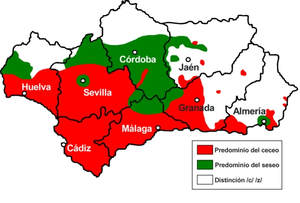
/θeˈθeo/. In still other areas, the distinction is retained (distinción). Ceceo predominates in more southerly parts of Andalusia, including CádizCádiz (province)Cádiz is a province of southern Spain, in the southwestern part of the autonomous community of Andalusia, the southernmost part of continental Western Europe....
, southern HuelvaHuelva (province)Huelva is a province of southern Spain, in the western part of the autonomous community of Andalusia. It is bordered by Portugal, the provinces of Badajoz, Seville, and Cádiz, and the Atlantic Ocean. Its capital is Huelva....
, most of MálagaMálaga (province)The Province of Málaga is located on the southern coast of Spain, in the Autonomous Community of Andalusia. It is bordered by the Mediterranean Sea to the South, and by the provinces of Cádiz, Sevilla, Córdoba and Granada.Its area is 7,308 km²...
and SevilleSeville (province)Seville is a province of southern Spain, in the western part of the autonomous community of Andalusia. It is bordered by the provinces of Málaga, Cádiz, Huelva, Badajoz, and Córdoba.Its area is 14,042 km²...
(except the northern parts of both provinces and the city of SevilleSevilleSeville is the artistic, historic, cultural, and financial capital of southern Spain. It is the capital of the autonomous community of Andalusia and of the province of Seville. It is situated on the plain of the River Guadalquivir, with an average elevation of above sea level...
) and south-western GranadaGranada (province)Granada is a province of southern Spain, in the eastern part of the autonomous community of Andalusia. It is bordered by the provinces of Albacete, Murcia, Almería, Jaén, Córdoba, Málaga, and the Mediterranean Sea . Its capital city is also called Granada.The province covers an area of 12,635 km²...
. A common stereotype about ceceo is that it is mostly found in backward rural areas, but the predominance of ceceo in major cities such as MálagaMálagaMálaga is a city and a municipality in the Autonomous Community of Andalusia, Spain. With a population of 568,507 in 2010, it is the second most populous city of Andalusia and the sixth largest in Spain. This is the southernmost large city in Europe...
, HuelvaHuelvaHuelva is a city in southwestern Spain, the capital of the province of Huelva in the autonomous region of Andalusia. It is located along the Gulf of Cadiz coast, at the confluence of the Odiel and Tinto rivers. According to the 2010 census, the city has a population of 149,410 inhabitants. The...
and GranadaGranadaGranada is a city and the capital of the province of Granada, in the autonomous community of Andalusia, Spain. Granada is located at the foot of the Sierra Nevada mountains, at the confluence of three rivers, the Beiro, the Darro and the Genil. It sits at an elevation of 738 metres above sea...
(where, on the other hand one can also find distinción, depending on the neighbourhood) are enough proof to refute this. Seseo predominates in Córdoba, northern Seville and Málaga and western Huelva. Interestingly, the cities of Seville and CádizCádizCadiz is a city and port in southwestern Spain. It is the capital of the homonymous province, one of eight which make up the autonomous community of Andalusia....
are seseante, but entirely surrounded by ceceo areas; Cádiz city is very unusual in that it is the only area in the entire province of Cádiz, along with San Fernando (La Isla de León), that is not ceceante. Distinción is mostly found in AlmeríaAlmería (province)-History:The rich customs and Fiestas of the denizens retain links deep into the past, unto the Moors, the Romans, the Greeks, and the Phoenicians.During the taifa era, it was ruled by the Moor Banu al-Amiri from 1012 to 1038, briefly annexed by Valencia , then given by Zaragoza to the Banu Sumadih...
, eastern Granada, Jaén, and the northern parts of Córdoba and Huelva. See map above for a detailed description of these zones. Outside Andalusia, seseo also existed in parts of ExtremaduraExtremaduraExtremadura is an autonomous community of western Spain whose capital city is Mérida. Its component provinces are Cáceres and Badajoz. It is bordered by Portugal to the west...
and MurciaRegion of MurciaThe Region of Murcia is an autonomous community of Spain located in the southeast of the country, between Andalusia and Valencian Community, on the Mediterranean coast....
up to at least 1940. The standard distinction which predominates in Eastern Andalusia is now to be heard in many cultivated speakers of the West, especially among younger speakers in urban areas or in monitored speech. The influence of media and school is now strong in Andalusia and this is eroding traditional seseo and ceceo. - YeísmoYeísmoYeísmo is a distinctive feature of many dialects of the Spanish language, which consists of the loss of the traditional palatal lateral approximant phoneme and its merger into the phoneme , usually realized as a palatal fricative or affricate. In other words, ‹ll› and ‹y› represent the same sound...
, that is the merging of /ʎ/ into /ʝ/, is general in most of Andalusia. In Western Andalusian, /ʝ/ is an affricate ɟʝ in all instances, whereas in standard Spanish this realization only occurs word-initially and after a pause. - Intervocalic /d/ is elidedElisionElision is the omission of one or more sounds in a word or phrase, producing a result that is easier for the speaker to pronounce...
in most intances, for example *pesao for pesado ('heavy'), *a menúo for a menudo ('often'). This is especially common in the past participle; e.g. he acabado becomes *he acabao ('I have finished'). For the -ado suffix, this feature is common to all peninsular variants of Spanish, while in other positions it is widespread throughout most of the southern half of Spain. This is the continuation of the tendency of lenitionLenitionIn linguistics, lenition is a kind of sound change that alters consonants, making them "weaker" in some way. The word lenition itself means "softening" or "weakening" . Lenition can happen both synchronically and diachronically...
in Vulgar Latin which developed into the Romance languages. Compare Latin [ˈwiːta], Italian vita [ˈvita], Brazilian Portuguese vida [ˈvidɐ] with a fully occlusive [d], European Portuguese vida [ˈviðɐ], Castilian Spanish vida [ˈbiða] with an interdental [ð] (as in English ‹th› in "this") and French vie [vi], where the /d/ is elided as in Andalusian (vida [ˈbi.a] 'life'). - Similarly, intervocalic /ɾ/ is also elided, although this tends to occur only in certain environments. For example, parece becomes *paece ('it appears'), quieres becomes *quies ('you want') and padre and madre may sometimes *pae and *mae ('father' and 'mother', respectively). This feature can be heard in many other parts of Spain, too (such as para → *pa 'for').
- Obstruents (/b/, /d/, /g/, /p/, /t/, /k/, /f/, /s/, /x/, /θ/) and sonorants (/r/, /m/, /n/) often assimilate the place of articulation of the following consonant producing geminationGeminationIn phonetics, gemination happens when a spoken consonant is pronounced for an audibly longer period of time than a short consonant. Gemination is distinct from stress and may appear independently of it....
(or aspirationDebuccalizationDebuccalization is a sound change in which a consonant loses its original place of articulation and becomes or . The pronunciation of a consonant as is sometimes called aspiration, but in phonetics aspiration is the burst of air accompanying a plosive...
); e.g. perla [ˈpe̞hla]~[ˈpe̞lːa] ('pearl'), carne [ˈkahne̞]~[ˈkãnːe̞] ('meat'), adquirí [ahkiˈɾi]~[akːiˈɾi] ('I acquired'), mismo [ˈmihmo̞]~[ˈmĩmːo̞]] ('same'), desde [ˈdɛhðe̞]~[ˈdɛθːe̞] ('from'), rasgos [ˈrahɣɔh]~[ˈræ̞xːɔ] ('traits'). In Andalusian and Murcian Spanish syllable-final /s/ is very unstable; often assimilated to ɸ before /b/ (/sb/ → [hβ] → [hɸ] → [ɸː]), as in desbaratar → *effaratar [ɛhɸaɾaˈta]~[ɛɸːaɾaˈta] ('to ruin, to disrupt') or to ɹ (where ceceoCeceoIn Spanish dialectology, the terms distinción, seseo and ceceo are used to describe the opposition between dialects that distinguish the phonemes and , and those that exhibit merger of the two sounds into either or .Dialects that distinguish the two sounds, and thus pronounce the words casa...
or distinción occur) before /θ/ (/sθ/ → [ɹθ]), as in ascensor [aɹθẽ̞nˈso̞] ('lift'). - Utterance-final /s/, /x/ and /θ/ (where ceceoCeceoIn Spanish dialectology, the terms distinción, seseo and ceceo are used to describe the opposition between dialects that distinguish the phonemes and , and those that exhibit merger of the two sounds into either or .Dialects that distinguish the two sounds, and thus pronounce the words casa...
or distinción occur) are usually aspirated or just omitted. In Eastern Andalusian dialects, including also Murcian SpanishMurcian SpanishMurciano, more popularly known as panocho, is a variant of the Peninsular Spanish, spoken mainly in autonomous region of Murcia and the adjacent Comarca of Vega Baja del Segura in the province of Alicante on the Mediterranean coast.It is considered a southern dialect of the Spanish language,...
, the previous vowel is also lowered. Thus, in these varieties one distinguishes la casa [la ˈkasa] ('the house') and las casas [læ̞(k) ˈkæ̞sæ̞] ('the houses') by a final omitted /s/ and open vowels, whereas northern Spanish speakers would have [s] and [θ] and closed vowels. As a result, these varieties have 5 tense vowels (roughly the same as in northern Spanish); [a], [e̞], [i], [o̞], [u] plus 5 allophonic open vowels; [æ̞], [ɛ], [i̞], [ɔ], [u̞]. In addition to this, a process of vowel harmonyVowel harmonyVowel harmony is a type of long-distance assimilatory phonological process involving vowels that occurs in some languages. In languages with vowel harmony, there are constraints on which vowels may be found near each other....
may take place where tense vowels that precede a lax vowel may become lax themselves; e.g. trébol [ˈtɾe̞βo̞l] ('clover, club') vs tréboles [ˈtɾɛβɔlɛ] ('clovers, clubs'). S-aspiration is general in all of the southern half of Spain, and now becoming common in the northern half too. - As in standard Spanish, phonetic vowel nasalization occurs for vowels occurring between nasal consonants or when preceding a syllable-final nasal. However, contrary to standard Spanish (where syllable-final nasal consonants are retained), in Andalusian varieties utterance-final nasalsNasal consonantA nasal consonant is a type of consonant produced with a lowered velum in the mouth, allowing air to escape freely through the nose. Examples of nasal consonants in English are and , in words such as nose and mouth.- Definition :...
are often lost; e.g. bien [ˈbjẽ̞] ('good'). - In many instances final consonants are dropped. This does not cause the previous vowel to lower; e.g. [ko̞ˈme̞] ('to eat'), [ko̞me̞rˈθja] or [ko̞me̞rˈsja] ('commercial'), pared [paˈɾe̞] ('wall'). This often gives rise to a situation where two different words sound exactly the same, as with the infinitiveInfinitiveIn grammar, infinitive is the name for certain verb forms that exist in many languages. In the usual description of English, the infinitive of a verb is its basic form with or without the particle to: therefore, do and to do, be and to be, and so on are infinitives...
cortar ('to cut'), the imperativeImperative moodThe imperative mood expresses commands or requests as a grammatical mood. These commands or requests urge the audience to act a certain way. It also may signal a prohibition, permission, or any other kind of exhortation.- Morphology :...
¡cortad! ('cut [it]!') and the feminine past participle cortada, ('[a] cut thing'); which are all pronounced [ko̞rˈta]. The geographical extent of this consonant drop is variable, and in some cases, like final ‹d›, common to most of Spain. is deaffricated to [ʃ] in Western Andalusia, including cities like SevilleSevilleSeville is the artistic, historic, cultural, and financial capital of southern Spain. It is the capital of the autonomous community of Andalusia and of the province of Seville. It is situated on the plain of the River Guadalquivir, with an average elevation of above sea level...
and CádizCádizCadiz is a city and port in southwestern Spain. It is the capital of the homonymous province, one of eight which make up the autonomous community of Andalusia....
; e.g. escucha [ɛˈkuʃa] ('s/he listens'). may be pronounced as /r/RhotacismRhotacism refers to several phenomena related to the usage of the consonant r :*the excessive or idiosyncratic use of the r;...
in syllable-final position, as in [ˈarma] instead of [ˈalma] for alma ('soul') or [e̞r] instead of [e̞l] for el ('the'). The opposite may also happen; i.e. /r/ becomes /l/ (e.g. sartén [salˈtẽ̞] 'frying pan'). is usually pronounced [h] except in some eastern Andalusian subvarieties (i.e. Jaén, GranadaGranada (province)Granada is a province of southern Spain, in the eastern part of the autonomous community of Andalusia. It is bordered by the provinces of Albacete, Murcia, Almería, Jaén, Córdoba, Málaga, and the Mediterranean Sea . Its capital city is also called Granada.The province covers an area of 12,635 km²...
, AlmeríaAlmería (province)-History:The rich customs and Fiestas of the denizens retain links deep into the past, unto the Moors, the Romans, the Greeks, and the Phoenicians.During the taifa era, it was ruled by the Moor Banu al-Amiri from 1012 to 1038, briefly annexed by Valencia , then given by Zaragoza to the Banu Sumadih...
provinces), where the dorsal [x] is retained. This also happens in most of ExtremaduraExtremaduraExtremadura is an autonomous community of western Spain whose capital city is Mérida. Its component provinces are Cáceres and Badajoz. It is bordered by Portugal to the west...
and parts of CantabriaCantabriaCantabria is a Spanish historical region and autonomous community with Santander as its capital city. It is bordered on the east by the Basque Autonomous Community , on the south by Castile and León , on the west by the Principality of Asturias, and on the north by the Cantabrian Sea.Cantabria...
. - Before [h] (Western Andalusian), /r/ can be pronounced in two ways: it may be elided, thus leaving only the [h] or it may be retained, intensifying the aspirated sound of the [h]. Thus, virgen ('virgin') becomes either [ˈbihẽ̞] or [ˈbirhẽ̞].
- Words of Latin origin starting with ‹h› (originally ‹›) in writing (that is, that have kept the etymological ‹h› in writing) are sometimes pronounced with an initial [h] sound; e.g. Latin 'stuffed, full' → harto [ˈharto̞] (standard Spanish [ˈarto̞] 'fed up'). This also occurs in the speech of ExtremaduraExtremaduraExtremadura is an autonomous community of western Spain whose capital city is Mérida. Its component provinces are Cáceres and Badajoz. It is bordered by Portugal to the west...
. However, this characteristic is limited to rural areas and the flamencoFlamencoFlamenco is a genre of music and dance which has its foundation in Andalusian music and dance and in whose evolution Andalusian Gypsies played an important part....
culture.
Morphology and syntax
- Many Andalusian speakers (especially in western parts) replace the informal second person plural vosotros with the (in other parts of Spain) more formal ustedes, often mixing the pronoun ustedes with the vosotros form of the verb. For example, the standard second person plural verb forms for ir ('to go') are vosotros vais (informal) and ustedes van (formal), but in Andalusian one often hears ustedes vais for the informal version.
- The standard form of imperative, second person plural with a reflexive pronoun (vosotros) is -aos, or -aros in informal speech, whereas in Andalusian, and other dialects, too, -se is used instead, so ¡callaos ya! / ¡callaros ya! ('shut up!') becomes ¡callarse ya! and ¡sentaos! / ¡sentaros! ('sit down!') becomes ¡sentarse!.
- The genderGrammatical genderGrammatical gender is defined linguistically as a system of classes of nouns which trigger specific types of inflections in associated words, such as adjectives, verbs and others. For a system of noun classes to be a gender system, every noun must belong to one of the classes and there should be...
of some words may not match that of Standard Spanish, e.g. la calor not el calor ('the heat'), el chinche not la chinche ('the bedbug').
Lexicon
Many words of Mozarabic, RomaniCaló (Spanish Romani)
Caló is a language spoken by the Spanish and Portuguese Romani. It is a mixed language based on Romance grammar, with an adstratum of Romani lexical items through language shift by the Romani community. It is often used as an argot, a secret language for discreet communication amongst Iberian...
and Old Castilian origin occur in Andalusian which are not found in other dialects in Spain (but many of these may occur in South American dialects due to the greater influence of Andalusian there). For example: chispenear instead of standard lloviznar or chispear ('to drizzle'), babucha instead of zapatilla ('slipper'), chavea or antié for anteayer ('the day before yesterday').
Many words of Andalusi Arabic
Andalusi Arabic
Andalusian Arabic was a variety of the Arabic language spoken in Al-Andalus, the regions of the Iberian Peninsula under Muslim rule...
origin that have become archaisms or unknown in general Spanish can be found, together with multitude of sayings: eg. haciendo morisquetas (from the word morisco
Morisco
Moriscos or Mouriscos , meaning "Moorish", were the converted Christian inhabitants of Spain and Portugal of Muslim heritage. Over time the term was used in a pejorative sense applied to those nominal Catholics who were suspected of secretly practicing Islam.-Demographics:By the beginning of the...
, meaning pulling faces and gesticulating, historically associated with Muslim prayers). There are some doublets of Arabic-Latinate synonyms with the Arabic
Arabic language
Arabic is a name applied to the descendants of the Classical Arabic language of the 6th century AD, used most prominently in the Quran, the Islamic Holy Book...
form being more common in Andalusian like Andalusian alcoba for standard habitación or dormitorio ('bedroom') or alhaja for standard joya ('jewel').
Influence
Some words pronounced in the Andalusian way have entered general Spanish with a specific meaning.Examples are juerga ("debauchery", or "partying") that is the Andalusian pronunciation of huelga (originally "period without work", now "work strike
Strike action
Strike action, also called labour strike, on strike, greve , or simply strike, is a work stoppage caused by the mass refusal of employees to work. A strike usually takes place in response to employee grievances. Strikes became important during the industrial revolution, when mass labour became...
").
The Flamenco
Flamenco
Flamenco is a genre of music and dance which has its foundation in Andalusian music and dance and in whose evolution Andalusian Gypsies played an important part....
lexicon incorporates many Andalusisms: cantaor, tocaor, bailaor which is another example of the dropped "d", example "cantador" becomes "cantaor" (where the same non-Flamenco-specific terms are cantante, músico, bailarín). Note that, when referring to the Flamenco terms, the correct spelling drops the "d" (a Flamenco cantaor is written this way, not cantador).
In another cases, the dropped "d" may also be included as a real word. An example occurs with "pescaíto frito" (little fried fish), which in Standard Spanish is spelled "pescadito frito". However, the word is written without the "d" in many parts of Spain, but only when referring to the Andalusian version (in Andalusia, fried fish is really popular).
Llanito
Llanito
Llanito or Yanito is an Andalusian Spanish based creole spoken in the British overseas territory of Gibraltar. It consists of an eclectic mix of Andalusian Spanish and British English, marked by a great deal of code switching and loanwords from many other Mediterranean languages.Gibraltarians also...
, the vernacular
Vernacular
A vernacular is the native language or native dialect of a specific population, as opposed to a language of wider communication that is not native to the population, such as a national language or lingua franca.- Etymology :The term is not a recent one...
of the British overseas territory of Gibraltar
Gibraltar
Gibraltar is a British overseas territory located on the southern end of the Iberian Peninsula at the entrance of the Mediterranean. A peninsula with an area of , it has a northern border with Andalusia, Spain. The Rock of Gibraltar is the major landmark of the region...
, mainly originates from British English
British English
British English, or English , is the broad term used to distinguish the forms of the English language used in the United Kingdom from forms used elsewhere...
and Andalusian among others.
See also
- Norma Ortográfica Andaluza (Andalusian spelling norm)
- Standard SpanishStandard SpanishStandard Spanish or neutral Spanish is a linguistic variety, or lect, that is considered a correct educated standard for the Spanish language. Standard Spanish is not merely Spanish adjusted to fit in prescriptive molds dictated by a linguistic overseeing authority, but also a form of language that...
- Spanish dialects and varietiesSpanish dialects and varietiesSpanish dialects and varieties are the regional variants of the Spanish language, some of which are quite divergent from one another, especially in pronunciation and vocabulary, and less so in grammar....
- CastúoCastúoCastúo is the generic name for the dialects of Spanish spoken in the autonomous community of Extremadura, in Spain.-Phonological characteristics:...
- The cant Caló is pronounced with Andalusian phonetics among Andalusian Gipsies.
External links
- Isogloss maps of phonetic variants in the Iberian Peninsula
- Ariza, Manuel: Lingüística e historia de Andalucía
- Gomez Solis, Felipe: Contribucion a las Historia Linguistica de Andalucia: Cordoba.
- Morillo-Velarde Pérez, Ramon: "Un modelo de variación sintáctica dialectal: El demostrativo de realce en el andaluz".
Further reading
- Ropero Núñez, Miguel (1992): "Un aspecto de lexicología histórica marginado: los préstamos del caló" (en Cervantes Virtual)
- Alvar, Manuel: A vueltas con el seseo y el ceceo (Alicante)
- Guitarte, Guillermo L. (1992): "Cecear y palabras afines" (en Cervantes Virtual)