

Aliasing

Encyclopedia

Signal processing
Signal processing is an area of systems engineering, electrical engineering and applied mathematics that deals with operations on or analysis of signals, in either discrete or continuous time...
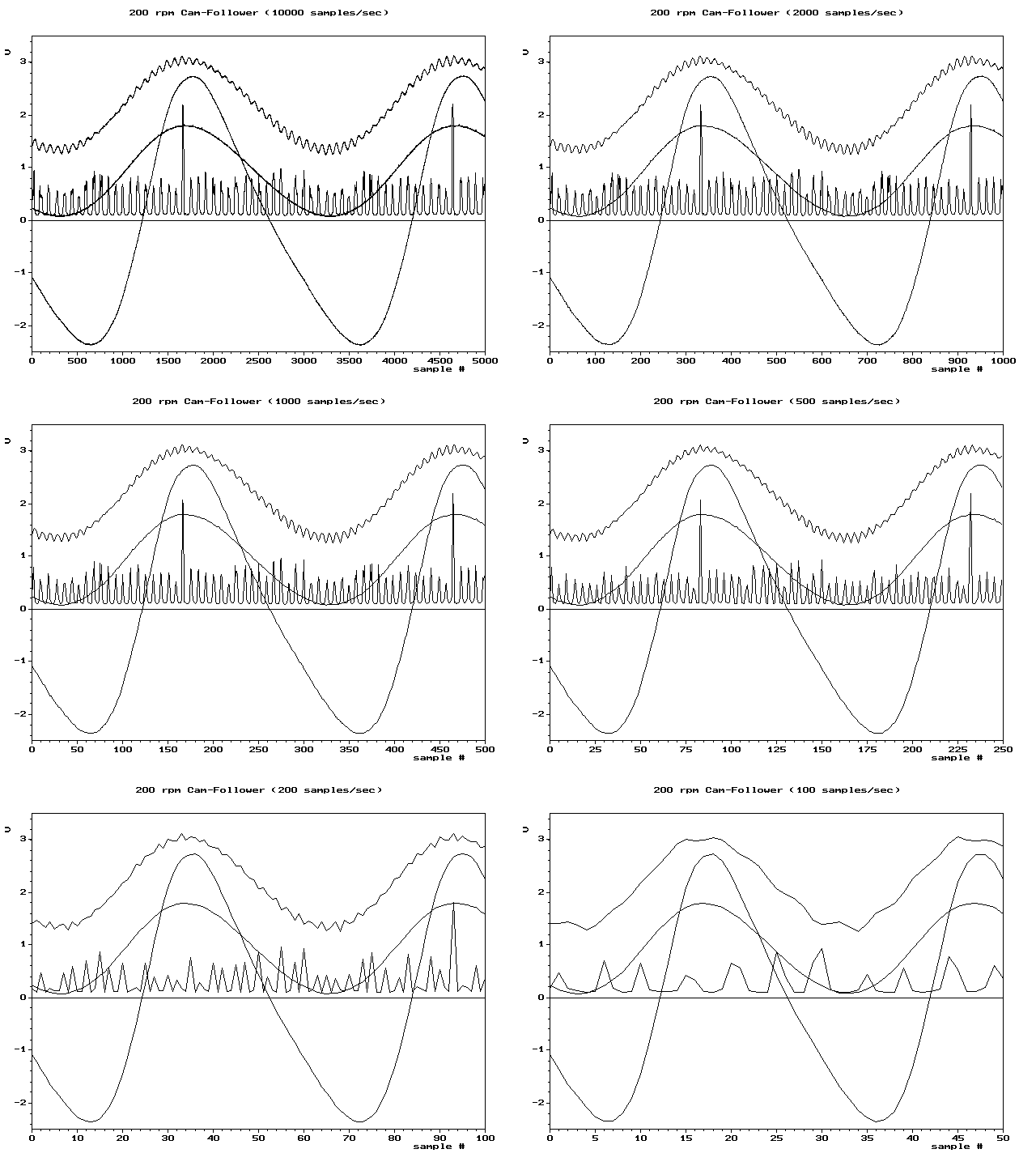
and related disciplines, aliasing refers to an effect that causes different signals to become indistinguishable (or aliases of one another) when sampled
Sampling (signal processing)
In signal processing, sampling is the reduction of a continuous signal to a discrete signal. A common example is the conversion of a sound wave to a sequence of samples ....
. It also refers to the distortion
Distortion
A distortion is the alteration of the original shape of an object, image, sound, waveform or other form of information or representation. Distortion is usually unwanted, and often many methods are employed to minimize it in practice...
or artifact
Artifact (error)
In natural science and signal processing, an artifact is any error in the perception or representation of any visual or aural information introduced by the involved equipment or technique....
that results when the signal reconstructed from samples is different from the original continuous signal.
Description
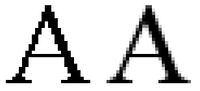
Image resolution
Image resolution is an umbrella term that describes the detail an image holds. The term applies to raster digital images, film images, and other types of images. Higher resolution means more image detail....
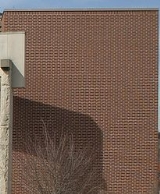
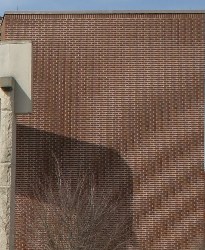
is too low, the reconstructed image will differ from the original image, and an alias is seen. An example of spatial aliasing is the Moiré pattern
Moiré pattern
In physics, a moiré pattern is an interference pattern created, for example, when two grids are overlaid at an angle, or when they have slightly different mesh sizes.- Etymology :...
one can observe in a poorly pixelized image of a brick wall. Techniques that avoid such poor pixelizations are called anti-aliasing
Anti-aliasing
In digital signal processing, spatial anti-aliasing is the technique of minimizing the distortion artifacts known as aliasing when representing a high-resolution image at a lower resolution...
. Aliasing can be caused either by the sampling stage or the reconstruction stage; these may be distinguished by calling sampling aliasing prealiasing and reconstruction aliasing postaliasing.
Temporal aliasing is a major concern in the sampling of video
Video
Video is the technology of electronically capturing, recording, processing, storing, transmitting, and reconstructing a sequence of still images representing scenes in motion.- History :...
and audio signals. Music, for instance, may contain high-frequency components that are inaudible to humans. If a piece of music is sampled at 32000 samples per second
Sampling rate
The sampling rate, sample rate, or sampling frequency defines the number of samples per unit of time taken from a continuous signal to make a discrete signal. For time-domain signals, the unit for sampling rate is hertz , sometimes noted as Sa/s...
(sps), any frequency components above 16000 Hz
Hertz
The hertz is the SI unit of frequency defined as the number of cycles per second of a periodic phenomenon. One of its most common uses is the description of the sine wave, particularly those used in radio and audio applications....
(the Nyquist frequency
Nyquist frequency
The Nyquist frequency, named after the Swedish-American engineer Harry Nyquist or the Nyquist–Shannon sampling theorem, is half the sampling frequency of a discrete signal processing system...
) will cause aliasing when the music is reproduced by a digital to analog converter (DAC). To prevent that, it is customary to remove components above the Nyquist frequency (with an anti-aliasing filter
Anti-aliasing
In digital signal processing, spatial anti-aliasing is the technique of minimizing the distortion artifacts known as aliasing when representing a high-resolution image at a lower resolution...
) prior to sampling. But any realistic filter or DAC will also affect (attenuate) the components just below the Nyquist frequency. Therefore, it is also customary to choose a higher Nyquist frequency by sampling faster (typically 44100 sps (CD
Compact Disc
The Compact Disc is an optical disc used to store digital data. It was originally developed to store and playback sound recordings exclusively, but later expanded to encompass data storage , write-once audio and data storage , rewritable media , Video Compact Discs , Super Video Compact Discs ,...
), 48000 (professional audio
Professional audio
Professional audio, also 'pro audio', refers to both an activity and a type of audio equipment. Typically it encompasses the production or reproduction of sound for an audience, by individuals who do such work as an occupation like live event support, using sound reinforcement systems designed for...
), or 96000 (high definition audio)).
In video or cinematography, temporal aliasing results from the limited frame rate, and causes the wagon-wheel effect
Wagon-wheel effect
The wagon-wheel effect is an optical illusion in which a spoked wheel appears to rotate differently from its true rotation. The wheel can appear to rotate more slowly than the true rotation, it can appear stationary, or it can appear to rotate in the opposite direction from the true rotation...
, whereby a spoked wheel appears to rotate too slowly or even backwards. Aliasing has changed its apparent frequency of rotation. A reversal of direction can be described as a negative frequency
Negative frequency
The concept of negative and positive frequency can be as simple as a wheel rotating one way or the other way. A signed value of frequency indicates both the rate and direction of rotation...
. Temporal aliasing frequencies in video and cinematography are determined by the frame rate of the camera, but the relative intensity of the aliased frequencies is determined by the shutter timing (exposure time) or the use of a temporal aliasing reduction filter during filming.
Like the video camera, most sampling schemes are periodic; that is they have a characteristic sampling frequency in time or in space. Digital cameras provide a certain number of samples (pixel
Pixel
In digital imaging, a pixel, or pel, is a single point in a raster image, or the smallest addressable screen element in a display device; it is the smallest unit of picture that can be represented or controlled....
s) per degree or per radian, or samples per mm in the focal plane of the camera. Audio signals are sampled (digitized) with an analog-to-digital converter
Analog-to-digital converter
An analog-to-digital converter is a device that converts a continuous quantity to a discrete time digital representation. An ADC may also provide an isolated measurement...
, which produces a constant number of samples per second. Some of the most dramatic and subtle examples of aliasing occur when the signal being sampled also has periodic content.
Bandlimited functions
Actual signals have finite duration and their frequency content, as defined by the Fourier transform, has no upper bound. Some amount of aliasing always occurs when such functions are sampled. Functions whose frequency content is bounded (bandlimited) have infinite duration. If sampled at a high enough rate, determined by the bandwidth, the original function can in theory be perfectly reconstructed from the infinite set of samples.Bandpass signals
Sometimes aliasing is used intentionally on signals with no low-frequency content, called bandpass signals. UndersamplingUndersampling
In signal processing, undersampling or bandpass sampling is a technique where one samples a bandpass filtered signal at a sample rate below the usual Nyquist rate In signal processing, undersampling or bandpass sampling is a technique where one samples a bandpass filtered signal at a sample rate...
, which creates low-frequency aliases, can produce the same result, with less effort, as frequency-shifting the signal to lower frequencies before sampling at the lower rate. Some digital channelizers
exploit aliasing in this way for computational efficiency. See Sampling (signal processing) and Nyquist rate (relative to sampling).
Sampling sinusoidal functions
Sinusoids are an important type of periodic function, because realistic signals are often modeled as the summation of many sinusoids of different frequencies and different amplitudes (with a Fourier seriesFourier series
In mathematics, a Fourier series decomposes periodic functions or periodic signals into the sum of a set of simple oscillating functions, namely sines and cosines...
or transform
Fourier transform
In mathematics, Fourier analysis is a subject area which grew from the study of Fourier series. The subject began with the study of the way general functions may be represented by sums of simpler trigonometric functions...
). Understanding what aliasing does to the individual sinusoids is useful in understanding what happens to their sum.

 . For instance, if the interval is 1 second, the rate is 1 sample per second. Nine cycles of the red sinusoid and 1 cycle of the blue sinusoid span an interval of 10. The respective sinusoid frequencies are
  = 0.9 and
  = 0.1.
In general, when a sinusoid of frequency
 is sampled with frequency
  the resulting samples are indistinguishable from those of another sinusoid of frequency
  for any integer
  (with
(with  being the actual signal frequency). Most reconstruction techniques produce the minimum of these frequencies, so it is often important that
  be the unique minimum. A sufficient condition for that is
  where
where  is commonly called the Nyquist frequency
Nyquist frequency
The Nyquist frequency, named after the Swedish-American engineer Harry Nyquist or the Nyquist–Shannon sampling theorem, is half the sampling frequency of a discrete signal processing system...
of a system that samples at rate
 .
.In our graphic example, the Nyquist condition is satisfied if the original signal is the blue sinusoid (
 ). But if
  the lowest image frequency is:
-

- A reconstruction technique that constructs the lowest possible frequency from the samples will reproduce the blue sinusoid instead of the red one.
- We note that
 is also an image frequency, but since there is no way to distinguish a sinusoid of frequency
  from one of frequency
  all aliases can be described in terms of just positive frequencies.
Sample frequency
 is met for the highest frequency component of the original signal, then it is met for all the frequency components, a condition known as the Nyquist criterion
Nyquist–Shannon sampling theorem
The Nyquist–Shannon sampling theorem, after Harry Nyquist and Claude Shannon, is a fundamental result in the field of information theory, in particular telecommunications and signal processing. Sampling is the process of converting a signal into a numeric sequence...
. That is typically approximated by filtering the original signal to attenuate high frequency components before it is sampled. They still generate low-frequency aliases, but at very low amplitude levels, so as not to cause a problem. A filter chosen in anticipation of a certain sample frequency is called an anti-aliasing filter
Anti-aliasing filter
An anti-aliasing filter is a filter used before a signal sampler, to restrict the bandwidth of a signal to approximately satisfy the sampling theorem....
. The filtered signal can subsequently be reconstructed without significant additional distortion, for example by the Whittaker–Shannon interpolation formula
Whittaker–Shannon interpolation formula
The Whittaker–Shannon interpolation formula or sinc interpolation is a method to reconstruct a continuous-time bandlimited signal from a set of equally spaced samples.-Definition:...
.
The Nyquist criterion presumes that the frequency content of the signal being sampled has an upper bound. Implicit in that assumption is that the signal's duration has no upper bound. Similarly, the Whittaker–Shannon interpolation formula represents an interpolation filter with an unrealizable frequency response. These assumptions make up a mathematical model that is an idealized approximation, at best, to any realistic situation. The conclusion, that perfect reconstruction is possible, is mathematically correct for the model, but only an approximation for real samples of a real signal.
Complex signal representation
Complex signals are signals whose samples are complex numbers, and the concept of negative frequencyNegative frequency
The concept of negative and positive frequency can be as simple as a wheel rotating one way or the other way. A signed value of frequency indicates both the rate and direction of rotation...
is necessary for such signals. In that case, the frequencies of the aliases are given by just:
 Therefore, as
  increases from
  to
to  the image closest to 0 moves from
  up to 0.
Folding
Real-valued sinusoids have the same negative-frequency aliases as complex ones. The absolute value operator, is introduced because there is always an equivalent sinusoid with a positive frequency. Therefore, as ƒ increases from 0 to ƒs/2, the image at frequency
  moves from ƒs to ƒs/2. Similarly, as ƒ increases from ƒs/2 to ƒs,
  continues decreasing from ƒs/2 to 0.
A graph of amplitude vs frequency for a single sinusoid at frequency 0.6ƒs and some of its aliases at 0.4ƒs, 1.4ƒs, and 1.6ƒs would look like the 4 black dots in the adjacent figure. The red lines depict the paths (loci) of the 4 dots if we were to adjust the frequency and amplitude of the sinusoid along the solid red segment (between ƒs/2 and ƒs). No matter what function we choose to change the amplitude vs frequency, the graph will exhibit symmetry between 0 and ƒs. This symmetry is commonly referred to as folding, and another name for ƒs/2 (the Nyquist frequency) is folding frequency. Folding is most often observed in practice when viewing the frequency spectrum of real-valued, sampled signals.
Historical usage
Historically the term aliasing evolved from radio engineering because of the action of superheterodyne receiverSuperheterodyne receiver
In electronics, a superheterodyne receiver uses frequency mixing or heterodyning to convert a received signal to a fixed intermediate frequency, which can be more conveniently processed than the original radio carrier frequency...
s. When the receiver shifts multiple signals down to lower frequencies, from RF
Radio frequency
Radio frequency is a rate of oscillation in the range of about 3 kHz to 300 GHz, which corresponds to the frequency of radio waves, and the alternating currents which carry radio signals...
to IF
Intermediate frequency
In communications and electronic engineering, an intermediate frequency is a frequency to which a carrier frequency is shifted as an intermediate step in transmission or reception. The intermediate frequency is created by mixing the carrier signal with a local oscillator signal in a process called...
by heterodyning
Heterodyne
Heterodyning is a radio signal processing technique invented in 1901 by Canadian inventor-engineer Reginald Fessenden where high frequency signals are converted to lower frequencies by combining two frequencies. Heterodyning is useful for frequency shifting information of interest into a useful...
, an unwanted signal, from an RF frequency equally far from the local oscillator
Local oscillator
A local oscillator is an electronic device used to generate a signal normally for the purpose of converting a signal of interest to a different frequency using a mixer. This process of frequency conversion, also referred to as heterodyning, produces the sum and difference frequencies of the...
(LO) frequency as the desired signal, but on the wrong side of the LO, can end up at the same IF frequency as the wanted one. If it is strong enough it can interfere with reception of the desired signal. This unwanted signal is known as an image or alias of the desired signal.
Angular aliasing
Aliasing occurs whenever the use of discrete elements to capture or produce a continuous signal causes frequency ambiguity.Spatial aliasing, particular of angular frequency, can occur when reproducing a light field
Light field
The light field is a function that describes the amount of light faring in every direction through every point in space. Michael Faraday was the first to propose that light should be interpreted as a field, much like the magnetic fields on which he had been working for several years...
or sound field with discrete elements, as in 3D display
3D display
A 3D display is any display device capable of conveying a stereoscopic perception of 3-D depth to the viewer. The basic requirement is to present offset images that are displayed separately to the left and right eye. Both of these 2-D offset images are then combined in the brain to give the...
s or wave field synthesis
Wave field synthesis
Wave field synthesis is a spatial audio rendering technique, characterized by creation of virtual acoustic environments. It produces "artificial" wave fronts synthesized by a large number of individually driven speakers. Such wave fronts seem to originate from a virtual starting point, the virtual...
of sound.
This aliasing is visible in images such as posters with lenticular printing
Lenticular printing
Lenticular printing is a technology in which a lenticular lens is used to produce images with an illusion of depth, or the ability to change or move as the image is viewed from different angles...
: if they have low angular resolution, then as one moves past them, say from left-to-right, the 2D image does not initially change (so it appears to move left), then as one moves to the next angular image, the image suddenly changes (so it jumps right) – and the frequency and amplitude of this side-to-side movement corresponds to the angular resolution of the image (and, for frequency, the speed of the viewer's lateral movement), which is the angular aliasing of the 4D light field.
The lack of parallax
Parallax
Parallax is a displacement or difference in the apparent position of an object viewed along two different lines of sight, and is measured by the angle or semi-angle of inclination between those two lines. The term is derived from the Greek παράλλαξις , meaning "alteration"...
on viewer movement in 2D images and in 3-D film
3-D film
A 3-D film or S3D film is a motion picture that enhances the illusion of depth perception...
produced by stereoscopic
Stereoscopy
Stereoscopy refers to a technique for creating or enhancing the illusion of depth in an image by presenting two offset images separately to the left and right eye of the viewer. Both of these 2-D offset images are then combined in the brain to give the perception of 3-D depth...
glasses (in 3D films the effect is called "yaw
Yaw
The word yaw can refer to:* Yaw angle, one of the Tait-Bryan angles, describing the heading of a vehicle or machine, and some other related elements:**Yaw system, component responsible for the orientation of a wind turbine towards the wind....
ing", as the image appears to rotate on its axis) can similarly be seen as loss of angular resolution, all angular frequencies being aliased to 0 (constant).
Online "live" example
The qualitative effects of aliasing can be heard in the following audio demonstration. Six sawtooth waveSawtooth wave
The sawtooth wave is a kind of non-sinusoidal waveform. It is named a sawtooth based on its resemblance to the teeth on the blade of a saw....
s are played in succession, with the first two sawtooths having a fundamental frequency
Fundamental frequency
The fundamental frequency, often referred to simply as the fundamental and abbreviated f0, is defined as the lowest frequency of a periodic waveform. In terms of a superposition of sinusoids The fundamental frequency, often referred to simply as the fundamental and abbreviated f0, is defined as the...
of 440 Hz (A4), the second two having fundamental frequency of 880 Hz (A5), and the final two at 1760 Hz (A6). The sawtooths alternate between bandlimited
Bandlimited
Bandlimiting is the limiting of a deterministic or stochastic signal's Fourier transform or power spectral density to zero above a certain finite frequency...
(non-aliased) sawtooths and aliased sawtooths and the sampling rate is 22.05 kHz. The bandlimited sawtooths are synthesized from the sawtooth waveform's Fourier series
Fourier series
In mathematics, a Fourier series decomposes periodic functions or periodic signals into the sum of a set of simple oscillating functions, namely sines and cosines...
such that no harmonics above the Nyquist frequency
Nyquist frequency
The Nyquist frequency, named after the Swedish-American engineer Harry Nyquist or the Nyquist–Shannon sampling theorem, is half the sampling frequency of a discrete signal processing system...
are present.
The aliasing distortion in the lower frequencies is increasingly obvious with higher fundamental frequencies, and while the bandlimited sawtooth is still clear at 1760 Hz, the aliased sawtooth is degraded and harsh with a buzzing audible at frequencies lower than the fundamental.
Direction finding
A form of spatial aliasing can also occur in antenna arrays or microphone arrays used to estimate the direction of arrival of a wave signal, as in geophysical exploration by seismic waves. Waves must be sampled at more than two points per wavelengthWavelength
In physics, the wavelength of a sinusoidal wave is the spatial period of the wave—the distance over which the wave's shape repeats.It is usually determined by considering the distance between consecutive corresponding points of the same phase, such as crests, troughs, or zero crossings, and is a...
, or the wave arrival direction becomes ambiguous.
See also
- JaggiesJaggies"Jaggies" is the informal name for artifacts in raster images, most frequently from aliasing, which in turn is often caused by non-linear mixing effects producing high-frequency components and/or missing or poor anti-aliasing filtering prior to sampling....
- Kell factorKell factorThe Kell factor, named after RCA engineer Raymond D. Kell, is a parameter used to limit the bandwidth of a sampled image signal to avoid the appearance of beat frequency patterns when displaying the image in a discrete display devices, usually taken to be 0.7. The number was first measured in 1934...
- Sinc filterSinc filterIn signal processing, a sinc filter is an idealized filter that removes all frequency components above a given bandwidth, leaves the low frequencies alone, and has linear phase...
- Sinc function
- Stroboscopic effect
- Wagon-wheel effectWagon-wheel effectThe wagon-wheel effect is an optical illusion in which a spoked wheel appears to rotate differently from its true rotation. The wheel can appear to rotate more slowly than the true rotation, it can appear stationary, or it can appear to rotate in the opposite direction from the true rotation...
External links
- Frequency Aliasing Demonstration by Burton MacKenZie using stop frame animation and a clock.
- Your Calculator is Wrong Video from YouTubeYouTubeYouTube is a video-sharing website, created by three former PayPal employees in February 2005, on which users can upload, view and share videos....
, includes some information about aliasing toward the end.