


Analog-to-digital converter

Encyclopedia
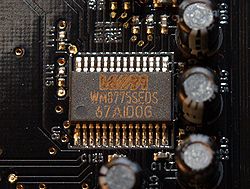
Continuous signal
A continuous signal or a continuous-time signal is a varying quantity whose domain, which is often time, is a continuum . That is, the function's domain is an uncountable set. The function itself need not be continuous...
to a discrete time
Discrete signal
A discrete signal or discrete-time signal is a time series consisting of a sequence of qualities...
digital
Digital
A digital system is a data technology that uses discrete values. By contrast, non-digital systems use a continuous range of values to represent information...
representation. An ADC may also provide an isolated measurement. The reverse operation is performed by a digital-to-analog converter
Digital-to-analog converter
In electronics, a digital-to-analog converter is a device that converts a digital code to an analog signal . An analog-to-digital converter performs the reverse operation...
(DAC).
Typically, an ADC is an electronic
Electronics
Electronics is the branch of science, engineering and technology that deals with electrical circuits involving active electrical components such as vacuum tubes, transistors, diodes and integrated circuits, and associated passive interconnection technologies...
device that converts an input analog voltage
Voltage
Voltage, otherwise known as electrical potential difference or electric tension is the difference in electric potential between two points — or the difference in electric potential energy per unit charge between two points...
or current
Electric current
Electric current is a flow of electric charge through a medium.This charge is typically carried by moving electrons in a conductor such as wire...
to a digital number proportional to the magnitude of the voltage or current. However, some non-electronic or only partially electronic devices, such as rotary encoder
Rotary encoder
A rotary encoder, also called a shaft encoder, is an electro-mechanical device that converts the angular position or motion of a shaft or axle to an analog or digital code. The output of incremental encoders provides information about the motion of the shaft which is typically further processed...
s, can also be considered ADCs.
The digital output may use different coding schemes. Typically the digital output will be a two's complement
Two's complement
The two's complement of a binary number is defined as the value obtained by subtracting the number from a large power of two...
binary number that is proportional to the input, but there are other possibilities. An encoder, for example, might output a Gray code
Gray code
The reflected binary code, also known as Gray code after Frank Gray, is a binary numeral system where two successive values differ in only one bit. It is a non-weighted code....
.
Resolution
The resolution of the converter indicates the number of discrete values it can produce over the range of analog values. The values are usually stored electronically in binaryBinary numeral system
The binary numeral system, or base-2 number system, represents numeric values using two symbols, 0 and 1. More specifically, the usual base-2 system is a positional notation with a radix of 2...
form, so the resolution is usually expressed in bit
Bit
A bit is the basic unit of information in computing and telecommunications; it is the amount of information stored by a digital device or other physical system that exists in one of two possible distinct states...
s. In consequence, the number of discrete values available, or "levels", is a power of two. For example, an ADC with a resolution of 8 bits can encode an analog input to one in 256 different levels, since 28 = 256. The values can represent the ranges from 0 to 255 (i.e. unsigned integer) or from −128 to 127 (i.e. signed integer), depending on the application.
Resolution can also be defined electrically, and expressed in volt
Volt
The volt is the SI derived unit for electric potential, electric potential difference, and electromotive force. The volt is named in honor of the Italian physicist Alessandro Volta , who invented the voltaic pile, possibly the first chemical battery.- Definition :A single volt is defined as the...
s. The minimum change in voltage required to guarantee a change in the output code level is called the least significant bit
Least significant bit
In computing, the least significant bit is the bit position in a binary integer giving the units value, that is, determining whether the number is even or odd. The lsb is sometimes referred to as the right-most bit, due to the convention in positional notation of writing less significant digits...
(LSB) voltage. The resolution Q of the ADC is equal to the LSB voltage. The voltage resolution of an ADC is equal to its overall voltage measurement range divided by the number of discrete voltage intervals:

where N is the number of voltage intervals and EFSR is the full scale voltage range. EFSR is given by

where VRefHi and VRefLow are the upper and lower extremes, respectively, of the voltages that can be coded.
Normally, the number of voltage intervals is given by

where M is the ADC's resolution in bits.
That is, one voltage interval is assigned per code level.
Example:
- Coding scheme as in figure 1 (assume input signal x(t) = Acos(t), A = 5V)
- Full scaleFull scaleIn electronics and signal processing, full scale or full code represents the maximum amplitude a system can present.-Electronics and signal processing:...
measurement range = -5 to 5 volts - ADC resolution is 8 bits: 28 = 256 quantization levels (codes)
- ADC voltage resolution, Q = (10 V − 0 V) / 256 = 10 V / 256 ≈ 0.039 V ≈ 39 mV.
In practice, the useful resolution of a converter is limited by the best signal-to-noise ratio
Signal-to-noise ratio
Signal-to-noise ratio is a measure used in science and engineering that compares the level of a desired signal to the level of background noise. It is defined as the ratio of signal power to the noise power. A ratio higher than 1:1 indicates more signal than noise...
(SNR) that can be achieved for a digitized signal. An ADC can resolve a signal to only a certain number of bits of resolution, called the effective number of bits
ENOB
Effective number of bits is a measure of the quality of a digitised signal. The resolution of a digital-to-analog or analog-to-digital converter is commonly specified by the number of bits used to represent the analog value, in principle giving 2N signal levels for an N-bit signal. However, all...
(ENOB). One effective bit of resolution changes the signal-to-noise ratio
Signal-to-noise ratio
Signal-to-noise ratio is a measure used in science and engineering that compares the level of a desired signal to the level of background noise. It is defined as the ratio of signal power to the noise power. A ratio higher than 1:1 indicates more signal than noise...
of the digitized signal by 6 dB, if the resolution is limited by the ADC. If a preamplifier
Preamplifier
A preamplifier is an electronic amplifier that prepares a small electrical signal for further amplification or processing. A preamplifier is often placed close to the sensor to reduce the effects of noise and interference. It is used to boost the signal strength to drive the cable to the main...
has been used prior to A/D conversion, the noise introduced by the amplifier can be an important contributing factor towards the overall SNR.
Response type
Most ADCs are linear types. The term linear implies that the range of input values has a linear relationship with the output value.Some early converters had a logarithmic response to directly implement A-law or μ-law coding. These encodings are now achieved by using a higher-resolution linear ADC (e.g. 12 or 16 bits) and mapping its output to the 8-bit coded values.
Accuracy
An ADC has several sources of errors. QuantizationQuantization (signal processing)
Quantization, in mathematics and digital signal processing, is the process of mapping a large set of input values to a smaller set – such as rounding values to some unit of precision. A device or algorithmic function that performs quantization is called a quantizer. The error introduced by...
error and (assuming the ADC is intended to be linear) non-linearity are intrinsic to any analog-to-digital conversion. There is also a so-called aperture error which is due to a clock jitter
Jitter
Jitter is the undesired deviation from true periodicity of an assumed periodic signal in electronics and telecommunications, often in relation to a reference clock source. Jitter may be observed in characteristics such as the frequency of successive pulses, the signal amplitude, or phase of...
and is revealed when digitizing a time-variant signal (not a constant value).
These errors are measured in a unit called the least significant bit
Least significant bit
In computing, the least significant bit is the bit position in a binary integer giving the units value, that is, determining whether the number is even or odd. The lsb is sometimes referred to as the right-most bit, due to the convention in positional notation of writing less significant digits...
(LSB). In the above example of an eight-bit ADC, an error of one LSB is 1/256 of the full signal range, or about 0.4%.
Quantization error
Quantization error (or quantization noise) is the difference between the original signal and the digitized signal. Hence, The magnitudeMagnitude (mathematics)
The magnitude of an object in mathematics is its size: a property by which it can be compared as larger or smaller than other objects of the same kind; in technical terms, an ordering of the class of objects to which it belongs....
of the quantization error at the sampling instant is between zero and half of one LSB. Quantization error is due to the finite resolution of the digital representation of the signal, and is an unavoidable imperfection in all types of ADCs.
Non-linearity
All ADCs suffer from non-linearity errors caused by their physical imperfections, causing their output to deviate from a linear function (or some other function, in the case of a deliberately non-linear ADC) of their input. These errors can sometimes be mitigated by calibrationCalibration
Calibration is a comparison between measurements – one of known magnitude or correctness made or set with one device and another measurement made in as similar a way as possible with a second device....
, or prevented by testing.
Important parameters for linearity are integral non-linearity
Integral nonlinearity
Integral nonlinearity is a term describing the maximum deviation between the ideal output of a DAC and the actual output level...
(INL) and differential non-linearity
Differential nonlinearity
Differential nonlinearity is a term describing the deviation between two analog values corresponding to adjacent input digital values. It is an important specification for measuring error in a digital-to-analog converter ; the accuracy of a DAC is mainly determined by this specification...
(DNL). These non-linearities reduce the dynamic range of the signals that can be digitized by the ADC, also reducing the effective resolution of the ADC.
Aperture error
Imagine digitizing a sine wave . Provided that the actual sampling time uncertainty due to the clock jitter
Jitter
Jitter is the undesired deviation from true periodicity of an assumed periodic signal in electronics and telecommunications, often in relation to a reference clock source. Jitter may be observed in characteristics such as the frequency of successive pulses, the signal amplitude, or phase of...
is
 , the error caused by this phenomenon can be estimated as
  .
.The error is zero for DC, small at low frequencies, but significant when high frequencies have high amplitudes. This effect can be ignored if it is drowned out by the quantizing error. Jitter requirements can be calculated using the following formula:
 , where q is the number of ADC bits.
| Output size (bits) |
Input frequency | ||||||
|---|---|---|---|---|---|---|---|
| 1 Hz | 44.1 kHz | 192 kHz | 1 MHz | 10 MHz | 100 MHz | 1 GHz | |
| 8 | 1,243 µs | 28.2 ns | 6.48 ns | 1.24 ns | 124 ps | 12.4 ps | 1.24 ps |
| 10 | 311 µs | 7.05 ns | 1.62 ns | 311 ps | 31.1 ps | 3.11 ps | 0.31 ps |
| 12 | 77.7 µs | 1.76 ns | 405 ps | 77.7 ps | 7.77 ps | 0.78 ps | 0.08 ps |
| 14 | 19.4 µs | 441 ps | 101 ps | 19.4 ps | 1.94 ps | 0.19 ps | 0.02 ps |
| 16 | 4.86 µs | 110 ps | 25.3 ps | 4.86 ps | 0.49 ps | 0.05 ps | – |
| 18 | 1.21 µs | 27.5 ps | 6.32 ps | 1.21 ps | 0.12 ps | – | – |
| 20 | 304 ns | 6.88 ps | 1.58 ps | 0.16 ps | – | – | – |
| 24 | 19.0 ns | 0.43 ps | 0.10 ps | – | – | – | – |
| 32 | 74.1 ps | – | – | – | – | – | – |
This table shows, for example, that it is not worth using a precise 24-bit ADC for sound recording if there is not an ultra low jitter clock. One should consider taking this phenomenon into account before choosing an ADC.
Clock jitter is caused by phase noise
Phase noise
Phase noise is the frequency domain representation of rapid, short-term, random fluctuations in the phase of a waveform, caused by time domain instabilities...
.
The resolution of ADCs with a digitization bandwidth between 1 MHz and 1 GHz is limited by jitter.
When sampling audio signals at 44.1 kHz, the anti-aliasing filter
Anti-aliasing filter
An anti-aliasing filter is a filter used before a signal sampler, to restrict the bandwidth of a signal to approximately satisfy the sampling theorem....
should have eliminated all frequencies above 22 kHz.
The input frequency (in this case, 22 kHz), not the ADC clock frequency, is the determining factor with respect to jitter performance.
Sampling rate
The analog signal is continuousContinuous function
In mathematics, a continuous function is a function for which, intuitively, "small" changes in the input result in "small" changes in the output. Otherwise, a function is said to be "discontinuous". A continuous function with a continuous inverse function is called "bicontinuous".Continuity of...
in time
Time
Time is a part of the measuring system used to sequence events, to compare the durations of events and the intervals between them, and to quantify rates of change such as the motions of objects....
and it is necessary to convert this to a flow of digital values. It is therefore required to define the rate at which new digital values are sampled from the analog signal. The rate of new values is called the sampling rate or sampling frequency of the converter.
A continuously varying bandlimited signal can be sampled (that is, the signal values at intervals of time T, the sampling time, are measured and stored) and then the original signal can be exactly reproduced from the discrete-time values by an interpolation
Interpolation
In the mathematical field of numerical analysis, interpolation is a method of constructing new data points within the range of a discrete set of known data points....
formula. The accuracy is limited by quantization error. However, this faithful reproduction is only possible if the sampling rate is higher than twice the highest frequency of the signal. This is essentially what is embodied in the Shannon-Nyquist sampling theorem.
Since a practical ADC cannot make an instantaneous conversion, the input value must necessarily be held constant during the time that the converter performs a conversion (called the conversion time). An input circuit called a sample and hold
Sample and hold
In electronics, a sample and hold circuit is an analog device that samples the voltage of a continuously varying analog signal and holds its value at a constant level for a specified minimal period of time. Sample and hold circuits and related peak detectors are the elementary analog memory...
performs this task—in most cases by using a capacitor
Capacitor
A capacitor is a passive two-terminal electrical component used to store energy in an electric field. The forms of practical capacitors vary widely, but all contain at least two electrical conductors separated by a dielectric ; for example, one common construction consists of metal foils separated...
to store the analog voltage at the input, and using an electronic switch or gate to disconnect the capacitor from the input. Many ADC integrated circuit
Integrated circuit
An integrated circuit or monolithic integrated circuit is an electronic circuit manufactured by the patterned diffusion of trace elements into the surface of a thin substrate of semiconductor material...
s include the sample and hold subsystem internally.
Aliasing
All ADCs work by sampling their input at discrete intervals of time. Their output is therefore an incomplete picture of the behaviour of the input. There is no way of knowing, by looking at the output, what the input was doing between one sampling instant and the next. If the input is known to be changing slowly compared to the sampling rate, then it can be assumed that the value of the signal between two sample instants was somewhere between the two sampled values. If, however, the input signal is changing rapidly compared to the sample rate, then this assumption is not valid.If the digital values produced by the ADC are, at some later stage in the system, converted back to analog values by a digital to analog converter or DAC
Digital-to-analog converter
In electronics, a digital-to-analog converter is a device that converts a digital code to an analog signal . An analog-to-digital converter performs the reverse operation...
, it is desirable that the output of the DAC be a faithful representation of the original signal. If the input signal is changing much faster than the sample rate, then this will not be the case, and spurious signals called aliases will be produced at the output of the DAC. The frequency of the aliased signal is the difference between the signal frequency and the sampling rate. For example, a 2 kHz sine wave being sampled at 1.5 kHz would be reconstructed as a 500 Hz sine wave. This problem is called aliasing
Aliasing
In signal processing and related disciplines, aliasing refers to an effect that causes different signals to become indistinguishable when sampled...
.
To avoid aliasing, the input to an ADC must be low-pass filtered
Electronic filter
Electronic filters are electronic circuits which perform signal processing functions, specifically to remove unwanted frequency components from the signal, to enhance wanted ones, or both...
to remove frequencies above half the sampling rate. This filter is called an anti-aliasing
Anti-aliasing
In digital signal processing, spatial anti-aliasing is the technique of minimizing the distortion artifacts known as aliasing when representing a high-resolution image at a lower resolution...
filter, and is essential for a practical ADC system that is applied to analog signals with higher frequency content.
Although aliasing in most systems is unwanted, it should also be noted that it can be exploited to provide simultaneous down-mixing of a band-limited high frequency signal (see undersampling
Undersampling
In signal processing, undersampling or bandpass sampling is a technique where one samples a bandpass filtered signal at a sample rate below the usual Nyquist rate In signal processing, undersampling or bandpass sampling is a technique where one samples a bandpass filtered signal at a sample rate...
and frequency mixer
Frequency mixer
In electronics a mixer or frequency mixer is a nonlinear electrical circuit that creates new frequencies from two signals applied to it. In its most common application, two signals at frequencies f1 and f2 are applied to a mixer, and it produces new signals at the sum f1 + f2 and difference f1 -...
).
Dither
In A-to-D converters, performance can usually be improved using ditherDither
Dither is an intentionally applied form of noise used to randomize quantization error, preventing large-scale patterns such as color banding in images...
. This is a very small amount of random noise (white noise
White noise
White noise is a random signal with a flat power spectral density. In other words, the signal contains equal power within a fixed bandwidth at any center frequency...
), which is added to the input before conversion. Its effect is to cause the state of the LSB to randomly oscillate between 0 and 1 in the presence of very low levels of input, rather than sticking at a fixed value. Rather than the signal simply getting cut off altogether at this low level (which is only being quantized to a resolution of 1 bit), it extends the effective range of signals that the A-to-D converter can convert, at the expense of a slight increase in noise - effectively the quantization error is diffused across a series of noise values which is far less objectionable than a hard cutoff. The result is an accurate representation of the signal over time. A suitable filter at the output of the system can thus recover this small signal variation.
An audio signal of very low level (with respect to the bit depth of the ADC) sampled without dither sounds extremely distorted and unpleasant. Without dither the low level may cause the least significant bit to "stick" at 0 or 1. With dithering, the true level of the audio may be calculated by averaging the actual quantized sample with a series of other samples [the dither] that are recorded over time.
A virtually identical process, also called dither or dithering, is often used when quantizing photographic images to a fewer number of bits per pixel—the image becomes noisier but to the eye looks far more realistic than the quantized image, which otherwise becomes banded
Colour banding
Colour banding is a problem of inaccurate colour presentation in computer graphics. While in 24 bit colour modes, 8 bits per channel should be enough to render images in the full visible spectrum, in some cases there is a risk of producing abrupt changes between shades of the same colour...
. This analogous process may help to visualize the effect of dither on an analogue audio signal that is converted to digital.
Dithering is also used in integrating systems such as electricity meter
Electricity meter
An electricity meter or energy meter is a device that measures the amount of electric energy consumed by a residence, business, or an electrically powered device....
s. Since the values are added together, the dithering produces results that are more exact than the LSB of the analog-to-digital converter.
Note that dither can only increase the resolution of a sampler, it cannot improve the linearity, and thus accuracy does not necessarily improve.
Oversampling
Usually, signals are sampled at the minimum rate required, for economy, with the result that the quantization noise introduced is white noiseWhite noise
White noise is a random signal with a flat power spectral density. In other words, the signal contains equal power within a fixed bandwidth at any center frequency...
spread over the whole pass band of the converter. If a signal is sampled at a rate much higher than the Nyquist frequency
Nyquist frequency
The Nyquist frequency, named after the Swedish-American engineer Harry Nyquist or the Nyquist–Shannon sampling theorem, is half the sampling frequency of a discrete signal processing system...
and then digitally filtered
Digital filter
In electronics, computer science and mathematics, a digital filter is a system that performs mathematical operations on a sampled, discrete-time signal to reduce or enhance certain aspects of that signal. This is in contrast to the other major type of electronic filter, the analog filter, which is...
to limit it to the signal bandwidth there are the following advantages:
- digital filters can have better properties (sharper rolloff, phase) than analogue filters, so a sharper anti-aliasing filter can be realised and then the signal can be downsampled giving a better result
- a 20-bit ADC can be made to act as a 24-bit ADC with 256× oversampling
- the signal-to-noise ratioSignal-to-noise ratioSignal-to-noise ratio is a measure used in science and engineering that compares the level of a desired signal to the level of background noise. It is defined as the ratio of signal power to the noise power. A ratio higher than 1:1 indicates more signal than noise...
due to quantization noise will be higher than if the whole available band had been used. With this technique, it is possible to obtain an effective resolution larger than that provided by the converter alone - The improvement in SNR is 3 dB (equivalent to 0.5 bits) per octave of oversampling which is not sufficient for many applications. Therefore, oversampling is usually coupled with noise shaping (see sigma-delta modulators). With noise shaping, the improvement is 6L+3 dB per octave where L is the order of loop filter used for noise shaping. e.g. - a 2nd order loop filter will provide an improvement of 15 dB/octave.
Relative speed and precision
The speed of an ADC varies by type. The Wilkinson ADC is limited by the clock rate which is processable by current digital circuits. Currently, frequencies up to 300 MHz are possible. The conversion time is directly proportional to the number of channels. For a successive-approximation ADC, the conversion time scales with the logarithm of the number of channels. Thus for a large number of channels, it is possible that the successive-approximation ADC is faster than the Wilkinson. However, the time consuming steps in the Wilkinson are digital, while those in the successive-approximation are analog. Since analog is inherently slower than digital, as the number of channels increases, the time required also increases. Thus there are competing processes at work. Flash ADCs are certainly the fastest type of the three. The conversion is basically performed in a single parallel step. For an 8-bit unit, conversion takes place in a few tens of nanoseconds.There is, as expected, somewhat of a tradeoff between speed and precision. Flash ADCs have drifts and uncertainties associated with the comparator levels, which lead to poor uniformity in channel width. Flash ADCs have a resulting poor linearity. For successive-approximation ADCs, poor linearity is also apparent, but less so than for flash ADCs. Here, non-linearity arises from accumulating errors from the subtraction processes. Wilkinson ADCs are the best of the three. These have the best differential non-linearity. The other types require channel smoothing in order to achieve the level of the Wilkinson.
The sliding scale principle
The sliding scale or randomizing method can be employed to greatly improve the channel width uniformity and differential linearity of any type of ADC, but especially flash and successive approximation ADCs. Under normal conditions, a pulse of a particular amplitude is always converted to a certain channel number. The problem lies in that channels are not always of uniform width, and the differential linearity decreases proportionally with the divergence from the average width. The sliding scale principle uses an averaging effect to overcome this phenomenon. A random, but known analog voltage is added to the input pulse. It is then converted to digital form, and the equivalent digital version is subtracted, thus restoring it to its original value. The advantage is that the conversion has taken place at a random point. The statistical distribution of the final channel numbers is decided by a weighted average over a region of the range of the ADC. This in turn desensitizes it to the width of any given channel.ADC types
These are the most common ways of implementing an electronic ADC:- A direct-conversion ADC or flash ADCFlash ADCA Flash ADC is a type of analog-to-digital converter that uses a linear voltage ladder with a comparator at each "rung" of the ladder to compare the input voltage to successive reference voltages...
has a bank of comparatorComparatorIn electronics, a comparator is a device that compares two voltages or currents and switches its output to indicate which is larger. They are commonly used in devices such as Analog-to-digital converters .- Input voltage range :...
s sampling the input signal in parallel, each firing for their decoded voltage range. The comparator bank feeds a logic circuit that generates a code for each voltage range. Direct conversion is very fast, capable of gigahertz sampling rates, but usually has only 8 bits of resolution or fewer, since the number of comparators needed, 2N - 1, doubles with each additional bit, requiring a large, expensive circuit. ADCs of this type have a large dieDie (integrated circuit)A die in the context of integrated circuits is a small block of semiconducting material, on which a given functional circuit is fabricated.Typically, integrated circuits are produced in large batches on a single wafer of electronic-grade silicon or other semiconductor through processes such as...
size, a high input capacitanceCapacitanceIn electromagnetism and electronics, capacitance is the ability of a capacitor to store energy in an electric field. Capacitance is also a measure of the amount of electric potential energy stored for a given electric potential. A common form of energy storage device is a parallel-plate capacitor...
, high power dissipation, and are prone to produce glitchGlitchA glitch is a short-lived fault in a system. It is often used to describe a transient fault that corrects itself, and is therefore difficult to troubleshoot...
es at the output (by outputting an out-of-sequence code). Scaling to newer submicrometre technologies does not help as the device mismatch is the dominant design limitation. They are often used for videoVideoVideo is the technology of electronically capturing, recording, processing, storing, transmitting, and reconstructing a sequence of still images representing scenes in motion.- History :...
, wideband communications or other fast signals in optical storageOptical storageOptical storage is a term from engineering referring to the storage of data on an optically readable medium. Data is recorded by making marks in a pattern that can be read back with the aid of light, usually a beam of laser light precisely focused on a spinning disc. An older example, that does...
. - A successive-approximation ADCSuccessive Approximation ADCA successive approximation ADC is a type of analog-to-digital converter that converts a continuous analog waveform into a discrete digital representation via a binary search through all possible quantization levels before finally converging upon a digital output for each conversion.-Block...
uses a comparator to successively narrow a range that contains the input voltage. At each successive step, the converter compares the input voltage to the output of an internal digital to analog converter that might represent the midpoint of the current range. At each step in this process, the approximation is stored in a successive approximation register (SAR). For example, consider an input voltage of 6.3 V and the initial range is 0 to 16 V. For the first step, the input 6.3 V is compared to 8 V (the midpoint of the 0–16 V range). The comparator reports that the input voltage is less than 8 V, so the SAR is updated to narrow the range to 0–8 V. For the second step, the input voltage is compared to 4 V (midpoint of 0–8). The comparator reports the input voltage is above 4 V, so the SAR is updated to reflect the input voltage is in the range 4–8 V. For the third step, the input voltage is compared with 6 V (halfway between 4 V and 8 V); the comparator reports the input voltage is greater than 6 volts, and search range becomes 6–8 V. The steps are continued until the desired resolution is reached. - A ramp-compare ADC produces a saw-tooth signalSawtooth waveThe sawtooth wave is a kind of non-sinusoidal waveform. It is named a sawtooth based on its resemblance to the teeth on the blade of a saw....
that ramps up or down then quickly returns to zero. When the ramp starts, a timer starts counting. When the ramp voltage matches the input, a comparator fires, and the timer's value is recorded. Timed ramp converters require the least number of transistorTransistorA transistor is a semiconductor device used to amplify and switch electronic signals and power. It is composed of a semiconductor material with at least three terminals for connection to an external circuit. A voltage or current applied to one pair of the transistor's terminals changes the current...
s. The ramp time is sensitive to temperature because the circuit generating the ramp is often just some simple oscillatorElectronic oscillatorAn electronic oscillator is an electronic circuit that produces a repetitive electronic signal, often a sine wave or a square wave. They are widely used in innumerable electronic devices...
. There are two solutions: use a clocked counter driving a DACDigital-to-analog converterIn electronics, a digital-to-analog converter is a device that converts a digital code to an analog signal . An analog-to-digital converter performs the reverse operation...
and then use the comparator to preserve the counter's value, or calibrate the timed ramp. A special advantage of the ramp-compare system is that comparing a second signal just requires another comparator, and another register to store the voltage value. A very simple (non-linear) ramp-converter can be implemented with a microcontroller and one resistor and capacitor. Vice versa, a filled capacitor can be taken from an integrator, time-to-amplitude converter, phase detectorPhase detectorA phase detector or phase comparator is a frequency mixer, analog multiplier or logic circuit that generates a voltage signal which represents the difference in phase between two signal inputs...
, sample and holdSample and holdIn electronics, a sample and hold circuit is an analog device that samples the voltage of a continuously varying analog signal and holds its value at a constant level for a specified minimal period of time. Sample and hold circuits and related peak detectors are the elementary analog memory...
circuit, or peak and hold circuit and discharged. This has the advantage that a slow comparatorComparatorIn electronics, a comparator is a device that compares two voltages or currents and switches its output to indicate which is larger. They are commonly used in devices such as Analog-to-digital converters .- Input voltage range :...
cannot be disturbed by fast input changes. - The Wilkinson ADC was designed by D. H. Wilkinson in 1950. The Wilkinson ADC is based on the comparison of an input voltage with that produced by a charging capacitor. The capacitor is allowed to charge until its voltage is equal to the amplitude of the input pulse (a comparator determines when this condition has been reached). Then, the capacitor is allowed to discharge linearly, which produces a ramp voltage. At the point when the capacitor begins to discharge, a gate pulse is initiated. The gate pulse remains on until the capacitor is completely discharged. Thus the duration of the gate pulse is directly proportional to the amplitude of the input pulse. This gate pulse operates a linear gate which receives pulses from a high-frequency oscillator clock. While the gate is open, a discrete number of clock pulses pass through the linear gate and are counted by the address register. The time the linear gate is open is proportional to the amplitude of the input pulse, thus the number of clock pulses recorded in the address register is proportional also. Alternatively, the charging of the capacitor could be monitored, rather than the discharge.
- An integrating ADCIntegrating ADCAn integrating ADC is a type of analog-to-digital converter that converts an unknown input voltage into a digital representation through the use of an integrator. In its most basic implementation, the unknown input voltage is applied to the input of the integrator and allowed to ramp for a fixed...
(also dual-slope or multi-slope ADC) applies the unknown input voltage to the input of an integrator and allows the voltage to ramp for a fixed time period (the run-up period). Then a known reference voltage of opposite polarity is applied to the integrator and is allowed to ramp until the integrator output returns to zero (the run-down period). The input voltage is computed as a function of the reference voltage, the constant run-up time period, and the measured run-down time period. The run-down time measurement is usually made in units of the converter's clock, so longer integration times allow for higher resolutions. Likewise, the speed of the converter can be improved by sacrificing resolution. Converters of this type (or variations on the concept) are used in most digital voltmeters for their linearity and flexibility. - A delta-encoded ADC or counter-ramp has an up-down counterCounterIn digital logic and computing, a counter is a device which stores the number of times a particular event or process has occurred, often in relationship to a clock signal.- Electronic counters :...
that feeds a digital to analog converter (DAC). The input signal and the DAC both go to a comparator. The comparator controls the counter. The circuit uses negative feedbackFeedbackFeedback describes the situation when output from an event or phenomenon in the past will influence an occurrence or occurrences of the same Feedback describes the situation when output from (or information about the result of) an event or phenomenon in the past will influence an occurrence or...
from the comparator to adjust the counter until the DAC's output is close enough to the input signal. The number is read from the counter. Delta converters have very wide ranges and high resolution, but the conversion time is dependent on the input signal level, though it will always have a guaranteed worst-case. Delta converters are often very good choices to read real-world signals. Most signals from physical systems do not change abruptly. Some converters combine the delta and successive approximation approaches; this works especially well when high frequencies are known to be small in magnitude. - A pipeline ADC (also called subranging quantizer) uses two or more steps of subranging. First, a coarse conversion is done. In a second step, the difference to the input signal is determined with a digital to analog converter (DAC). This difference is then converted finer, and the results are combined in a last step. This can be considered a refinement of the successive-approximation ADC wherein the feedback reference signal consists of the interim conversion of a whole range of bits (for example, four bits) rather than just the next-most-significant bit. By combining the merits of the successive approximation and flash ADCs this type is fast, has a high resolution, and only requires a small die size.
- A sigma-delta ADC (also known as a delta-sigma ADC) oversamples the desired signal by a large factor and filters the desired signal band. Generally, a smaller number of bits than required are converted using a Flash ADC after the filter. The resulting signal, along with the error generated by the discrete levels of the Flash, is fed back and subtracted from the input to the filter. This negative feedback has the effect of noise shapingNoise shapingNoise shaping is a technique typically used in digital audio, image, and video processing, usually in combination with dithering, as part of the process of quantization or bit-depth reduction of a digital signal...
the error due to the Flash so that it does not appear in the desired signal frequencies. A digital filter (decimation filter) follows the ADC which reduces the sampling rate, filters off unwanted noise signal and increases the resolution of the output (sigma-delta modulation, also called delta-sigma modulationDelta-sigma modulationDelta-sigma modulation is a method for encoding high-resolution or analog signals into lower-resolution digital signals. The conversion is done using error feedback, where the difference between the two signals is measured and used to improve the conversion...
). - A time-interleaved ADC uses M parallel ADCs where each ADC sample data every M:th cycle of the effective sample clock. The result is that the sample rate is increased M times compared to what each individual ADC can manage. In practice, the individual differences between the M ADCs degrade the overall performance reducing the SFDR. However, technologies exist to correct for these time-interleaving mismatch errors.
- An ADC with intermediate FM stage first uses a voltage-to-frequency converter to convert the desired signal into an oscillating signal with a frequency proportional to the voltage of the desired signal, and then uses a frequency counterFrequency counterA frequency counter is an electronic instrument, or component of one, that is used for measuring frequency. Frequency is defined as the number of events of a particular sort occurring in a set period of time. Frequency counters usually measure the number of oscillations or pulses per second in a...
to convert that frequency into a digital count proportional to the desired signal voltage. Longer integration times allow for higher resolutions. Likewise, the speed of the converter can be improved by sacrificing resolution. The two parts of the ADC may be widely separated, with the frequency signal passed through an opto-isolatorOpto-isolatorIn electronics, an opto-isolator, also called an optocoupler, photocoupler, or optical isolator, is "an electronic device designed to transfer electrical signals by utilizing light waves to provide coupling with electrical isolation between its input and output"...
or transmitted wirelessly. Some such ADCs use sine wave or square wave frequency modulationFrequency modulationIn telecommunications and signal processing, frequency modulation conveys information over a carrier wave by varying its instantaneous frequency. This contrasts with amplitude modulation, in which the amplitude of the carrier is varied while its frequency remains constant...
; others use pulse-frequency modulation. Such ADCs were once the most popular way to show a digital display of the status of a remote analog sensor.
There can be other ADCs that use a combination of electronics and other technologies
Technology
Technology is the making, usage, and knowledge of tools, machines, techniques, crafts, systems or methods of organization in order to solve a problem or perform a specific function. It can also refer to the collection of such tools, machinery, and procedures. The word technology comes ;...
:
- A time-stretch analog-to-digital converter (TS-ADC)Time stretch analog-to-digital converterTime-stretch analog-to-digital converter is an analog-to-digital converter system that has the capability of digitizing very high bandwidth signals that cannot be captured by conventional electronic ADCs. Alternatively, it is also known as the Photonic Time Stretch digitizer, since it uses an...
digitizes a very wide bandwidth analog signal, that cannot be digitized by a conventional electronic ADC, by time-stretching the signal prior to digitization. It commonly uses a photonicPhotonicsThe science of photonics includes the generation, emission, transmission, modulation, signal processing, switching, amplification, detection and sensing of light. The term photonics thereby emphasizes that photons are neither particles nor waves — they are different in that they have both particle...
preprocessorPreprocessorIn computer science, a preprocessor is a program that processes its input data to produce output that is used as input to another program. The output is said to be a preprocessed form of the input data, which is often used by some subsequent programs like compilers...
frontendFront-end and back-endFront end and back end are generalized terms that refer to the initial and the end stages of a process. The front end is responsible for collecting input in various forms from the user and processing it to conform to a specification the back end can use...
to time-stretch the signal, which effectively slows the signal down in time and compresses its bandwidth. As a result, an electronic backendFront-end and back-endFront end and back end are generalized terms that refer to the initial and the end stages of a process. The front end is responsible for collecting input in various forms from the user and processing it to conform to a specification the back end can use...
ADC, that would have been too slow to capture the original signal, can now capture this slowed down signal. For continuous capture of the signal, the frontend also divides the signal into multiple segments in addition to time-stretching. Each segment is individually digitized by a separate electronic ADC. Finally, a digital signal processorDigital signal processorA digital signal processor is a specialized microprocessor with an architecture optimized for the fast operational needs of digital signal processing.-Typical characteristics:...
rearranges the samples and removes any distortions added by the frontend to yield the binary data that is the digital representation of the original analog signal.
Commercial analog-to-digital converters
These are usually integrated circuitIntegrated circuit
An integrated circuit or monolithic integrated circuit is an electronic circuit manufactured by the patterned diffusion of trace elements into the surface of a thin substrate of semiconductor material...
s.
Most converters sample with 6 to 24 bit
Bit
A bit is the basic unit of information in computing and telecommunications; it is the amount of information stored by a digital device or other physical system that exists in one of two possible distinct states...
s of resolution, and produce fewer than 1 megasample per second. Thermal noise generated by passive components such as resistors masks the measurement when higher resolution is desired. For audio applications and in room temperatures, such noise is usually a little less than 1 μV (microvolt) of white noise
White noise
White noise is a random signal with a flat power spectral density. In other words, the signal contains equal power within a fixed bandwidth at any center frequency...
. If the MSB corresponds to a standard 2 V of output signal, this translates to a noise-limited performance that is less than 20~21 bits, and obviates the need for any dither
Dither
Dither is an intentionally applied form of noise used to randomize quantization error, preventing large-scale patterns such as color banding in images...
ing. As of February 2002, Mega- and giga-sample per second converters are available. Mega-sample converters are required in digital video camera
Video camera
A video camera is a camera used for electronic motion picture acquisition, initially developed by the television industry but now common in other applications as well. The earliest video cameras were those of John Logie Baird, based on the electromechanical Nipkow disk and used by the BBC in...
s, video capture cards, and TV tuner card
TV tuner card
A TV tuner card is a kind of television tuner that allows television signals to be received by a computer. Most TV tuners also function as video capture cards, allowing them to record television programs onto a hard disk much like the Tivo digital video recorder does.-Variants: The interfaces for...
s to convert full-speed analog video to digital video files.
Commercial converters usually have ±0.5 to ±1.5 LSB
Least significant bit
In computing, the least significant bit is the bit position in a binary integer giving the units value, that is, determining whether the number is even or odd. The lsb is sometimes referred to as the right-most bit, due to the convention in positional notation of writing less significant digits...
error in their output.
In many cases, the most expensive part of an integrated circuit is the pins, because they make the package larger, and each pin has to be connected to the integrated circuit's silicon. To save pins, it is common for slow ADCs to send their data one bit at a time over a serial interface to the computer, with the next bit coming out when a clock signal changes state, say from 0 to 5 V. This saves quite a few pins on the ADC package, and in many cases, does not make the overall design any more complex (even microprocessor
Microprocessor
A microprocessor incorporates the functions of a computer's central processing unit on a single integrated circuit, or at most a few integrated circuits. It is a multipurpose, programmable device that accepts digital data as input, processes it according to instructions stored in its memory, and...
s which use memory-mapped I/O
Memory-mapped I/O
Memory-mapped I/O and port I/O are two complementary methods of performing input/output between the CPU and peripheral devices in a computer...
only need a few bits of a port to implement a serial bus to an ADC).
Commercial ADCs often have several inputs that feed the same converter, usually through an analog multiplexer
Multiplexer
In electronics, a multiplexer is a device that selects one of several analog or digital input signals and forwards the selected input into a single line. A multiplexer of 2n inputs has n select lines, which are used to select which input line to send to the output...
. Different models of ADC may include sample and hold
Sample and hold
In electronics, a sample and hold circuit is an analog device that samples the voltage of a continuously varying analog signal and holds its value at a constant level for a specified minimal period of time. Sample and hold circuits and related peak detectors are the elementary analog memory...
circuits, instrumentation amplifier
Amplifier
Generally, an amplifier or simply amp, is a device for increasing the power of a signal.In popular use, the term usually describes an electronic amplifier, in which the input "signal" is usually a voltage or a current. In audio applications, amplifiers drive the loudspeakers used in PA systems to...
s or differential inputs, where the quantity measured is the difference between two voltages.
Music recording
ADCs are integral to current music reproduction technology. Since much music production is done on computers, when an analog recording is used, an ADC is needed to create the PCM data stream that goes onto a compact discCompact Disc
The Compact Disc is an optical disc used to store digital data. It was originally developed to store and playback sound recordings exclusively, but later expanded to encompass data storage , write-once audio and data storage , rewritable media , Video Compact Discs , Super Video Compact Discs ,...
or digital music file.
The current crop of AD converters utilized in music can sample at rates up to 192 kilohertz. High bandwidth headroom allows the use of cheaper or faster anti-aliasing
Anti-aliasing
In digital signal processing, spatial anti-aliasing is the technique of minimizing the distortion artifacts known as aliasing when representing a high-resolution image at a lower resolution...
filters of less severe filtering slopes. The proponents of oversampling assert that such shallower anti-aliasing filters produce less deleterious effects on sound quality, exactly because of their gentler slopes. Others prefer entirely filterless AD conversion, arguing that aliasing is less detrimental to sound perception than pre-conversion brickwall filtering. Considerable literature exists on these matters, but commercial considerations often play a significant role. Most high-profile recording studios record in 24-bit/192-176.4 kHz PCM or in DSD
Direct Stream Digital
Direct-Stream Digital is the trademark name used by Sony and Philips for their system of recreating audible signals which uses pulse-density modulation encoding, a technology to store audio signals on digital storage media which is used for the Super Audio CD .The signal is stored as delta-sigma...
formats, and then downsample or decimate the signal for Red-Book CD production (44.1 kHz) or to 48 kHz for commonly used for radio/TV broadcast applications.
Digital signal processing
AD converters are used virtually everywhere where an analog signal has to be processed, stored, or transported in digital form. Fast video ADCs are used, for example, in TV tuner cardTV tuner card
A TV tuner card is a kind of television tuner that allows television signals to be received by a computer. Most TV tuners also function as video capture cards, allowing them to record television programs onto a hard disk much like the Tivo digital video recorder does.-Variants: The interfaces for...
s. Slow on-chip 8, 10, 12, or 16 bit ADCs are common in microcontroller
Microcontroller
A microcontroller is a small computer on a single integrated circuit containing a processor core, memory, and programmable input/output peripherals. Program memory in the form of NOR flash or OTP ROM is also often included on chip, as well as a typically small amount of RAM...
s. Very fast ADCs are needed in Digital storage oscilloscope
Digital storage oscilloscope
A digital storage oscilloscope is an oscilloscope which stores and analyses the signal digitally rather than using analogue techniques. It is now the most common type of oscilloscope in use because of the advanced trigger, storage, display and measurement features which they typically provide.The...
s, and are crucial for new applications like software defined radio.
See also
- Audio converterAudio converterIn signal processing, an audio converter or digital audio converter is a type of electronic hardware technology which converts an analog audio signal to a digital audio format, either on the input , or the output...
- Beta encoderBeta encoderA beta encoder is an analog to digital conversion system in which a real number in the unit interval is represented by a finite representation of a sequence in base beta, with beta being a real number between 1 and 2...
- Digital signal processingDigital signal processingDigital signal processing is concerned with the representation of discrete time signals by a sequence of numbers or symbols and the processing of these signals. Digital signal processing and analog signal processing are subfields of signal processing...
- Quantization (signal processing)Quantization (signal processing)Quantization, in mathematics and digital signal processing, is the process of mapping a large set of input values to a smaller set – such as rounding values to some unit of precision. A device or algorithmic function that performs quantization is called a quantizer. The error introduced by...
- ModemModemA modem is a device that modulates an analog carrier signal to encode digital information, and also demodulates such a carrier signal to decode the transmitted information. The goal is to produce a signal that can be transmitted easily and decoded to reproduce the original digital data...
- Differential linearityDifferential linearityIn measurement systems differential linearity refers to a constant relation between the change in the output and input. For transducers if a change in the input produces a uniform step change in the output the tranducer possess differential linearity...
- Sample-and-hold amplifier
- Ideal samplerIdeal samplerIn signal processing, an ideal sampler is a theoretical operation whose input is a continuous signal and whose output is a sequence of instantaneous values of the signal at discrete moments of time, which is called a discrete signal....
- Integral linearityIntegral linearityA measurement system consists of a sensor, to input the physical parameter that is of interest, and an output to a medium that is suitable for reading by the system that needs to know the value of the parameter...
External links
- Counting Type ADC A simple tutorial showing how to build your first ADC.
- An Introduction to Delta Sigma Converters A very nice overview of Delta-Sigma converter theory.
- Digital Dynamic Analysis of A/D Conversion Systems through Evaluation Software based on FFT/DFT Analysis RF Expo East, 1987
- Which ADC Architecture Is Right for Your Application? article by Walt Kester
- AN71 - The Care and Feeding of High Performance ADCs Real world circuit and layout advice
- ADC and DAC Glossary Defines commonly used technical terms.
- Signal processing and system aspects of time-interleaved ADCs.
- Introduction to ADC in AVR - Analog to digital conversion with Atmel microcontrollers