
|
|
Fourier seriesThe Fourier series is a mathematical tool used for analyzing an arbitrary periodic function by decomposing it into a weighted sum of much simpler sinusoidal component functions sometimes referred to as normal Fourier modes, or simply modes for short. The weights, or coefficients, of the modes, are a one-to-one mapping of the original function. These modal coefficients are sometimes themselves confusingly referred to as "modes" for brevity, especially in physics literature. Fourier series serve many useful purposes, as manipulation and conceptualization of the modal coefficients are often easier than with the original function.
Discussions
|
Discussion
Features
|
|
 |
Ask a
question about 'Fourier series' |
|
|
 |
|
 |
Start a new
discussion about 'Fourier series' |
|
|
 |
|
 |
Answer
questions about 'Fourier series' |
|
|
 |
|
 |
'Fourier series' discussion
forum |
|
|
Encyclopedia
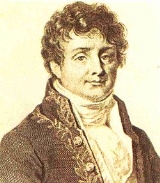
The Fourier series is a mathematical tool used for analyzing an arbitrary periodic function by decomposing it into a weighted sum of much simpler sinusoidal component functions sometimes referred to as normal Fourier modes, or simply modes for short. The weights, or coefficients, of the modes, are a one-to-one mapping of the original function. These modal coefficients are sometimes themselves confusingly referred to as "modes" for brevity, especially in physics literature. Fourier series serve many useful purposes, as manipulation and conceptualization of the modal coefficients are often easier than with the original function. Areas of application include electrical engineering, vibration analysis, acoustics, optics, signal and image processing, and data compression. Using the tools and techniques of spectroscopy, for example, astronomers can deduce the chemical composition of a star by analyzing the frequency components, or spectrum, of the star's emitted light. Similarly, engineers can optimize the design of a telecommunications system using information about the spectral components of the data signal that the system will carry. See also spectrum analyzer. The Fourier series is named after the French scientist and mathematician Joseph Fourier, who used them in his influential work on heat conduction, Théorie Analytique de la Chaleur , published in 1822. DefinitionGeneral formGiven a complex-valued function f of real argument t, , where f is piecewise continuous, periodic with period T, and square-integrable over the interval from to of length T, that is, where - is the period,
- and are times to integrate between.
the Fourier series expansion of f is: where, for any non-negative integer n: - is the nth harmonic of the function f,
- are the even Fourier coefficients of f, and
- are the odd Fourier coefficients of f.
Equivalently, in exponential form,
where:
For a formal justification, see Modern derivation of the Fourier coefficients below.
Canonical form In the special case where the period T = 2p, we have
In this case, the Fourier series expansion reduces to a particularly simple form:
where
for any integer n.
or, equivalently:
where
Choice of the formThe form for period T can be easily derived from the canonical one with the change of variable defined by . Therefore, both formulations are equivalent. However, the form for period T is used in most practical cases because it is directly applicable. For the theory, the canonical form is preferred because it is more elegant and easier to interpret mathematically, as will be later seen.
Examples
Simple Fourier series Let f be periodic of period , with for x from -p to p. Note that this function is a periodic version of the identity function.
We will compute the Fourier coefficients for this function.
Notice that an are 0 because the are odd functions. Hence the Fourier series for this function is:
One application of this Fourier series is to compute the value of the Riemann zeta function at s = 2; by Parseval's theorem, we have: which yields: .
The wave equation The wave equation governs the motion of a vibrating string, which may be fastened down at its endpoints. The solution of this problem requires the trigonometric expansion of a general function f that vanishes at the endpoints of an interval x=0 and x=L. The Fourier series for such a function takes the form
where
Vibrations of air in a pipe that is open at one end and closed at the other are also described by the wave equation. Its solution requires expansion of a function that vanishes at x = 0 and whose derivative vanishes at x=L. The Fourier series for such a function takes the form
where
Interpretation: decomposing a movement in rotations Fourier series have a kinematic interpretation. Indeed, the function can be seen as the movement of an object on a plane . Since f is complex-valued, we can write
for real-valued functions u and v. In this form, we can interpret f as a sum of horizontal and vertical translations.
From time to time , where dt is a very small incremental period, the object moves from the point to the point , which corresponds to an infinitesimal translation in space by the vector . As a result, we can write f as:
Now instead of seeing f as a sum of infinitesimal translations, we can see it as an infinite sum of rotations of different radii. This interpretation is convenient, in particular when the movement is periodic.
Let be the n-turn per second rotation . We want to write f as . We can prove that the radii of the rotations are exactly the ones we gave in the previous paragraph.
For example, the plot of the function is closed, which means the function is periodic. The loop in the curve suggests that it is the sum of two periodic functions, one having a shorter period than the other. Indeed, it can be written: . All its Fourier coefficients are zero except and . The graphical interpretation of a rotation is much harder to do than that of the translations because instead of visually seeing the movement from one point to another we have to add the whole motion for the decomposition to make sense .
Mathematically, adopting this point of view is seeing Fourier series as a tool to understand linear operators that commute with translations. The functions are precisely the mutliplicative characters of the group .
Historical development
ContextFourier series are named in honor of Joseph Fourier , who made important contributions to the study of trigonometric series, after preliminary investigations by Madhava, Nilakantha Somayaji, Jyesthadeva, Leonhard Euler, Jean le Rond d'Alembert, and Daniel Bernoulli. He applied this technique to find the solution of the heat equation, publishing his initial results in and 1811, and publishing his Théorie analytique de la chaleur in 1822.
From a modern point of view, Fourier's results are somewhat informal, due in no small part to the lack of a precise notion of function and integral in the early nineteenth century . Later, Dirichlet and Riemann expressed Fourier's results with greater precision and formality.
A revolutionary articleIn Fourier's work entitled , on pages 218 and 219, we can read the following :
- Multiplying both sides by , and then integrating from to yields:
In these few lines, which are surprisingly close to the modern formalism used in Fourier series, Fourier unwittingly revolutionized both mathematics and physics. Although similar trigonometric series were previously used by Euler, d'Alembert, Daniel Bernoulli and Gauss, Fourier was the first to recognize that such trigonometric series could represent arbitrary functions, even those with discontinuities. It has required many years to clarify this insight, and it has led to important theories of convergence, function space, and harmonic analysis.
The originality of this work was such that when Fourier submitted his paper in 1807, the committee concluded: ...the manner in which the author arrives at these equations is not exempt of difficulties and that his analysis to integrate them still leaves something to be desired on the score of generality and even rigour.
The birth of harmonic analysisSince Fourier's time, many different approaches to defining and understanding the concept of Fourier series have been discovered, all of which are mathematically equivalent , but each of which emphasizes different aspects of the topic. Some of the more powerful and elegant approaches are based on mathematical ideas and tools that were not available at the time Fourier completed his original work. Fourier originally defined the Fourier series for real-valued functions of real arguments, and using the sine and cosine functions as the basis set for the decomposition.
Many other Fourier-related transforms have since been defined, extending to other applications the initial idea of representing any periodic function as a superposition of harmonics. This general area of inquiry is now sometimes called harmonic analysis.
Modern derivation of the Fourier coefficientsThe method used by Fourier to derive the coefficients of the series is very practical and well-suited to the problem he was dealing with . However, this method has since been generalized to a much wider class of problems: writing a function as a sum of periodic functions.
More precisely, if is a function, we would like to write this function as a sum of trigonometric functions, i.e. . We have to restrict our choice of functions in order for this to make sense. First of all, if f has period T, then by changing variables, can study which has period . This simplifies notations a lot and allows us to use a canonical form. We can restrict the study of to any interval of length , , say.
We will take the functions in the set of piecewise continuous, periodic functions with . Technically speaking, we are in fact taking functions from the Lp space , where is the standardized Lebesgue measure of the interval .
Complex Fourier coefficients We can make into a Hilbert space, which is well-suited for orthogonal projections, by defining the scalar product:
where denotes the conjugate of . We will denote by the associated norm.
is an orthonormal basis of , which means we can write
We usually define . These numbers are called complex Fourier coefficients. Their expression is
An equivalent formulation is to write f as a sum of sine and cosine functions.
Real Fourier coefficients The sum in the previous section is symmetrical around 0: indeed, except for , a coefficient corresponds to every coefficient. This reminds one of the formulae
and
This means we probably can express the sum above with real-valued functions. To do this, we first notice that
After replacing by its expression and simplifying the result we get
If, for a non-negative integer n, we define the real Fourier coefficients and by
we get:
Properties
- .
- If f is an odd function, then for all because is then also odd, so its integral on is zero. If f is an even function, then for a similar reason.
- If f is piecewise continuous, , , and .
- If f is k-times piecewise continuously differentiable, then we can easily compute the Fourier coefficients of given those of f:
where denotes the kth derivative of f.
- For any positive integer k, if f is Ck - 1 and piecewise Ck, then
- because
This means that the sequence is rapidly decreasing.
General caseFourier series take advantage of the periodicity of a function f but what if f is periodic in more than one variable, or for that matter, what if f is not periodic? These problems led mathematicians and theoretical physicists to try and define Fourier series on any group G. The advantage of this is that it allows us, for example, to define Fourier series for functions of several variables. Fourier series and Fourier transforms usually used in signal processing then become special cases of this theory and are easier to interpret.
If G is a locally compact Abelian group and is the unit circle, we can define the dual of by . This is the set of rotations on the unit circle and its elements are called characters. We can define a scalar product on by: . is then an orthonormal basis of with respect to this scalar product. Let . The Fourier coefficients of f are defined by: and we have . If the group is discrete, then the integral reduces to an ordinary sum.
For example, the Fourier series of this article are obtained by taking . We get
and
Periodic functions in n dimensions can be defined on an n-dimensional torus . Such a torus is defined by . For we get a circle, for the cartesian product of two circles, i.e. a torus in the usual sense. Choosing gives the corresponding Fourier series.
Approximation and convergence of Fourier series
Definition of a Fourier seriesLet . We call Fourier series of the function f the series . For any positive integer N, we call the N-th partial sum of the Fourier series of this function.
Approximation with the partial sumsSay we want to find the best approximation of f using only the functions for n from to N. Let . We are trying to find coefficients such that is minimum .
We have , where Re denotes the real part of z.
Parseval's theorem gives us
By definition, ; therefore
It is clear that this expression is minimum for and for this value only.
This means that there is one and only one such that
it is given by
where
This means that the best approximation of f we can make using only the functions for n from to N is precisely the Nth partial sum of the Fourier series. An illustration of this is given on the animated plot of example 1.
Convergence While the Fourier coefficients an and bn can be formally defined for any function for which the integrals make sense, whether the series so defined actually converges to f depends on the properties of f.
The simplest answer is that if f is square-integrable then
This is convergence in the norm of the space L2, which means that the series converges almost everywhere to f.
There are many known tests that ensure that the series converges at a given point x, for example, if the function is differentiable at x. Even a jump discontinuity does not pose a problem: if the function has left and right derivatives at x, then the Fourier series will converge to the average of the left and right limits . However, a fact that many find surprising, is that the Fourier series of a continuous function need not converge pointwise.
This unpleasant situation is counter-balanced by a theorem by Dirichlet which states that if f is -periodic and piecewise continuously differentiable function, then its Fourier series converges pointwise and , where and . If f is continuous as well as piecewise continuously differentiable, then the Fourier series converges in norm and hence converges uniformly.
In 1922, Andrey Kolmogorov published an article entitled in which he gave an example of a Lebesgue-integrable function whose Fourier series diverges almost everywhere. This function is not in .
Plancherel's and Parseval's theorems Another important property of the Fourier series is the Plancherel theorem. Let and be the corresponding complex Fourier coefficients. Then
where denotes the conjugate of z.
Parseval's theorem, a special case of the Plancherel theorem, states that:
which can be restated with the real Fourier coefficients:
These theorems may be proven using the orthogonality relationships. They can be interpreted physically by saying that writing a signal as a Fourier series does not change its energy.
See also
References 2003 unabridged republication of the 1878 English translation by Alexander Freeman of Fourier's work Théorie Analytique de la Chaleur, originally published in 1822.
- Yitzhak Katznelson, An introduction to harmonic analysis, Second corrected edition. Dover Publications, Inc., New York, 1976. ISBN 0-486-63331-4
- Felix Klein, Development of mathematics in the 19th century. Mathsci Press Brookline, Mass, 1979. Translated by M. Ackerman from Vorlesungen uber die Entwicklung der Matematik im 19 Jahrhundert, Springer, Berlin, 1928.
- Walter Rudin, Principles of mathematical analysis, Third edition. McGraw-Hill, Inc., New York, 1976. ISBN 0-07-054235-X
- William E. Boyce and Richard C. DiPrima, Elementary Differential Equations and Boundary Value Problems, Eighth edition. John Wiley & Sons, Inc., New Jersey, 2005. ISBN 0-471-43338-1
External links- Allows custom control of the harmonic amplitudes for arbitrary terms
- shows Fourier series expansion of an arbitrary function
- - Examples of computing Fourier Series
- - A simple, non-mathematical approach
- - A site on Fourier's life which was used for the historical section of this article
|