

Aesculus

Encyclopedia
Tree
A tree is a perennial woody plant. It is most often defined as a woody plant that has many secondary branches supported clear of the ground on a single main stem or trunk with clear apical dominance. A minimum height specification at maturity is cited by some authors, varying from 3 m to...
s and shrub
Shrub
A shrub or bush is distinguished from a tree by its multiple stems and shorter height, usually under 5–6 m tall. A large number of plants may become either shrubs or trees, depending on the growing conditions they experience...
s native to the temperate northern hemisphere
Northern Hemisphere
The Northern Hemisphere is the half of a planet that is north of its equator—the word hemisphere literally means “half sphere”. It is also that half of the celestial sphere north of the celestial equator...
, with 6 species native to North America
North America
North America is a continent wholly within the Northern Hemisphere and almost wholly within the Western Hemisphere. It is also considered a northern subcontinent of the Americas...
and 7-13 species native to Eurasia
Eurasia
Eurasia is a continent or supercontinent comprising the traditional continents of Europe and Asia ; covering about 52,990,000 km2 or about 10.6% of the Earth's surface located primarily in the eastern and northern hemispheres...
; there are also several hybrids. Species are deciduous or evergreen. This genus has traditionally been treated in the ditypic family Hippocastanaceae
Hippocastanaceae
thumb|230pxHippocastanaceae is the name given to a small group of trees and shrubs, when this group is treated as a family. Its most widespread genus is Aesculus . However, the American genus Billia and the Chinese genus Handeliodendron are also sometimes included in this family...
along with Billia
Billia
Billia is a genus of two species of tree native to the Americas, from central Mexico to Ecuador. The wood is used in carpentry....
, but recent phylogenetic analysis of morphological and molecular data has led to this family, along with the Aceraceae
Aceraceae
Aceraceae is a family of flowering plants also called the Maple Family. It contains two to four genera, depending upon the circumscription, of some 120 species of trees and shrubs. A common characteristic is that the leaves are opposite, and the fruit a schizocarp.The maples have long been known...
(Maple
Maple
Acer is a genus of trees or shrubs commonly known as maple.Maples are variously classified in a family of their own, the Aceraceae, or together with the Hippocastanaceae included in the family Sapindaceae. Modern classifications, including the Angiosperm Phylogeny Group system, favour inclusion in...
s and Dipteronia
Dipteronia
Dipteronia is a genus of two living and one extinct species, regarded in the soapberry family Sapindaceae sensu lato after Angiosperm Phylogeny Group and more recently )or traditionally by several authors in Aceraceae, related to the maples.They are deciduous flowering shrubs or small trees,...
), being included in the soapberry family (Sapindaceae
Sapindaceae
Sapindaceae, also known as the soapberry family, is a family of flowering plants in the order Sapindales. There are about 140-150 genera with 1400-2000 species, including maple, horse chestnut and lychee....
).
Linnaeus named the genus Aesculus after the Roman name for an edible acorn. The Eurasian species are known as horse chestnuts while the North American species are called buckeyes. Some are also called white chestnut or red chestnut (as in some of the Bach flower remedies
Bach flower remedies
Bach flower remedies are dilutions of flower material developed by Edward Bach, an English bacteriologist, pathologist and homeopath, in the 1930s. Bach believed that dew found on flower petals retain healing properties of that plant...
). In Britain, they are sometimes called conker trees because of their link with the game of conkers, played with the seeds, also called conkers. Aesculus seeds were traditionally eaten, after leaching, by the Jomon people of Japan over about 4 millennia, until 300AD.
Description
Aesculus species are woody plantWoody plant
A woody plant is a plant that uses wood as its structural tissue. These are typically perennial plants whose stems and larger roots are reinforced with wood produced adjacent to the vascular tissues. The main stem, larger branches, and roots of these plants are usually covered by a layer of...
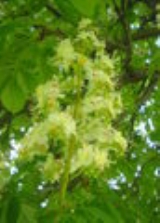
s from 4 to 36m tall (depending on species), and have stout shoots with resinous, often sticky, buds; opposite, palmately divided leaves, often very large (to 65 cm across in the Japanese horse chestnut Aesculus turbinata). Flowers are showy, insect-pollinated, with four or five petal
Petal
Petals are modified leaves that surround the reproductive parts of flowers. They often are brightly colored or unusually shaped to attract pollinators. Together, all of the petals of a flower are called a corolla. Petals are usually accompanied by another set of special leaves called sepals lying...
s fused into a lobed corolla tube, arranged in a panicle inflorescence. Flowering starts after 80–110 growing degree day
Growing degree day
Growing degree days , also called growing degree units , are a heuristic tool in phenology. GDD are a measure of heat accumulation used by horticulturists, gardeners, and farmers to predict plant and pest development rates such as the date that a flower will bloom or a crop reach...
s. The fruit matures to a capsule
Capsule (fruit)
In botany a capsule is a type of simple, dry fruit produced by many species of flowering plants. A capsule is a structure composed of two or more carpels that in most cases is dehiscent, i.e. at maturity, it splits apart to release the seeds within. A few capsules are indehiscent, for example...
, 2–5 cm diameter, usually globose, containing 1-3 seeds (often erroneously called a nut
Nut (fruit)
A nut is a hard-shelled fruit of some plants having an indehiscent seed. While a wide variety of dried seeds and fruits are called nuts in English, only a certain number of them are considered by biologists to be true nuts...
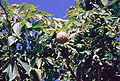
) per capsule. Capsules containing more than one seed result in seeds being flat on one side. The point of attachment of the seed in the capsule (hilum) shows as a large circular whitish scar. The capsule epidermis has "spines" (botanically: prickles) in some species, other capsules are warty or smooth; capsule splits into three sections to release the seeds.
The species of Aesculus include:
Aesculus californica
Aesculus californica is a species of buckeye that is native [ |] to California and southwest Oregon [Jackson, County], and the only buckeye native to these states.-Description:...
: California buckeye
Aesculus × carnea
Aesculus × carnea or Red Horse Chestnut is an artificial hybrid between the Red Buckeye and the Common Horse Chestnut . The origin of the tree is not known, but it probably first appeared in Germany before 1820...
: red horse chestnut
Aesculus indica
-Description:Indian or Himalayan Horse Chestnut is an attractive tree growing to about 30 meters with a spread to about by 12 meters . It is hardy to -15°C , USDA zones 7-9 . It is in flower from Jun to July, and the seeds ripen in October...
: Indian horse chestnut
Aesculus parviflora
Aesculus parviflora is a species of Aesculus native to open woodlands of the southeastern United States....
: bottlebrush buckeye
Aesculus sylvatica
Aesculus sylvatica is a species of shrub. The species has five leaflets that are 4.5 to 6 inches long and 1.5 to 2.5 inches wide. The flowers are yellow and occasionally have red also. The species have dry fruit and brown, scaly bark. The species is commonly found in forests and along stream...
: painted buckeye
Aesculus wangii
Aesculus wangii is a species of plant in the Hippocastanaceae family. It is found in China and Vietnam. It is threatened by habitat loss. It is usually considered conspecific with Aesculus assamica.-References:...
= Aesculus assamica
Cultivation
The most familiar member of the genus worldwide is the common horse chestnut Aesculus hippocastanum, native to a small area of the BalkansBalkans
The Balkans is a geopolitical and cultural region of southeastern Europe...
in southeast Europe
Europe
Europe is, by convention, one of the world's seven continents. Comprising the westernmost peninsula of Eurasia, Europe is generally 'divided' from Asia to its east by the watershed divides of the Ural and Caucasus Mountains, the Ural River, the Caspian and Black Seas, and the waterways connecting...
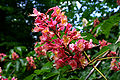
, but widely cultivated throughout the temperate world. The yellow buckeye Aesculus flava (syn. A. octandra) is also a valuable ornamental tree with yellow flowers, but is less widely planted. Among the smaller species, the bottlebrush buckeye Aesculus parviflora also makes a very interesting and unusual flowering shrub. Several other members of the genus are used as ornamentals, and several horticultural hybrids have also been developed, most notably the red horse chestnut Aesculus × carnea
Aesculus × carnea
Aesculus × carnea or Red Horse Chestnut is an artificial hybrid between the Red Buckeye and the Common Horse Chestnut . The origin of the tree is not known, but it probably first appeared in Germany before 1820...
, a hybrid between A. hippocastanum and A. pavia.
External links
- Germplasm Resources Information Network: Aesculus
- Forest, F., Drouin, J. N., Charest, R., Brouillet, L., & Bruneau A. (2001). A morphological phylogenetic analysis of Aesculus L. and Billia Peyr. (Sapindaceae). Canad. J. Botany 79 (2): 154-169. Abstract.
- Aesculus glabra (Ohio buckeye) King's American Dispensatory
- Winter ID pictures