All Topics  
Acylation


   Email Print
   Bookmark   Link


Acylation


In chemistry
Chemistry

Chemistry is the science concerned with the composition, structure, and properties of matter, as well as the changes it undergoes during chemical reactions....
, acylation (rarely, but more formally: alkanoylation) is the process of adding an acyl
Acyl

An acyl group is a functional group derived by the removal of one or more hydroxyl groups from an oxoacid.. In organic chemistry, the acyl group is usually derived from a carboxylic acid of the form RCarbon Oxygen hydroxyl....
 group to a compound. The compound providing the acyl group is called the acylating agent.

Because they form a strong electrophile
Electrophile

In chemistry, an electrophile is a reagent attracted to electrons that participates in a chemical reaction by accepting an electron pair in order to Chemical bond to a nucleophile....
 when treated with some metal catalysts, acyl halide
Acyl halide

An acyl halide is a chemical compound derived from an oxoacid by replacing a hydroxyl group with a halide group.If the acid is a carboxylic acid, the compound contains a ?COX functional group, which consists of a carbonyl group singly bonded to a halogen atom....
s are commonly used as acylating agents. For example, Friedel-Crafts acylation
Friedel-Crafts reaction

The Friedel-Crafts reactions are a set of organic reaction developed by Charles Friedel and James Crafts in 1877. There are two main types of Friedel-Crafts reactions: alkylation reactions and acylation reactions....
 uses acetyl chloride
Acetyl chloride

Acetyl chloride is an acid chloride derived from acetic acid. It has the formula CH3COCl and it belongs to the class of organic compounds called acyl halides....
 (ethanoyl chloride), C
Carbon

Carbon is a chemical element with chemical symbol C and atomic number 6. As a member of group 14 on the periodic table, it is nonmetallic and tetravalence?making four electrons available to form covalent bond chemical bonds....
H
Hydrogen

Hydrogen is the chemical element with atomic number 1. It is represented by the chemical symbol H. At standard temperature and pressure, hydrogen is a colorless, odorless, nonmetallic, tasteless, highly combustion and explosive Diatomic molecule gas with the molecular formula H2....
3C
Carbon

Carbon is a chemical element with chemical symbol C and atomic number 6. As a member of group 14 on the periodic table, it is nonmetallic and tetravalence?making four electrons available to form covalent bond chemical bonds....
O
Oxygen

Oxygen no O2 produced; 2) O2 produced, but absorbed in oceans & seabed rock; 3) O2 starts to gas out of the oceans, but is absorbed by land surfaces and formation of ozone layer; 4-5) O2 sinks filled and the gas accumulates]]...
Cl
Chloride

The chloride ion is formed when the chemical element chlorine picks up one electron to form an anion Cl−....
, as the agent and aluminum chloride (AlCl3) as a catalyst to add an ethanoyl(acetyl
Acetyl

In organic chemistry, acetyl , is a functional group, the acyl of acetic acid, with chemical formula -CarbonOxygenCarbonHydrogen3. It is sometimes abbreviated as Ac ....
) group to benzene
Benzene

Benzene, or benzol, is an organic compound chemical compound and a known carcinogen with the molecular formula Carbon6Hydrogen6....
:

The mechanism of this reaction is electrophilic substitution
Electrophilic substitution

Electrophilic substitution reactions are chemical reactions in which an electrophile displaces another group, typically but not always hydrogen....
.

Acyl halide
Acyl halide

An acyl halide is a chemical compound derived from an oxoacid by replacing a hydroxyl group with a halide group.If the acid is a carboxylic acid, the compound contains a ?COX functional group, which consists of a carbonyl group singly bonded to a halogen atom....
s and anhydrides of carboxylic acid
Carboxylic acid

Carboxylic acids are organic acids characterized by the presence of a carboxyl group, which has the Chemical formula -COH, usually written -COOH or -CO2H....
s are also commonly used acylating agents to acylate amine
Amine

Amines are organic compounds and functional groups that contain a base nitrogen atom with a lone pair. Amines are derivative s of ammonia, wherein one or more hydrogen atoms are replaced by organic substituents such as alkyl and aryl groups....
s to form amide
Amide

In chemistry, an amide is one of three kinds of compounds:* the organic chemistry functional group characterized by a carbonyl group linked to a nitrogen atom , or a compound that contains this functional group ; or...
s or acylate alcohol
Alcohol

In chemistry, an alcohol is any organic compound in which a hydroxyl Functional group is bound to a carbon atom of an alkyl or substituted alkyl group....
s to form ester
Ester

An ester is an often Aroma compound organic chemistry or partially organic compound formed by the reaction between an acid and an alcohol or aromatic alcohol with the elimination of water....
s.


Discussion
Ask a question about 'Acylation'
Start a new discussion about 'Acylation'
Answer questions from other users
Full Discussion Forum


Recent Posts


Encyclopedia


In chemistry
Chemistry

Chemistry is the science concerned with the composition, structure, and properties of matter, as well as the changes it undergoes during chemical reactions....
, acylation (rarely, but more formally: alkanoylation) is the process of adding an acyl
Acyl

An acyl group is a functional group derived by the removal of one or more hydroxyl groups from an oxoacid.. In organic chemistry, the acyl group is usually derived from a carboxylic acid of the form RCarbon Oxygen hydroxyl....
 group to a compound. The compound providing the acyl group is called the acylating agent.

Because they form a strong electrophile
Electrophile

In chemistry, an electrophile is a reagent attracted to electrons that participates in a chemical reaction by accepting an electron pair in order to Chemical bond to a nucleophile....
 when treated with some metal catalysts, acyl halide
Acyl halide

An acyl halide is a chemical compound derived from an oxoacid by replacing a hydroxyl group with a halide group.If the acid is a carboxylic acid, the compound contains a ?COX functional group, which consists of a carbonyl group singly bonded to a halogen atom....
s are commonly used as acylating agents. For example, Friedel-Crafts acylation
Friedel-Crafts reaction

The Friedel-Crafts reactions are a set of organic reaction developed by Charles Friedel and James Crafts in 1877. There are two main types of Friedel-Crafts reactions: alkylation reactions and acylation reactions....
 uses acetyl chloride
Acetyl chloride

Acetyl chloride is an acid chloride derived from acetic acid. It has the formula CH3COCl and it belongs to the class of organic compounds called acyl halides....
 (ethanoyl chloride), C
Carbon

Carbon is a chemical element with chemical symbol C and atomic number 6. As a member of group 14 on the periodic table, it is nonmetallic and tetravalence?making four electrons available to form covalent bond chemical bonds....
H
Hydrogen

Hydrogen is the chemical element with atomic number 1. It is represented by the chemical symbol H. At standard temperature and pressure, hydrogen is a colorless, odorless, nonmetallic, tasteless, highly combustion and explosive Diatomic molecule gas with the molecular formula H2....
3C
Carbon

Carbon is a chemical element with chemical symbol C and atomic number 6. As a member of group 14 on the periodic table, it is nonmetallic and tetravalence?making four electrons available to form covalent bond chemical bonds....
O
Oxygen

Oxygen no O2 produced; 2) O2 produced, but absorbed in oceans & seabed rock; 3) O2 starts to gas out of the oceans, but is absorbed by land surfaces and formation of ozone layer; 4-5) O2 sinks filled and the gas accumulates]]...
Cl
Chloride

The chloride ion is formed when the chemical element chlorine picks up one electron to form an anion Cl−....
, as the agent and aluminum chloride (AlCl3) as a catalyst to add an ethanoyl(acetyl
Acetyl

In organic chemistry, acetyl , is a functional group, the acyl of acetic acid, with chemical formula -CarbonOxygenCarbonHydrogen3. It is sometimes abbreviated as Ac ....
) group to benzene
Benzene

Benzene, or benzol, is an organic compound chemical compound and a known carcinogen with the molecular formula Carbon6Hydrogen6....
:

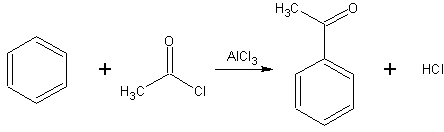
Friedel Crafts Acylation of Benzene By Ethanol Chloride
The mechanism of this reaction is electrophilic substitution
Electrophilic substitution

Electrophilic substitution reactions are chemical reactions in which an electrophile displaces another group, typically but not always hydrogen....
.

Acyl halide
Acyl halide

An acyl halide is a chemical compound derived from an oxoacid by replacing a hydroxyl group with a halide group.If the acid is a carboxylic acid, the compound contains a ?COX functional group, which consists of a carbonyl group singly bonded to a halogen atom....
s and anhydrides of carboxylic acid
Carboxylic acid

Carboxylic acids are organic acids characterized by the presence of a carboxyl group, which has the Chemical formula -COH, usually written -COOH or -CO2H....
s are also commonly used acylating agents to acylate amine
Amine

Amines are organic compounds and functional groups that contain a base nitrogen atom with a lone pair. Amines are derivative s of ammonia, wherein one or more hydrogen atoms are replaced by organic substituents such as alkyl and aryl groups....
s to form amide
Amide

In chemistry, an amide is one of three kinds of compounds:* the organic chemistry functional group characterized by a carbonyl group linked to a nitrogen atom , or a compound that contains this functional group ; or...
s or acylate alcohol
Alcohol

In chemistry, an alcohol is any organic compound in which a hydroxyl Functional group is bound to a carbon atom of an alkyl or substituted alkyl group....
s to form ester
Ester

An ester is an often Aroma compound organic chemistry or partially organic compound formed by the reaction between an acid and an alcohol or aromatic alcohol with the elimination of water....
s. The amines and alcohols are nucleophiles; the mechanism is nucleophilic addition-elimination. Succinic acid
Succinic acid

Succinic acid is a dicarboxylic acid. Succinate plays a biochemical role in the citric acid cycle....
 is also commonly used in a specific type of acylation called succination. Oversuccination occurs when more than one succinate adds to a single compound. An industrial example of acylation in the synthesis of aspirin
Aspirin

Aspirin , also known as acetylsalicylic acid , is a salicylate medication, often used as an analgesic to relieve minor aches and pains, as an antipyretic to reduce fever, and as an anti-inflammatory medication....
, in which salicylic acid
Salicylic acid

Salicylic acid is a beta hydroxy acid with the chemical formula C6H4COOH, where the OH group is adjacent to the carboxylic acid....
 is acylated by acetic anhydride
Acetic anhydride

Acetic anhydride is the chemical compound with the chemical formula 2O. Commonly abbreviated Acetyl2O, it is one of the simplest acid anhydrides and is a widely used reagent in organic synthesis....
.

See also


  • acetyl
    Acetyl

    In organic chemistry, acetyl , is a functional group, the acyl of acetic acid, with chemical formula -CarbonOxygenCarbonHydrogen3. It is sometimes abbreviated as Ac ....
  • ketene
    Ketene

    A ketene is an organic compound of the form R2C=C=O. Hermann Staudinger pioneered the research of ketenes. Ketene also refers to ethenone, the specific compound of this class in which both Rs are hydrogen....
  • indicator
    Indicator

    Indicator may mean:* Indicator , a genus of birds in the honeyguide family* In chemistry:** pH indicator, a chemical detector for protons in acid-base titrations...
  • chemical synthesis
    Chemical synthesis

    In chemistry, chemical synthesis is purposeful execution of chemical reactions in order to get a product , or several products. This happens by physics and chemical manipulations usually involving one or more reactions....