

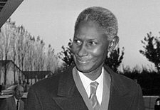
Abdou Diouf

Encyclopedia
Abdou Diouf (born September 7, 1935) was the second President of Senegal
, serving from 1981 to 2000. Diouf is notable both for coming to power by peaceful succession, and leaving willingly after losing the 2000 presidential election
to Abdoulaye Wade
. He has been the Secretary-General of La Francophonie since 2003.
, Senegal, the child of an Hal Pulaar
mother and a Serer
e father. He went to primary and secondary school at the Lycée Faidherbe in Saint-Louis
, and studied law at Dakar
University and then at the Sorbonne
, Paris
. Diouf graduated in 1959.
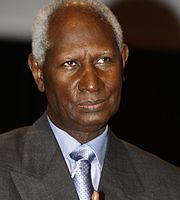
. In December 1961 he became Governor of the Sine-Saloum
Region, serving in that position until December 1962, when he became Director of the Cabinet of the Ministry of Foreign Affairs. In May 1963 he was moved to the position of Director of the Cabinet of President Léopold Senghor, where he remained until December 1965. In January 1964 he became Secretary-General of the Presidency, serving in that post until March 1968, when he became Minister of Planning and Industry. He remained in the latter position until February 1970, when he was named Prime Minister.
In 1985, opposing parties tried to form a coalition. It was broken up on the grounds that coalitions were forbidden by the constitution. Also in 1985, Abdoulaye Wade
, Diouf's main political opponent, was temporarily arrested for unlawful demonstration.
In February, 1988, elections were held again. Diouf won 72.3 percent of the vote to Wade's 25.8 percent, and opposing parties alleged electoral fraud
. Disturbances followed, and Diouf declared a state of emergency, detaining Wade again until May of that year.
with neighboring Gambia on December 12, 1981; this union took place on February 1, 1982. In April 1989, the Mauritania-Senegal Border War
developed, leading to an outbreak of ethnic violence and the severing of diplomatic relations with Mauritania
. As the region destabilized, Senegambia was dissolved.
program in Senegal, before the virus was able to take off in earnest. He used the media and schools to promote safe-sex messages, and required prostitutes to be registered. He also encouraged civic organizations and both Christian
and Muslim
religious leaders to raise awareness about AIDS. The result was that while AIDS was decimating much of Africa, the infection rate for Senegal stayed below 2 per cent.
, but in the second round on March 19 he received only 41.5% against 58.5% for Wade. Diouf conceded defeat and left office on April 1.
From this electoral defeat came one of Diouf's greatest contributions to African peace, for he gracefully surrendered power to Abdoulaye Wade, his long-time rival. When Diouf left office Wade said he should receive a Nobel Peace Prize
for leaving without violence.
became First Secretary, having been proposed by Diouf.
, the President of France
, resulting in France speaking strongly for sanctions against South Africa
. In 1992, he was re-elected President of the OAU again for another year-long term.
After leaving office as President of Senegal, he was unanimously elected as Secretary-General of La Francophonie
at that organization's Ninth Summit on October 20, 2002 in Beirut
, following the withdrawal of the only other candidate, Henri Lopes
of the Republic of the Congo. Diouf took office as Secretary-General on January 1, 2003. He was re-elected as Secretary-General for another four years at the organization's summit in Bucharest
in September 2006.
Mr Diouf is an Eminent Member of the Sergio Vieira de Mello Foundation.
Senegal
Senegal , officially the Republic of Senegal , is a country in western Africa. It owes its name to the Sénégal River that borders it to the east and north...
, serving from 1981 to 2000. Diouf is notable both for coming to power by peaceful succession, and leaving willingly after losing the 2000 presidential election
Senegalese presidential election, 2000
Presidential elections were held in Senegal on 27 February 2000, with a second round taking place on 19 March after no candidate won over 50% of votes in the first round...
to Abdoulaye Wade
Abdoulaye Wade
Abdoulaye Wade is the third and current President of Senegal, in office since 2000. He is also the Secretary-General of the Senegalese Democratic Party and has led the party since it was founded in 1974...
. He has been the Secretary-General of La Francophonie since 2003.
Early life
Diouf was born in LougaLouga
Louga is a town in northwestern Senegal. Louga is a cattle market centre and has road and rail links with the port city of Saint-Louis to the northwest and Dakar to the southwest...
, Senegal, the child of an Hal Pulaar
Pulaar
Pulaar is a Fula language spoken primarily as a first language by Fula people and Tukolor in the Senegal River valley area traditionally known as Futa Tooro, and further south and east...
mother and a Serer
Serer people
The Serer people along with the Jola people are acknowledged to be the oldest inhabitants of The Senegambia....
e father. He went to primary and secondary school at the Lycée Faidherbe in Saint-Louis
Saint-Louis, Senegal
Saint-Louis, or Ndar as it is called in Wolof, is the capital of Senegal's Saint-Louis Region. Located in the northwest of Senegal, near the mouth of the Senegal River, and 320 km north of Senegal's capital city Dakar, it has a population officially estimated at 176,000 in 2005. Saint-Louis...
, and studied law at Dakar
Dakar
Dakar is the capital city and largest city of Senegal. It is located on the Cap-Vert Peninsula on the Atlantic coast and is the westernmost city on the African mainland...
University and then at the Sorbonne
Sorbonne
The Sorbonne is an edifice of the Latin Quarter, in Paris, France, which has been the historical house of the former University of Paris...
, Paris
Paris
Paris is the capital and largest city in France, situated on the river Seine, in northern France, at the heart of the Île-de-France region...
. Diouf graduated in 1959.
Political career
After graduation, Diouf returned to Senegal, where in September 1960 he was appointed Director of International Technical Cooperation. In November 1960 he became assistant of the Secretary-General of the Government, and in June 1961 he became Secretary-General of the Ministry of Defense. In 1961 he joined the Senegalese Progressive Union (Union Progressiste Sénégalaise, UPS), which later became the Socialist Party of SenegalSocialist Party of Senegal
The Socialist Party of Senegal is a political party in Senegal. It was the ruling party in Senegal from independence in 1960 until 2000. Ousmane Tanor Dieng has been the First Secretary of the party since 1996...
. In December 1961 he became Governor of the Sine-Saloum
Sine-Saloum
Sine-Saloum is a region in Senegal located north of The Gambia and south of the Petite Côte. It encompasses an area of 24,000 square kilometers, about 12% of Senegal, with a population in the 1990s of 1,060,000....
Region, serving in that position until December 1962, when he became Director of the Cabinet of the Ministry of Foreign Affairs. In May 1963 he was moved to the position of Director of the Cabinet of President Léopold Senghor, where he remained until December 1965. In January 1964 he became Secretary-General of the Presidency, serving in that post until March 1968, when he became Minister of Planning and Industry. He remained in the latter position until February 1970, when he was named Prime Minister.
Presidency
In 1970 Senghor reinstated the post of prime minister, giving it to Diouf, his protégé. Senghor trusted Diouf, Diouf had administrative experience, and also no independent power base of his own. This was important, for Senghor's last prime minister Mamadou Dia was accused of using the position to launch a coup d’état. On January 1, 1981, Senghor resigned in favor of Diouf, who became president of Senegal.1983 and 1988 elections
Diouf continued the political liberalization Senghor had begun by holding elections in 1983. He allowed fourteen opposition parties to run, instead of the four Senghor had allowed. The practical effect of this was to fragment the opposition, and Diouf won with 83.5 percent of the vote.In 1985, opposing parties tried to form a coalition. It was broken up on the grounds that coalitions were forbidden by the constitution. Also in 1985, Abdoulaye Wade
Abdoulaye Wade
Abdoulaye Wade is the third and current President of Senegal, in office since 2000. He is also the Secretary-General of the Senegalese Democratic Party and has led the party since it was founded in 1974...
, Diouf's main political opponent, was temporarily arrested for unlawful demonstration.
In February, 1988, elections were held again. Diouf won 72.3 percent of the vote to Wade's 25.8 percent, and opposing parties alleged electoral fraud
Electoral fraud
Electoral fraud is illegal interference with the process of an election. Acts of fraud affect vote counts to bring about an election result, whether by increasing the vote share of the favored candidate, depressing the vote share of the rival candidates or both...
. Disturbances followed, and Diouf declared a state of emergency, detaining Wade again until May of that year.
Senegambia
Under Diouf, Senegal agreed to form a confederation called SenegambiaSénégambia Confederation
Senegambia, officially the Senegambia Confederation, was a loose confederation between the West African countries of Senegal and its neighbour the Gambia, which is almost completely surrounded by Senegal. The confederation came into existence on 1 February 1982 following an agreement between the...
with neighboring Gambia on December 12, 1981; this union took place on February 1, 1982. In April 1989, the Mauritania-Senegal Border War
Mauritania-Senegal Border War
The Mauritania–Senegal Border War was a conflict fought between the West African countries of Mauritania and Senegal during 1989–1991. The conflict began around the two countries' River Senegal border, over grazing rights.-Background:...
developed, leading to an outbreak of ethnic violence and the severing of diplomatic relations with Mauritania
Mauritania
Mauritania is a country in the Maghreb and West Africa. It is bordered by the Atlantic Ocean in the west, by Western Sahara in the north, by Algeria in the northeast, by Mali in the east and southeast, and by Senegal in the southwest...
. As the region destabilized, Senegambia was dissolved.
Response to AIDS
In 1986, Diouf began an anti-AIDSAIDS
Acquired immune deficiency syndrome or acquired immunodeficiency syndrome is a disease of the human immune system caused by the human immunodeficiency virus...
program in Senegal, before the virus was able to take off in earnest. He used the media and schools to promote safe-sex messages, and required prostitutes to be registered. He also encouraged civic organizations and both Christian
Christian
A Christian is a person who adheres to Christianity, an Abrahamic, monotheistic religion based on the life and teachings of Jesus of Nazareth as recorded in the Canonical gospels and the letters of the New Testament...
and Muslim
Muslim
A Muslim, also spelled Moslem, is an adherent of Islam, a monotheistic, Abrahamic religion based on the Quran, which Muslims consider the verbatim word of God as revealed to prophet Muhammad. "Muslim" is the Arabic term for "submitter" .Muslims believe that God is one and incomparable...
religious leaders to raise awareness about AIDS. The result was that while AIDS was decimating much of Africa, the infection rate for Senegal stayed below 2 per cent.
1993 and 2000 elections
Diouf was reelected in February 1993 with 58% of the vote to a 7-year term; presidential term lengths had been extended by two years in 1991. In the first round of the 2000 elections, on February 27, he took 41.3% of the vote against 30.1% for the long-time opposition leader Abdoulaye WadeAbdoulaye Wade
Abdoulaye Wade is the third and current President of Senegal, in office since 2000. He is also the Secretary-General of the Senegalese Democratic Party and has led the party since it was founded in 1974...
, but in the second round on March 19 he received only 41.5% against 58.5% for Wade. Diouf conceded defeat and left office on April 1.
From this electoral defeat came one of Diouf's greatest contributions to African peace, for he gracefully surrendered power to Abdoulaye Wade, his long-time rival. When Diouf left office Wade said he should receive a Nobel Peace Prize
Nobel Peace Prize
The Nobel Peace Prize is one of the five Nobel Prizes bequeathed by the Swedish industrialist and inventor Alfred Nobel.-Background:According to Nobel's will, the Peace Prize shall be awarded to the person who...
for leaving without violence.
Socialist Party leadership
Diouf was Deputy Secretary-General of the Socialist Party under Senghor. He became Secretary-General in 1981, and when the party was restructured at its Thirteenth Congress in 1996, he was moved to the position of President of the PS, while Ousmane Tanor DiengOusmane Tanor Dieng
Ousmane Tanor Dieng is the First Secretary of the Socialist Party of Senegal. He has been vice-president of the Socialist International since 1996.-Background and early life:...
became First Secretary, having been proposed by Diouf.
International organizations
Both during and after his presidency, Diouf has been active in international organizations. He was elected President of the Organization of African Unity (OAU) for 1985 to 1986. Soon after his election, he made a personal plea to François MitterrandFrançois Mitterrand
François Maurice Adrien Marie Mitterrand was the 21st President of the French Republic and ex officio Co-Prince of Andorra, serving from 1981 until 1995. He is the longest-serving President of France and, as leader of the Socialist Party, the only figure from the left so far elected President...
, the President of France
France
The French Republic , The French Republic , The French Republic , (commonly known as France , is a unitary semi-presidential republic in Western Europe with several overseas territories and islands located on other continents and in the Indian, Pacific, and Atlantic oceans. Metropolitan France...
, resulting in France speaking strongly for sanctions against South Africa
South Africa
The Republic of South Africa is a country in southern Africa. Located at the southern tip of Africa, it is divided into nine provinces, with of coastline on the Atlantic and Indian oceans...
. In 1992, he was re-elected President of the OAU again for another year-long term.
After leaving office as President of Senegal, he was unanimously elected as Secretary-General of La Francophonie
La Francophonie
Francophonie is an international organization of politics and governments with French as the mother or customary language, where a significant proportion of people are francophones , or where there is a notable affiliation with the French language or culture.Formally known as the Organisation...
at that organization's Ninth Summit on October 20, 2002 in Beirut
Beirut
Beirut is the capital and largest city of Lebanon, with a population ranging from 1 million to more than 2 million . Located on a peninsula at the midpoint of Lebanon's Mediterranean coastline, it serves as the country's largest and main seaport, and also forms the Beirut Metropolitan...
, following the withdrawal of the only other candidate, Henri Lopes
Henri Lopès
Henri Lopès is a Congolese writer, diplomat, and political figure. He was Prime Minister of Congo-Brazzaville from 1973 to 1975, and since 1998 he has been Congo-Brazzaville's Ambassador to France.-Political and diplomatic career:...
of the Republic of the Congo. Diouf took office as Secretary-General on January 1, 2003. He was re-elected as Secretary-General for another four years at the organization's summit in Bucharest
Bucharest
Bucharest is the capital municipality, cultural, industrial, and financial centre of Romania. It is the largest city in Romania, located in the southeast of the country, at , and lies on the banks of the Dâmbovița River....
in September 2006.
Mr Diouf is an Eminent Member of the Sergio Vieira de Mello Foundation.