


Aaron Buzacott

Encyclopedia
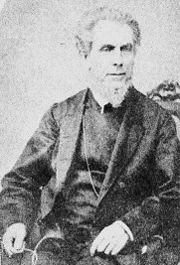
John Williams (missionary)
John Williams was an English missionary, active in the South Pacific. Born near London, England, he was trained as a foundry worker and mechanic...
(the 'Martyr of Erromanga'), author of ethnographic works and co-translator of the Bible into the language of Rarotonga, was a central figure in the South Seas
Pacific Ocean
The Pacific Ocean is the largest of the Earth's oceanic divisions. It extends from the Arctic in the north to the Southern Ocean in the south, bounded by Asia and Australia in the west, and the Americas in the east.At 165.2 million square kilometres in area, this largest division of the World...
missionary work of the London Missionary Society
London Missionary Society
The London Missionary Society was a non-denominational missionary society formed in England in 1795 by evangelical Anglicans and Nonconformists, largely Congregationalist in outlook, with missions in the islands of the South Pacific and Africa...
, living on Rarotonga
Rarotonga
Rarotonga is the most populous island of the Cook Islands, with a population of 14,153 , out of the country's total population of 19,569.The Cook Islands' Parliament buildings and international airport are on Rarotonga...
(one of the Cook Islands) between 1828 and 1857.
Early life
Greatly influenced by his mother, he was born in South Moulton, DevonDevon
Devon is a large county in southwestern England. The county is sometimes referred to as Devonshire, although the term is rarely used inside the county itself as the county has never been officially "shired", it often indicates a traditional or historical context.The county shares borders with...
where his father was a whitesmith
Whitesmith
A whitesmith is a person who works with "white" or light-coloured metals such as tin and pewter. While blacksmiths work mostly with hot metal, whitesmiths do the majority of their work on cold metal .The term is also applied to metalworkers who do only finishing work – such as filing or polishing –...
and ironmonger and the family attended the local Congregational chapel. Sarah, his wife, was also from South Moulton, and became known for her educational work and writings in the South Seas mission. Her sisters also married missionaries, and her brother, Mr George Hitchcock, a friend and neighbour of Samuel Morley
Samuel Morley (MP)
Samuel Morley , was an English woollen manufacturer, philanthropist, dissenter , abolitionist, political radical, and statesman.-Introduction:...
's at St Paul's Churchyard, became noted for his support of Congregationalism and his support for the nascent Young Men's Christian Association (YMCA)
YMCA
The Young Men's Christian Association is a worldwide organization of more than 45 million members from 125 national federations affiliated through the World Alliance of YMCAs...
.
Aaron Buzacott entered Hoxton Academy in 1820 and devoted himself for three years to the study of general and classical literature and frequently attended the metropolitan Methodist chapels, the Tottenham Court Road Chapel
Whitefield's Tabernacle, Tottenham Court Road
Whitefield's Tabernacle, Tottenham Court Road, a church in London, England; also called Tottenham Court Road Chapel, was built in 1756 for George Whitefield. It was enlarged in 1759...
and Moorfields Chapel (Whitefield's Tabernacle)
Whitefield's Tabernacle, Moorfields
Whitefield's Tabernacle, Moorfields is a church at the corner of Tabernacle Street and Leonard Street, London, England, originally a wooden building built by followers of George Whitefield in 1741, replaced by a brick building in 1753, and again rebuilt over a century later...
. Expressing an interest in missionary work, his tutors commended him to the Board of the London Missionary Society, and after examination they accepted him for training at their Mission College under Dr Bogue. Upon his death the students were transferred to Highbury College and the old Hoxton Academy near London. He completed his course in 1826, being ordained in January 1827 at Castle Street Congregational Church in Exeter
Exeter
Exeter is a historic city in Devon, England. It lies within the ceremonial county of Devon, of which it is the county town as well as the home of Devon County Council. Currently the administrative area has the status of a non-metropolitan district, and is therefore under the administration of the...
. He married Miss Hitchcock the following month and later that year the couple set sail, via Tahiti, for Rarotonga in the South Seas, where they were to spend most of the rest of their lives.
Missionary work in the South Seas
Aaron Buzacott considered schools constitute one of the most important departments of missionary labour, and he paid special attention to the selection and education of native people. This purpose was advanced by his purchase of a piece of land on AvaruaAvarua
Avarua is a town and district in the north of Rarotonga Island, the national capital of the Cook Islands...
(Rarotonga) for 150 dollars, funded by the London Missionary Society; around which he paid for a stone wall built, and within which four cottages for Rarotongan families and single men, and a college building which still exists (Takamoa Theological College
Takamoa Theological College
Takamoa Theological College is a Bible school located in Rarotonga, Cook Islands. It was founded by the noted Congregationalist missionary Aaron Buzacott . It offers a Diploma of Theology and a Certificate of Bible Studies. The college trains pastors for the Cook Islands Christian Church...
), were completed. Besides Mr Buzacott himself, the college was also staffed by Mrs Sarah Buzacott - who taught the married women students writing, arithmetic and needlework. The building architecture was designed to withstand the most violent hurricanes and was still in good condition when the Buzacott family left in 1857 owing to Aaron's ill health.
The work of the college built on educational work to record Cook Islands Maori
Cook Islands Maori
The Cook Islands Māori language, also called Māori Kūki 'Āirani or Rarotongan, is the official language of the Cook Islands. Most Cook Islanders also call it Te reo Ipukarea, literally "the language of the Ancestral Homeland"....
and print books in the native language. English only became the dominant language on the islands after the missionary period, and though it was taught at the college, the training of local pastors to encourage reading in the native language was seen as the key. This project of education in the native language, had begun in 1821 with the arrival of the missionary John Williams on Aitutaki. In 1823 his entourage, which included the native Tahitian from Borabora, Papehia, arrived on Rarotonga, soon to be joined by Charles Pitman in 1827 and, in 1828, by Buzacott. Initial translation of the Bible commenced in 1828 and was completed in 1851. Buzacott's Te Akataka Reo Rarotonga (published 1854-69) long remained the authoritative grammatical resource. By the early 1830s a printing press was in full operation under Buzacott's guidance, and by the mid-1850s most Rarotongans were able to read.
In 1831 Aaron Buzacott visited all the islands in the Hervey Group, with John Williams, and found them to suffer badly from hurricanes and cyclones during the winter. To help prevent famine he introduced the sweet potato
Sweet potato
The sweet potato is a dicotyledonous plant that belongs to the family Convolvulaceae. Its large, starchy, sweet-tasting, tuberous roots are an important root vegetable. The young leaves and shoots are sometimes eaten as greens. Of the approximately 50 genera and more than 1,000 species of...
, growing a crop in a piece of ground granted by the chief. Intense interest was arounsed when he showed that the crop could be sold to a passing captain in exchange for coloured calicoes
Calico (fabric)
Calico is a plain-woven textile made from unbleached, and often not fully processed, cotton. It may contain unseparated husk parts, for example. The fabric is less coarse and thick than canvas or denim, but owing to its unfinished and undyed appearance, it is still very cheap. Originally from the...
. The effect was magical records Mr Buzacott, Chiefs and people were eager for 'eyes' and 'tops' for planting. a suitable district was fixed upon and in a given week the whole population turned out. In the following year Mr Buzacott and John Williams traveled to Tahiti
Tahiti
Tahiti is the largest island in the Windward group of French Polynesia, located in the archipelago of the Society Islands in the southern Pacific Ocean. It is the economic, cultural and political centre of French Polynesia. The island was formed from volcanic activity and is high and mountainous...
together.
Aaron Buzacott later visited Samoa
Samoa
Samoa , officially the Independent State of Samoa, formerly known as Western Samoa is a country encompassing the western part of the Samoan Islands in the South Pacific Ocean. It became independent from New Zealand in 1962. The two main islands of Samoa are Upolu and one of the biggest islands in...
(in 1834, and again in 1836) where he found American and English sailors who had run away from whaling ships, living on the islands with the permission of Samoan Chiefs but without schools. Mr Buzacott wrote: It was pleasing to observe, by contrasting the present condition of Rarotonga with that of Samoa, the progress the gospel had already made among us.
Aaron Buzacott visited England 1847-51, being for that time a communicant under the pastoral care of the Rev. Henry Allon
Henry Allon
Henry Allon , English Nonconformist divine, was born on 13 October 1818 at Welton, Elloughton-cum-Brough, near Hull, in Yorkshire.Under Methodist influence Henry Allon decided to enter the ministry, but, developing Congregational ideas, was trained at Cheshunt College, Hertfordshire and became...
of Union Chapel
Union Chapel, Islington
The Union Chapel is a Grade II* listed church and music venue in Islington, North London, England, located on Compton Terrace.An example of Victorian gothic architecture, it was designed by James Cubitt, and constructed between 1874 and 1877, with further additions 1877-90, providing an ambitious...
, Islington
Islington
Islington is a neighbourhood in Greater London, England and forms the central district of the London Borough of Islington. It is a district of Inner London, spanning from Islington High Street to Highbury Fields, encompassing the area around the busy Upper Street...
, near London
London
London is the capital city of :England and the :United Kingdom, the largest metropolitan area in the United Kingdom, and the largest urban zone in the European Union by most measures. Located on the River Thames, London has been a major settlement for two millennia, its history going back to its...
.
Retirement, death & memorial
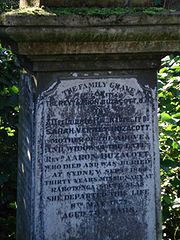
New South Wales
New South Wales is a state of :Australia, located in the east of the country. It is bordered by Queensland, Victoria and South Australia to the north, south and west respectively. To the east, the state is bordered by the Tasman Sea, which forms part of the Pacific Ocean. New South Wales...
in 1857, Aaron Buzacott died there on September 20, 1864, attended by his wife and many friends. His funeral was held on 21 September, a Presbyterian minister reading from Scripture, and the procession then moving on to the Bourke Street Congregational Church where Rev Hartley, a Primitive Methodist, gave out the hymn. He was buried in the Congregational burying-ground in Devonshire Street, Sydney
Sydney
Sydney is the most populous city in Australia and the state capital of New South Wales. Sydney is located on Australia's south-east coast of the Tasman Sea. As of June 2010, the greater metropolitan area had an approximate population of 4.6 million people...
, now the location of the Central Railway Station
Central railway station, Sydney
Central Railway Station, the largest railway station in Australia, is at the southern end of the Sydney CBD. It services almost all the lines on the CityRail network, and is the major terminus for interurban and interstate rail services...
.
Much of his contribution to published ethnographic knowledge of the Cook Islands, Samoa and Melanesia, was set out in a volume that was published posthumously in 1866 back in London, edited by his son and J. P. Sunderland, and with a preface by the Rev. Henry Allon
Henry Allon
Henry Allon , English Nonconformist divine, was born on 13 October 1818 at Welton, Elloughton-cum-Brough, near Hull, in Yorkshire.Under Methodist influence Henry Allon decided to enter the ministry, but, developing Congregational ideas, was trained at Cheshunt College, Hertfordshire and became...
. The work was concluded by several letters to Mrs. Buzacott written just after the death of her husband and in high estimation of him, and a list of diseases prevalent in the islands of the South Seas.
Aaron's widow Sarah Verney Buzacott, who kept her own written account of life in the coral islands of the Pacific, died some while later in England, and is buried at the Congregationalist's Abney Park Cemetery
Abney Park Cemetery
Abney Park in Stoke Newington, in the London Borough of Hackney, is a historic parkland originally laid out in the early 18th century by Lady Mary Abney and Dr. Isaac Watts, and the neighbouring Hartopp family. In 1840 it became a non-denominational garden cemetery, semi-public park arboretum, and...
, Stoke Newington
Stoke Newington
Stoke Newington is a district in the London Borough of Hackney. It is north-east of Charing Cross.-Boundaries:In modern terms, Stoke Newington can be roughly defined by the N16 postcode area . Its southern boundary with Dalston is quite ill-defined too...
, London. Their son, Rev. Aaron Buzacott the younger (1829–81) - who styled himself Rev Aaron Buzcott BA to distinguish his work from that of his father - became Secretary of the Anti-Slavery Society
Anti-Slavery Society
The Anti-Slavery Society or A.S.S. was the everyday name of two different British organizations.The first was founded in 1823 and was committed to the abolition of slavery in the British Empire. Its official name was the Society for the Mitigation and Gradual Abolition of Slavery Throughout the...
- now Anti-Slavery International
Anti-Slavery International
Anti-Slavery International is an international nongovernmental organization, charity and a lobby group, based in the United Kingdom. Founded in 1839, it is the world's oldest international human rights organization, and the only charity in the United Kingdom to work exclusively against slavery and...
- and pastor (c.1870) of the Asylum Road Congregational Chapel, later known as the Clifton Congregational Chapel, Peckham
Peckham
Peckham is a district in south London, England, located in the London Borough of Southwark. It is situated south-east of Charing Cross. The area is identified in the London Plan as one of 35 major centres in Greater London...
; he is buried with his mother at Abney Park Cemetery.
Today the two-story Takamoa Mission House in the coastal town of Avarua, erected by Aaron Buzacott, is a government office; and the settlement of Arorangi, established by the Rev. Aaron Buzacott as a model village to resettle people near the coast under a native pastor, a tourist destination.
References
- Buzacott, Aaron (1985 reprint), Mission Life in the Islands of the Pacific, Institute of Pacific Studies of the University of the South Pacific (SUAV) & The Cook Islands Library & Museum Society
- Joyce, Paul (1985), A Guide to Abney Park Cemetery, London: SAPC & L.B.Hackney
- French, James Branwhite (1883), A Guide to Abney Park Cemetery, London:James Clarke & Co
- Hiney, Tom (2000), On the Missionary Trail: a journey through Polynesia, Asia and Africa with the London Missionary Society
Books
- Buzacott, Aaron (1866), Mission Life in the Islands of the Pacific, London:John Snow & Co