


A Letter Concerning Toleration

Encyclopedia
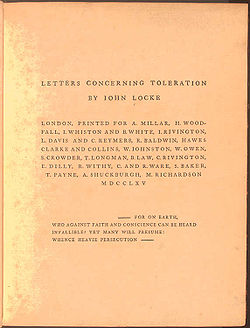
A Letter Concerning Toleration by John Locke
John Locke
John Locke FRS , widely known as the Father of Liberalism, was an English philosopher and physician regarded as one of the most influential of Enlightenment thinkers. Considered one of the first of the British empiricists, following the tradition of Francis Bacon, he is equally important to social...
was originally published in 1689. Its initial publication was in Latin
Latin
Latin is an Italic language originally spoken in Latium and Ancient Rome. It, along with most European languages, is a descendant of the ancient Proto-Indo-European language. Although it is considered a dead language, a number of scholars and members of the Christian clergy speak it fluently, and...
, though it was immediately translated into other languages. Locke's work appeared amidst a fear that Catholicism
Catholicism
Catholicism is a broad term for the body of the Catholic faith, its theologies and doctrines, its liturgical, ethical, spiritual, and behavioral characteristics, as well as a religious people as a whole....
might be taking over England
England
England is a country that is part of the United Kingdom. It shares land borders with Scotland to the north and Wales to the west; the Irish Sea is to the north west, the Celtic Sea to the south west, with the North Sea to the east and the English Channel to the south separating it from continental...
, and responds to the problem of religion and government by proposing religious toleration
Religious toleration
Toleration is "the practice of deliberately allowing or permitting a thing of which one disapproves. One can meaningfully speak of tolerating, ie of allowing or permitting, only if one is in a position to disallow”. It has also been defined as "to bear or endure" or "to nourish, sustain or preserve"...
as the answer. This "letter" is addressed to an anonymous "Honored Sir": this was actually Locke's close friend Philipp van Limborch
Philipp van Limborch
Philipp van Limborch , Dutch Remonstrant theologian, was born at Amsterdam, where his father was a lawyer.He received his education at Utrecht, at Leiden, in his native city, and finally at Utrecht University, which he entered in 1652...
, who published it without Locke's knowledge.
Argument of the Letter
Locke argues for a new understanding of the relationship between religionReligion
Religion is a collection of cultural systems, belief systems, and worldviews that establishes symbols that relate humanity to spirituality and, sometimes, to moral values. Many religions have narratives, symbols, traditions and sacred histories that are intended to give meaning to life or to...
and government
Government
Government refers to the legislators, administrators, and arbitrators in the administrative bureaucracy who control a state at a given time, and to the system of government by which they are organized...
. One of the founders of Empiricism
Empiricism
Empiricism is a theory of knowledge that asserts that knowledge comes only or primarily via sensory experience. One of several views of epistemology, the study of human knowledge, along with rationalism, idealism and historicism, empiricism emphasizes the role of experience and evidence,...
, Locke develops a philosophy
Philosophy
Philosophy is the study of general and fundamental problems, such as those connected with existence, knowledge, values, reason, mind, and language. Philosophy is distinguished from other ways of addressing such problems by its critical, generally systematic approach and its reliance on rational...
that is contrary to the one expressed by Thomas Hobbes
Thomas Hobbes
Thomas Hobbes of Malmesbury , in some older texts Thomas Hobbs of Malmsbury, was an English philosopher, best known today for his work on political philosophy...
in Leviathan
Leviathan (book)
Leviathan or The Matter, Forme and Power of a Common Wealth Ecclesiasticall and Civil — commonly called simply Leviathan — is a book written by Thomas Hobbes and published in 1651. Its name derives from the biblical Leviathan...
, primarily because it supports toleration for various Christian
Christian
A Christian is a person who adheres to Christianity, an Abrahamic, monotheistic religion based on the life and teachings of Jesus of Nazareth as recorded in the Canonical gospels and the letters of the New Testament...
denominations. That being said, it is important to recognize that Hobbes allowed for individuals to maintain their own religious beliefs as long as they outwardly expressed those of the state.
Unlike Hobbes, who saw uniformity of religion as the key to a well-functioning civil society, Locke argues that more religious groups actually prevent civil unrest. Locke argues that civil unrest results from confrontations caused by any magistrate's attempt to prevent different religions from being practiced, rather than tolerating their proliferation. Locke's primary goal is to "distinguish exactly the business of civil government from that of religion." He makes use of extensive argument from analogy to accomplish his goal, and relies on several key points. He wants to persuade the reader that government is instituted to promote external interests, relating to life, liberty, and the general welfare, while the church exists to promote internal interests, i.e., salvation. The two serve separate functions, and so, must be considered to be separate institutions.
For Locke, the only way a Church can gain genuine converts is through persuasion and not through violence. This relates to his central conclusion, namely, that the government should not involve itself in care of souls. In support of this argument he presents three main reasons: (1) individuals, according to Locke, cannot divest control over their souls to secular forces, as God does not appoint the magistrate; (2) force cannot create the change necessary for salvation, because while it can coerce obedience, it cannot change one's beliefs; and (3) even if coercion could persuade someone of a notion, it would not help for the salvation of the soul, because then birth would be related with salvation.
Locke argued that atheists should not be tolerated because 'Promises, covenants, and oaths, which are the bonds of human society, can have no hold upon an atheist'. The Roman Catholic Church can not be tolerated either, according to Locke, because 'all those who enter into it do thereby ipso facto deliver themselves up to the protection and service of another prince'. If this Church were tolerated, a magistrate
Magistrate
A magistrate is an officer of the state; in modern usage the term usually refers to a judge or prosecutor. This was not always the case; in ancient Rome, a magistratus was one of the highest government officers and possessed both judicial and executive powers. Today, in common law systems, a...
would have to abide by the settling of a 'foreign jurisdiction
Jurisdiction
Jurisdiction is the practical authority granted to a formally constituted legal body or to a political leader to deal with and make pronouncements on legal matters and, by implication, to administer justice within a defined area of responsibility...
' in his own country and see its followers 'listed, as it were, for soldiers against his own Government'.
There is, however, a passage added in a later edition of the Essay concerning Human Understanding, where Locke perhaps questions "whether 'atheism' was necessarily inimical to political obedience."
Toleration
Toleration
Toleration is "the practice of deliberately allowing or permitting a thing of which one disapproves. One can meaningfully speak of tolerating, ie of allowing or permitting, only if one is in a position to disallow”. It has also been defined as "to bear or endure" or "to nourish, sustain or preserve"...
is central to Locke's political philosophy. Consequently, only churches that teach toleration are to be allowed in his society. Locke’s view on the difficulty of knowing the one true religion may suggest that religion is not personally important to Locke. As an empiricist, he took practical considerations into account, such as how the peace of civil society will be affected by religious toleration. However, a closer reading of the text reveals that Locke relies on Biblical
Bible
The Bible refers to any one of the collections of the primary religious texts of Judaism and Christianity. There is no common version of the Bible, as the individual books , their contents and their order vary among denominations...
analysis at several key points in his argument, as does study of his spiritual life, mainly influenced by Deism
Deism
Deism in religious philosophy is the belief that reason and observation of the natural world, without the need for organized religion, can determine that the universe is the product of an all-powerful creator. According to deists, the creator does not intervene in human affairs or suspend the...
, a belief in which God does not intervene in human affairs.
Reception
There were immediate responses from the High ChurchHigh church
The term "High Church" refers to beliefs and practices of ecclesiology, liturgy and theology, generally with an emphasis on formality, and resistance to "modernization." Although used in connection with various Christian traditions, the term has traditionally been principally associated with the...
Anglican clergy, published by Thomas Long
Thomas Long (writer)
Thomas Long was an English clergyman and writer on Church politics. He spent almost all of his life in Exeter.-Life:He was educated at Exeter College, Oxford, where he graduated B.A. in 1642...
and Jonas Proast
Jonas Proast
Jonas Proast was an English High Church Anglican clergyman and academic. He was an opponent of latitudinarianism, associated with Henry Dodwell, George Hickes, Thomas Hearne and Jonathan Edwards. He is now known for his controversy with John Locke, over Locke's Letter concerning...
. Long believed the letter was written by an atheistically disguised Jesuit plot for the Roman Catholic Church to gain dominance by bringing chaos and ruin to church and state. Proast attacked the Letter and defended the view that the government has the right to use force to cause dissenters to reflect on the merits of Anglicanism, the True Religion. Locke's reply to Proast developed into an extended, controversial exchange.