

Nematomorpha

Encyclopedia
Nematomorpha is a phylum
of parasitic animal
s that are superficially morphologically
similar to nematode
worms, hence the name. They range in size in most species from 50 to 100 cm (19.7 to 39.4 in) long and can reach in extreme cases up to 2 metres, and 1 to 3 mm (0.0393700787401575 to 0.118110236220472 ) in diameter. Horsehair worms can be discovered in damp areas such as watering troughs, streams, puddles, and cisterns. The adult worms are free living, but the larva
e are parasitic on beetle
s, cockroach
es, orthoptera
ns, and crustacean
s. About 326 species are known and a conservative estimate suggests that there may be about 2000 species worldwide. The name "Gordian" stems from the legendary Gordian knot
. This relates to the fact that nematomorpha often tie themselves in knots.
without cilia. Internally, they have only longitudinal muscle and a non-functional gut, with no excretory
, respiratory
or circulatory system
s. The nervous system consists of a nerve ring near the anterior end of the animal, and a ventral nerve cord running along the body.
Reproductively, they are dioecious
, with the internal fertilization of eggs that are then laid in gelatinous strings. Adults have cylindrical gonad
s, opening into the cloaca
. The larvae have rings of cuticular hooks and terminal stylets that are believed to be used to enter the hosts. Once inside the host, the larvae live inside the haemocoel and absorb nutrients directly through their skin. Development into the adult form takes weeks or months, and the larva moult
s several times as it grows in size.
The adults are mostly free living in freshwater or marine environments, and males and females aggregate into tight balls (Gordian knots) during mating.
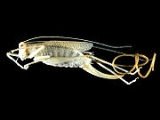
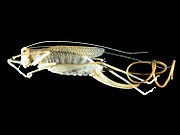 In Spinochordodes tellinii
, which has orthopterans as its vector, the infection acts on the insect's brain and causes it to seek water and drown itself, thus returning the nematomorph to water. They are also remarkably able to survive the predation of their host, being able to wriggle out of the predator that has eaten the host.
worms. Unlike nematomorphs, mermithids do not have a terminal cloaca. Male mermithids have one or two spicules just before the end apart from having a thinner, smoother cuticle, without areoles and a paler brown colour.
The phylum is placed along with the Ecdysozoa
clade of moulting organisms that include the Arthropod
a. Fossilized worms have been reported from Early Cretaceous
Burmese amber dated to 100–110 million years.
Relationships within the phylum are still somewhat unclear, but two classes are recognised. The five marine species of nematomorph are contained in Nectonematoida. Adults are planktonic and the larvae parasitise decapod crustaceans
, especially crabs. They are characterized by a double row of natotory seta
e along each side of the body, dorsal and ventral longitudinal epidermal cords, a spacious and fluid-filled blastocoelom and singular gonad
s.
The approximately 320 remaining species are distributed into two families and seven genera within order Gordioida. Gordioidean adults are free-living in freshwater or semiterrestrial habitats and larvae parasitise insects, primarily orthoptera
ns. Unlike nectonematiodeans, gordioideans lack lateral rows of setae, have a a single, ventral epidermal cord and their blastocoels are filled with mesenchyme
in young animals but become spacious in older individuals.
Phylum
In biology, a phylum The term was coined by Georges Cuvier from Greek φῦλον phylon, "race, stock," related to φυλή phyle, "tribe, clan." is a taxonomic rank below kingdom and above class. "Phylum" is equivalent to the botanical term division....
of parasitic animal
Animal
Animals are a major group of multicellular, eukaryotic organisms of the kingdom Animalia or Metazoa. Their body plan eventually becomes fixed as they develop, although some undergo a process of metamorphosis later on in their life. Most animals are motile, meaning they can move spontaneously and...
s that are superficially morphologically
Morphology (biology)
In biology, morphology is a branch of bioscience dealing with the study of the form and structure of organisms and their specific structural features....
similar to nematode
Nematode
The nematodes or roundworms are the most diverse phylum of pseudocoelomates, and one of the most diverse of all animals. Nematode species are very difficult to distinguish; over 28,000 have been described, of which over 16,000 are parasitic. It has been estimated that the total number of nematode...
worms, hence the name. They range in size in most species from 50 to 100 cm (19.7 to 39.4 in) long and can reach in extreme cases up to 2 metres, and 1 to 3 mm (0.0393700787401575 to 0.118110236220472 ) in diameter. Horsehair worms can be discovered in damp areas such as watering troughs, streams, puddles, and cisterns. The adult worms are free living, but the larva
Larva
A larva is a distinct juvenile form many animals undergo before metamorphosis into adults. Animals with indirect development such as insects, amphibians, or cnidarians typically have a larval phase of their life cycle...
e are parasitic on beetle
Beetle
Coleoptera is an order of insects commonly called beetles. The word "coleoptera" is from the Greek , koleos, "sheath"; and , pteron, "wing", thus "sheathed wing". Coleoptera contains more species than any other order, constituting almost 25% of all known life-forms...
s, cockroach
Cockroach
Cockroaches are insects of the order Blattaria or Blattodea, of which about 30 species out of 4,500 total are associated with human habitations...
es, orthoptera
Orthoptera
Orthoptera is an order of insects with paurometabolous or incomplete metamorphosis, including the grasshoppers, crickets and locusts.Many insects in this order produce sound by rubbing their wings against each other or their legs, the wings or legs containing rows of corrugated bumps...
ns, and crustacean
Crustacean
Crustaceans form a very large group of arthropods, usually treated as a subphylum, which includes such familiar animals as crabs, lobsters, crayfish, shrimp, krill and barnacles. The 50,000 described species range in size from Stygotantulus stocki at , to the Japanese spider crab with a leg span...
s. About 326 species are known and a conservative estimate suggests that there may be about 2000 species worldwide. The name "Gordian" stems from the legendary Gordian knot
Gordian Knot
The Gordian Knot is a legend of Phrygian Gordium associated with Alexander the Great. It is often used as a metaphor for an intractable problem solved by a bold stroke :"Turn him to any cause of policy,...
. This relates to the fact that nematomorpha often tie themselves in knots.
Description and biology
Nematomorphs possess an external cuticleCuticle
A cuticle , or cuticula, is a term used for any of a variety of tough but flexible, non-mineral outer coverings of an organism, or parts of an organism, that provide protection. Various types of "cuticles" are non-homologous; differing in their origin, structure, function, and chemical composition...
without cilia. Internally, they have only longitudinal muscle and a non-functional gut, with no excretory
Excretory system
The excretory system is a passive biological system that removes excess, unnecessary or dangerous materials from an organism, so as to help maintain homeostasis within the organism and prevent damage to the body. It is responsible for the elimination of the waste products of metabolism as well as...
, respiratory
Respiratory system
The respiratory system is the anatomical system of an organism that introduces respiratory gases to the interior and performs gas exchange. In humans and other mammals, the anatomical features of the respiratory system include airways, lungs, and the respiratory muscles...
or circulatory system
Circulatory system
The circulatory system is an organ system that passes nutrients , gases, hormones, blood cells, etc...
s. The nervous system consists of a nerve ring near the anterior end of the animal, and a ventral nerve cord running along the body.
Reproductively, they are dioecious
Dioecious
Dioecy is the property of a group of biological organisms that have males and females, but not members that have organs of both sexes at the same time. I.e., those whose individual members can usually produce only one type of gamete; each individual organism is thus distinctly female or male...
, with the internal fertilization of eggs that are then laid in gelatinous strings. Adults have cylindrical gonad
Gonad
The gonad is the organ that makes gametes. The gonads in males are the testes and the gonads in females are the ovaries. The product, gametes, are haploid germ cells. For example, spermatozoon and egg cells are gametes...
s, opening into the cloaca
Cloaca
In zoological anatomy, a cloaca is the posterior opening that serves as the only such opening for the intestinal, reproductive, and urinary tracts of certain animal species...
. The larvae have rings of cuticular hooks and terminal stylets that are believed to be used to enter the hosts. Once inside the host, the larvae live inside the haemocoel and absorb nutrients directly through their skin. Development into the adult form takes weeks or months, and the larva moult
Ecdysis
Ecdysis is the moulting of the cuticula in many invertebrates. This process of moulting is the defining feature of the clade Ecdysozoa, comprising the arthropods, nematodes, velvet worms, horsehair worms, rotifers, tardigrades and Cephalorhyncha...
s several times as it grows in size.
The adults are mostly free living in freshwater or marine environments, and males and females aggregate into tight balls (Gordian knots) during mating.
Spinochordodes tellinii
The nematomorph hairworm Spinochordodes tellinii is a parasitic worm whose larvae develop in orthopteran insects . This parasite is able to influence its host's behavior: once the parasite is grown, it causes its grasshopper host to jump into water, where the grasshopper will likely drown...
, which has orthopterans as its vector, the infection acts on the insect's brain and causes it to seek water and drown itself, thus returning the nematomorph to water. They are also remarkably able to survive the predation of their host, being able to wriggle out of the predator that has eaten the host.
Taxonomy
Nematomorphs can be confused with nematodes, particularly mermithidMermithidae
Mermithidae is a family of nematode worms that are endoparasites in arthropods. As early as 1877, Mermithidae was listed as one of nine subdivisions of the Nematoidea. Mermithidae are confusable with the horsehair worms of the phylum Nematomorpha that have a similar life history and...
worms. Unlike nematomorphs, mermithids do not have a terminal cloaca. Male mermithids have one or two spicules just before the end apart from having a thinner, smoother cuticle, without areoles and a paler brown colour.
The phylum is placed along with the Ecdysozoa
Ecdysozoa
Ecdysozoa is a group of protostome animals, including Arthropoda , Nematoda, and several smaller phyla. They were first defined by Aguinaldo et al. in 1997, based mainly on trees constructed using 18S ribosomal RNA genes...
clade of moulting organisms that include the Arthropod
Arthropod
An arthropod is an invertebrate animal having an exoskeleton , a segmented body, and jointed appendages. Arthropods are members of the phylum Arthropoda , and include the insects, arachnids, crustaceans, and others...
a. Fossilized worms have been reported from Early Cretaceous
Cretaceous
The Cretaceous , derived from the Latin "creta" , usually abbreviated K for its German translation Kreide , is a geologic period and system from circa to million years ago. In the geologic timescale, the Cretaceous follows the Jurassic period and is followed by the Paleogene period of the...
Burmese amber dated to 100–110 million years.
Relationships within the phylum are still somewhat unclear, but two classes are recognised. The five marine species of nematomorph are contained in Nectonematoida. Adults are planktonic and the larvae parasitise decapod crustaceans
Decapoda
The decapods or Decapoda are an order of crustaceans within the class Malacostraca, including many familiar groups, such as crayfish, crabs, lobsters, prawns and shrimp. Most decapods are scavengers. It is estimated that the order contains nearly 15,000 species in around 2,700 genera, with...
, especially crabs. They are characterized by a double row of natotory seta
Seta
Seta is a biological term derived from the Latin word for "bristle". It refers to a number of different bristle- or hair-like structures on living organisms.-Animal setae:In zoology, most "setae" occur in invertebrates....
e along each side of the body, dorsal and ventral longitudinal epidermal cords, a spacious and fluid-filled blastocoelom and singular gonad
Gonad
The gonad is the organ that makes gametes. The gonads in males are the testes and the gonads in females are the ovaries. The product, gametes, are haploid germ cells. For example, spermatozoon and egg cells are gametes...
s.
The approximately 320 remaining species are distributed into two families and seven genera within order Gordioida. Gordioidean adults are free-living in freshwater or semiterrestrial habitats and larvae parasitise insects, primarily orthoptera
Orthoptera
Orthoptera is an order of insects with paurometabolous or incomplete metamorphosis, including the grasshoppers, crickets and locusts.Many insects in this order produce sound by rubbing their wings against each other or their legs, the wings or legs containing rows of corrugated bumps...
ns. Unlike nectonematiodeans, gordioideans lack lateral rows of setae, have a a single, ventral epidermal cord and their blastocoels are filled with mesenchyme
Mesenchyme
Mesenchyme, or mesenchymal connective tissue, is a type of undifferentiated loose connective tissue that is derived mostly from mesoderm, although some are derived from other germ layers; e.g. some mesenchyme is derived from neural crest cells and thus originates from the ectoderm...
in young animals but become spacious in older individuals.
External links
- Nematomorpha Biodiversity Project website. Provides pictures, life cycle information and searchable databases.
- horsehair worms on the UFUniversity of FloridaThe University of Florida is an American public land-grant, sea-grant, and space-grant research university located on a campus in Gainesville, Florida. The university traces its historical origins to 1853, and has operated continuously on its present Gainesville campus since September 1906...
/ IFASInstitute of Food and Agricultural SciencesThe University of Florida’s Institute of Food and Agricultural Sciences is a federal-state-county partnership dedicated to developing knowledge in agriculture, human and natural resources, and the life sciences, and enhancing and sustaining the quality of human life by making that information...
Featured Creatures Web site
Videos
- Video of worm and beetle host in pet's water bowl (see bottom of page), submitted by R. Preston and collected by E. M. Preston from central California, USA.
- Videos of a cricket infected with a Gordian worm with the worm emerging to mate, as well as emerging from predators that have eaten the infected cricket. From NatureNature (journal)Nature, first published on 4 November 1869, is ranked the world's most cited interdisciplinary scientific journal by the Science Edition of the 2010 Journal Citation Reports...
, April 2006. — explains the proteomeProteomeThe proteome is the entire set of proteins expressed by a genome, cell, tissue or organism. More specifically, it is the set of expressed proteins in a given type of cells or an organism at a given time under defined conditions. The term is a portmanteau of proteins and genome.The term has been...
research done on this worm - The cricket suicide (video)