
All Topics  
Zulu

 
Zulu

   Email Print
   Bookmark   Link


Zulu


Amazulu redirects here. For other uses of Zulu, see Zulu (disambiguation)
Zulu (disambiguation)

The Zulu or amaZulu are an ethnic group of southern Africa.Zulu can also be* Zulu language, a Bantu language of Southern Africa* Zulu, code for the letter Z in the NATO phonetic alphabet...
.


The Zulu (isiZulu: amaZulu) are the largest South African ethnic group of an estimated 10-11 million people who live mainly in the province of KwaZulu-Natal
KwaZulu-Natal

KwaZulu-Natal , often referred to as "KZN", is a Provinces of South Africa of South Africa. Prior to 1994 the territory now known as KwaZulu-Natal was made up of the Natal Province and all pieces of territory that made up the homeland of KwaZulu....
, South Africa
South Africa

The Republic of South Africa, also known by Official names of South Africa, is a country located at the southern tip of the continent of Africa....
. Small numbers also live in Zimbabwe
Zimbabwe

Zimbabwe , is a landlocked country located in the southern part of the continent of Africa, between the Zambezi and Limpopo River rivers. It is bordered by South Africa to the south, Botswana to the southwest, Zambia to the northwest and Mozambique to the east....
, Zambia
Zambia

The Republic of Zambia is a landlocked country in Southern Africa. The neighbouring countries are the Democratic Republic of the Congo to the north, Tanzania to the north-east, Malawi to the east, Mozambique, Zimbabwe, Botswana, and Namibia to the south, and Angola to the west....
, and Mozambique
Mozambique

Mozambique, officially the Republic of Mozambique , is a country in southeastern Africa bordered by the Indian Ocean to the east, Tanzania to the north, Malawi and Zambia to the northwest, Zimbabwe to the west and Swaziland and South Africa to the southwest....
. Their language, isiZulu, is a Bantu language
Bantu languages

The Bantu languages constitute a grouping belonging to the Niger-Congo languages family. This grouping is deep down in the genealogical tree of the Bantoid grouping, which in turn is deep down in the Niger-Congo tree....
; more specifically, part of the Nguni
Nguni

Nguni languages are mostly spoken by Nguni people, which are group of clans and nations living in south-east Africa.The languages are a group of Bantu languages spoken in southern Africa including Zulu language, Xhosa language, Swati language, amaHlubi,Phuthi language and Ndebele language ....
 subgroup. The Zulu Kingdom played a major role in South African History
History of South Africa

The history of South Africa is marked by imigration and ethnic conflict. The Khoisan peoples are the aboriginal people of the region who have lived there for millennia....
 during the 19th and 20th centuries.


Discussion
Ask a question about 'Zulu'
Start a new discussion about 'Zulu'
Answer questions from other users
Full Discussion Forum


Quotations


Category:War films Category:1960s films

A prayer's as good as a bayonet on a day like this.

All right, then! Nobody told you to stop working!

Brandy's for heroes, Mister Hook. The rest of you will make do with flies in your meat, boils in your skin, and dysentery in your bellies.

Commissary Dalton: Careful! POT that chap, somebody! Good fellow. Good fellow.

Commissary Dalton: Now, don't distress yourself, my dear fellow. There's your own officer, over there. You go and speak to him.


Encyclopedia


Amazulu redirects here. For other uses of Zulu, see Zulu (disambiguation)
Zulu (disambiguation)

The Zulu or amaZulu are an ethnic group of southern Africa.Zulu can also be* Zulu language, a Bantu language of Southern Africa* Zulu, code for the letter Z in the NATO phonetic alphabet...
.


The Zulu (isiZulu: amaZulu) are the largest South African ethnic group of an estimated 10-11 million people who live mainly in the province of KwaZulu-Natal
KwaZulu-Natal

KwaZulu-Natal , often referred to as "KZN", is a Provinces of South Africa of South Africa. Prior to 1994 the territory now known as KwaZulu-Natal was made up of the Natal Province and all pieces of territory that made up the homeland of KwaZulu....
, South Africa
South Africa

The Republic of South Africa, also known by Official names of South Africa, is a country located at the southern tip of the continent of Africa....
. Small numbers also live in Zimbabwe
Zimbabwe

Zimbabwe , is a landlocked country located in the southern part of the continent of Africa, between the Zambezi and Limpopo River rivers. It is bordered by South Africa to the south, Botswana to the southwest, Zambia to the northwest and Mozambique to the east....
, Zambia
Zambia

The Republic of Zambia is a landlocked country in Southern Africa. The neighbouring countries are the Democratic Republic of the Congo to the north, Tanzania to the north-east, Malawi to the east, Mozambique, Zimbabwe, Botswana, and Namibia to the south, and Angola to the west....
, and Mozambique
Mozambique

Mozambique, officially the Republic of Mozambique , is a country in southeastern Africa bordered by the Indian Ocean to the east, Tanzania to the north, Malawi and Zambia to the northwest, Zimbabwe to the west and Swaziland and South Africa to the southwest....
. Their language, isiZulu, is a Bantu language
Bantu languages

The Bantu languages constitute a grouping belonging to the Niger-Congo languages family. This grouping is deep down in the genealogical tree of the Bantoid grouping, which in turn is deep down in the Niger-Congo tree....
; more specifically, part of the Nguni
Nguni

Nguni languages are mostly spoken by Nguni people, which are group of clans and nations living in south-east Africa.The languages are a group of Bantu languages spoken in southern Africa including Zulu language, Xhosa language, Swati language, amaHlubi,Phuthi language and Ndebele language ....
 subgroup. The Zulu Kingdom played a major role in South African History
History of South Africa

The history of South Africa is marked by imigration and ethnic conflict. The Khoisan peoples are the aboriginal people of the region who have lived there for millennia....
 during the 19th and 20th centuries. Under apartheid, Zulu people were classed as third-class citizens and suffered from state sanctioned discrimination. They remain today the most numerous ethnic group in South Africa, and now have equal rights along with all other citizens.

Origins

The Zulu were originally a major clan in what is today Northern KwaZulu-Natal
KwaZulu-Natal

KwaZulu-Natal , often referred to as "KZN", is a Provinces of South Africa of South Africa. Prior to 1994 the territory now known as KwaZulu-Natal was made up of the Natal Province and all pieces of territory that made up the homeland of KwaZulu....
, founded ca. 1709 by Zulu kaNtombhela
Zulu kaNtombhela

Zulu kaNtombela, son of Ntombela kaMalandela, was the founder and chief of the Zulu clan from ca. 1709. In the Zulu language, Zulu means heaven, or sky....
. the Nguni languages, iZulu/iliZulu/liTulu means heaven, or sky. At that time, the area was occupied by many large Nguni
Nguni

Nguni languages are mostly spoken by Nguni people, which are group of clans and nations living in south-east Africa.The languages are a group of Bantu languages spoken in southern Africa including Zulu language, Xhosa language, Swati language, amaHlubi,Phuthi language and Ndebele language ....
 communities and clans (also called isizwe=nation, people or isibongo=clan). Nguni communities had migrated down Africa's east coast over thousands of years, as part of the Bantu migrations
Bantu expansion

The Bantu expansion was a millennia-long series of migrations of speakers of the original proto-Bantu languages language group. This group is hypothesized to have originated from the southwestern border of modern Nigeria and Cameroon....
 probably arriving in what is now South Africa in about the 9th century A.D.

Kingdom

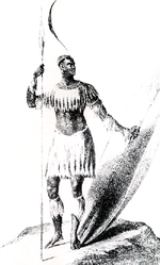
The Zulu formed a powerful state in 1816 under the leader Shaka
Shaka

Shaka was the most influential leader of the Zulu Empire.He is widely credited with uniting many of the Northern Nguni people, specifically the Mthethwa Paramountcy and the Ndwandwe into the Zulu kingdom, the beginnings of a nation that held sway over the large portion of southern Africa between the Phongolo River and Mzimkhulu River river...
. Shaka, like all the Zulu chiefs before him, gained a large amount of power over the tribe. A commander in the army of the powerful Mthethwa Empire, he became leader of his mentor Dingiswayo
Dingiswayo

Dingiswayo was a Mtetwa chief, best known for his mentorship over a young Zulu general, Shaka, who rose to become the greatest of the List of Zulu kings....
's paramountcy and united what was once a confederation of tribes into an imposing empire under Zulu hegemony.

Conflict with the British

On December 11, 1878, agents of the British delivered an ultimatum to 11 chiefs representing Cetshwayo. The terms required Cetshwayo to disband his army and accept British authority. Cetshwayo refused, and war followed at the start of 1879 . During the war, the Zulus defeated the British at the Battle of Isandlwana
Battle of Isandlwana

The Battle of Isandlwana on 22 January 1879 was the opening, major encounter in the Anglo-Zulu War between the British Empire and the Zulu Kingdom....
 on January 22. The British managed to get the upper hand after the battle at Rorke's Drift
Rorke's Drift

Rorke's Drift was a mission station in KwaZulu-Natal Province, South Africa, situated near a natural Ford on the Buffalo River at . During the Anglo-Zulu War, the defence of Rorke's Drift immediately followed the British Army's defeat at the Battle of Isandlwana earlier in the day....
, and win the war with the Zulu defeat at the Battle of Ulundi
Battle of Ulundi

The Battle of Ulundi took place at the Zulu capital of Ulundi on 4 July 1879 and was the last major battle of the Anglo-Zulu War. The British army finally broke the military power of the Zulu by defeating the main Zulu army and immediately afterwards capturing and razing the capital of Zululand, the royal kraal of Ulundi....
 on July 4.

Absorption into Cape Colony

After Cetshwayo's capture a month after his defeat, the British divided the Zulu Empire into 13 "kinglets". The subkingdoms fought amongst each other until 1883 when Cetshwayo was reinstated as king over Zululand
Zululand

Zululand, the Zulu-dominated area of northern KwaZulu-Natal Province in South Africa, extends along the coast of the Indian Ocean from the Tugela River in the south to Pongola River in the north....
. This still did not stop the fighting and the Zulu monarch was forced to flee his realm by Zibhebhu
Usibepu

UZibhebhu kaMaphitha was a Zulu chief 1883-1884; rival of Cetshwayo.Zibhebhu was a son of Maphita, son of Sojiyisa.He was one of the 13 'kinglets' allocated land in the aftermath of the Anglo-Zulu War, and vied for the royal succession with another of Cetshwayo's sons, Dinuzulu....
, one of the 13 kinglets, supported by Boer mercenaries. Cetshwayo died in February 1884, possibly poisoned, leaving his son, the 15 year-old Dinuzulu
Dinuzulu

Dinuzulu kaCetshwayo was the monarch of the Zulu nation from 20 May 1884 until his death in 1913.He succeeded his father Cetshwayo, who was the last king of the Zulus to be officially recognized as such by the United Kingdom....
, to inherit the throne. In-fighting between the Zulu continued for years, until Zululand was absorbed fully into the Cape Colony.

Apartheid years


The KwaZulu homeland


Under apartheid, the homeland
Bantustan

A bantustan or euphemistically black african homeland or simply homeland, was territory set aside for black inhabitants of South Africa and South-West Africa , as part of the policy of South Africa under apartheid....
 of KwaZulu
KwaZulu

KwaZulu was a bantustan in South Africa, intended by the apartheid government as a semi-independent homeland for the Zulu people. The capital, formerly at Nongoma, was moved in 1980 to Ulundi....
 (Kwa meaning place of) was created for Zulu people. In 1970, the Bantu Homeland Citizenship Act provided that all Zulus would become citizens of KwaZulu, losing their South African citizenship. KwaZulu consisted of a large number of disconnected pieces of land, in what is now KwaZulu-Natal
KwaZulu-Natal

KwaZulu-Natal , often referred to as "KZN", is a Provinces of South Africa of South Africa. Prior to 1994 the territory now known as KwaZulu-Natal was made up of the Natal Province and all pieces of territory that made up the homeland of KwaZulu....
. Hundreds of thousands of Zulu people living on privately owned "black spots" outside of KwaZulu were dispossessed and forcibly moved to bantustans - worse land previously reserved for whites contiguous to existing areas of KwaZulu - in the name of "consolidation." By 1993, approximately 5.2 million Zulu people lived in KwaZulu, and approximately 2 million lived in the rest of South Africa. The Chief Minister
Chief Ministers of KwaZulu

Leaders of KwaZulu ...
 of KwaZulu, from its creation in 1970 (as Zululand) was Chief Mangosuthu Buthelezi
Mangosuthu Buthelezi

Inkosi Mangosuthu Ashpenaz Nathan Buthelezi is a South African Zulu leader, and leader of the Inkatha Freedom Party which he formed in 1975....
. In 1994, KwaZulu was joined with the province of Natal, to form modern KwaZulu-Natal.

Inkatha YeSizwe ("the crown of the nation")

In 1975, Buthelezi revived the Inkatha YaKwaZulu, predecessor of the Inkatha Freedom Party
Inkatha Freedom Party

The Inkatha Freedom Party is a political party in South Africa. As of 2008, it is led by Mangosuthu Buthelezi. It is currently the third largest party in the National Assembly of South Africa....
. This organization was nominally a protest movement against apartheid, but held more conservative views than the ANC
African National Congress

The African National Congress has been South Africa's governing party, supported by its tripartite alliance with the Congress of South African Trade Unions and the South African Communist Party , since the establishment of non-racial democracy in May 1994....
. For example, Inkatha was opposed to the armed struggle, and to sanctions against South Africa. Inkatha was initially on good terms with the ANC, but the two organizations came into increasing conflict beginning in 1979 in the aftermath of the Soweto Uprising.

Because its stances were more in accordance with the apartheid government's views, Inkatha was the only mass organization recognized as being representative of the views of black South Africans by the apartheid government (the ANC and other movements were banned). In the last years of apartheid, this acceptance extended to the covert provision of funds and guerrilla warfare training to Inkatha by the government. Yet unlike the leaders of the Transkei
Transkei

The Transkei?which means "the area beyond the Kei River"?is a region situated in the Eastern Cape of South Africa. It is also the name of an Apartheid-era Bantustan corresponding to this territory....
, Ciskei
Ciskei

Ciskei was a Bantustan in the south east of South Africa. It consisted 2,970 square miles , almost entirely surrounded by what was then the Cape Province and possessing a small coastline along the shore of the Indian Ocean....
, Bophuthatswana
Bophuthatswana

Bophuthatswana was a bantustan in the northwest of South Africa. It had a surface area of approximately 40 000 km? and consisted of seven enclaves dispersed over the former South African provinces of Cape Province, Transvaal and Orange Free State....
 and Venda
Venda

Venda was a bantustan in northern South Africa, now part of Limpopo Province province. It was founded as a homeland for the Venda people, speakers of the Venda language....
 bantustans, Buthelezi never accepted the pseudo-independence offered under the policy of Separate Development, despite strong pressure from the ruling white government.

Political violence

From 1985, members of opposing protest movements in what is now KwaZulu-Natal began engaging in bloody armed clashes, with combatants armed with AK-47
AK-47

The AK-47 is a 7.62x39mm assault rifle developed in the Soviet Union by Mikhail Kalashnikov in two versions: the fixed stock AK-47 and the AKS-47 variant equipped with an underfolding metal shoulder stock....
's and machetes. This political violence occurred primarily between Inkatha and ANC members, and included atrocities committed by both sides. It was believed to be frequently instigated by a branch of the apartheid government's security forces, which became known as the "third force". The violence continued through the 1980s, and escalated in the 1990s in the build up to the first national elections in 1994.

The modern Zulu population

The modern Zulu population is fairly evenly distributed in both urban and rural areas. Although KwaZulu-Natal is still their heartland, large numbers have been attracted to the relative economic prosperity of Gauteng province. Indeed, Zulu
Zulu language

Zulu , is a language of the Zulu people with about 10 million speakers, the vast majority of whom live in South Africa. Zulu is the most widely spoken home language in South Africa as well as being understood by over 50% of the population ....
 is the most widely spoken home language in the province, followed by Sotho. Zulu is also widely spoken in rural and small-town Mpumalanga province.

Zulus also play an important part in South African politics. Mangosuthu Buthelezi served a term as one of two Deputy Presidents
Deputy President of South Africa

The Deputy President of South Africa is the acting President of South Africa when the President is outside the country's borders, unable to fulfill the duties of the office, or when the Presidency is vacant....
 in the government of national unity which came into power in 1994, when reduction of civil conflict between ANC and IFP followers was a key national issue. Within the ANC, two recent (Jacob Zuma
Jacob Zuma

Jacob Gedleyihlekisa Zuma is a South African politician. He is the President of the African National Congress , the governing political party, and was Deputy President of South Africa from 1999 to 2005....
) (Phumzile Mlambo-Ngcuka
Phumzile Mlambo-Ngcuka

Phumzile Mlambo-Ngcuka is a South African politician who was Deputy President of South Africa from 2005 to 2008. She was the first woman to hold the position and was the highest ranking woman in the history of South Africa....
) Deputy Presidents
Deputy President of South Africa

The Deputy President of South Africa is the acting President of South Africa when the President is outside the country's borders, unable to fulfill the duties of the office, or when the Presidency is vacant....
 of the country have been Zulu, in part to bolster the ANC's claim to be a pan-ethnic national party and refute IFP claims that it was primarily a Xhosa
Xhosa

The Xhosa people are speakers of Bantu languages living in south-east South Africa, and in the last two centuries throughout the southern and central-southern parts of the country....
 party.

Language


The language of the Zulu people is Zulu
Zulu language

Zulu , is a language of the Zulu people with about 10 million speakers, the vast majority of whom live in South Africa. Zulu is the most widely spoken home language in South Africa as well as being understood by over 50% of the population ....
 or "isiZulu", a Bantu language
Bantu languages

The Bantu languages constitute a grouping belonging to the Niger-Congo languages family. This grouping is deep down in the genealogical tree of the Bantoid grouping, which in turn is deep down in the Niger-Congo tree....
; more specifically, part of the Nguni
Nguni

Nguni languages are mostly spoken by Nguni people, which are group of clans and nations living in south-east Africa.The languages are a group of Bantu languages spoken in southern Africa including Zulu language, Xhosa language, Swati language, amaHlubi,Phuthi language and Ndebele language ....
 subgroup. Zulu is the most widely spoken language in South Africa, where it is an official language
Official language

An official language is a language that is given a special legal status in a particular country, state, or other territory. Typically a nation's official language will be the one used in that nation's courts, parliament and administration....
. More than half of the South African population are able to understand it, with over 9 million first-language and over 15 million second-language speakers. Many Zulu people also speak English
English language

English is a West Germanic language that originated in Anglo-Saxon England and has lingua franca status in many parts of the world as a result of the military, economic, scientific, political and cultural influence of the British Empire in the 18th, 19th and early 20th centuries and that of the United States from the mid 20th century onwa...
, Portuguese
Portuguese language

Portuguese is a Romance language that originated in what is now Galicia and Portugal. It is derived from the Latin language spoken by the Romanization Pre-Roman peoples of the Iberian Peninsula around 2000 years ago....
, Shangaan, Sesotho and others from among South Africa's 11 official languages.

Food

The rural Zulu economy is based on cattle and agriculture. Consequently, the main staple diet consists of cow and agricultural products. This includes barbecued and boiled meat; amasi (curdled milk), mixed with dry, ground corn or dry, cooked mealie-meal (corn flour); amadumbe (yams); vegetables; and fruits. The Zulu traditional beer is not only a staple food but a considerable source of nutrition. It is also socially and ritually important and is drunk on all significant occasions.

Drinking and eating from the same plate was and still is a sign of friendship. It is customary for children to eat from the same dish, usually a big basin. This derives from a "share what you have" belief which is part of ubuntu (humane) philosophy.

Clothing

Older Zulu women wear clothes that cover their bodies. They wear isicholo( Izzy-chow-low ), a wide hat made of straw and decorated with beads (ubuhlalu). They also wear isidwaba, a pleated skirt made of cowhide and softened by hand. Younger women sometimes decorate their 'isidwaba' with beads, whereas older women wear it plain. Clothing for Zulu girls is mainly made of beadwork and is usually revealing.

Beads are the pride of the Zulu nation. Zulu beadwork encompasses a symbolic language that may include reprimands and warnings, messages of love, and encouragement. Different beads carry symbolic meanings that may be used during courtship. When a young man proposes love from a woman, she gives him a gift of betrothal beads as an indication of her acceptance of him. This acceptance is usually followed by lobolo (bride price) by which the young man pays eleven cows to the woman’s family.

Religion and beliefs


Most Zulu people state their beliefs to be Christian
Christianity

Christianity is a Monotheistic religion #Christian view religion centered on the life and teachings of Jesus as New Testament view on Jesus' life....
. Some of the most common churches to which they belong are African Initiated Churches
African Initiated Church

An African Initiated Church is a Christian denomination started in Africa, by Africans, and not by missionaries from another continent....
, especially the Zion Christian Church
Zion Christian Church

The Zion Christian Church is the largest African Initiated Church in southern Africa, with 10-15 million members belonging to ZCC star and 3-5 million members belonging to the saint Engenas ZCC....
 and various Apostolic Churches
Apostolic

Apostolic may refer to:*The Twelve Apostles of Jesus, or something related to them*Apostolic Succession, the doctrine connecting the Church to the original Twelve Apostles...
, although membership of major European Churches, such as the Dutch Reformed
Dutch Reformed Church

Dutch Reformed Church was one of many branches of churches established during the Protestant Reformation in Europe in the sixteenth century. While the Dutch Reformed Church was based in the Netherlands, other churches holding similar theological views were founded in France, Switzerland, Germany, Hungary, England, and Scotland....
, Anglican
Anglicanism

Anglicanism is a tradition of Christianity faith. Churches in this tradition either have historical connections to the Church of England or have similar beliefs, worship and church structures....
 and Catholic
Catholicism

Catholicism is a broad term for the body of the Catholic faith, its Theology and doctrines, its Catholic liturgy, Ethics, spiritual, and behavioral characteristics, as well as a religious people as a whole....
 Churches is also common. Nevertheless, many Zulus retain their traditional pre-Christian belief system of ancestor worship in parallel with their Christianity.

Zulu religion includes belief in a creator God (Nkulunkulu) who is above interacting in day-to-day human affairs, although this belief appears to have originated from efforts by early Christian missionaries to frame the idea of the Christian God in Zulu terms. Traditionally, the more strongly held Zulu belief was in ancestor spirits (Amatongo or Amadhlozi), who had the power to intervene in people's lives, for good or ill. This belief continues to be widespread among the modern Zulu population.

Ancestral spirits are important in Zulu religious life. Offerings and sacrifices are made to the ancestors for protection, good health, and happiness. Ancestral spirits come back to the world in the form of dreams, illnesses, and sometimes snakes. It is believed that many misfortunes, sometimes even death, are the result of angry spirits.

In order to appeal to the spirit world, a diviner (sangoma
Sangoma

A sangoma is a practitioner of herbal medicine, divination and psychotherapy in traditional Nguni societies of Southern Africa .The philosophy is based on a belief in spiritual beings....
) must invoke
Invocation

An invocation may take the form of:*Supplication or prayer.*A form of Spirit possession.*Command or conjuration.*Self-identification with certain spirits....
 the ancestors through divination processes to determine the problem. Then, a herbalist (inyanga
Inyanga

Inyanga is a Zulu language word for a traditional healer.Although the word sangoma is generally used in South African English to mean all types of traditional Southern African healers, inyangas and sangomas are in fact different....
) prepares a mixture to be consumed (muthi) in order to influence the ancestors. As such, diviners and herbalists play an important part in the daily lives of the Zulu people. However, a distinction is made between white muthi (umuthi omhlope), which has positive effects, such as healing or the prevention or reversal of misfortune, and black muthi (umuthi omnyama), which can bring illness or death to others, or ill-gotten wealth to the user. Users of black muthi are considered witches, and shunned by society.

Christianity had difficulty gaining a foothold among the Zulu people, and when it did it was in a syncretic fashion. Isaiah Shembe, considered the Zulu Messiah
Messiah

Messiah literally means "anointed ".In Jewish messiah tradition and Jewish eschatology, messiah refers to a future monarch of United Monarchy from the Davidic line, who will rule the people of Israelite#The Twelve Tribes, and herald the Messianic Age of global peace....
, presented a form of Christianity (the Nazareth Baptist Church
Nazareth Baptist Church

Nazareth Baptist Church is an African Initiated Church founded by Isaiah Shembe in 1910. It has approximately a million members in KwaZulu-Natal and Inanda, KwaZulu-Natal....
) which incorporated traditional customs.

See also

  • Inkatha Freedom Party
    Inkatha Freedom Party

    The Inkatha Freedom Party is a political party in South Africa. As of 2008, it is led by Mangosuthu Buthelezi. It is currently the third largest party in the National Assembly of South Africa....
  • List of Zulu kings
    List of Zulu kings

    This List of Zulu kings gives a list of Zulu chieftains and kings from their earliest known history up to the current monarch:* Mnguni* Nkosinkulu...
  • Nguni
    Nguni

    Nguni languages are mostly spoken by Nguni people, which are group of clans and nations living in south-east Africa.The languages are a group of Bantu languages spoken in southern Africa including Zulu language, Xhosa language, Swati language, amaHlubi,Phuthi language and Ndebele language ....
  • Shaka Zulu
    Shaka

    Shaka was the most influential leader of the Zulu Empire.He is widely credited with uniting many of the Northern Nguni people, specifically the Mthethwa Paramountcy and the Ndwandwe into the Zulu kingdom, the beginnings of a nation that held sway over the large portion of southern Africa between the Phongolo River and Mzimkhulu River river...
  • Zulu language
    Zulu language

    Zulu , is a language of the Zulu people with about 10 million speakers, the vast majority of whom live in South Africa. Zulu is the most widely spoken home language in South Africa as well as being understood by over 50% of the population ....


External links

  • - This includes detailed, well-referenced sections on recent Zulu history.