

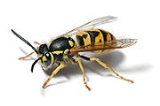
Yellowjacket

Encyclopedia
Yellowjacket is the common name
in North America for predatory wasp
s of the genera
Vespula
and Dolichovespula
. Members of these genera are known simply as "wasps" in other English-speaking
countries. Most of these are black and yellow; some are black and white (such as the bald-faced hornet
, Dolichovespula maculata), while others may have the abdomen
background color red instead of black. They can be identified by their distinctive markings, small size (similar to a honey bee
), their occurrence only in colonies, and a characteristic, rapid, side to side flight pattern prior to landing. All females are capable of stinging
. Yellowjackets are important predators of pest insects.
s" as they are similar in size and appearance, and both sting, but are actually wasps. A typical yellowjacket worker is about 12 mm (0.47244094488189 in) long, with alternating bands on the abdomen; the queen is larger, about 19 mm (0.748031496062992 in) long (the different patterns on the abdomen help separate various species). Workers are sometimes confused with honey bee
s, especially when flying in and out of their nests. Yellowjackets, in contrast to honey bees, are not covered with tan-brown dense hair on their bodies, They do not carry pollen and do not have the flattened hairy hind legs used to carry it. They have a lance-like stinger with small barbs and typically sting repeatedly, though occasionally the stinger becomes lodged and pulls free of the wasp's body; the venom
, like most bee and wasp venoms, is primarily only dangerous to humans if allergic, unless a victim is stung many times (main article: Bee sting
). All species have yellow or white on the face. Mouthparts are well-developed with strong mandibles
for capturing and chewing insects, with a proboscis for sucking nectar, fruit, and other juices. Yellowjackets build nests in trees, shrubs, or in protected places such as inside human-made structures (attics
, hollow walls or flooring, in sheds, under porches, and eaves of houses), or in soil cavities, mouse burrows, etc. They build them from wood fiber they chew into a paper-like pulp.
Many other insects exhibit protective mimicry of aggressive, stinging yellowjackets; in addition to numerous bee
s and wasp
s (Müllerian mimicry
), the list includes some flies
, moth
s, and beetle
s (Batesian mimicry
).
Yellowjackets' closest relatives, the hornet
s, closely resemble them but have a much bigger head, seen especially in the large distance from the eyes to the back of the head.
ing. Fertilized queens occur in protected places such as hollow logs, in stumps, under bark, in leaf litter, in soil cavities, and human-made structures. Queens emerge during the warm days of late spring or early summer, select a nest site, and build a small paper nest in which they lay eggs. After eggs hatch from the 30 to 50 brood cells, the queen feeds the young larvae for about 18 to 20 days. After that, the workers in the colony will take over caring for the larvae, feeding them with chewed up food, meat or fruit (called trophallaxis
). Larvae
pupate emerge later as small, infertile females called workers. By mid-summer, the first adult workers emerge and assume the tasks of nest expansion, foraging for food, care of the queen and larvae, and colony defense.
From this time until her death in the autumn, the queen remains inside the nest, laying eggs. The colony then expands rapidly, reaching a maximum size of 4,000 to 5,000 workers and a nest of 10,000 to 15,000 cells in late summer. At peak size, reproductive cells are built with new males and queens produced. Adult reproductives remain in the nest fed by the workers. New queens build up fat reserves to overwinter
. Adult reproductives leave the parent colony to mate. After mating, males quickly die, while fertilized queens seek protected places to overwinter. Parent colony workers dwindle, usually leaving the nest to die, as does the foundress queen. Abandoned nests rapidly decompose and disintegrate during the winter. They can persist as long as they are kept dry, but are rarely used again. In the spring, the cycle is repeated; weather in the spring is the most important factor in colony establishment. Adults feed primarily on items rich in sugars and carbohydrates such as fruits, flower nectar, and tree sap, and larvae feed on proteins such as insects, meats, and fish. Adult workers chew and condition the meat fed to the larvae. Larvae in return secrete a sugar material relished by the adults; this exchange is a form of trophallaxis
. In late summer foraging workers change their food preference from meats to ripe, decaying fruits, or scavenge human garbage, sodas, picnics—where they are a common and unwelcome nuisance—etc., since larvae in the nest fail to meet requirements as a source of sugar.
, Dolichovespula maculata) tend to create exposed aerial nests (a feature shared with true hornet
s, which has led to some confusion as to the use of the name "hornet").
Vespula species, in contrast, build concealed nests, usually underground.
Yellowjacket nests usually last for only one season, dying off in winter. The nest is started by a single queen, called the "foundress". Typically, a nest can reach the size of a basketball by the end of a season. In parts of Australia, New Zealand, the Pacific Islands, and southwestern coastal areas of the United States, the winters are mild enough to allow nest overwintering. Nests that survive multiple seasons become massive and often possess multiple egg-laying queens.
first appeared in Ohio, and has now become the dominant species over the eastern yellowjacket. It is bold and aggressive, and if provoked, it can sting repeatedly and painfully. It will mark aggressors, and will pursue them if provoked. The German yellowjacket builds its nests in cavities (not necessarily underground) with the peak worker population in temperate areas between 1,000 and 3,000 individuals between May to August, each colony producing several thousand new reproductives after this point, through November. The eastern yellowjacket builds its nests underground, also with the peak worker population between 1,000 and 3,000 individuals similar to the German yellowjacket. Nests are built entirely of wood fiber (usually weathered or dead) and are completely enclosed (football or soccer-ball shaped) except for a small opening (entrance) at the bottom. The color of the paper is highly dependent on the source of the wood fibers used. The nests contain multiple, horizontal tiers of combs (10 or more) within. Larvae hang down in combs.
In the southeastern United States, where southern yellowjacket (Vespula squamosa) nests may persist through the winter, colony sizes
of this species may reach 100,000 adult wasps. The same kind of nest expansion has occurred in Hawaii
with the invasive western yellowjacket Vespula pensylvanica.
. Notable college and university examples include the American International College
, Baldwin-Wallace College
, Black Hills State University
, California State University, Sacramento
, Cedarville University
, Defiance College
, Georgia Institute of Technology
, Graceland University
, Howard Payne University
, LeTourneau University
, Montana State University Billings, Randolph-Macon College
, University of Rochester
, University of Wisconsin–Superior
, and Waynesburg University
.
Notable secondary schools and school districts include Alvin High School (Alvin, TX) Sprayberry High School
(Marietta, Georgia), Thomas County Central High School, (Thomasville, GA), Xavier University Preparatory High School (New Orleans, Louisiana), Berkeley High School (Berkeley, California), Freeport Area School District
(Sarver, Pennsylvania), Llano High, Junior High, Elementary, and Packsaddle Elementary Schools (Llano County Texas), Cleburne High School (Cleburne, Texas), Mount Vernon High School
(Mount Vernon, Ohio), Newark High School
(Newark, Delaware), Osbourn Park High School
(Manassas, Virginia), Sabinal School District (Sabinal, Texas), Perrysburg High School
(Perrysburg, Ohio), Sidney High School
(Sidney, Ohio), Girard High School (Girard, Pennsylvania), Vincent High School
(Vincent, Alabama), Thomas Jefferson High School
(Council Bluffs, Iowa), Irmo Middle School
, Irmo High School
(Irmo, South Carolina) and Oxnard High School
(Oxnard, California), Saint Augustine High School (Saint John's County FLA), Lee County Senior High School (Sanford, NC), George Washington Carver High School
(Winston-Salem, North Carolina) Northampton High School
(Eastville, Virginia), Coffee High School (Florence, Alabama), Blue Ridge High School (Pinetop-Lakeside, Arizona), and Oneonta High School (Oneonta, New York).
Also has been used as the name of multiple superheroes, including: as the third superhero identity of Marvel Comics character Hank Pym; the villainess turned hero Rita Demara, who stole the identity from Pym; and YellowJacket, a Charlton Comics character who got his powers from being bitten by mutant yellowjackets.
Common name
A common name of a taxon or organism is a name in general use within a community; it is often contrasted with the scientific name for the same organism...
in North America for predatory wasp
Wasp
The term wasp is typically defined as any insect of the order Hymenoptera and suborder Apocrita that is neither a bee nor an ant. Almost every pest insect species has at least one wasp species that preys upon it or parasitizes it, making wasps critically important in natural control of their...
s of the genera
Genus
In biology, a genus is a low-level taxonomic rank used in the biological classification of living and fossil organisms, which is an example of definition by genus and differentia...
Vespula
Vespula
Vespula is a small genus of social wasps, widely distributed in the Northern Hemisphere. Along with members of their sister genus Dolichovespula, they are collectively known by the common name yellowjackets in North America...
and Dolichovespula
Dolichovespula
Dolichovespula is a small genus of social wasps distributed widely throughout the Northern Hemisphere. The yellow and black members of the genus are known by the common name yellowjackets in North America along with members of their sister genus Vespula...
. Members of these genera are known simply as "wasps" in other English-speaking
English language
English is a West Germanic language that arose in the Anglo-Saxon kingdoms of England and spread into what was to become south-east Scotland under the influence of the Anglian medieval kingdom of Northumbria...
countries. Most of these are black and yellow; some are black and white (such as the bald-faced hornet
Bald-faced hornet
Dolichovespula maculata is a North American insect commonly called the bald-faced hornet...
, Dolichovespula maculata), while others may have the abdomen
Abdomen
In vertebrates such as mammals the abdomen constitutes the part of the body between the thorax and pelvis. The region enclosed by the abdomen is termed the abdominal cavity...
background color red instead of black. They can be identified by their distinctive markings, small size (similar to a honey bee
Honey bee
Honey bees are a subset of bees in the genus Apis, primarily distinguished by the production and storage of honey and the construction of perennial, colonial nests out of wax. Honey bees are the only extant members of the tribe Apini, all in the genus Apis...
), their occurrence only in colonies, and a characteristic, rapid, side to side flight pattern prior to landing. All females are capable of stinging
Stinger
-Biology:* Stinger, an organ or body part found in various animals that usually delivers some kind of venom.* Stinger , a minor neurological injury suffered by athletes.-Sports and entertainment:...
. Yellowjackets are important predators of pest insects.
Identification
Yellowjackets are often called "beeBee
Bees are flying insects closely related to wasps and ants, and are known for their role in pollination and for producing honey and beeswax. Bees are a monophyletic lineage within the superfamily Apoidea, presently classified by the unranked taxon name Anthophila...
s" as they are similar in size and appearance, and both sting, but are actually wasps. A typical yellowjacket worker is about 12 mm (0.47244094488189 in) long, with alternating bands on the abdomen; the queen is larger, about 19 mm (0.748031496062992 in) long (the different patterns on the abdomen help separate various species). Workers are sometimes confused with honey bee
Honey bee
Honey bees are a subset of bees in the genus Apis, primarily distinguished by the production and storage of honey and the construction of perennial, colonial nests out of wax. Honey bees are the only extant members of the tribe Apini, all in the genus Apis...
s, especially when flying in and out of their nests. Yellowjackets, in contrast to honey bees, are not covered with tan-brown dense hair on their bodies, They do not carry pollen and do not have the flattened hairy hind legs used to carry it. They have a lance-like stinger with small barbs and typically sting repeatedly, though occasionally the stinger becomes lodged and pulls free of the wasp's body; the venom
Venom
Venom is the general term referring to any variety of toxins used by certain types of animals that inject it into their victims by the means of a bite or a sting...
, like most bee and wasp venoms, is primarily only dangerous to humans if allergic, unless a victim is stung many times (main article: Bee sting
Bee sting
A bee sting is strictly a sting from a bee . In the vernacular it can mean a sting of a bee, wasp, hornet, or yellow jacket. Some people may even call the bite of a horse-fly a bee sting...
). All species have yellow or white on the face. Mouthparts are well-developed with strong mandibles
Mandible (insect)
Insect mandibles are a pair of appendages near the insect’s mouth, and the most anterior of the three pairs of oral appendages . Their function is typically to grasp, crush, or cut the insect’s food, or to defend against predators or rivals...
for capturing and chewing insects, with a proboscis for sucking nectar, fruit, and other juices. Yellowjackets build nests in trees, shrubs, or in protected places such as inside human-made structures (attics
Attic
An attic is a space found directly below the pitched roof of a house or other building . Attic is generally the American/Canadian reference to it...
, hollow walls or flooring, in sheds, under porches, and eaves of houses), or in soil cavities, mouse burrows, etc. They build them from wood fiber they chew into a paper-like pulp.
Many other insects exhibit protective mimicry of aggressive, stinging yellowjackets; in addition to numerous bee
Bee
Bees are flying insects closely related to wasps and ants, and are known for their role in pollination and for producing honey and beeswax. Bees are a monophyletic lineage within the superfamily Apoidea, presently classified by the unranked taxon name Anthophila...
s and wasp
Wasp
The term wasp is typically defined as any insect of the order Hymenoptera and suborder Apocrita that is neither a bee nor an ant. Almost every pest insect species has at least one wasp species that preys upon it or parasitizes it, making wasps critically important in natural control of their...
s (Müllerian mimicry
Müllerian mimicry
Müllerian mimicry is a natural phenomenon when two or more harmful species, that may or may not be closely related and share one or more common predators, have come to mimic each other's warning signals...
), the list includes some flies
Fly
True flies are insects of the order Diptera . They possess a pair of wings on the mesothorax and a pair of halteres, derived from the hind wings, on the metathorax...
, moth
Moth
A moth is an insect closely related to the butterfly, both being of the order Lepidoptera. Moths form the majority of this order; there are thought to be 150,000 to 250,000 different species of moth , with thousands of species yet to be described...
s, and beetle
Beetle
Coleoptera is an order of insects commonly called beetles. The word "coleoptera" is from the Greek , koleos, "sheath"; and , pteron, "wing", thus "sheathed wing". Coleoptera contains more species than any other order, constituting almost 25% of all known life-forms...
s (Batesian mimicry
Batesian mimicry
Batesian mimicry is a form of mimicry typified by a situation where a harmless species has evolved to imitate the warning signals of a harmful species directed at a common predator...
).
Yellowjackets' closest relatives, the hornet
Hornet
Hornets are the largest eusocial wasps; some species can reach up to in length. The true hornets make up the genus Vespa and are distinguished from other vespines by the width of the vertex , which is proportionally larger in Vespa and by the anteriorly rounded gasters .- Life cycle :In...
s, closely resemble them but have a much bigger head, seen especially in the large distance from the eyes to the back of the head.
Life cycle and habits
Yellowjackets are social hunters living in colonies containing workers, queens, and males. Colonies are annual with only inseminated queens overwinterOverwinter
To overwinter is to pass through or wait out the winter season, or to pass through that period of the year when “winter” conditions make normal activity or even survival difficult or near impossible...
ing. Fertilized queens occur in protected places such as hollow logs, in stumps, under bark, in leaf litter, in soil cavities, and human-made structures. Queens emerge during the warm days of late spring or early summer, select a nest site, and build a small paper nest in which they lay eggs. After eggs hatch from the 30 to 50 brood cells, the queen feeds the young larvae for about 18 to 20 days. After that, the workers in the colony will take over caring for the larvae, feeding them with chewed up food, meat or fruit (called trophallaxis
Trophallaxis
Trophallaxis is the transfer of food or other fluids among members of a community through mouth-to-mouth or anus-to-mouth feeding. It is most highly developed in social insects such as ants, termites, wasps and bees. The word was introduced by the entomologist William Morton Wheeler in 1918...
). Larvae
Larvae
In Roman mythology, lemures were shades or spirits of the restless or malignant dead, and are probably cognate with an extended sense of larvae as disturbing or frightening...
pupate emerge later as small, infertile females called workers. By mid-summer, the first adult workers emerge and assume the tasks of nest expansion, foraging for food, care of the queen and larvae, and colony defense.
From this time until her death in the autumn, the queen remains inside the nest, laying eggs. The colony then expands rapidly, reaching a maximum size of 4,000 to 5,000 workers and a nest of 10,000 to 15,000 cells in late summer. At peak size, reproductive cells are built with new males and queens produced. Adult reproductives remain in the nest fed by the workers. New queens build up fat reserves to overwinter
Overwinter
To overwinter is to pass through or wait out the winter season, or to pass through that period of the year when “winter” conditions make normal activity or even survival difficult or near impossible...
. Adult reproductives leave the parent colony to mate. After mating, males quickly die, while fertilized queens seek protected places to overwinter. Parent colony workers dwindle, usually leaving the nest to die, as does the foundress queen. Abandoned nests rapidly decompose and disintegrate during the winter. They can persist as long as they are kept dry, but are rarely used again. In the spring, the cycle is repeated; weather in the spring is the most important factor in colony establishment. Adults feed primarily on items rich in sugars and carbohydrates such as fruits, flower nectar, and tree sap, and larvae feed on proteins such as insects, meats, and fish. Adult workers chew and condition the meat fed to the larvae. Larvae in return secrete a sugar material relished by the adults; this exchange is a form of trophallaxis
Trophallaxis
Trophallaxis is the transfer of food or other fluids among members of a community through mouth-to-mouth or anus-to-mouth feeding. It is most highly developed in social insects such as ants, termites, wasps and bees. The word was introduced by the entomologist William Morton Wheeler in 1918...
. In late summer foraging workers change their food preference from meats to ripe, decaying fruits, or scavenge human garbage, sodas, picnics—where they are a common and unwelcome nuisance—etc., since larvae in the nest fail to meet requirements as a source of sugar.
Notable species
- European yellowjackets (the German waspGerman waspThe German wasp, or European wasp, Vespula germanica, is a wasp found in much of the Northern Hemisphere, native to Europe, northern Africa, and temperate Asia. It has been introduced and is well-established in many other places, including North America, South America , Australia and New Zealand...
, Vespula germanica and the common waspCommon waspThe common wasp, Vespula vulgaris, known in the US as the yellowjacket, is found in much of the Northern Hemisphere and has been introduced to Australia and New Zealand. It is a eusocial vespid which builds its grey paper nest in or on a structure capable of supporting it...
, Vespula vulgaris) were originally native to Europe, but are now established in North America, southern Africa, New Zealand, and eastern Australia. - The Eastern yellowjacket (Vespula maculifrons), and western yellowjacket (Vespula pensylvanicaVespula pensylvanicaVespula pensylvanica is a species of wasp in the genus Vespula.-Description:V. pensylvanica is a predatory species that feeds on a wide range of invertebrate taxa and this has great potential for negative impact on the native fauna in insular habitats...
), are native to North America. - The Southern yellowjacket, Vespula squamosa
- Bald-faced hornetBald-faced hornetDolichovespula maculata is a North American insect commonly called the bald-faced hornet...
s, Dolichovespula maculata, belong among the yellowjackets rather than the true hornetHornetHornets are the largest eusocial wasps; some species can reach up to in length. The true hornets make up the genus Vespa and are distinguished from other vespines by the width of the vertex , which is proportionally larger in Vespa and by the anteriorly rounded gasters .- Life cycle :In...
s, but are not usually called "yellowjackets" because of their ivory-on-black coloration. - Tree wasp, Dolichovespula sylvestris
Nest
Dolichovespula species (for example, the aerial yellowjacket, Dolichovespula arenaria, and the bald-faced hornetBald-faced hornet
Dolichovespula maculata is a North American insect commonly called the bald-faced hornet...
, Dolichovespula maculata) tend to create exposed aerial nests (a feature shared with true hornet
Hornet
Hornets are the largest eusocial wasps; some species can reach up to in length. The true hornets make up the genus Vespa and are distinguished from other vespines by the width of the vertex , which is proportionally larger in Vespa and by the anteriorly rounded gasters .- Life cycle :In...
s, which has led to some confusion as to the use of the name "hornet").
Vespula species, in contrast, build concealed nests, usually underground.
Yellowjacket nests usually last for only one season, dying off in winter. The nest is started by a single queen, called the "foundress". Typically, a nest can reach the size of a basketball by the end of a season. In parts of Australia, New Zealand, the Pacific Islands, and southwestern coastal areas of the United States, the winters are mild enough to allow nest overwintering. Nests that survive multiple seasons become massive and often possess multiple egg-laying queens.
In the United States
In 1975, the German yellowjacketGerman wasp
The German wasp, or European wasp, Vespula germanica, is a wasp found in much of the Northern Hemisphere, native to Europe, northern Africa, and temperate Asia. It has been introduced and is well-established in many other places, including North America, South America , Australia and New Zealand...
first appeared in Ohio, and has now become the dominant species over the eastern yellowjacket. It is bold and aggressive, and if provoked, it can sting repeatedly and painfully. It will mark aggressors, and will pursue them if provoked. The German yellowjacket builds its nests in cavities (not necessarily underground) with the peak worker population in temperate areas between 1,000 and 3,000 individuals between May to August, each colony producing several thousand new reproductives after this point, through November. The eastern yellowjacket builds its nests underground, also with the peak worker population between 1,000 and 3,000 individuals similar to the German yellowjacket. Nests are built entirely of wood fiber (usually weathered or dead) and are completely enclosed (football or soccer-ball shaped) except for a small opening (entrance) at the bottom. The color of the paper is highly dependent on the source of the wood fibers used. The nests contain multiple, horizontal tiers of combs (10 or more) within. Larvae hang down in combs.
In the southeastern United States, where southern yellowjacket (Vespula squamosa) nests may persist through the winter, colony sizes
Group size measures
Many animals, including humans, tend to live in groups, herds, flocks, bands, packs, shoals, or colonies of conspecific individuals. The size of these groups, as expressed by the number of participant individuals, is an important aspect of their social environment...
of this species may reach 100,000 adult wasps. The same kind of nest expansion has occurred in Hawaii
Hawaii
Hawaii is the newest of the 50 U.S. states , and is the only U.S. state made up entirely of islands. It is the northernmost island group in Polynesia, occupying most of an archipelago in the central Pacific Ocean, southwest of the continental United States, southeast of Japan, and northeast of...
with the invasive western yellowjacket Vespula pensylvanica.
In popular culture
The yellowjacket's most visible place in American popular culture is as a mascotMascot
The term mascot – defined as a term for any person, animal, or object thought to bring luck – colloquially includes anything used to represent a group with a common public identity, such as a school, professional sports team, society, military unit, or brand name...
. Notable college and university examples include the American International College
American International College
American International College is a private, co-educational liberal-arts college located in the Mason Square neighborhood of Springfield, Massachusetts.-History:...
, Baldwin-Wallace College
Baldwin-Wallace College
Baldwin–Wallace College is a liberal arts college in Berea, Ohio, founded in 1845. It is home to the Riemenschneider-Bach Institute and the Baldwin–Wallace Conservatory of Music, an internationally renowned music school. The college is affiliated with the United Methodist Church. Students receive a...
, Black Hills State University
Black Hills State University
Black Hills State University, South Dakota's third largest comprehensive public university, offering both undergraduate and graduate programs. The campus is located in Spearfish, South Dakota. Close to 5,000 students attend classes at the Spearfish campus, at sites in Rapid City, Pierre, Yankton,...
, California State University, Sacramento
California State University, Sacramento
California State University, Sacramento, popularly known as Sacramento State, is a public university located in the city of Sacramento, California. It is part of the California State University system...
, Cedarville University
Cedarville University
Cedarville University is a private, co-educational liberal arts university located in Cedarville, Ohio.At its founding, the school was affiliated with the conservative General Synod of the Reformed Presbyterian Church in North America. Today, Cedarville is a Southern Baptist school known for its...
, Defiance College
Defiance College
Defiance College, located in Defiance, Ohio, USA, is an independent, co-educational liberal arts college affiliated with the United Church of Christ. The campus includes eighteen buildings and access to the Thoreau Wildlife Sanctuary....
, Georgia Institute of Technology
Georgia Institute of Technology
The Georgia Institute of Technology is a public research university in Atlanta, Georgia, in the United States...
, Graceland University
Graceland University
Graceland is not ranked by U.S. News & World Report, being deemed a Tier 3 institution. It is accredited by The Higher Learning Commission as a member of the North Central Association of Colleges and Schools.-Housing System:...
, Howard Payne University
Howard Payne University
Howard Payne University is a four-year private university located in Brownwood, Texas.Currently the university enrolls 1,400 full-time students. Howard Payne is known for the Douglas MacArthur Academy of Freedom, its Music program and its Christian Studies program...
, LeTourneau University
LeTourneau University
LeTourneau University is a private, interdenominational Christian university located in Longview, Texas, United States with flagship programs in engineering, aeronautical science, business and education...
, Montana State University Billings, Randolph-Macon College
Randolph-Macon College
Randolph–Macon College is a private, co-educational liberal arts college located in Ashland, Virginia, United States, near the capital city of Richmond. Founded in 1830, the school has an enrollment of over 1,200 students...
, University of Rochester
University of Rochester
The University of Rochester is a private, nonsectarian, research university in Rochester, New York, United States. The university grants undergraduate and graduate degrees, including doctoral and professional degrees. The university has six schools and various interdisciplinary programs.The...
, University of Wisconsin–Superior
University of Wisconsin–Superior
The University of Wisconsin–Superior is a public university located in Superior, Wisconsin. UW–Superior grants bachelor's, master's, and specialist's degrees...
, and Waynesburg University
Waynesburg University
Waynesburg University is a private, university located in Waynesburg, Pennsylvania, USA. The university offers graduate and undergraduate programs in more than 70 academic concentrations, and enrolls over 2,500 students, including approximately 1,500 undergraduates.Waynesburg University was...
.
Notable secondary schools and school districts include Alvin High School (Alvin, TX) Sprayberry High School
Sprayberry High School
Sprayberry High School is a public high school located in eastern Cobb County in Georgia. Middle schools feeding upcoming students into Sprayberry are McCleskey, Daniell, and Simpson Middle School...
(Marietta, Georgia), Thomas County Central High School, (Thomasville, GA), Xavier University Preparatory High School (New Orleans, Louisiana), Berkeley High School (Berkeley, California), Freeport Area School District
Freeport Area School District
Freeport Area School District is home of the Yellow Jackets and Buffalo Elementary, South Buffalo, Junior High School, and Senior High School. Buffalo Elementary School and the Senior High, along with the Administration building, are in Sarver, Butler County, and the Freeport Junior High School...
(Sarver, Pennsylvania), Llano High, Junior High, Elementary, and Packsaddle Elementary Schools (Llano County Texas), Cleburne High School (Cleburne, Texas), Mount Vernon High School
Mount Vernon High School (Ohio)
Mount Vernon High School is a public four-year high school located in Mount Vernon, Ohio. It is the only high school in the Mount Vernon City Schools district. The school's mascot is the Yellow Jacket, and its official colors are orange and black. The yellow jacket mascot is actually orange and...
(Mount Vernon, Ohio), Newark High School
Newark High School (Delaware)
Newark High School is a public high school in Newark, Delaware and is one of three high schools within the Christina School District. It is also one of the oldest educational institutions in the state, graduating its first class of students in 1893. In 2009 it saw its 20,000th student graduate...
(Newark, Delaware), Osbourn Park High School
Osbourn Park High School
Osbourn Park Senior High School is a public secondary school in unincorporated Prince William County, Virginia.Osbourn Park serves the mid-part of the county and is located between the cities of Manassas and Manassas Park. The community consists of business, professional, U.S. Government and...
(Manassas, Virginia), Sabinal School District (Sabinal, Texas), Perrysburg High School
Perrysburg High School
Perrysburg High School is a public high school in Perrysburg, Ohio, United States. It is the only high school in Perrysburg Exempted Village School District. School athletic teams are known as the Yellow Jackets, and the school colors are black and gold. PHS's rival is Maumee High School. They...
(Perrysburg, Ohio), Sidney High School
Sidney High School (Ohio)
Sidney High School is a public high school in Sidney, Ohio which is located 40 miles north of Dayton, Ohio on Interstate 75. It is the only public high school in the Sidney City Schools district.-Notable alumni:* Lois Lenski, writer...
(Sidney, Ohio), Girard High School (Girard, Pennsylvania), Vincent High School
Vincent High School
Vincent High School may refer to any of several institutions, including:*Harold S. Vincent High School*Chester County Training School *Strong Vincent High School...
(Vincent, Alabama), Thomas Jefferson High School
Thomas Jefferson High School (Council Bluffs, Iowa)
Thomas Jefferson High School is one of two senior high schools in the Council Bluffs Community School District.The school was founded in 1922 to service students on the west end of Council Bluffs....
(Council Bluffs, Iowa), Irmo Middle School
Irmo Middle School
Irmo Middle School is located at 6051 Wescott Road, Irmo, South Carolina. It is part of School District 5 of Lexington and Richland Counties. The school enrolls rising seventh and eighth graders, and after passing the eighth grade, students continue to Irmo High School. The principal is Mrs. Marie...
, Irmo High School
Irmo High School
Irmo High School is a four-grade public high school in Irmo, a suburb of Columbia, South Carolina. Around 2,000 students are enrolled in any single year...
(Irmo, South Carolina) and Oxnard High School
Oxnard High School
Oxnard High School, or OHS as it is commonly referred to, is a public four-year high school serving grades 9–12 in Oxnard, Ventura County, California, United States...
(Oxnard, California), Saint Augustine High School (Saint John's County FLA), Lee County Senior High School (Sanford, NC), George Washington Carver High School
George Washington Carver High School
George Washington Carver High School for the Health Professions, Engineering, and Technology is a four-year public high school within the city of Birmingham, Alabama. It is one seven high schools in the Birmingham City Schools System....
(Winston-Salem, North Carolina) Northampton High School
Northampton High School
Northampton High School is a private selective day school for girls in Hardingstone, Northampton, England.- Location :The school is about from Northampton town centre along the Newport Pagnell road which separates the school from Wootton.- History :The school was founded in 1878 by a committee of...
(Eastville, Virginia), Coffee High School (Florence, Alabama), Blue Ridge High School (Pinetop-Lakeside, Arizona), and Oneonta High School (Oneonta, New York).
Also has been used as the name of multiple superheroes, including: as the third superhero identity of Marvel Comics character Hank Pym; the villainess turned hero Rita Demara, who stole the identity from Pym; and YellowJacket, a Charlton Comics character who got his powers from being bitten by mutant yellowjackets.
See also
- German waspGerman waspThe German wasp, or European wasp, Vespula germanica, is a wasp found in much of the Northern Hemisphere, native to Europe, northern Africa, and temperate Asia. It has been introduced and is well-established in many other places, including North America, South America , Australia and New Zealand...
, Vespula germanica - Common waspCommon waspThe common wasp, Vespula vulgaris, known in the US as the yellowjacket, is found in much of the Northern Hemisphere and has been introduced to Australia and New Zealand. It is a eusocial vespid which builds its grey paper nest in or on a structure capable of supporting it...
, Vespula vulgaris - WaspWaspThe term wasp is typically defined as any insect of the order Hymenoptera and suborder Apocrita that is neither a bee nor an ant. Almost every pest insect species has at least one wasp species that preys upon it or parasitizes it, making wasps critically important in natural control of their...
- Biological pest controlBiological pest controlBiological control of pests in agriculture is a method of controlling pests that relies on predation, parasitism, herbivory, or other natural mechanisms...
- Volucella pellucensVolucella pellucensVolucella pellucens is a hover-fly. It occurs in much of Europe, and across Asia to Japan.It is about 15–16 mm in length with a broad body. It is mainly black, but the front part of the abdomen has a broad yellow band, giving it the appearance of a bee or wasp...
External links
- Yellowjacket fact sheet providing information on habits, habitat and threats
- "Yellowjackets and Hornets of Florida" on the UFUniversity of FloridaThe University of Florida is an American public land-grant, sea-grant, and space-grant research university located on a campus in Gainesville, Florida. The university traces its historical origins to 1853, and has operated continuously on its present Gainesville campus since September 1906...
/ IFASInstitute of Food and Agricultural SciencesThe University of Florida’s Institute of Food and Agricultural Sciences is a federal-state-county partnership dedicated to developing knowledge in agriculture, human and natural resources, and the life sciences, and enhancing and sustaining the quality of human life by making that information...
Featured Creatures Web site - Successful Removal of German Yellow Jackets by Toxic Baiting