
All Topics  
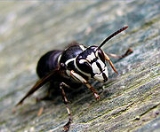
Bald-faced hornet

 
Bald Faced Hornet

   Email Print
   Bookmark   Link


Bald-faced hornet


Dolichovespula maculata is a North America
North America

North America is the northern continent of the Americas, situated in the Earth's northern hemisphere and almost totally in the western hemisphere....
n insect which, despite commonly being called the bald-faced hornet (or white-faced hornet), is not a true hornet
Hornet

Hornets are the largest eusociality wasps, that reach up to 45 millimetres in length. The true hornets make up the genus Vespa, and are distinguished from other vespines by the width of the vertex , which is proportionally larger in Vespa; and by the anteriorly rounded gasters ....
 at all. It belongs to a genus of wasp
WAsP

WAsP is a PC program for predicting wind climates, wind resources, and power productions from wind turbines and wind farms. The predictions are based on wind data measured at stations in the same region....
s called yellowjacket
Yellowjacket

Yellowjacket or yellow-jacket is the common name in North America for predatory wasps of the genus Vespula and Dolichovespula. Members of these genera are known simply as "wasps" in other English language countries....
s in North America, and is more distantly related to true hornets like the Asian giant hornet
Asian giant hornet

The Asian giant hornet, Vespa mandarinia, also known as the Japanese hornet and known colloquially as the yak-killer hornet, is the world's largest hornet, native to temperate and tropical Eastern Asia....
 or European hornet
European hornet

The European hornet Vespa crabro, commonly known simply as the "hornet", is the largest European eusociality wasp. Its name is not to be confused with the colloquial use of "hornet" for the bald-faced hornet, or other social wasps in other countries....
, but the term "hornet" is often used colloquially to refer to any vespine with an exposed aerial nest.

The bald-faced hornet lives throughout North America
North America

North America is the northern continent of the Americas, situated in the Earth's northern hemisphere and almost totally in the western hemisphere....
, including southern Canada
Canada

Canada is a country occupying most of northern North America, extending from the Atlantic Ocean in the east to the Pacific Ocean in the west and northward into the Arctic Ocean....
, the Rocky Mountains, the western coast of the United States, and most of the eastern US.


Discussion
Ask a question about 'Bald-faced hornet'
Start a new discussion about 'Bald-faced hornet'
Answer questions from other users
Full Discussion Forum


Encyclopedia


Dolichovespula maculata is a North America
North America

North America is the northern continent of the Americas, situated in the Earth's northern hemisphere and almost totally in the western hemisphere....
n insect which, despite commonly being called the bald-faced hornet (or white-faced hornet), is not a true hornet
Hornet

Hornets are the largest eusociality wasps, that reach up to 45 millimetres in length. The true hornets make up the genus Vespa, and are distinguished from other vespines by the width of the vertex , which is proportionally larger in Vespa; and by the anteriorly rounded gasters ....
 at all. It belongs to a genus of wasp
WAsP

WAsP is a PC program for predicting wind climates, wind resources, and power productions from wind turbines and wind farms. The predictions are based on wind data measured at stations in the same region....
s called yellowjacket
Yellowjacket

Yellowjacket or yellow-jacket is the common name in North America for predatory wasps of the genus Vespula and Dolichovespula. Members of these genera are known simply as "wasps" in other English language countries....
s in North America, and is more distantly related to true hornets like the Asian giant hornet
Asian giant hornet

The Asian giant hornet, Vespa mandarinia, also known as the Japanese hornet and known colloquially as the yak-killer hornet, is the world's largest hornet, native to temperate and tropical Eastern Asia....
 or European hornet
European hornet

The European hornet Vespa crabro, commonly known simply as the "hornet", is the largest European eusociality wasp. Its name is not to be confused with the colloquial use of "hornet" for the bald-faced hornet, or other social wasps in other countries....
, but the term "hornet" is often used colloquially to refer to any vespine with an exposed aerial nest.

The bald-faced hornet lives throughout North America
North America

North America is the northern continent of the Americas, situated in the Earth's northern hemisphere and almost totally in the western hemisphere....
, including southern Canada
Canada

Canada is a country occupying most of northern North America, extending from the Atlantic Ocean in the east to the Pacific Ocean in the west and northward into the Arctic Ocean....
, the Rocky Mountains, the western coast of the United States, and most of the eastern US. They are most common in the southeastern United States
United States

The United States of America is a Federal government constitutional republic comprising U.S. state and a federal district. The country is situated mostly in central North America, where its Contiguous United States and Washington, D.C., the Capital districts and territories, lie between the Pacific Ocean and Atlantic Oceans, Borders of the U...
. They are best known for their large football-shaped paper
Paper

Paper is thin material mainly used for writing upon, printing upon or packaging. It is produced by pressing together moist fibers, typically cellulose pulp derived from wood, rags or grasses, and drying them into flexible sheets....
 nest
Nest

A nest is a place of refuge to hold an animal's Egg s and/or provide a place to live or raise offspring. They are usually made of some life material such as twigs, grass, and leaf; or may simply be a depression in the ground, or a hole in a tree, rock or building....
, which they build in the spring for raising their young. These nests can sometimes reach 3 feet tall. Like the median wasp
Median wasp

The median wasp, Dolichovespula media, is a wasp of the genus Dolichovespula native to Europe. Aside from its black-and-yellow coloration, it is very similar to Dolichovespula maculata, the bald-faced hornet, which is found in the USA, Alaska and Canada....
 Dolichovespula media in Europe
Europe

Europe is, conventionally, one of the world's seven continents. Comprising the westernmost peninsula of Eurasia, Europe is generally divided from Asia to its east by the water divide of the Ural Mountains, the Ural , the Caspian Sea, and by the Caucasus Mountains to the southeast....
, bald-faced hornets are extremely protective of their nests and will sting repeatedly if disturbed.

Every year young queens that were born and fertilized
Fertilisation

Fertilisation , is the fusion of gametes to produce a new organism. In animals, the process involves a sperm fusing with an ovum, which eventually leads to the development of an embryo....
 the previous year start a new colony and raise their young. The workers expand the nest by chewing up wood
Wood

Wood is an organic material; in the strict sense wood is produced as secondary xylem in the stems of woody plants, notably trees but also shrubs, etc....
 that mixes with a starch
Starch

File:Amylose2.svgFile:Amylopektin Sessel.svgStarch or amylum is a polysaccharide carbohydrate consisting of a large number of glucose units joined together by glycosidic bonds....
 in their saliva
Saliva

Saliva is the watery and usually frothy substance produced in the mouths of humans and most other animals. Saliva is produced in and secreted from the salivary glands....
, which they spread with their mandible
Mandible

The mandible or inferior maxillary bone forms the lower jaw and holds the lower tooth in place. It also refers to both the upper and lower sections of the beaks of birds....
s and legs to dry into paper. The workers also guard the nest and collect nectar and arthropod
Arthropod

Arthropods are animals belonging to the Scientific classification Arthropoda , and include the insects, arachnids, crustaceans, and others....
s to feed the larvae. This continues through summer and into fall. As winter approaches, the wasps die, except for young fertilized queens which hibernate underground or in hollow trees. The nest is generally abandoned by winter, and will most likely not be reused. When spring arrives the young queens emerge, and the cycle begins again.

Bald-faced hornets visit flowers, especially in late summer, and can be minor pollinator
Pollinator

A pollinator is the biotic agent that moves pollen from the male anthers of a flower to the female carpel of a flower to accomplish fertilization or syngamy of the female gamete in the ovule of the flower by the male gamete from the pollen grain....
s.

Like other social wasps, bald-faced hornets have a caste system made up of the following:

  1. Queens — fertile females which begin the colonies and lay eggs.
  2. Workers — infertile females which do the manual labor.
  3. Drones — males, which have no stingers, and are born from unfertilized eggs.

Photos


External links

  • - "Hornets: Gentle Giants!" web site.