

Xiaolongbao

Encyclopedia
Xiaolongbao is a type of steamed bun or baozi
from eastern China
, especially Shanghai
and Wuxi
. It is traditionally steamed in small bamboo baskets, hence the name (xiaolong is literally small steaming basket). Xiaolongbao are often referred to as soup dumplings or simply dumplings in English, but are not regarded as "dumplings" in China - see English translation below.
Xiaolongbao are known as xiaolong mantou
in Shanghainese
. Mantou describes both filled and unfilled buns in southern China, but only describes unfilled buns in northern China.
(dumpling) has meant that the xiaolongbao is sometimes classified as a dumpling
outside of China. It is, however, distinct from both steamed and boiled jiaozi in texture and method of production, and is never regarded as a jiaozi (which is more usually translated as dumpling) inside China. As is traditional for buns of various sizes in the Jiangnan
region, xiaolongbao are pinched at the top prior to steaming, so the skin has a circular cascade of ripples around the crown, whereas jiaozi are usually made from a round piece of dough folded in half, and pinched along the semicircle.
Some English sources translate xiaolongbao as "soup dumpling". As well as causing confusion between the xiaolongbao and the tang bao
, which means literally "soup bun", "soup dumpling" is more likely to be understood by a Chinese speaker to be jiaozi
or possibly wonton
s served in soup.
. This means that their skin is tender, smoother, and somewhat translucent, rather than being white and fluffy.
Xiaolongbao are traditionally filled with pork, but variations include other meats, seafood and vegetarian fillings, as well as other possibilities. One popular and commonly seen variant is pork with minced crab meat and roe. The characteristic soup-filled kind are created by wrapping solid meat aspic
inside the skin alongside the meat filling. Heat from steaming then melts the gelatin
-gelled aspic into soup. In modern times, refrigeration has made the process of making xiaolongbao during hot weather easier, since making gelled aspic is much more difficult at room temperature.
Semi-leavened dough is uncommon in northern China, and in those parts of China small buns made with fully leavened dough are often also called "xiaolongbao". These buns are sometimes marketed as "Hangzhou
-style" to distinguish them from the Jiangnan-style buns.
or snack item, as well as a kind of xiaochi
or "small eat". The buns are served hot in the bamboo baskets in which they were steamed, usually on a bed of dried leaves or on a woven mat, although some restaurants today use napa cabbage
instead. The buns are usually dipped in Chinkiang vinegar
with ginger
slivers. They are traditionally served with a clear soup.
The buns are traditionally part of Jiangnan-style morning tea. In Cantonese
regions and the West it is also commonly served as a Cantonese yum cha
item. While not traditionally eaten as part of a main meal, some restaurants have in recent years begun serving xiaolongbao as a main dish.
Frozen xiaolongbao are now mass-produced and a popular frozen food
sold worldwide.
 Shanghai-style xiaolongbao originated in Nanxiang
, a suburb of Shanghai
in the Jiading District
. The inventor of xiaolongbao sold them in his first store in Nanxiang next to the town's notable park, Guyi Garden
. From there the xiaolongbao expanded into downtown Shanghai and outward.
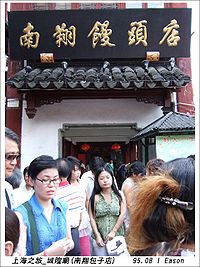
Two specialist xiaolongbao restaurants are often regarded as the most authentic. One is Nanxiang Mantou Dian (Nanxiang Bun Shop), which derives from the original store in Nanxiang
but is now located in the City God Temple
precinct. It is famed for its crab-meat-filled buns. The other is Gulong Restaurant, at the original site next to Guyi Garden in Nanxiang.
Jia Jia Tan Bao next to the People's Square
makes many types and has a long queue waiting to order. Girls fold the dumplings in view from the restaurant.
Baozi
A bāozi or simply known as bao, bau, humbow, nunu, bausak, pow or pau is a type of steamed, filled bun or bread-like item in various Chinese cuisines, as there is much variation as to the fillings and the preparations...
from eastern China
China
Chinese civilization may refer to:* China for more general discussion of the country.* Chinese culture* Greater China, the transnational community of ethnic Chinese.* History of China* Sinosphere, the area historically affected by Chinese culture...
, especially Shanghai
Shanghai
Shanghai is the largest city by population in China and the largest city proper in the world. It is one of the four province-level municipalities in the People's Republic of China, with a total population of over 23 million as of 2010...
and Wuxi
Wuxi
Wuxi is an old city in Jiangsu province, People's Republic of China. Split in half by Lake Tai, Wuxi borders Changzhou to the west and Suzhou to the east. The northern half looks across to Taizhou across the Yangtze River, while the southern half also borders the province of Zhejiang to the south...
. It is traditionally steamed in small bamboo baskets, hence the name (xiaolong is literally small steaming basket). Xiaolongbao are often referred to as soup dumplings or simply dumplings in English, but are not regarded as "dumplings" in China - see English translation below.
Xiaolongbao are known as xiaolong mantou
Mantou
Mantou, often referred to as Chinese steamed bun/bread, is a kind of steamed bun originating in China. They are typically eaten as a staple in northern parts of China where wheat, rather than rice, is grown. They are made with milled wheat flour, water and leavening agents...
in Shanghainese
Shanghainese
Shanghainese , or the Shanghai language , is a dialect of Wu Chinese spoken in the city of Shanghai and the surrounding region. It is classified as part of the Sino-Tibetan family of languages. Shanghainese, like other Wu dialects, is largely not mutually intelligible with other Chinese varieties...
. Mantou describes both filled and unfilled buns in southern China, but only describes unfilled buns in northern China.
English translation
The similarities between the appearance of xiaolongbao and jiaoziJiaozi
Jiǎozi 餃子 or 饺子 , bánh bột luộc , gyōza , Mo:Mo: or Momocha म:म: or ममचा , or pot sticker is a Chinese dumpling widely spread to Japan, Eastern and Western Asia.Jiaozi typically consist of a ground meat and/or vegetable filling wrapped into...
(dumpling) has meant that the xiaolongbao is sometimes classified as a dumpling
Dumpling
Dumplings are cooked balls of dough. They are based on flour, potatoes or bread, and may include meat, fish, vegetables, or sweets. They may be cooked by boiling, steaming, simmering, frying, or baking. They may have a filling, or there may be other ingredients mixed into the dough. Dumplings may...
outside of China. It is, however, distinct from both steamed and boiled jiaozi in texture and method of production, and is never regarded as a jiaozi (which is more usually translated as dumpling) inside China. As is traditional for buns of various sizes in the Jiangnan
Jiangnan
Jiangnan or Jiang Nan is a geographic area in China referring to lands immediately to the south of the lower reaches of the Yangtze River, including the southern part of the Yangtze Delta...
region, xiaolongbao are pinched at the top prior to steaming, so the skin has a circular cascade of ripples around the crown, whereas jiaozi are usually made from a round piece of dough folded in half, and pinched along the semicircle.
Some English sources translate xiaolongbao as "soup dumpling". As well as causing confusion between the xiaolongbao and the tang bao
Tang bao
Tang bao is a large, soup-filled baozi from Jingjiang, China. Two forms exist. The first looks similar to normal baozi and the second is steamed in a bamboo steamer. The former is more traditional and is eaten by biting it open to empty its liquid by spoon. The other is more modern and the liquid...
, which means literally "soup bun", "soup dumpling" is more likely to be understood by a Chinese speaker to be jiaozi
Jiaozi
Jiǎozi 餃子 or 饺子 , bánh bột luộc , gyōza , Mo:Mo: or Momocha म:म: or ममचा , or pot sticker is a Chinese dumpling widely spread to Japan, Eastern and Western Asia.Jiaozi typically consist of a ground meat and/or vegetable filling wrapped into...
or possibly wonton
Wonton
Not to be confused with WantonA wonton is a type of dumpling commonly found in a number of Chinese cuisines.-Filling:...
s served in soup.
Ingredients
Chinese buns in general may be divided into two types, depending on the degree of leavening of the flour skin. Steamed buns made with raised flour are seen throughout China and are what is usually referred to as baozi. Steamed xiolongbao made with partially raised flour are more commonly seen in the southJiangnan
Jiangnan or Jiang Nan is a geographic area in China referring to lands immediately to the south of the lower reaches of the Yangtze River, including the southern part of the Yangtze Delta...
. This means that their skin is tender, smoother, and somewhat translucent, rather than being white and fluffy.
Xiaolongbao are traditionally filled with pork, but variations include other meats, seafood and vegetarian fillings, as well as other possibilities. One popular and commonly seen variant is pork with minced crab meat and roe. The characteristic soup-filled kind are created by wrapping solid meat aspic
Aspic
Aspic is a dish in which ingredients are set into a gelatin made from a meat stock or consommé. Non-savory dishes, often made with commercial gelatin mixes without stock or consommé, are usually called gelatin salads....
inside the skin alongside the meat filling. Heat from steaming then melts the gelatin
Gelatin
Gelatin is a translucent, colorless, brittle , flavorless solid substance, derived from the collagen inside animals' skin and bones. It is commonly used as a gelling agent in food, pharmaceuticals, photography, and cosmetic manufacturing. Substances containing gelatin or functioning in a similar...
-gelled aspic into soup. In modern times, refrigeration has made the process of making xiaolongbao during hot weather easier, since making gelled aspic is much more difficult at room temperature.
Semi-leavened dough is uncommon in northern China, and in those parts of China small buns made with fully leavened dough are often also called "xiaolongbao". These buns are sometimes marketed as "Hangzhou
Hangzhou
Hangzhou , formerly transliterated as Hangchow, is the capital and largest city of Zhejiang Province in Eastern China. Governed as a sub-provincial city, and as of 2010, its entire administrative division or prefecture had a registered population of 8.7 million people...
-style" to distinguish them from the Jiangnan-style buns.
Serving
Traditionally the xiaolongbao is a kind of dim sumDim sum
Dim sum refers to a style of Chinese food prepared as small bite-sized or individual portions of food traditionally served in small steamer baskets or on small plates...
or snack item, as well as a kind of xiaochi
Xiaochi
Xiaochi are an important category of Chinese food, substantial snacks along the lines of Spanish tapas or Levantine meze.Xiaochi are not typically cooked in homes nor are they featured prominently on the menus of more formal reaturants...
or "small eat". The buns are served hot in the bamboo baskets in which they were steamed, usually on a bed of dried leaves or on a woven mat, although some restaurants today use napa cabbage
Napa cabbage
Napa cabbage , also known as celery cabbage, is a type of Chinese cabbage originating near the Beijing region of China, and is widely used in East Asian cuisine. In much of the world, this is the vegetable referred to as "Chinese cabbage"...
instead. The buns are usually dipped in Chinkiang vinegar
Rice vinegar
Rice vinegar is a vinegar made from fermented rice or rice wine in China, Japan, Korea, and Vietnam.-Chinese:Chinese rice vinegars are stronger than Japanese ones, and range in colour from clear to various shades of red and brown...
with ginger
Ginger
Ginger is the rhizome of the plant Zingiber officinale, consumed as a delicacy, medicine, or spice. It lends its name to its genus and family . Other notable members of this plant family are turmeric, cardamom, and galangal....
slivers. They are traditionally served with a clear soup.
The buns are traditionally part of Jiangnan-style morning tea. In Cantonese
Guangdong
Guangdong is a province on the South China Sea coast of the People's Republic of China. The province was previously often written with the alternative English name Kwangtung Province...
regions and the West it is also commonly served as a Cantonese yum cha
Yum cha
Yum cha , also known as Ban ming , is a Chinese style morning or afternoon tea, which involves drinking Chinese tea and eating dim sum dishes...
item. While not traditionally eaten as part of a main meal, some restaurants have in recent years begun serving xiaolongbao as a main dish.
Frozen xiaolongbao are now mass-produced and a popular frozen food
Frozen food
Freezing food preserves it from the time it is prepared to the time it is eaten. Since early times, farmers, fishermen, and trappers have preserved their game and produce in unheated buildings during the winter season. Freezing food slows down decomposition by turning water to ice, making it...
sold worldwide.
Origins in Shanghai
Nanxiang
Nanxiang is one of the districts in the Shanghai Jiading District.-Sights:It is home to Guyi Garden , a large Ming Dynasty Suzhou-style park...
, a suburb of Shanghai
Shanghai
Shanghai is the largest city by population in China and the largest city proper in the world. It is one of the four province-level municipalities in the People's Republic of China, with a total population of over 23 million as of 2010...
in the Jiading District
Jiading District
Jiading District is one of the 18 districts of Shanghai, People's Republic of China. It has a population of 1,471,100 .-Geography:...
. The inventor of xiaolongbao sold them in his first store in Nanxiang next to the town's notable park, Guyi Garden
GuYi Garden
Guyi Garden is a classical Chinese garden located in Nanxiang, a town in Shanghai Municipality, China. The garden is located about 21 km from the city centre...
. From there the xiaolongbao expanded into downtown Shanghai and outward.
Two specialist xiaolongbao restaurants are often regarded as the most authentic. One is Nanxiang Mantou Dian (Nanxiang Bun Shop), which derives from the original store in Nanxiang
Nanxiang
Nanxiang is one of the districts in the Shanghai Jiading District.-Sights:It is home to Guyi Garden , a large Ming Dynasty Suzhou-style park...
but is now located in the City God Temple
City God Temple
The City God Temple or Chenghuang Miao is a temple located in Shanghai, China, within the old walled city. Today the "City God Temple" not only refers to the large temple complex, but also the traditional district of commerce in the city, surrounding the temple. There are over a hundred stores...
precinct. It is famed for its crab-meat-filled buns. The other is Gulong Restaurant, at the original site next to Guyi Garden in Nanxiang.
Jia Jia Tan Bao next to the People's Square
People's Square (Shanghai)
People's Square is a large public square adjacent to Nanjing Road in the Huangpu District of Shanghai, China. People's Square is the site of Shanghai's municipal government headquarter building, and is used as the standard reference point for measurement of distance in the Shanghai...
makes many types and has a long queue waiting to order. Girls fold the dumplings in view from the restaurant.
See also
- BaoziBaoziA bāozi or simply known as bao, bau, humbow, nunu, bausak, pow or pau is a type of steamed, filled bun or bread-like item in various Chinese cuisines, as there is much variation as to the fillings and the preparations...
- Din Tai FungDin Tai FungDin Tai Fung is an award-winning restaurant originating in Taiwan, specialising in xiaolongbao . Outside its native Taiwan, Din Tai Fung also has its restaurant chains in Australia, China, Hong Kong, Indonesia, Japan, Malaysia, Singapore, South Korea, the United States, Canada, and...
- DumplingDumplingDumplings are cooked balls of dough. They are based on flour, potatoes or bread, and may include meat, fish, vegetables, or sweets. They may be cooked by boiling, steaming, simmering, frying, or baking. They may have a filling, or there may be other ingredients mixed into the dough. Dumplings may...
- JiaoziJiaoziJiǎozi 餃子 or 饺子 , bánh bột luộc , gyōza , Mo:Mo: or Momocha म:म: or ममचा , or pot sticker is a Chinese dumpling widely spread to Japan, Eastern and Western Asia.Jiaozi typically consist of a ground meat and/or vegetable filling wrapped into...
- Nanxiang Bun Shop
- Shanghainese cuisine
- Momo (dumpling)