


William Martin Murphy

Encyclopedia

Ireland
Ireland is an island to the northwest of continental Europe. It is the third-largest island in Europe and the twentieth-largest island on Earth...
nationalist
Irish nationalism
Irish nationalism manifests itself in political and social movements and in sentiment inspired by a love for Irish culture, language and history, and as a sense of pride in Ireland and in the Irish people...
journalist, businessman and politician. A Member of Parliament
Member of Parliament
A Member of Parliament is a representative of the voters to a :parliament. In many countries with bicameral parliaments, the term applies specifically to members of the lower house, as upper houses often have a different title, such as senate, and thus also have different titles for its members,...
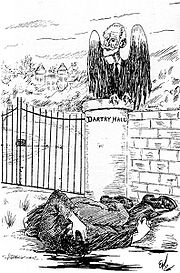
(MP) representing Dublin from 1885 to 1892, he was dubbed 'William Murder Murphy' among Dublin workers and the press due to the Dublin Lockout of 1913. He was arguably both Ireland's first "press baron" and the leading promoter of tram development.
Early life
Murphy was born on 21 November 1844 in BantryBantry
Bantry is a town on the coast of County Cork, Ireland. It lies on the N71 national secondary road at the head of Bantry Bay, a deep-water gulf extending for 30 km to the west...
, County Cork
County Cork
County Cork is a county in Ireland. It is located in the South-West Region and is also part of the province of Munster. It is named after the city of Cork . Cork County Council is the local authority for the county...
, and educated at Belvedere College
Belvedere College
Belvedere College SJ is a private secondary school for boys located on Great Denmark Street, Dublin, Ireland. It is also known as St. Francis Xavier's College....
. When his father, a building contractor, died, he took over the family business. His enterprise and business acumen expanded the business, and he built churches, schools and bridges throughout Ireland, as well as railways and tramways in Britain and Africa.
Politician
He was elected as Irish Parliamentary PartyIrish Parliamentary Party
The Irish Parliamentary Party was formed in 1882 by Charles Stewart Parnell, the leader of the Nationalist Party, replacing the Home Rule League, as official parliamentary party for Irish nationalist Members of Parliament elected to the House of Commons at...
MP for St Patrick's, Dublin
Dublin St Patrick's (UK Parliament constituency)
Dublin St Patrick's, a division of Dublin, was a UK parliamentary constituency in Ireland. It returned one Member of Parliament to the British House of Commons 1885–1922. It had three wards – Merchant's Quay, Usher's Quay and Wood Quay....
at the 1885 general election
United Kingdom general election, 1885
-Seats summary:-See also:*List of MPs elected in the United Kingdom general election, 1885*Parliamentary Franchise in the United Kingdom 1885–1918*Representation of the People Act 1884*Redistribution of Seats Act 1885-References:...
, taking his seat in the House of Commons of the United Kingdom of Great Britain and Ireland
United Kingdom of Great Britain and Ireland
The United Kingdom of Great Britain and Ireland was the formal name of the United Kingdom during the period when what is now the Republic of Ireland formed a part of it....
. He was a member of the informal grouping, the "Bantry band" - a group of politicians who hailed from the Bantry Bay area. The Bantry Band was also disparagingly dubbed the "Pope's
Pope
The Pope is the Bishop of Rome, a position that makes him the leader of the worldwide Catholic Church . In the Catholic Church, the Pope is regarded as the successor of Saint Peter, the Apostle...
brass band". Its most famous member was Timothy Healy
Timothy Michael Healy
Timothy Michael Healy, KC , also known as Tim Healy, was an Irish nationalist politician, journalist, author, barrister and one of the most controversial Irish Members of Parliament in the House of Commons of the United Kingdom of Great Britain and Ireland...
MP and included Timothy Harrington MP, sometime Lord Mayor of Dublin City - however, Harrington (unlike Healy and Murphy) was a Parnellite in the 1890s. (Tim Harrington MP was not the same individual as TR Harrington, who edited the Irish Independent from 1905–31, though they both came from the Bantry/Schull area in West Cork.)
When the Irish Parliamentary Party split in 1890 over Charles Stewart Parnell
Charles Stewart Parnell
Charles Stewart Parnell was an Irish landowner, nationalist political leader, land reform agitator, and the founder and leader of the Irish Parliamentary Party...
's leadership, Murphy sided with the majority Anti-Parnellites
Irish National Federation
The Irish National Federation was a nationalist political party in Ireland. It was founded in March 1891 by former members of the Irish National League who had left the Irish Parliamentary Party in protest when Charles Stewart Parnell refused to resign the party leadership as a result of his...
. However, Dublin emerged as a Parnellite stronghold and in the bitter general election of 1892, Murphy lost his seat by over three to one to a Parnellite newcomer, William Field
William Field (Irish politician)
William Field was an Irish butcher from Dublin, and a nationalist politician. From 1892 to 1918 he was Member of Parliament for Dublin St Patrick's, taking his seat in the House of Commons of the United Kingdom of Great Britain and Ireland.His father was a supporter of Young Ireland...
.
Murphy was the principal financial backer of the "Healyite" newspapers the National Press and the Daily Nation. His support for Healy attracted the hostility of the majority anti-Parnellite faction led by John Dillon. He made two attempts to return to Parliament, at Kerry South
County Kerry
Kerry means the "people of Ciar" which was the name of the pre-Gaelic tribe who lived in part of the present county. The legendary founder of the tribe was Ciar, son of Fergus mac Róich. In Old Irish "Ciar" meant black or dark brown, and the word continues in use in modern Irish as an adjective...
in 1895 and Mayo North
County Mayo
County Mayo is a county in Ireland. It is located in the West Region and is also part of the province of Connacht. It is named after the village of Mayo, which is now generally known as Mayo Abbey. Mayo County Council is the local authority for the county. The population of the county is 130,552...
in 1900, but both were unsuccessful because of Dillonite opposition.
Publisher
In 1900, he bought the insolvent Irish Daily Independent from the Parnellites, merging it with the Daily Nation. In 1900 he re-launched this as a cheap mass-circulation newspaper, which rapidly displaced the Freeman's JournalFreeman's Journal
The Freeman's Journal was the oldest nationalist newspaper in Ireland. It was founded in 1763 by Charles Lucas and was identified with radical 18th century Protestant patriot politicians Henry Grattan and Henry Flood...
as Ireland's most popular nationalist paper. In 1906, he founded the Sunday Independent newspaper.
He refused a knighthood from King Edward VII in 1907 after organising a controversial International Exhibition
Irish International Exhibition (1907)
The Irish International Exhibition was a world's fair held in Dublin, Ireland, in 1907, when the country was still part of the United Kingdom.-Summary:...
in Herbert Park
Herbert Park
Herbert Park is the name of a road and a public park in Ballsbridge, Dublin.-History:The land used for the park was given to the city by the Earl of Pembroke whose family name was Herbert. In 1907, the World Fair known as the Irish International Exhibition was held in Ballsbridge...
, Dublin (it was opposed by many nationalists because it was cosmopolitan and encouraged the purchase of imported goods). In fact, the King Edward VII was in the process of knighting Murphy when he refused. Murphy appears to have been motivated by pride; he did not wish to have it said that he had angled for a title and compromised his nationalist principles.
Murphy was highly critical of the Irish Parliamentary Party; from 1914 he used the Irish Independent to oppose the partition of Ireland and advocate Dominion Home Rule involving full fiscal autonomy (which the 1914 Home Rule Act would not have granted).
Anti-trade unionist
Worried that the trade unions would destroy his Dublin tram systemDublin tram system
Dublin tramways was a system of trams in Dublin, Ireland which commenced line-laying in 1871, and began service in 1872, following trials in the mid-1860s....
, he led Dublin employers against the trade unions led by James Larkin
James Larkin
James Larkin was an Irish trade union leader and socialist activist, born to Irish parents in Liverpool, England. He and his family later moved to a small cottage in Burren, southern County Down. Growing up in poverty, he received little formal education and began working in a variety of jobs...
, an opposition that culminated in the Dublin Lockout of 1913. This made him extremely unpopular with many, being depicted as a vulture or a vampire in the workers' press.
After the 1916 Easter Rising
Easter Rising
The Easter Rising was an insurrection staged in Ireland during Easter Week, 1916. The Rising was mounted by Irish republicans with the aims of ending British rule in Ireland and establishing the Irish Republic at a time when the British Empire was heavily engaged in the First World War...
he bought ruined buildings in Abbey Street
Abbey Street
Abbey Street is located on Dublin's Northside and is one of the principal shopping streets of Dublin, running from the Customs House in the east to Capel Street in the west...
as sites for his newspaper offices, however it was his viewpoints (expressed through his Irish Independent) that made him even more unpopular, by calling for the executions of Sean MacDiarmada and James Connolly
James Connolly
James Connolly was an Irish republican and socialist leader. He was born in the Cowgate area of Edinburgh, Scotland, to Irish immigrant parents and spoke with a Scottish accent throughout his life. He left school for working life at the age of 11, but became one of the leading Marxist theorists of...
at a point when the Irish public began to feel sympathy for their cause. Murphy privately disavowed the editorial, claiming it had been written and published without his knowledge.
Anti-conciliationist
He was invited in 1917 to take part in talks during the Irish ConventionIrish Convention
The Irish Convention was an assembly which sat in Dublin, Ireland from July 1917 until March 1918 to address the Irish Question and other constitutional problems relating to an early enactment of self-government for Ireland, to debate its wider future, discuss and come to an understanding on...
which was called to agree terms for the implementation of the suspended 1914 Home Rule Act
Home Rule Act 1914
The Government of Ireland Act 1914 , also known as the Third Home Rule Bill, was an Act passed by the Parliament of the United Kingdom intended to provide self-government for Ireland within the United Kingdom of Great Britain and Ireland.The Act was the first law ever passed by the Parliament of...
. However he discovered that John Redmond
John Redmond
John Edward Redmond was an Irish nationalist politician, barrister, MP in the House of Commons of the United Kingdom of Great Britain and Ireland and leader of the Irish Parliamentary Party from 1900 to 1918...
was negotiating agreeable terms with Unionists under the "Midleton plan" to avoid the partition of Ireland
Partition of Ireland
The partition of Ireland was the division of the island of Ireland into two distinct territories, now Northern Ireland and the Republic of Ireland . Partition occurred when the British Parliament passed the Government of Ireland Act 1920...
but at the partial loss of full Irish fiscal autonomy. This infuriated Murphy who criticized the intention in his newspaper
Irish Independent
The Irish Independent is Ireland's largest-selling daily newspaper that is published in both compact and broadsheet formats. It is the flagship publication of Independent News & Media.-History:...
, which severely damaged the Irish Parliamentary Party. However, the Convention remained inconclusive, and the ensuing demise of the Irish party resulted in the rise of Sinn Féin
Sinn Féin
Sinn Féin is a left wing, Irish republican political party in Ireland. The name is Irish for "ourselves" or "we ourselves", although it is frequently mistranslated as "ourselves alone". Originating in the Sinn Féin organisation founded in 1905 by Arthur Griffith, it took its current form in 1970...
, whose separatist policies Murphy also did not agree with.
Murphy died in 1919. His family controlled Independent Newspapers until the early 1970s, when the group was sold to Tony O'Reilly
Tony O'Reilly
Sir Anthony Joseph Francis O'Reilly is an Irish businessman and former international rugby union player. He is known for his involvement the Independent News & Media Group, which he led from 1973 to 2009, and as former CEO and Chairman of the H.J. Heinz Company. He was the leading shareholder of...
.