

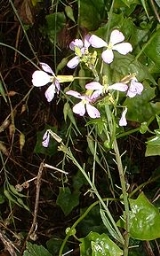
Wild radish

Encyclopedia
Wild Radish or Jointed Charlock, Raphanus raphanistrum, is a flowering plant
in the family Brassicaceae
. It is sometimes claimed to be the ancestor of the edible radish
, Raphanus sativus. Native to Asia
(or, according to some authorities, the Mediterranean), it has been introduced
into most parts of the world, and is regarded as a damagingly invasive species
in many, for example Australia
. It spreads rapidly, and is often found growing on roadsides or in other places where the ground has been disturbed.
In southeastern USA, the pale yellow form is common, sometimes entirely taking over fields in wintertime. It is often erroneously identified as mustard
. It is a significant source of pollen and nectar for a variety of pollinators, especially honey bees during the very early spring starting buildup.
Wild radish grows as an annual
or biennial plant
, with attractive four-petalled flowers 15-20 mm across and varying in colour, usually from white to purple but sometimes light orange to yellow, often with colour shading within a single petal. It is frost hardy, and even hard freezes only temporarily interrupt bloom. It blooms in early spring to late summer with flowers very similar to those of the searocket, which is found in some of the same regions and is easily distinguished from it by having thinner, non-succulent stems and leaves. It has a single taproot
which is similar to that of the cultivated radish but less enlarged.
Flowering plant
The flowering plants , also known as Angiospermae or Magnoliophyta, are the most diverse group of land plants. Angiosperms are seed-producing plants like the gymnosperms and can be distinguished from the gymnosperms by a series of synapomorphies...
in the family Brassicaceae
Brassicaceae
Brassicaceae, a medium sized and economically important family of flowering plants , are informally known as the mustards, mustard flowers, the crucifers or the cabbage family....
. It is sometimes claimed to be the ancestor of the edible radish
Radish
The radish is an edible root vegetable of the Brassicaceae family that was domesticated in Europe, in pre-Roman times. They are grown and consumed throughout the world. Radishes have numerous varieties, varying in size, color and duration of required cultivation time...
, Raphanus sativus. Native to Asia
Asia
Asia is the world's largest and most populous continent, located primarily in the eastern and northern hemispheres. It covers 8.7% of the Earth's total surface area and with approximately 3.879 billion people, it hosts 60% of the world's current human population...
(or, according to some authorities, the Mediterranean), it has been introduced
Introduced species
An introduced species — or neozoon, alien, exotic, non-indigenous, or non-native species, or simply an introduction, is a species living outside its indigenous or native distributional range, and has arrived in an ecosystem or plant community by human activity, either deliberate or accidental...
into most parts of the world, and is regarded as a damagingly invasive species
Invasive species
"Invasive species", or invasive exotics, is a nomenclature term and categorization phrase used for flora and fauna, and for specific restoration-preservation processes in native habitats, with several definitions....
in many, for example Australia
Australia
Australia , officially the Commonwealth of Australia, is a country in the Southern Hemisphere comprising the mainland of the Australian continent, the island of Tasmania, and numerous smaller islands in the Indian and Pacific Oceans. It is the world's sixth-largest country by total area...
. It spreads rapidly, and is often found growing on roadsides or in other places where the ground has been disturbed.
In southeastern USA, the pale yellow form is common, sometimes entirely taking over fields in wintertime. It is often erroneously identified as mustard
White Mustard
White mustard is an annual plant of the family Brassicaceae. It is sometimes also referred to as Brassica alba or B. hirta...
. It is a significant source of pollen and nectar for a variety of pollinators, especially honey bees during the very early spring starting buildup.
Wild radish grows as an annual
Annual plant
An annual plant is a plant that usually germinates, flowers, and dies in a year or season. True annuals will only live longer than a year if they are prevented from setting seed...
or biennial plant
Biennial plant
A biennial plant is a flowering plant that takes two years to complete its biological lifecycle. In the first year the plant grows leaves, stems, and roots , then it enters a period of dormancy over the colder months. Usually the stem remains very short and the leaves are low to the ground, forming...
, with attractive four-petalled flowers 15-20 mm across and varying in colour, usually from white to purple but sometimes light orange to yellow, often with colour shading within a single petal. It is frost hardy, and even hard freezes only temporarily interrupt bloom. It blooms in early spring to late summer with flowers very similar to those of the searocket, which is found in some of the same regions and is easily distinguished from it by having thinner, non-succulent stems and leaves. It has a single taproot
Taproot
A taproot is an enlarged, somewhat straight to tapering plant root that grows vertically downward. It forms a center from which other roots sprout laterally.Plants with taproots are difficult to transplant...
which is similar to that of the cultivated radish but less enlarged.