


Wiener Neustadt

Encyclopedia
Main sights
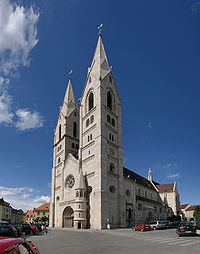
- The Late-RomanesqueRomanesque architectureRomanesque architecture is an architectural style of Medieval Europe characterised by semi-circular arches. There is no consensus for the beginning date of the Romanesque architecture, with proposals ranging from the 6th to the 10th century. It developed in the 12th century into the Gothic style,...
Dom, consecrated in 1279 and cathedral from 1469 to 1785. The choir and transept, in Gothic style, are from the 14th century. In the late 15th century 12 statues of the Apostles were added in the apse, while the bust of Cardinal Melchior KleslMelchior KleslMelchior Klesl was an Austrian statesman and cardinal of the Roman Catholic church during the time of the Counter-Reformation...
is attributed to Gian Lorenzo BerniniGian Lorenzo BerniniGian Lorenzo Bernini was an Italian artist who worked principally in Rome. He was the leading sculptor of his age and also a prominent architect...
. - Former church of St. Peter an der Sperr, erected in the 13th century and modified in the mid-15th century by the imperial architect Peter von Pusica. Secularized in the 19th century, it is now used for exhibitions.
- The Military AcademyMilitary academyA military academy or service academy is an educational institution which prepares candidates for service in the officer corps of the army, the navy, air force or coast guard, which normally provides education in a service environment, the exact definition depending on the country concerned.Three...
, a 13th century formerly four-towered castle which was later used as residence by Frederick III of Habsburg. The latter had it enlarged and the St. George Chapel built in the mid-15th century: it has notable glassworks and houses the tomb of Emperor Maximilian I. It became seat of the Academy in 1752. Destroyed during World War II, it has been rebuilt to the original appearance.
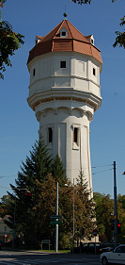
- Water towerWater towerA water tower or elevated water tower is a large elevated drinking water storage container constructed to hold a water supply at a height sufficient to pressurize a water distribution system....
- Tower of Tortures (early 13th century), now housing a private weapons collection.
- Mariensäule (a plague column at Hauptplatz)
- Church of the Capuchins, documented from the 13th century. Of the original construction today the Gothic choir (late 14th century) and the statues of St. Mary and St. James can be seen.
- The medieval walls, built using part of the ransom of Richard I of EnglandRichard I of EnglandRichard I was King of England from 6 July 1189 until his death. He also ruled as Duke of Normandy, Duke of Aquitaine, Duke of Gascony, Lord of Cyprus, Count of Anjou, Count of Maine, Count of Nantes, and Overlord of Brittany at various times during the same period...
. - Communal Museum of Wiener Neustadt
- City archives
- Flugmuseum Aviaticum
- Industrial museum
- Hospital museum
- Kurt Ingerl-Gedenkraum
- Mineralogical museum
- Tower museum in the cathedral
Transportation
Wiener Neustadt HauptbahnhofWiener Neustadt Hauptbahnhof
is the Hauptbahnhof at Wiener Neustadt, in the federal state of Lower Austria, south of Vienna.With over 700 trains and 25,000 passengers each day, the station is the busiest in Lower Austria....
connects Wiener Neustadt with other major population centers. It is owned and operated by the Austrian Federal Railway. Wiener Neustadt is also served by Autobahn.
The city has two airfields (a military one which was the first airfield in Austria and a civil one owned by Diamond Aircraft) and is the starting point of Austria's only shipping canal, the Wiener Neustaedter Kanal, which was meant to reach out to Trieste
Trieste
Trieste is a city and seaport in northeastern Italy. It is situated towards the end of a narrow strip of land lying between the Adriatic Sea and Italy's border with Slovenia, which lies almost immediately south and east of the city...
but was never finished.
University, professional schools, vocational academies
Austria's first and largest FachhochschuleFachhochschule
A Fachhochschule or University of Applied Sciences is a German type of tertiary education institution, sometimes specialized in certain topical areas . Fachhochschulen were founded in Germany and later adopted by Austria, Liechtenstein, Switzerland and Greece...
for business and engineering, the University of Applied Sciences Wiener Neustadt
University of Applied Sciences Wiener Neustadt
The University of Applied Sciences Wiener Neustadt is an Austrian Fachhochschule founded in 1994. It has seven areas of specialization. The main campus is in Wiener Neustadt and two smaller campuses are located in Wieselburg and Tulln .The business school also offers a course called "Business...
, is located here.
City partnerships
Monheim am RheinMonheim am Rhein
Monheim am Rhein is a town on the right bank of the river Rhine in North Rhine-Westphalia, Germany. Monheim belongs to the district of Mettmann - with the southern suburbs of Düsseldorf to the north, and the Bergisches Land to the south...
, Germany
Germany
Germany , officially the Federal Republic of Germany , is a federal parliamentary republic in Europe. The country consists of 16 states while the capital and largest city is Berlin. Germany covers an area of 357,021 km2 and has a largely temperate seasonal climate...
Desenzano del Garda
Desenzano del Garda
Desenzano del Garda is a town and comune in the province of Brescia, in Lombardy, Italy, which borders Lake Garda. It is bordered by other communes of Castiglione delle Stiviere, Lonato, Padenghe sul Garda and Sirmione.-History:...
, Italy
Italy
Italy , officially the Italian Republic languages]] under the European Charter for Regional or Minority Languages. In each of these, Italy's official name is as follows:;;;;;;;;), is a unitary parliamentary republic in South-Central Europe. To the north it borders France, Switzerland, Austria and...
Sopron
Sopron
In 1910 Sopron had 33,932 inhabitants . Religions: 64.1% Roman Catholic, 27.8% Lutheran, 6.6% Jewish, 1.2% Calvinist, 0.3% other. In 2001 the city had 56,125 inhabitants...
, Hungary
Hungary
Hungary , officially the Republic of Hungary , is a landlocked country in Central Europe. It is situated in the Carpathian Basin and is bordered by Slovakia to the north, Ukraine and Romania to the east, Serbia and Croatia to the south, Slovenia to the southwest and Austria to the west. The...
, since 1988 Harbin
Harbin
Harbin ; Manchu language: , Harbin; Russian: Харби́н Kharbin ), is the capital and largest city of Heilongjiang Province in Northeast China, lying on the southern bank of the Songhua River...
, People's Republic of China (PRC)
People's Republic of China
China , officially the People's Republic of China , is the most populous country in the world, with over 1.3 billion citizens. Located in East Asia, the country covers approximately 9.6 million square kilometres...
Development of the city
The most recent extension of the city is the CIVITAS NOVA, Latin for new city, an ambitious project for an industrial, research and commercial center. In 2008, on the area of the Civitas Nova, a cancer research center for ion therapyIon therapy
Negative air ionization therapy is the use of air ionisers as an experimental non-pharmaceutical treatment for seasonal affective disorder and mild depression....
will be opened under the name of Med Austron (link in German).
Culture
In 1996 Wiener Neustadt became internationally famous as a so-called "sidewalk" designed by Japanese artist Tadashi Kawamata was built around the main square.Sport
In 19951995 in sports
1995 in sports describes the year's events in world sport.-Alpine skiing:* Alpine Skiing World Cup** Men's overall season champion: Alberto Tomba, Italy** Women's overall season champion: Vreni Schneider, Switzerland-American football:...
Wiener Neustadt was the host of 1995 Speedway Grand Prix of Austria
1995 Speedway Grand Prix of Austria
The 1995 Speedway Grand Prix of Austria was the second race of the 1995 Speedway Grand Prix season. It was take place on 17 June in the ÖAMTC Zweigverein Stadium in Wiener Neustadt, Austria.- Starting positions draw :...
. It was the first, and so far, only Austrian SGP
Speedway Grand Prix of Austria
The Speedway Grand Prix of Austria was a speedway event that was a part of the Speedway Grand Prix Series.-Previous winners:-Classification:-References:...
.
People
- Maximilian I, Holy Roman EmperorMaximilian I, Holy Roman EmperorMaximilian I , the son of Frederick III, Holy Roman Emperor and Eleanor of Portugal, was King of the Romans from 1486 and Holy Roman Emperor from 1493 until his death, though he was never in fact crowned by the Pope, the journey to Rome always being too risky...
- Queen Mariana of SpainMariana of AustriaMariana of Austria was Queen consort of Spain as the second wife of King Philip IV, who was also her maternal uncle...
- Johanna BeisteinerJohanna BeisteinerJohanna Beisteiner is an Austrian classical guitarist.- Life :Johanna Beisteiner received her first guitar lessons at the age of nine at the Josef Matthias Hauer music school in her hometown Wiener Neustadt...
, classical guitarist - Elazar Benyoëtz
- Joseph Matthias Hauer, composer
- Karl MerkatzKarl MerkatzKarl Merkatz is a well-known Austrian actor. He participated in numerous Austrian film productions and plays....
, actor - Kurt Ingerl, sculptor
- Israel IsserleinIsrael IsserleinRabbi Israel Isserlein ben Petachia, also Israel Isserlin, Israel of Neustadt, Israel of Marpurk was a Talmudist, and Halakhist, best known for his Terumat HaDeshen, which served as one source for HaMapah, the component of the Shulkhan Arukh by Moses Isserles.- Biography :Even though...
, SloveniaSloveniaSlovenia , officially the Republic of Slovenia , is a country in Central and Southeastern Europe touching the Alps and bordering the Mediterranean. Slovenia borders Italy to the west, Croatia to the south and east, Hungary to the northeast, and Austria to the north, and also has a small portion of...
n and German rabbiGermanyGermany , officially the Federal Republic of Germany , is a federal parliamentary republic in Europe. The country consists of 16 states while the capital and largest city is Berlin. Germany covers an area of 357,021 km2 and has a largely temperate seasonal climate... - Viktor Gernot, actor and comedian.
- Arnold Grabner, politicianPoliticianA politician, political leader, or political figure is an individual who is involved in influencing public policy and decision making...
and Vice President of the OeOC - Michael HanekeMichael HanekeMichael Haneke is a German born Austrian filmmaker and writer best known for his bleak and disturbing style. His films often document problems and failures in modern society. Haneke has worked in television‚ theatre and cinema. He is also known for raising social issues in his work...
, film directorFilm directorA film director is a person who directs the actors and film crew in filmmaking. They control a film's artistic and dramatic nathan roach, while guiding the technical crew and actors.-Responsibilities:...
Cultural References
Wiener Neustadt is the setting for the book Reluctant Return: A Survivor's Journey to an Austrian town.http://books.google.com/books?id=DDEtbvYi0S4CNeighbouring municipalities
- TheresienfeldTheresienfeldTheresienfeld is a town in the Wiener Neustadt-Land district of Lower Austria, in eastern Austria. It lies 5 km north of Wiener Neustadt, in the southern part of the Vienna Basin...
- NeudörflNeudörflNeudörfl is a town in the district of Mattersburg in Burgenland in Austria....
- LichtenwörthLichtenwörthLichtenwörth is a town in Austria. It is situated by the Leitha and Warmer Fischa.The market town has a kindergarten school, an elementary school and a high school. It also has a music school.- History :The place was first mentioned in the 12th century....
- KatzelsdorfKatzelsdorfKatzelsdorf is an Austrian municipality in the district of Wiener Neustadt-Land in Lower Austria.-Location:Katzelsdorf is located in an area where hot springs are found. It is at the foot of the Rosaliengebirges. Its river is the Leitha and its canal is the Mühlbach.- External links :* *...
- Weikersdorf am SteinfeldeWeikersdorf am Steinfelde----Weikersdorf am Steinfelde is a municipality in the district of Wiener Neustadt-Land in Lower Austria, Austria....
- Bad Fischau-BrunnBad Fischau-BrunnThe market town of Bad Fischau-Brunn is an Austrian municipality in the district of Wiener Neustadt-Land in Lower Austria. It is situated some 50 km south of Vienna at the edge of Viennese Basin.Bad Fischau-Brunn is divided into two Katastralgemeinden:...
See also
- Steinfeld (de)
- Fischa
- Warme Fischa
- Hammerbach
- Kehrbach
- Wiener Neustädter Kanal
- Johannesbach
- FöhrenwaldFöhrenwaldThe Föhrenwald DP camp was one of the largest in post-World War II Europe and the last to close . It was located in the section now known as Waldram in Wolfratshausen in Bavaria, Germany....
, Kleine Föhrenwald - Wiener Neustädter Pforte
- Leitha