

Watertable control

Encyclopedia
Watertable control is the practice of controlling the water table in agricultural land by subsurface drainage with proper criteria to improve the crop production.
aims at controlling the water table
of the groundwater
in originally waterlogged
land at a depth acceptable for the purpose for which the land is used. The depth of the water table with drainage is greater than without.
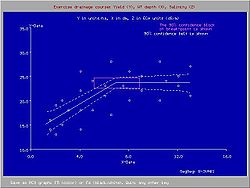
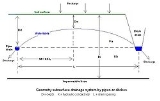
, the purpose of water table control is to establish a depth of the water table (Figure 1) that does no longer interfere negatively with the necessary farm operations and crop yields (Figure 2, made with the SegReg model, see the page: segmented regression
).
In addition, land drainage can help with soil salinity control.
The soil's hydraulic conductivity
plays an important role in drainage design.
The development of agricultural drainage criteria is required to give the designer and manager of the drainage system a target to achieve in terms of maintenance of an optimum depth of the water table.
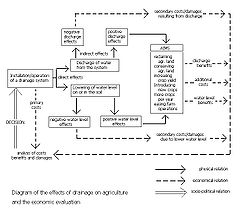
 The optimization of drainage design and the development of drainage criteria are discussed in the article on drainage research
.
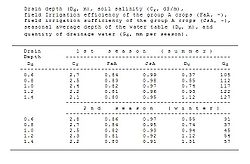
Figure 4 shows an example of the effect of drain depth on soil salinity and various irrigation/drainage parameters as simulated by the SaltMod
program.
started with the digging of relatively shallow open ditches that that received both runoff from the land surface and outflow of groundwater
. Hence the ditches had a surface as well as a subsurface drainage function.
By the end of the 19th century and early in the 20th century it was felt that the ditches were a hindrance for the farm operations and the ditches were replaced by buried lines of clay pipes (tiles), each tile about 30 cm long. Hence the term "tile drainage
".
Since 1960, one started using long, flexible, corrugated plastic
(PVC
or PE
) pipes that could be installed efficiently in one go by trenching machines. The pipes could be pre-wrapped with an envelope material, like synthetic fibre and geotextile
, that would prevent the entry of soil particles into the drains.
Thus, land drainage became a powerful industry. At the same time agriculture was steering towards maximum productivity, so that the installation of drainage systems came in full swing.
.
Nowadays, in some countries, the hardliner trend is reversed. Further, checked or controlled drainage systems were introduced, as shown in Figure 5 and discussed on the page: Drainage system (agriculture)
.
s with parameters like drain depth, depth of the water table, soil depth, hydraulic conductivity
of the soil and drain discharge. The drain discharge is found from an agricultural water balance
.
The computations can be done using computer models like EnDrain.
in these areas can be so wide (more than 1000m) that the installation of vertical drainage systems could be relatively cheap compared to horizontal subsurface drainage (drainage by pipes, ditches, trenches, at a spacing of 100m or less). For the design of a well field for control of the water table, the WellDrain model may be helpful.
.
Description and definitions
Subsurface land drainageDrainage
Drainage is the natural or artificial removal of surface and sub-surface water from an area. Many agricultural soils need drainage to improve production or to manage water supplies.-Early history:...
aims at controlling the water table
Water table
The water table is the level at which the submarine pressure is far from atmospheric pressure. It may be conveniently visualized as the 'surface' of the subsurface materials that are saturated with groundwater in a given vicinity. However, saturated conditions may extend above the water table as...
of the groundwater
Groundwater
Groundwater is water located beneath the ground surface in soil pore spaces and in the fractures of rock formations. A unit of rock or an unconsolidated deposit is called an aquifer when it can yield a usable quantity of water. The depth at which soil pore spaces or fractures and voids in rock...
in originally waterlogged
Waterlogging (agriculture)
Waterlogging refers to the saturation of soil with water. Soil may be regarded as waterlogged when the water table of the groundwater is too high to conveniently permit an anticipated activity, like agriculture....
land at a depth acceptable for the purpose for which the land is used. The depth of the water table with drainage is greater than without.
Purpose
In agricultural land drainageDrainage system (Agriculture)
An agricultural drainage system is a system by which the water level on or in the soil is controlled to enhance agricultural crop production.-Classification:Figure 1 classifies the various types of drainage systems...
, the purpose of water table control is to establish a depth of the water table (Figure 1) that does no longer interfere negatively with the necessary farm operations and crop yields (Figure 2, made with the SegReg model, see the page: segmented regression
Segmented regression
Segmented regression is a method in regression analysis in which the independent variable is partitioned into intervals and a separate line segment is fit to each interval. Segmented or piecewise regression analysis can also be performed on multivariate data by partitioning the various independent...
).
In addition, land drainage can help with soil salinity control.
The soil's hydraulic conductivity
Hydraulic conductivity
Hydraulic conductivity, symbolically represented as K, is a property of vascular plants, soil or rock, that describes the ease with which water can move through pore spaces or fractures. It depends on the intrinsic permeability of the material and on the degree of saturation...
plays an important role in drainage design.
The development of agricultural drainage criteria is required to give the designer and manager of the drainage system a target to achieve in terms of maintenance of an optimum depth of the water table.
Optimization
Optimization of the depth of the water table is related the benefits and costs of the drainage system (Figure 3). The shallower the permissible depth of the water table, the lower the cost of the drainage system to be installed to achieve this depth. However, the lowering of the originally too shallow depth by land drainage entails side effects. These have also to be taken into account, including the costs of mitigation of negative side effects.Drainage research
Drainage research is the study of agricultural drainage systems and their effects to arrive at optimal system design.- Aspects to be covered :...
.
Figure 4 shows an example of the effect of drain depth on soil salinity and various irrigation/drainage parameters as simulated by the SaltMod
SaltMod
SaltMod is computer program for the prediction of the salinity of soil moisture, groundwater and drainage water, the depth of the watertable, and the drain discharge in irrigated agricultural lands, using different hydrologic conditions, varying water management options, including the use of...
program.
History
Historically, agricultural land drainageDrainage system (Agriculture)
An agricultural drainage system is a system by which the water level on or in the soil is controlled to enhance agricultural crop production.-Classification:Figure 1 classifies the various types of drainage systems...
started with the digging of relatively shallow open ditches that that received both runoff from the land surface and outflow of groundwater
Groundwater
Groundwater is water located beneath the ground surface in soil pore spaces and in the fractures of rock formations. A unit of rock or an unconsolidated deposit is called an aquifer when it can yield a usable quantity of water. The depth at which soil pore spaces or fractures and voids in rock...
. Hence the ditches had a surface as well as a subsurface drainage function.
By the end of the 19th century and early in the 20th century it was felt that the ditches were a hindrance for the farm operations and the ditches were replaced by buried lines of clay pipes (tiles), each tile about 30 cm long. Hence the term "tile drainage
Tile drainage
Tile drainage is an agriculture practice that removes excess water from soil subsurface. Whereas irrigation is the practice of adding additional water when the soil is naturally too dry, drainage brings soil moisture levels down for optimal crop growth...
".
Since 1960, one started using long, flexible, corrugated plastic
Plastic
A plastic material is any of a wide range of synthetic or semi-synthetic organic solids used in the manufacture of industrial products. Plastics are typically polymers of high molecular mass, and may contain other substances to improve performance and/or reduce production costs...
(PVC
PVC
Polyvinyl chloride is a plastic.PVC may also refer to:*Param Vir Chakra, India's highest military honor*Peripheral venous catheter, a small, flexible tube placed into a peripheral vein in order to administer medication or fluids...
or PE
Polyethylene
Polyethylene or polythene is the most widely used plastic, with an annual production of approximately 80 million metric tons...
) pipes that could be installed efficiently in one go by trenching machines. The pipes could be pre-wrapped with an envelope material, like synthetic fibre and geotextile
Geotextile
Geotextiles are permeable fabrics which, when used in association with soil, have the ability to separate, filter, reinforce, protect, or drain...
, that would prevent the entry of soil particles into the drains.
Thus, land drainage became a powerful industry. At the same time agriculture was steering towards maximum productivity, so that the installation of drainage systems came in full swing.
Environment
As a result of large scale developments, many modern drainage projects were over-designed, while the negative environmental side effects were ignored. In circles with environmental concern, the profession of land drainage got a poor reputation, sometimes justly so, sometimes unjustified, notably when land drainage was confused with the more encompassing activity of wetland reclamationLand reclamation
Land reclamation, usually known as reclamation, is the process to create new land from sea or riverbeds. The land reclaimed is known as reclamation ground or landfill.- Habitation :...
.
Nowadays, in some countries, the hardliner trend is reversed. Further, checked or controlled drainage systems were introduced, as shown in Figure 5 and discussed on the page: Drainage system (agriculture)
Drainage system (Agriculture)
An agricultural drainage system is a system by which the water level on or in the soil is controlled to enhance agricultural crop production.-Classification:Figure 1 classifies the various types of drainage systems...
.
Drainage design
The design of subsurface drainage systems in terms layout, depth and spacing of the drains is often done using subsurface drainage equationDrainage equation
A drainage equation is an equation describing the relation between depth and spacing of parallel subsurface drains, depth of the watertable, depth and hydraulic conductivity of the soils. It is used in drainage design....
s with parameters like drain depth, depth of the water table, soil depth, hydraulic conductivity
Hydraulic conductivity
Hydraulic conductivity, symbolically represented as K, is a property of vascular plants, soil or rock, that describes the ease with which water can move through pore spaces or fractures. It depends on the intrinsic permeability of the material and on the degree of saturation...
of the soil and drain discharge. The drain discharge is found from an agricultural water balance
Hydrology (agriculture)
Agricultural hydrology is the study of water balance components intervening in agricultural water management, notably in irrigation and drainage.-Water balance components:...
.
The computations can be done using computer models like EnDrain.
Drainage by wells
Subsurface drainage of groundwater can also be accomplished by pumped wells (vertical drainage, in contrast to horizontal drainage). Drainage wells have been used extensively in the Salinity Control and Reclamation Program (SCARP) in the Indus valley of Pakistan. Although the experiences were not overly successful, the feasibility of this technique in areas with deep and permeable aquifers is not to be discarded. The well spacingsWell drainage
Well drainage means drainage of agricultural lands by wells. Agricultural land is drained by pumped wells to improve the soils by controlling water table levels and soil salinity.-Introduction:...
in these areas can be so wide (more than 1000m) that the installation of vertical drainage systems could be relatively cheap compared to horizontal subsurface drainage (drainage by pipes, ditches, trenches, at a spacing of 100m or less). For the design of a well field for control of the water table, the WellDrain model may be helpful.
Classification
A classification of drainage systems is found in the article Drainage system (agriculture)Drainage system (Agriculture)
An agricultural drainage system is a system by which the water level on or in the soil is controlled to enhance agricultural crop production.-Classification:Figure 1 classifies the various types of drainage systems...
.
External links
- American Wick Drain- Manufacturer of strip drain used in watertable management
- Chapters of ILRI publication 16 on "Drainage Principles and Applications" can be viewed in: http://www.alterra.wur.nl/NL/publicaties+Alterra/ILRI-publicaties/Downloadable+publications/
- Website on Waterlogging and Land Drainage : http://www.waterlog.info
- Various articles on Waterlogging and Land Drainage can be freely downloaded from : http://www.waterlog.info/articles.htm
- For answers to frequently asked questions on Waterlogging and Land Drainage see : http://www.waterlog.info/faqs.htm
- Reports and case studies on Waterlogging and Land Drainage can be consulted at : http://www.waterlog.info/annrep.htm
- Software on Waterlogging and Land Drainage can be freely downloaded from : http://www.waterlog.info/software.htm
- A model of subsurface groundwater drainage for water table and soil salinity control (SaltModSaltModSaltMod is computer program for the prediction of the salinity of soil moisture, groundwater and drainage water, the depth of the watertable, and the drain discharge in irrigated agricultural lands, using different hydrologic conditions, varying water management options, including the use of...
) can be freely downloaded from : http://www.waterlog.info/saltmod.htm - The combination of SaltMod with a polygonal model of groundwater flow (SahysModSahysModSahysMod is a computer program for the prediction of the salinity of soil moisture, groundwater and drainage water, the depth of the watertable, and the drain discharge in irrigated agricultural lands, using different hydrogeologic and aquifer conditions, varying water management options, including...
) can be freely downloaded from : http://www.waterlog.info/sahysmod.htm