

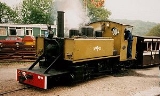
War Department Light Railways

Encyclopedia
The War Department Light Railways were a system of narrow gauge
trench railways
run by the British War Department in World War I
. Light railways made an important contribution to the Allied war effort in the First World War, and were used for the supply of ammunition and stores, the transport of troops and the evacuation of the wounded.
The military light railways in France
were of gauge and used a variety of steam and petrol locomotives from French
, British
and American
builders. The Germans installed their gauge Feldbahn
system early in the war. Trench railways
of the World War I
western front produced the greatest concentration of minimum gauge railway locomotives observed to date.
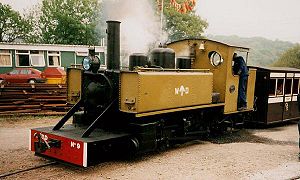 Britain came to the belated realisation that it needed a flexible and reliable method of supplying the front lines, bringing shells, timber, and fodder from the rear areas and their standard gauge supply points. narrow gauge light railway
s were the solution.
Hundreds of locomotives were built by companies such as Hunslet
, Kerr Stuart
, ALCO, Davenport
, Motor Rail
and Baldwin
to work these lines. Also, Model T
Ford conversions were used. Thirty or so Companies were formed within the Royal Engineers
to staff the lines. These were mostly British ex-railwaymen pressed into service, though Australian, South African and Canadian gangs served with distinction. An American unit also served under the British flag.
Each area of the front would have its own light rail to bring up materiel. The British perfected roll on roll off
train ferries to bring fodder and supplies direct from England via train ferries to France. Northern French rail lines were under direct military control of the Army in the area.
By 1917, the Canadians led the way in showing the utility of light railways. Having built thousands of miles of new frontier track in Western Canada in the previous decades, these "colonials", led by J. Stewart, supplied the Canadian Corps
who went on to victory at Vimy
. From this the light railways were expanded to 700 miles (1,126.5 km) of track, which supplied 7,000 tons of supplies daily. The ebb and flow of war meant that rail lines were built and rebuilt, moved and used elsewhere, but by the latter years of Passchendaele, Amiens
and Argonne
, light railways came into their own and pulled for the final victory.
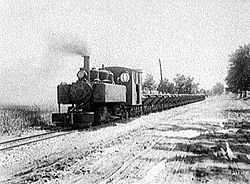
A few captured German feldbahn
locomotives were also used but these usually had short lives because no spare parts were available for them.
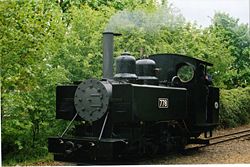 Probably the most famous of these war service engines were of class 10-12-D
, built by the Baldwin Locomotive Works
, U.S.A. Nearly 500 were built and those that survived the war found new homes around the world. Many went to India
and after the war a few went to railways in Britain
including:
Narrow gauge
A narrow gauge railway is a railway that has a track gauge narrower than the of standard gauge railways. Most existing narrow gauge railways have gauges of between and .- Overview :...
trench railways
Trench railways
Trench Railways represented military adaptation of early 20th century railway technology to the problem of keeping soldiers supplied during the static trench warfare phase of World War I...
run by the British War Department in World War I
World War I
World War I , which was predominantly called the World War or the Great War from its occurrence until 1939, and the First World War or World War I thereafter, was a major war centred in Europe that began on 28 July 1914 and lasted until 11 November 1918...
. Light railways made an important contribution to the Allied war effort in the First World War, and were used for the supply of ammunition and stores, the transport of troops and the evacuation of the wounded.
Track gauges
Different track gauges were used in different parts of the world including , , and .The military light railways in France
France
The French Republic , The French Republic , The French Republic , (commonly known as France , is a unitary semi-presidential republic in Western Europe with several overseas territories and islands located on other continents and in the Indian, Pacific, and Atlantic oceans. Metropolitan France...
were of gauge and used a variety of steam and petrol locomotives from French
France
The French Republic , The French Republic , The French Republic , (commonly known as France , is a unitary semi-presidential republic in Western Europe with several overseas territories and islands located on other continents and in the Indian, Pacific, and Atlantic oceans. Metropolitan France...
, British
United Kingdom
The United Kingdom of Great Britain and Northern IrelandIn the United Kingdom and Dependencies, other languages have been officially recognised as legitimate autochthonous languages under the European Charter for Regional or Minority Languages...
and American
United States
The United States of America is a federal constitutional republic comprising fifty states and a federal district...
builders. The Germans installed their gauge Feldbahn
Feldbahn
A Feldbahn is the German term for a narrow gauge railway, usually not open to the public, which in its simplest form provides for the transportation of agricultural, forestry and industrial raw materials such as wood, peat, stone, earth and sand...
system early in the war. Trench railways
Trench railways
Trench Railways represented military adaptation of early 20th century railway technology to the problem of keeping soldiers supplied during the static trench warfare phase of World War I...
of the World War I
World War I
World War I , which was predominantly called the World War or the Great War from its occurrence until 1939, and the First World War or World War I thereafter, was a major war centred in Europe that began on 28 July 1914 and lasted until 11 November 1918...
western front produced the greatest concentration of minimum gauge railway locomotives observed to date.
Development
Light railway
Light railway refers to a railway built at lower costs and to lower standards than typical "heavy rail". This usually means the railway uses lighter weight track, and is more steeply graded and tightly curved to avoid civil engineering costs...
s were the solution.
Hundreds of locomotives were built by companies such as Hunslet
Hunslet Engine Company
The Hunslet Engine Company is a British locomotive-building company founded in 1864 at Jack Lane, Hunslet, Leeds, West Yorkshire, England by John Towlerton Leather, a civil engineering contractor, who appointed James Campbell as his Works Manager.In 1871, James Campbell bought the company for...
, Kerr Stuart
Kerr Stuart
Kerr, Stuart and Company Ltd was a locomotive manufacturer from Stoke-on-Trent, England.-History:It was founded in 1881 by James Kerr as James Kerr & Company, and became Kerr, Stuart & Company from 1883 when John Stuart was taken on as a partner...
, ALCO, Davenport
Davenport Locomotive Works
The Davenport Locomotive Works, of Davenport, Iowa, USA built locomotives from 1902 until 1956. The company acquired the locomotive business of H. K...
, Motor Rail
Motor Rail
Motor Rail was a British locomotive-building company, based in Bedford. Formed in 1911 as The Motor Rail & Tramcar Co Ltd, they built petrol and diesel engined locomotives, mainly narrow gauge. During World War I over 900 locos were supplied for use on temporary military supply railways...
and Baldwin
Baldwin Locomotive Works
The Baldwin Locomotive Works was an American builder of railroad locomotives. It was located in Philadelphia, Pennsylvania, originally, and later in nearby Eddystone, Pennsylvania. Although the company was very successful as a producer of steam locomotives, its transition to the production of...
to work these lines. Also, Model T
Ford Model T
The Ford Model T is an automobile that was produced by Henry Ford's Ford Motor Company from September 1908 to May 1927...
Ford conversions were used. Thirty or so Companies were formed within the Royal Engineers
Royal Engineers
The Corps of Royal Engineers, usually just called the Royal Engineers , and commonly known as the Sappers, is one of the corps of the British Army....
to staff the lines. These were mostly British ex-railwaymen pressed into service, though Australian, South African and Canadian gangs served with distinction. An American unit also served under the British flag.
Each area of the front would have its own light rail to bring up materiel. The British perfected roll on roll off
RORO
Roll-on/roll-off ships are vessels designed to carry wheeled cargo such as automobiles, trucks, semi-trailer trucks, trailers or railroad cars that are driven on and off the ship on their own wheels...
train ferries to bring fodder and supplies direct from England via train ferries to France. Northern French rail lines were under direct military control of the Army in the area.
By 1917, the Canadians led the way in showing the utility of light railways. Having built thousands of miles of new frontier track in Western Canada in the previous decades, these "colonials", led by J. Stewart, supplied the Canadian Corps
Canadian Corps
The Canadian Corps was a World War I corps formed from the Canadian Expeditionary Force in September 1915 after the arrival of the 2nd Canadian Division in France. The corps was expanded by the addition of the 3rd Canadian Division in December 1915 and the 4th Canadian Division in August 1916...
who went on to victory at Vimy
Vimy
Vimy is a commune in the Pas-de-Calais department in the Nord-Pas-de-Calais region of France.-Geography and history:Vimy is a farming town, situated some north of Arras, at the junction of the D51 and the N17 roads....
. From this the light railways were expanded to 700 miles (1,126.5 km) of track, which supplied 7,000 tons of supplies daily. The ebb and flow of war meant that rail lines were built and rebuilt, moved and used elsewhere, but by the latter years of Passchendaele, Amiens
Amiens
Amiens is a city and commune in northern France, north of Paris and south-west of Lille. It is the capital of the Somme department in Picardy...
and Argonne
Meuse-Argonne Offensive
The Meuse-Argonne Offensive, or Maas-Argonne Offensive, also called the Battle of the Argonne Forest, was a part of the final Allied offensive of World War I that stretched along the entire western front.-Overview:...
, light railways came into their own and pulled for the final victory.
WDLR locomotives
A large number of locomotives (mostly of gauge) was ordered for the WDLR. These included:Steam
- HudsonRobert Hudson LtdRobert Hudson Ltd was a major international supplier of light railway materials, based in Gildersome, near Leeds, England. The name was later changed to Robert Hudson Ltd.- The business :...
0-6-0WT (built by Hudswell ClarkeHudswell ClarkeHudswell, Clarke and Company Limited was an engineering and locomotive building company in Jack Lane, Hunslet, Leeds, West Yorkshire, England.-History:...
) - BarclayAndrew Barclay & Sons Co.Andrew Barclay Sons & Co. was a builder of steam and diesel locomotives, based in Kilmarnock, Scotland, that was founded in 1840 and is now owned by Wabtec Rail.- History :...
0-6-0WT - HunsletHunslet Engine CompanyThe Hunslet Engine Company is a British locomotive-building company founded in 1864 at Jack Lane, Hunslet, Leeds, West Yorkshire, England by John Towlerton Leather, a civil engineering contractor, who appointed James Campbell as his Works Manager.In 1871, James Campbell bought the company for...
4-6-0T - Baldwin Class 10-12-DBaldwin Class 10-12-DThe Baldwin Class 10-12-D was a class of narrow gauge 4-6-0 pannier tank steam locomotives built by the Baldwin Locomotive Works for the British War Department Light Railways for service in France during World War I...
4-6-0T - ALCO 2-6-2T
Internal combustion
- BaguleyErnest E. Baguley-Employment:Baguley served an apprenticeship with R & W Hawthorn Leslie, initially at their Tyneside shipyard and later at their Forth Bank, Newcastle, locomotive works. In 1890 he moved to Stafford and became Chief Draughtsman for W G Bagnall Ltd...
(McEwan Pratt) 10 HP, petrol/paraffin - Motor RailMotor RailMotor Rail was a British locomotive-building company, based in Bedford. Formed in 1911 as The Motor Rail & Tramcar Co Ltd, they built petrol and diesel engined locomotives, mainly narrow gauge. During World War I over 900 locos were supplied for use on temporary military supply railways...
(Simplex) 20 HP, petrol - Motor Rail (Simplex) 40 HP, petrol
- British WestinghouseBritish WestinghouseBritish Westinghouse Electrical and Manufacturing Company was a subsidiary of the American Westinghouse Electric and Manufacturing Company. British Westinghouse would become a subsidiary of Metropolitan-Vickers in 1919; and after Metropolitan Vickers merged with British Thomson-Houston in 1929, it...
45 HP, petrol-electric - Dick, Kerr & Co.Dick, Kerr & Co.Dick, Kerr and Company was a locomotive and tramcar manufacturer based in Kilmarnock, Scotland and Preston, England.-Early history:Having previously been known as W.B.Dick and Company the company had built all kinds of tramway equipment and rolling stock. From 1883 the company joined with John Kerr...
45 HP, petrol-electric
A few captured German feldbahn
Feldbahn
A Feldbahn is the German term for a narrow gauge railway, usually not open to the public, which in its simplest form provides for the transportation of agricultural, forestry and industrial raw materials such as wood, peat, stone, earth and sand...
locomotives were also used but these usually had short lives because no spare parts were available for them.
Other locomotives
Both the French Army and the U.S. Army had their own locomotives, which included:After the war
Baldwin Class 10-12-D
The Baldwin Class 10-12-D was a class of narrow gauge 4-6-0 pannier tank steam locomotives built by the Baldwin Locomotive Works for the British War Department Light Railways for service in France during World War I...
, built by the Baldwin Locomotive Works
Baldwin Locomotive Works
The Baldwin Locomotive Works was an American builder of railroad locomotives. It was located in Philadelphia, Pennsylvania, originally, and later in nearby Eddystone, Pennsylvania. Although the company was very successful as a producer of steam locomotives, its transition to the production of...
, U.S.A. Nearly 500 were built and those that survived the war found new homes around the world. Many went to India
India
India , officially the Republic of India , is a country in South Asia. It is the seventh-largest country by geographical area, the second-most populous country with over 1.2 billion people, and the most populous democracy in the world...
and after the war a few went to railways in Britain
United Kingdom of Great Britain and Ireland
The United Kingdom of Great Britain and Ireland was the formal name of the United Kingdom during the period when what is now the Republic of Ireland formed a part of it....
including:
- Ashover Light Railway
- Glyn Valley TramwayGlyn Valley TramwayThe Glyn Valley Tramway was a narrow gauge railway that connected Chirk with Glyn Ceiriog in Denbighshire , Wales. The gauge of the line was...
- Snailbeach District RailwaysSnailbeach District RailwaysSnailbeach District Railways was a British narrow gauge railway in Shropshire. It was built to carry lead ore from mines in the Stiperstones to Pontesbury where the ore was transshipped to the Great Western Railway's Minsterley branch line. Coal from the Pontesford coal mines travelled in the...
- Welsh Highland RailwayWelsh Highland RailwayThe Welsh Highland Railway is a long restored narrow gauge heritage railway in North Wales, operating from Caernarfon to Porthmadog, and passing through a number of popular tourist destinations including Beddgelert and the Aberglaslyn Pass. At Porthmadog it connects with the Ffestiniog Railway...
See also
- Trench railwaysTrench railwaysTrench Railways represented military adaptation of early 20th century railway technology to the problem of keeping soldiers supplied during the static trench warfare phase of World War I...
- Light railwayLight railwayLight railway refers to a railway built at lower costs and to lower standards than typical "heavy rail". This usually means the railway uses lighter weight track, and is more steeply graded and tightly curved to avoid civil engineering costs...
- Railway Operating DivisionRailway Operating DivisionThe Railway Operating Division was a division of the Royal Engineers formed in 1915 to operate railways in the many theatres of the First World War...
- John StewartJohn Stewart (financier)John Stewart was a Canadian financier and railway builder.He was born in Nedd, Assynt, Sutherland, Scotland on 4 Dec 1860; died 24 Sep 1938 Vancouver, British Columbia, Canada....
- Foley, Welch and StewartFoley, Welch and StewartFoley, Welch and Stewart was an early 20th century American-Canadian railroad contracting company.They built miles of track for the Great Northern Railway, Northern Pacific Railroad, Canadian Pacific Railway, Canadian Northern Railway, Grand Trunk Pacific Railway and Pacific Great Eastern Railway...