


Wanderer above the Sea of Fog

Encyclopedia
Wanderer above the Sea of Fog is an oil painting
composed in 1818 by the German Romantic artist Caspar David Friedrich
. It currently resides in the Kunsthalle Hamburg
in Hamburg
, Germany
.
The painting is composed of various elements from the mountains of the Elbsandsteingebirge in Saxony
and Bohemia
, sketched in the field but in accordance with his usual practice, rearranged by Friedrich himself in the studio for the painting. In the background to the right is the Zirkelstein
. The mountain in the background to the left could be either the Rosenberg or the Kaltenberg. The group of rocks in front of it represent the Gamrig near Rathen
. The rocks on which the traveller stands are a group on the Kaiserkrone.
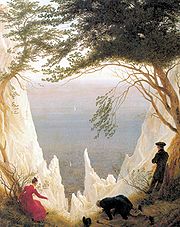 Wanderer above the Sea of Fog is true to the Romantic style and Friedrich's style in particular, being similar to other works such as Chalk Cliffs on Rügen
and The Sea of Ice
.
Gorra's (2004) analysis was that the message conveyed by the painting is one of Kantian
self-reflection, expressed through the wanderer's gazings into the murkiness of the sea of fog. Dembo (2001) sympathised, asserting that Wanderer presents a metaphor for the unknown future. Gaddis (2004) felt that the impression the wanderer's position atop the precipice and before the twisted outlook leaves "is contradictory, suggesting at once mastery over a landscape and the insignificance of the individual within it."
Some meaning of this work is lost in the translation of its title. In German, the title is "Wanderer über dem Nebelmeer." Wanderer in German can mean either "wanderer" or "hiker."
Oil painting
Oil painting is the process of painting with pigments that are bound with a medium of drying oil—especially in early modern Europe, linseed oil. Often an oil such as linseed was boiled with a resin such as pine resin or even frankincense; these were called 'varnishes' and were prized for their body...
composed in 1818 by the German Romantic artist Caspar David Friedrich
Caspar David Friedrich
Caspar David Friedrich was a 19th-century German Romantic landscape painter, generally considered the most important German artist of his generation. He is best known for his mid-period allegorical landscapes which typically feature contemplative figures silhouetted against night skies, morning...
. It currently resides in the Kunsthalle Hamburg
Kunsthalle Hamburg
The Hamburger Kunsthalle is an art museum in Hamburg, Germany. The art museum focuses on painting in Hamburg in the 14th century, paintings by Dutch and Flemish artists of the 16th and 17th centuries, French and German paintings of the 19th century, modern, and contemporary art...
in Hamburg
Hamburg
-History:The first historic name for the city was, according to Claudius Ptolemy's reports, Treva.But the city takes its modern name, Hamburg, from the first permanent building on the site, a castle whose construction was ordered by the Emperor Charlemagne in AD 808...
, Germany
Germany
Germany , officially the Federal Republic of Germany , is a federal parliamentary republic in Europe. The country consists of 16 states while the capital and largest city is Berlin. Germany covers an area of 357,021 km2 and has a largely temperate seasonal climate...
.
Description
In the foreground, a young man stands upon a rocky precipice, his back to the viewer. He is wrapped in a dark green overcoat, and grips a walking stick in his right hand. His hair caught in a wind, the wanderer gazes out on a landscape covered in a thick sea of fog. In the middle ground, several other ridges, perhaps not unlike the ones the wanderer himself stands upon, jut out from the mass. Through the wreaths of fog, forests of trees can be perceived atop these escarpments. In the far distance, faded mountains rise in the left, gently leveling off into lowland plains in the east. Beyond here, the pervading fog stretches out indefinitely, eventually commingling with the horizon and becoming indistinguishable from the cloud-filled sky.The painting is composed of various elements from the mountains of the Elbsandsteingebirge in Saxony
Saxony
The Free State of Saxony is a landlocked state of Germany, contingent with Brandenburg, Saxony Anhalt, Thuringia, Bavaria, the Czech Republic and Poland. It is the tenth-largest German state in area, with of Germany's sixteen states....
and Bohemia
Bohemia
Bohemia is a historical region in central Europe, occupying the western two-thirds of the traditional Czech Lands. It is located in the contemporary Czech Republic with its capital in Prague...
, sketched in the field but in accordance with his usual practice, rearranged by Friedrich himself in the studio for the painting. In the background to the right is the Zirkelstein
Zirkelstein
The Zirkelstein is the smallest table mountain of Saxon Switzerland. It is a wooded, cone-shaped hill with a striking 40 metre high summit block of sandstone rock.- Location and area :...
. The mountain in the background to the left could be either the Rosenberg or the Kaltenberg. The group of rocks in front of it represent the Gamrig near Rathen
Rathen
Rathen is a village in the Elbe Sandstone Mountains, in Saxony, Germany, about 35 km southeast of Dresden on the Elbe River. Rathen has between 400 and 500 inhabitants....
. The rocks on which the traveller stands are a group on the Kaiserkrone.
Commentary
Chalk Cliffs on Rügen
Chalk Cliffs on Rügen is an oil painting of circa 1818 by the German Romantic artist Caspar David Friedrich.-Development:In January 1818, Caspar David Friedrich married Christiane Caroline Bommer, who was about 20 years his junior. On their honeymoon in July and August 1818, they visited relatives...
and The Sea of Ice
The Sea of Ice
The Sea of Ice , also called The Wreck of Hope is an oil painting of 1823–1824 by the German Romantic artist Caspar David Friedrich.-Description:...
.
Gorra's (2004) analysis was that the message conveyed by the painting is one of Kantian
KANT
KANT is a computer algebra system for mathematicians interested in algebraic number theory, performing sophisticated computations in algebraic number fields, in global function fields, and in local fields. KASH is the associated command line interface...
self-reflection, expressed through the wanderer's gazings into the murkiness of the sea of fog. Dembo (2001) sympathised, asserting that Wanderer presents a metaphor for the unknown future. Gaddis (2004) felt that the impression the wanderer's position atop the precipice and before the twisted outlook leaves "is contradictory, suggesting at once mastery over a landscape and the insignificance of the individual within it."
Some meaning of this work is lost in the translation of its title. In German, the title is "Wanderer über dem Nebelmeer." Wanderer in German can mean either "wanderer" or "hiker."
In popular culture
- American black metalBlack metalBlack metal is an extreme subgenre of heavy metal music. Common traits include fast tempos, shrieked vocals, highly distorted guitars played with tremolo picking, blast beat drumming, raw recording, and unconventional song structure....
band Wolves in the Throne RoomWolves in the Throne RoomWolves in the Throne Room is a black metal band based in Olympia, Washington.Their sound is influenced by Scandinavian black metal, doom metal, dark ambient, crust punk, and folk music...
composed a song of the same name, which appears on their third album Black CascadeBlack Cascade- Line-up :* Nathan Weaver - vocals, guitar* Will Lindsay - guitar, backing vocals, bass* Aaron Weaver - drums, synth...
.
- Joe WalshJoe WalshJoseph Fidler "Joe" Walsh is an American musician, songwriter, record producer, and actor. He has been a member of three commercially successful bands, the James Gang, Barnstorm, and the Eagles, and has experienced notable success as a solo artist and prolific session musician, especially with B.B...
uses the painting for the back cover of his album The ConfessorThe ConfessorThe Confessor is the seventh studio album by Joe Walsh, released in 1985 .-Reception:Writing for Allmusic, critic James Chrispell highly complimented the title track, but wrote of the album "Joe Walsh just hasn't been able to produce a complete album of great material, and The Confessor is no...
.
- In 2010 a compilation of neofolkNeofolkNeofolk is a form of folk music-inspired experimental music that emerged from post-industrial music circles. Neofolk can either be solely acoustic folk music or a blend of acoustic folk instrumentation aided by varieties of accompanying sounds such as pianos, strings and elements of industrial...
and black metalBlack metalBlack metal is an extreme subgenre of heavy metal music. Common traits include fast tempos, shrieked vocals, highly distorted guitars played with tremolo picking, blast beat drumming, raw recording, and unconventional song structure....
music titled "Der Wanderer über dem Nebelmeer" was released as a tribute to the painting and artist.
- In 2008, Guy DavisGuy DavisGuy Davis is an American comic book artist primarily known for his work on Sandman Mystery Theatre and various Hellboy-related comics...
, drew a version of the painting featuring Abe SapienAbe SapienAbraham "Abe" Sapien is a fictional character in the comic book series Hellboy, created by Mike Mignola. He takes his name from "Icthyo sapiens," the fanciful species designation chosen for him by his colleagues in the 19th-century Oannes Club, and from Abraham Lincoln, on whose assassination date...
as the first page of issue four of the comic book mini series BPRD: The Warning.
- The painting is featured on the cover of White Identity: Racial Consciousness in the 21st Century, published in 2011 by Jared TaylorJared TaylorSamuel Jared Taylor of Oakton, Virginia, is an American journalist and an advocate of what he describes as "racial realism", a philosophy that views race as a biological reality and advocates the separateness of racial groups as the key of a well functioning society...
.
- The painting can be found as a portrait model on the PC video game MinecraftMinecraftMinecraft is a sandbox-building independent video game written in Java originally by Swedish creator Markus "Notch" Persson and now by his company, Mojang, formed from the proceeds of the game. It was released as an alpha on May 17, 2009, with a beta version on December 20, 2010...
.
- In his Open University Lecture Philip Pullman referenced this painting as an analogy for the experience of reading: the objective landscape (of the book) and his (the reader/wanderer's)subjective reaction to it.
- The painting is also the cover art of Barnes and Noble's printing of Thus Spake Zarathustra written by Friedrich Wilhelm Nietzsche.